Books on Venerable Mariangela Virgili Presented in Her Hometown, Ronciglione
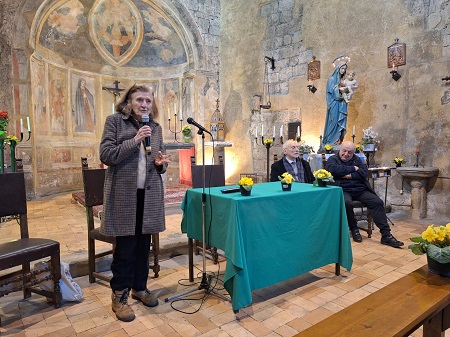
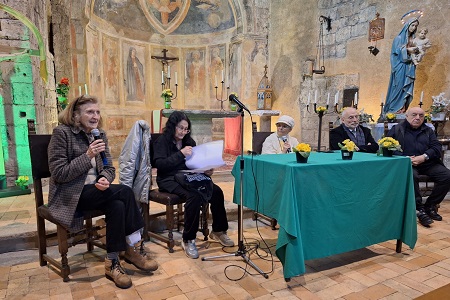
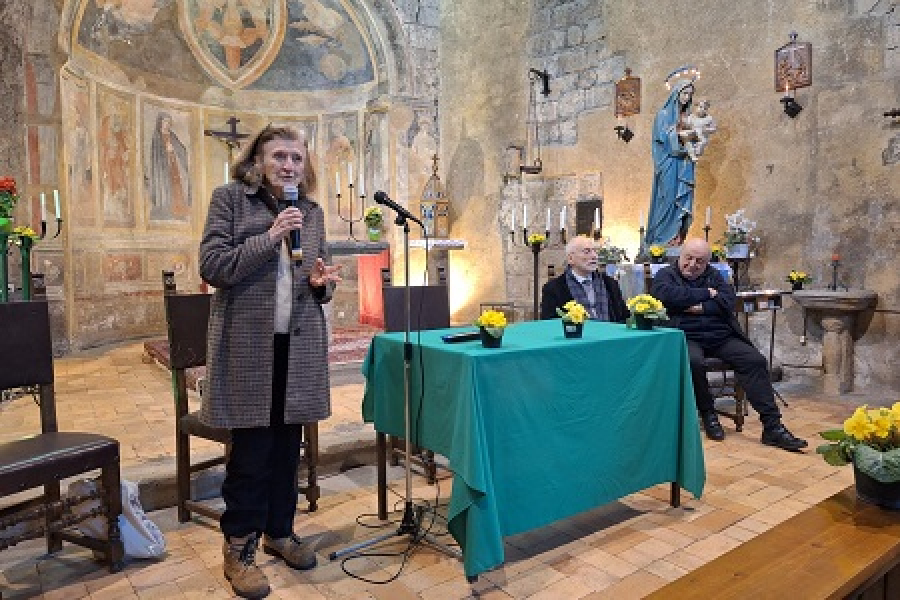
On March 8, starting at 4:00 p.m., two books titled “Mariangela Virgili, Carmelite Tertiary (1661–1734): Between Devotion and Sanctification” (2025) by Franca Fedeli Bernardini were presented in the Church of Santa Maria della Provvidenza in Ronciglione. The first volume has been published by Edizioni Carmelitane, the publishing house of the General Curia of the Carmelite Order and the Institutum Carmelitanum, and can be purchased on the website https://edizionicarmelitane.org/
The church of the “Borgo di Sotto,” particularly significant for Virgili—who was born and died in this district—was crowded due to the importance of the Venerable, who is still considered today a powerful and moving identity figure for the town, especially because of the miracles she performed during her life and after her death. These are analyzed in the second volume, which illustrates the testimonies and ex-votos still present in her house. Owing to the important extra-liturgical devotion connected with it, the house has become almost a kind of “sanctuary,” now turned into a museum and constantly visited by devoted pilgrims and attentive tourists.
The date of the presentation, particularly meaningful for women, had already been chosen in 2025 by the Municipal Councillor for Culture, Attorney Alessandra Ortenzi, as a moment to commemorate through the most significant female figure of the town, who worked for the well-being of women and who, among other initiatives, invited Rosa Venerini to Ronciglione, where she founded the first girls’ school.
The initiative, in addition to being supported by the Municipality of Ronciglione, was sponsored and promoted by Monsignor Silvio Iacomi, parish priest of Ronciglione; the Mariangela Virgili Cultural Association; the National Association of Social Centers and Senior Committees; the Multipurpose Cultural Center of the City of Ronciglione; and Unicoop Etruria.
Speakers included Maria Cangani, organizer of the initiative together with Daniele Trappolini, President of the Mariangela Virgili Cultural Association. They were followed by interventions from Franca Fedeli Bernardini; Sarina Aletta, who recited passages from the book recalling very moving miraculous events transmitted through oral tradition; Claudio Canonici, university professor and Director of the Diocesan Historical Archive of Civita Castellana; and Don Silvio Iacomi and Alessandra Ortenzi, who recalled particularly intense moments that had involved them respectively as parish priest and teacher, and as a family that experienced the war and is today deeply devoted.
Before the conclusion, entrusted to the Ronciglione Choir, which performed three pieces of sacred music, Alessio De Angelis gave a brief speech recalling how the Red Cross had placed the Blue Shield—the flag for peace and for the protection of cultural heritage—on the places frequented by Maria Mariangela Virgili, starting with her house.
In relation to the project “Ronciglione, a Village of Peace,” carried out in collaboration with the Mariangela Virgili school institute, and in light of current circumstances, the speakers—and later those present who remained for a long discussion—highlighted the figure of Mariangela Virgili as a bearer of peace and a dispenser of salvation to soldiers at war, who expressed their grateful thanks to her.
The importance of her figure as a poor and uneducated woman in promoting equality in a society full of social contradictions and strongly centralized and hierarchical was clearly emphasized. Together with forward-thinking individuals such as Rosa Venerini, whom she invited to Ronciglione to establish a girls’ school, Mariangela Virgili understood that poor, uneducated, widowed, sick, immigrant, and marginalized women needed spiritual and social uplift. This could be achieved through the reduction of need—which generates subjection—starting from education, training, study, and ultimately the social inclusion of the poorest classes, providing them with a body of essential knowledge in which teaching went hand in hand with moral education.
The renewed process of the feminization of “social holiness” and the recomposition of Christian society involved a complex adjustment that led to differentiated but courageous choices by women “outside the cloister,” yet deeply engaged in social reality, or “within the cloister” by conscious choice, yet strongly involved in different local contexts aimed particularly at the education of girls and young women.
Endowed with prodigious gifts and surprising healing abilities—often carried out simply using whatever was at hand—people from all social classes turned to her for help and predictions, including prisoners who were serving what was considered the “necessary retribution for peace in the world.” They surrounded her and crowded into her “hovel,” where she advised, hosted, welcomed, healed, and redistributed goods according to the needs of those who sought her help.
As a religious but lay woman, despite her poverty she externalized her charitable activity through the sharing of donated goods with neighbors, the sick, prisoners, women, and newborns—whose births she helped and whom she carried under her cloak to the city hospitals responsible for their care. Her voluntary activity complemented and strengthened the subsidiary work of the funded institutions.
Her own home became a refuge for those in need. On the ground floor of the same building, she rented an apartment to receive sick people who were not accepted in the city hospitals because of the severity of their conditions (such as those suffering from scabies or leprosy) and for long-term patients who had already been discharged.
Particularly attentive to the social causes of poverty, she affirmed the necessity of commutative and moral justice: giving the seller what is fair and the worker what is rightfully due. This attitude could make her appear naive, yet honesty and charity became a sort of necessity to be practiced through simple and continuous “ordinary acts.”
The importance of the Venerable is such that she is still internalized and felt today as a protector and a saint, regardless of the outcome of the cause for beatification. And if saints are figures who speak to their own times, as Claudio Canonici emphasized, the relevance of this “little woman dressed in black,” as emerged from the discussion and the themes proposed on this occasion, is still capable of speaking to people today, at a time when past models reappear and previously established certainties are once again in crisis.