










General Chapter Continues With Reports from General Councilors on the Four Geographical Areas of the Order
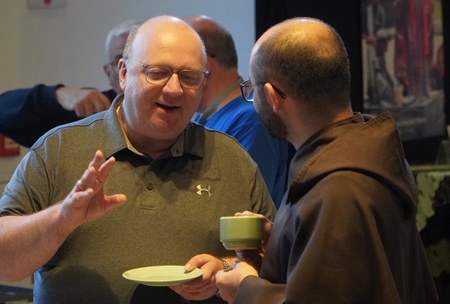
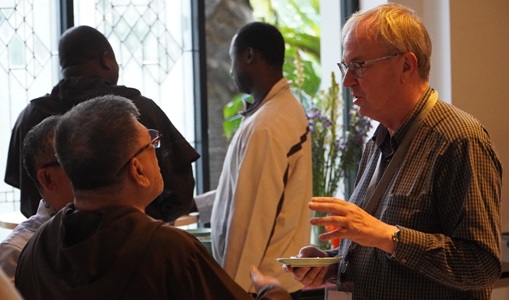
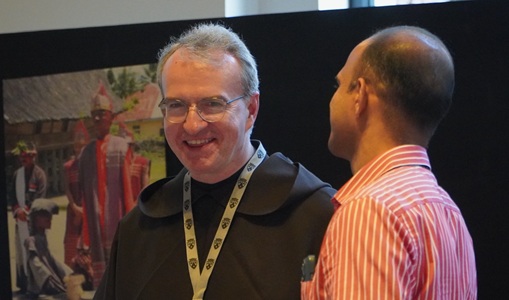
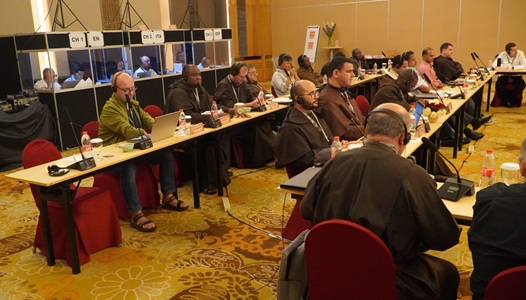
There is a strong fraternal part of a General Chapter during the daily celebration of Mass and the Liturgy of the Hours as well as during meals and casual gatherings following the evening meal. However, much time during a Chapter is spent in the Chapter Hall updating the members about the situations in each area of the Order, outlining the activities that have taken place during the last six years and highlighting areas of concern. CITOC highlighted the prior general’s talk during its September 10th update. We now turn to other reports.
The four General Councilors gave their reports on Wednesday and Thursday. Each presentation was followed by period for small group discussion and then a plenary session reporting on the small group discussions. The full report of each General Councilor will be published in Analecta (2025) #2 by Edizioni Carmelitane.
General Councilor for Europe
First to report was the General Councilor for Europe with its 15 entities divided into three regions. The Area’s six-year plan was to facilitate meetings of the vocations promoters, to continue the work of the Awakening Project and its ministry to young people, to establish an ad hoc Ongoing Formation Commission, to facilitate a process for preserving faithfully the charism of the Carmel in Europe, to explore and facilitate the unification of provinces, to organize and facilitate an annual meeting of the superiors of the area’s entities, and to research the possibilities for a common European student house for those in simple vows.
The annual meetings took place (two were online because of the covid pandemic), each with a distinct theme or topic. A committee developed an online program of formation, each meeting lasting for 90 minutes. The common student house has been a topic for about ten years. Three potential locations were selected but there was no consensus around any of the three.
A gathering and retreat of “young Carmelites” was held in the summer of 2024 in Nocera Umbra, Italy. Thirty-three Carmelites took part. Participants thought more such gatherings should take place. The Carmelite European Youth Committee (CEYC) held a gathering for the Jubilee of Youth in the summer of 2025. Approximately 240 young people and leaders took part and was in conjunction with Pope Leo’s prayer vigil at Tor Vergate and the Sunday Eucharist.
Several events connected with the canonization of St. Titus Brandsma were coordinated by the General Councilor for Europe and Benny Phang, the Vice General including Eucharistic celebration in churches around Rome before and after the canonization. Leaflets were created examining different aspects of Titus’s life and spirituality as well. For the Jubilee Year a series of leaflets on various Carmelite themes were also developed but can be used beyond the Jubilee Year.
Together with Christian Körner a Jubilee Year celebration for the two General Councils (OCARM and OCD) was organized. Finally, much information was also given about the activities of the various regions within the European area.
General Councilor for Africa
Conrad Mutizamhepo, General Councilor for Africa, spoke on the situation of the Order in his area, focusing on statistics, realities, challenges, and opportunities for the Carmelites. The Order is now present in six African countries, five being dependent on European provinces and one on a province in South America. Vocation discernment, formation, and ongoing formation are focuses of the area. While formation programs take place in each country, there is a common novitiates in English in Zimbabwe. The Final Message of African Leaders and Formators Conference in 2024 acknowledged some areas to be addressed in the formation program, including the publication of the Constitutions in French.
While there are some challenges to life in common, overall, the general approach to communal life is good. Priors are being trained to take a lead in developing stronger community life. Members are being offered periodic workshops on community dynamics and some practical issues that if dealt with properly could improve community life.
The Carmelites in Africa are serving in a wide variety of ministries, from twenty houses. Carmelites minister in twenty-two parishes. Carmelite houses are centers of prayer and spiritual accompaniment. An increasing number of lay people commence their day participating in Morning Prayer and Eucharist in some Carmelite communities.
Founding provinces have made large financial investments in Africa. These provinces have continued to bear the financial burden. So, along with the absence of missionary Carmelites, two of the major questions for the future concern leadership and the financial viability of entities. Of course, socio-political and economic instability is beyond the control of the individuals or the Order. Unfortunately, a dependency syndrome has developed in some places. It is felt that more reflection by the Carmelites in Africa is needed for healthy development to take place.
Carmel in Africa is young, vibrant, and hopeful. There are many opportunities for Carmel to live on her own resources from the fruits of her labors. But to counteract the dependency syndrome, African Carmel needs capacitation and fraternal accompaniment to enable her to grow the Carmelite charism and values as she grows numerically.
General Councilor for the Americas
The first report on Thursday, September 11, was dedicated to the General Councilor for the Americas, Luis Maza. Communities of Carmelites are present in 12 countries in the Americas. Each of these countries has its own challenges and difficulties. There has been an increase of vocations in Hispanic America and Brazil. While there is concern around the reduced number of vocations in Canada and the United States, there is great dedication to vocation ministry in the area.
There is an online formation program for the Portuguese and Spanish-speaking Carmelite Family, sometimes open to English speaking Carmelites. The long-established project of formation for formators of Latin America (FOCAL) has been changed to include the two North American provinces (FOCAM) and to include as well the nuns, religious, and lay people. FOCAM was held twice this six-year period. ALACAR (Latin American Carmelite Association), a joint project with the OCDs, was not held during this six-year period.
Considerable work has been done with the presence of Carmelite youth in the Americas (JUCAR). Many young people participated. Some participated in the World Youth Day in Lisbon and the Youth Jubilee in Rome. Other initiatives have been quite successful: 600 people participated in a July 4, 2021, online youth meeting. They shared their Carmelite experiences in a WhatsApp chat. Local efforts also result in week long missions, camps, retreats, formation presentations, charity work, virtual rosary prayers and discussions with young people which is called “A Coffee with Titus.”
A Mission was carried out for 10 days in the Prelature of Itaituba in March 2024. Carmelite bishop, Wilmar Santin, is the local bishop. The participants learned about the pastoral reality of the region and its many challenges. Besides Bishop Santin, the Sisters of the CDP and the CMSTMJ Congregations are present in the prelature.
Finally, Luis concluded by enumerating the meetings that took place in each of the years of the sexennium and highlighted the scheduled ALACAR meeting in October 2025 and the III FOCAM meeting in Camocin de São Felix, Brazil in September 2026.
General Councilor for Asia/Oceania/Australia (AAO)
The final report from the four geographical areas of the Order was given by Robert Puthussery, the General Councilor for Asia/Oceania/Australia. While it is one of the most vibrant and dynamic areas of the Order today, it is marked by immense cultural, religious, and linguistic diversity as well as the presence of the world’s major religions and a multitude of indigenous and traditional spiritualities.
There is an ever-growing number of young vocations testifying to a flourishing spiritual thirst and missionary zeal. In March 2025, there were five provinces, one general commissariat, and two provincial commissariats with a total of 793 members— 530 solemnly professed, 192 temporarily professed, and 71 novices.
The global plan for the Area called for canonical visitations; regular meetings of the regional superiors; encouraging members to develop expertise in Asian/Oriental spirituality; foster intra-geographical collaboration; organize area wide programs in initial and ongoing formation; explore and support forming international communities throughout the Order; promote initiatives to support young Carmelites in higher studies; and, collaborate with the JPIC Commission.
Some challenges were highlighted for reflection: approaches for accommodating and forming the increasing number of vocations; innovative strategies and methods to engage the younger generation in vocation ministry; cultivating “vocation-friendly communities.”
There are 47 formators in the Asia/Oceania/Australia area. While initial formation and the novitiate are seen as working well, there is growing concern that after first profession, the formation in Carmelite spirituality—both in terms of knowledge and lived experience—tends to become vague and diluted. To foster a deeper sense of internationality within the Order, there should be a concerted effort to encourage the learning of the three official languages of the Order from the earliest stages of formation. There is a recent decision to plan and implement a formators’ training program within this geographical area.
Principal among the major activities that took place during this sexennium is, perhaps, the erection of the Eastern Indonesian Province (Ordo Karmel Provinsi Indonesia Timur) on March 25, 2025. The province has 21 communities with 4 canonically erected houses. There are three formation houses. The province consists of 117 solemnly professed, 65 simply professed, 33 novices, and 60 postulancy candidates. Its territory included the ecclesiastical provinces of Makassar, Ende, Kupang, and Merauke.
To promote inter-geographical collaboration and to coordinate key initiatives, three commissions were established: the Commission for Formation; the Youth Commission; the Commission for Justice, Peace, and the Integrity of Creation (JPIC). Each commission met 4 times each year. A list of the activities of each commission was outlined.
Robert concluded with a reflection on the Area’s future challenges: collaboration (intra-inter-geographical); financial stability; and development of regional expertise to better serve the Order and society.
Friday and Saturday’s presentations are from the various International Commission and the Curia officials who head up offices within the General Curia.