












Lectio Divina: St. Thomas, Ap - Jn. 20,24-29
Ordinary Time
1) Opening prayer
Father,
You call your children
to walk in the light of Christ.
Free us from darkness
and keep us in the radiance of Your truth.
We ask this through our Lord Jesus Christ, Your Son,
who lives and reigns with You and the Holy Spirit,
one God, for ever and ever. Amen.
2) Gospel Reading - John 20:24-29
Thomas, called Didymus, one of the Twelve, was not with them when Jesus came. So the other disciples said to him, "We have seen the Lord." But Thomas said to them, "Unless I see the mark of the nails in his hands and put my finger into the nail marks and put my hand into his side, I will not believe." Now a week later his disciples were again inside and Thomas was with them. Jesus came, although the doors were locked, and stood in their midst and said, "Peace be with you." Then he said to Thomas, "Put your finger here and see my hands, and bring your hand and put it into my side, and do not be unbelieving, but believe." Thomas answered and said to him, "My Lord and my God!" Jesus said to him, "Have you come to believe because you have seen me? Blessed are those who have not seen and have believed."
3) Reflection
• Today is the Feast of Saint Thomas, and the Gospel speaks to us about the encounter of Jesus with Thomas, the apostle who wanted to see in order to believe. For this reason many call him “Doubting Thomas.”
The message of the Gospel today is much more profound and timely than it might initially appear. Let us look deeper into it:
• John 20:24-25: The doubt of Thomas. Thomas, one of the twelve, was not present when Jesus appeared to the disciples the week before. He did not believe in the witness of the others who said, “We have seen the Lord.” He gives some conditions: “Unless I can see the holes that the nails made in His hands and can put my finger into the holes they made, and unless I can put my hand into His side, I refuse to believe.” Thomas is very demanding. In order to believe he wants to see! He does not want a miracle in order to believe. No! He wants to see the signs on the hands, on the feet and on the side! He does not believe in the glorious Jesus, separated from the human Jesus who suffered on the Cross. When John writes, at the end of the first century, there were some people who did not accept the coming of the Son of God in the flesh (2Jn 7; 1 Jn 4:2-3). They were the Gnostics, who despised matter and the body. John presents this concern of Thomas to criticize the Gnostics: “To see in order to believe.” Thomas’ doubt also makes us see the difficulty of believing in the Resurrection!
• John 20:26-27: Do not be unbelieving but believe. The text says “six days later.” That means that Thomas was capable of maintaining his opinion for a whole week against the witness of the other apostles. Stubborn! Thank God, for us! Thus, six days later, during the community meeting, they once again had the profound experience of the presence of the risen Lord in their midst. The closed doors could not prevent the presence of Jesus in the midst of those who believe in him. Today, it is also like this. When we are meeting, even when we are meeting with the doors closed, Jesus is in our midst. The first word of Jesus is, and will always be, “Peace be with you!” What impresses us is the kindness of Jesus. He does not criticize, nor does He judge the disbelief of Thomas, but He accepts the challenge and says, “Thomas, put your finger in the hole of My hands!” Jesus confirms the conviction of Thomas and of the communities, that the glorious Risen One is the tortured crucified One! The Jesus who is in the community is not a glorious Jesus who has nothing in common with our life. He is the same Jesus who lived on this earth and on His body He bears the signs of His Passion. The signs of the Passion are found today in the sufferings of people, in hunger, in the signs of torture and injustice. Jesus becomes present in our midst in the people who react, who struggle for life and who do not allow themselves to be disheartened. Thomas believes in this Christ and so do we!
• John 20:28-29: Blessed are those who have not seen and yet believe. Together with Thomas we say: “My Lord and my God!” This gift of Thomas is the ideal attitude of faith. And Jesus concludes with a final message: “You believe because you can see Me. Blessed are those who have not seen and yet believe!” With this phrase, Jesus declares blessed all of us who find ourselves in the same condition: without having seen, we believe that Jesus, who is in our midst, is the same One who died crucified!
The mandate: “As the Father sent Me so I am sending you!” From this Jesus, who was crucified and rose from the dead, we receive the mission, the same one which He has received from the Father (Jn 20:21). Here, in the second appearance, Jesus repeats, “Peace be with you!” This repetition stresses the importance of peace. Making peace is part of the mission. Peace means much more than the absence of war. It means to build a harmonious human life together in which people can be themselves, having everything necessary to live, living happily together in peace. This was the mission of Jesus and is also our own mission. Jesus breathed and said, “Receive the Holy Spirit” (Jn 20:22), and with the help of the Holy Spirit we will be able to fulfill the mission which He has entrusted to us. Then Jesus communicates the power to forgive sins: “If you forgive anyone’s sins, they are forgiven; if you retain anyone’s sins, they are retained!” The central point of the mission of peace is reconciliation, the effort of trying to overcome barriers which separate us. This power of reconciling and of forgiving is given to the community (Jn 20:23; Mt 18:18). In the Gospel of Matthew, this power is also given to Peter (Mt 16:19). Here we can see that a community without forgiveness and without reconciliation is not a Christian community. In one word, our mission is that of “forming community” according to the example of the community of the Father, of the Son, and of the Holy Spirit.
4) Personal questions
• In society today, the divergence and the tensions of race, social class, religion, gender and culture are enormous and they continue to grow every day. How can the mission of reconciliation be carried out today?
• In your community and in your family is there some mustard seed, the sign of a reconciled society?
For further study
Saint Thomas traveled east to India and converted many in the states of Kerala and Tamil Nadu to Christianity in the first century. The history of the Church in India is very diverse, with many rifts. However, one of these communities of “Saint Thomas Christians” (Nasrani) is the Syro-Malabar Church, one of several Eastern Churches which are in full communion with Rome.
Take some time to look at the history of some of these Eastern Churches this week. In addition to the various Roman Rites, there are several other Rites used throughout these Churches. These historical traditions are preserved within the Vatican through the Congregation for the Oriental Churches.
5) Concluding Prayer
Praise Yahweh, all nations,
extol Him, all peoples,
for His faithful love is strong
and His constancy never-ending. (Ps 117)
Lectio Divina: Matthew 9:18-26
Ordinary Time
1) Opening prayer
Father,
through the obedience of Jesus,
Your servant and Your Son,
You raised a fallen world.
Free us from sin
and bring us the joy that lasts for ever.
We ask this through our Lord Jesus Christ, Your Son,
who lives and reigns with You and the Holy Spirit,
one God, for ever and ever. Amen.
2) Gospel Reading - Matthew 9:18-26
While Jesus was speaking, an official came forward, knelt down before him, and said, “My daughter has just died. But come, lay your hand on her, and she will live.” Jesus rose and followed him, and so did his disciples. A woman suffering hemorrhages for twelve years came up behind him and touched the tassel on his cloak. She said to herself, “If only I can touch his cloak, I shall be cured.” Jesus turned around and saw her, and said, “Courage, daughter! Your faith has saved you.” And from that hour the woman was cured. When Jesus arrived at the official’s house and saw the flute players and the crowd who were making a commotion, he said, “Go away! The girl is not dead but sleeping.” And they ridiculed him. When the crowd was put out, he came and took her by the hand, and the little girl arose. And news of this spread throughout all that land.
3) Reflection
• Today’s Gospel leads us to meditate on two miracles of Jesus. The first one was in favor of a woman considered unclean because of an irregular hemorrhage which had lasted for more than twelve years; the second one in favor of a girl who had just died. According to the mentality of that time, the person who touched blood or a corpse or dead body was considered unclean and whoever touched that person became unclean. Blood and death were factors of exclusion! This is why those two women were marginalized people, excluded from participation in the community. Whoever touched them became unclean, and therefore, would not be able to participate in the community and could not relate with God. In order to be admitted to participate fully in the community, it was necessary to go through the rite of purification prescribed by the norms of the law. Now, curing the impurity of the woman through faith, Jesus opens a new path toward God which does not depend anymore on the rites of purification, controlled by the priests. In resurrecting the girl, Jesus conquers the power of death and opens a new horizon on life.
• Matthew 9:18-19: The death of the little girl. When Jesus was still speaking, an official of the place came to intercede for his daughter who has just died. He asks Jesus to go to impose His hands on her so that “she will live.” The official thinks that Jesus has the power to make his daughter rise from the dead. This is a sign of much faith in Jesus on the part of the little girl’s father. Jesus rises and goes with him, taking only His disciples. This is the starting point of both episodes which follow: the cure of the woman who had been suffering for the past twelve years from a hemorrhage, and the resurrection of the little girl. The Gospel of Mark presents both of these episodes, but with many details: the official was called Jairus, and he was the president of the Synagogue. The little girl was not dead as yet, and she was twelve years old, etc. (Mk 5:21-43). Matthew gives a briefer version of Mark’s lively narration.
• Matthew 9:20-21: The situation of the woman. While they were on the way to the official’s house, a woman who had been suffering for twelve years because of an irregular hemorrhage got close to Jesus seeking to be cured. Twelve years with a hemorrhage! This is why she was marginalized, excluded, because as we have said, at that time blood rendered the person impure. Mark says that the woman had spent all she had with doctors, but instead of improving her situation had become worse (Mk 5:25-26) But she had heard some speak about Jesus (Mk 5:27). This is why a new hope sprang up in her. She told herself, “If I can just touch His clothes, I shall be saved.” The catechism of that time said: “If I touch His clothes I will remain impure.” The woman thinks exactly the contrary! This was a sign of great courage! It was a sign also that women were not in agreement with everything that the religious authority taught. The teaching of the Pharisees and of the scribes did not succeed in controlling the thinking of the people. Thank God! The woman got close to Jesus from behind. She touched the end of His cloak and she was cured.
• Matthew 9:22. The word of Jesus which enlightens. Jesus turns and seeing the woman declares: “Courage, My daughter, your faith has saved you.” A brief utterance, but which makes us see three very important points: (1) In saying “My daughter”, Jesus accepts the woman in the new community which has formed around Him. She was no longer excluded. (2) What she expected and believed takes place in fact: she was cured. This proves that the catechism of the religious authority was not correct and that in Jesus was opened a new path which gave people the possibility of obtaining the purity which the law demanded and also to enter into contact with God. (3) Jesus recognizes that without the faith of this woman, He would not have been able to work the miracle. The cure was not a magic rite, but an act of faith.
• Matthew 9:23-24: In the house of the official. After that Jesus goes to the house of the official. Seeing the agitation of those who were mourning because of the death of the little girl, He asks everybody to get out of the room. And He says: “The little girl is not dead, she is sleeping!” People laugh, because they know how to distinguish when a person sleeps or when she is dead. Death was for them a barrier that nobody could go beyond. It is the laughter of Abraham and of Sarah, that is, of those who do not believe that nothing is impossible for God (Gen 17:17; 18:12-14; Lk 1:27). The words of Jesus still have a very deep significance. The situation of the communities at the time of Matthew seemed to be in a situation of death, even though they heard said, “It is not death, you are asleep! Wake up!”
• Matthew 9:25-26: The resurrection of the little girl. Jesus does not attach any importance to the people’s laughter . He waits for everyone to get out of the house. Then He enters, takes the little girl by the hand, and she gets up. Mark keeps the words of Jesus, “Talita kúmi!” which mean, “Little girl, I tell you to get up!” (Mk 5:41). The news spread throughout that region. The people believed that Jesus is the Lord of life who overcomes death.
4) Personal questions
• Today, what are the categories of people who feel excluded from participating in the Christian community? What are the factors which cause the exclusion of so many people and render life difficult for them in the family and in society?
• “The little girl is not dead. She sleeps!” She is not dead! You are sleeping! Wake up! This is the message of today’s Gospel. What does it tell me? Am I one of those who laugh?
• Have I suffered ridicule from others in society for having Faith? If not, why not? Trusting in God goes against many modern beliefs. Should I expect this reaction?
5) Concluding Prayer
I shall praise You to the heights, God my King,
I shall bless Your name for ever and ever.
Day after day I shall bless You,
I shall praise Your name for ever and ever. (Ps 145:1-2)
Lectio Divina: Matthew 9:9-13
Ordinary Time
1) Opening prayer
Father,
You call Your children
to walk in the light of Christ.
Free us from darkness
and keep us in the radiance of Your truth.
We ask this through our Lord Jesus Christ, Your Son,
who lives and reigns with You and the Holy Spirit,
one God, for ever and ever. Amen.
2) Gospel Reading - Matthew 9:9-13
As Jesus passed by, he saw a man named Matthew sitting at the customs post. He said to him, "Follow me." And he got up and followed him. While he was at table in his house, many tax collectors and sinners came and sat with Jesus and his disciples. The Pharisees saw this and said to his disciples, "Why does your teacher eat with tax collectors and sinners?" He heard this and said, "Those who are well do not need a physician, but the sick do. Go and learn the meaning of the words, I desire mercy, not sacrifice. I did not come to call the righteous but sinners."
3) Reflection
• The Sermon on the Mount takes chapters 5, 6 and 7 of the Gospel of Matthew. The purpose of the narrative part of chapters 8 and 9 is to show how Jesus put into practice what He had just taught. In the Sermon on the Mount, He teaches acceptance (Mt 5:23-25, 38-42,43). Now He puts it into practice by accepting the lepers (Mt 8:1-4), the foreigners (Mt 8:5-13), the women (Mt 8:14-15), the sick (Mt 8:16-17), the possessed (Mt 8:28-34), the paralytics (Mt 9:1-8), the tax collectors (Mt 9:9-13), unclean people (Mt 9:20-22), etc. Jesus breaks the norms and customs which excluded and divided people: fear and lack of faith (Mt 8:23-27) and the laws on purity (9:14-17) and He clearly states the requirements for those who want to follow Him. They should have the courage to give up many things (Mt 8:18-22). In the same way in the attitudes and in the practice of Jesus we see in what the Kingdom and the perfect observance of the Law of God consists.
• Matthew 9:9: The call to follow Jesus. The first people called to follow Jesus are four fishermen, all Jewish (Mt 4:18-22). Now Jesus calls a tax collector, considered a sinner and treated as an unclean person by the community of the most observant of the Pharisees. In the other Gospels, this tax collector is called Levi. Here, his name is Matthew, which means gift of God or given by God. The communities, instead of excluding the tax collector and considering him unclean, should consider him a Gift of God for the community, because his presence makes the community become a sign of salvation for all! Like the first four who were called, Matthew, the tax collector, leaves everything that he has and follows Jesus. The following of Jesus requires breaking away from many things. Matthew leaves the tax office, his source of revenue, and follows Jesus!
• Matthew 9:10: Jesus sits at table with sinners and tax collectors. At that time, the Jews lived apart from tax collectors and sinners and they did not eat with them at the same table. The Christian Jews should break from this isolation and sit at table with tax collectors and with the unclean according to the teaching given by Jesus in the Sermon on the Mount, the expression of the universal love of God the Father (Mt 5:44-48). The mission of the communities was that of offering a place to those who did not have one. But this new law was not accepted by all. In some communities people coming from paganism, even if they were Christians, were not accepted around the same table (cf. Acts 10:28; 11:3; Gal 2:12). The text of today’s Gospel shows us Jesus, who sits at table with tax collectors and sinners in the same house, around the same table.
• Matthew 9:11: The question of the Pharisees. Jews were forbidden to sit at table with the tax collectors and with sinners, but Jesus does not follow this prohibition. Rather, He becomes a friend to them. The Pharisees, seeing the attitude of Jesus, ask the disciples, “Why does your master eat with tax collectors and sinners?” This question may be interpreted as an expression of their desire to know why Jesus acts in that way. Others interpret the question as a criticism of Jesus’ behavior, because for over five hundred years, from the time of the exile in Babylon until the time of Jesus, the Jews had observed the laws of purity. This secular observance became a strong sign of identity. At the same time it was a factor in their separation in the midst of other peoples. Thus, because of the purity laws, they could not sit around the same table to eat with tax collectors. To eat with tax collectors meant to get contaminated, to become unclean. The precepts of legal purity were rigorously observed in Palestine as well as in the Jewish communities of the Diaspora. At the time of Jesus there were more than five hundred precepts to keep purity. In the years of the 70’s, at the time when Matthew wrote, this conflict was very timely.
• Matthew 9:12-13: “Mercy is what pleases me, not sacrifice.” Jesus hears the question of the Pharisees to the disciples and He answers with two clarifications: the first one is taken from common sense: “It is not the healthy who need a doctor, but the sick.” The second one is taken from the Bible: “Go and learn the meaning of the words: ‘Mercy is what pleases Me, not sacrifice’.” Through these clarifications, Jesus makes explicit His mission among the people: “I have not come to call the upright but sinners.” Jesus rejects the criticism of the Pharisees; He does not accept their arguments, because they came from a false idea of the Law of God. He Himself invokes the Bible: “Mercy is what pleases me, not sacrifice.” For Jesus, mercy is more important than legal purity. He refers to the prophetic tradition to say that mercy has greater value for God than all sacrifices (Hos 6:6; Isa 1:10-17). God has profound mercy, and is moved before the failures of His people (Hos 11:8-9).
4) Personal questions
• Today, in our society, who is marginalized and excluded? Why? In our community, do we have preconceptions or prejudices? What is the challenge which the words of Jesus present to our community?
• Jesus asks the people to read and to understand the Old Testament which says, “Mercy is what pleases Me and not sacrifice.” What does Jesus want to say to us about this today?
5) Concluding Prayer
Blessed are those who observe His instructions,
who seek Him with all their hearts,
and, doing no evil, who walk in His ways. (Ps 119:2-3)
Lectio Divina: Matthew 9:1-8
Ordinary Time
1) Opening prayer
Father,
You call your children
to walk in the light of Christ.
Free us from darkness
and keep us in the radiance of Your truth.
We ask this through our Lord Jesus Christ, Your Son,
who lives and reigns with You and the Holy Spirit,
one God, for ever and ever. Amen.
2) Gospel Reading - Matthew 9:1-8
After entering a boat, Jesus made the crossing, and came into his own town. And there people brought to him a paralytic lying on a stretcher. When Jesus saw their faith, he said to the paralytic, "Courage, child, your sins are forgiven." At that, some of the scribes said to themselves, "This man is blaspheming." Jesus knew what they were thinking, and said, "Why do you harbor evil thoughts? Which is easier, to say, 'Your sins are forgiven,' or to say, 'Rise and walk'? But that you may know that the Son of Man has authority on earth to forgive sins"– he then said to the paralytic, "Rise, pick up your stretcher, and go home." He rose and went home. When the crowds saw this they were struck with awe and glorified God who had given such authority to men.
3) Reflection
• The extraordinary authority of Jesus. To the reader, Jesus appears as a person invested with extraordinary authority by means of words and actions (Mt 9:6-8). The authoritative word of Jesus strikes evil at its root: in the case of the paralytic man, on sin that affects the man in his liberty and obstructs his living: “Your sins are forgiven” (v. 5); “Rise, pick up your bed and go home” (v. 6). Truly all the forms of paralysis of the heart and mind to which we are subject are canceled by the authority of Jesus (9:6), because during His life on earth He met all these forms. The authoritative and effective word of Jesus awakens paralyzed humanity (9:5-7) and gives it the gift of walking (9:6) in a renewed faith
• The encounter with the paralytic. After the storm and a visit to the country of the Gadarenes, Jesus returns to Capernaum, His city. And as He was on His way, He met the paralytic. The healing did not take place in a house, but along the road. Therefore, along the road that leads to Capernaum they brought Him a paralytic man. Jesus addresses him, calling him “My son,” a gesture of attention that soon becomes a gesture of salvation: “your sins are forgiven you” (v. 2) The forgiveness of sins which Jesus pronounces on the part of God to the paralytic refers to the bond between sickness, failure and sin. This is the first time that the evangelist attributes this particular divine power to Jesus in an explicit way. For the Jews, a person’s illness was considered a punishment because of sins committed. The physical illness was always considered a consequence of one’s own or one’s parents’ moral evil (Jn 9:2). Jesus restores to man the condition of salvation freeing him from illness as well as from sin.
• For some of those who were present, for the scribes, the words of Jesus which announced forgiveness of sins was a true and proper blasphemy. According to them, Jesus was arrogant because God alone can forgive sins. They did not manifest openly such a judgment of Jesus but expressed it by murmuring among themselves. Jesus, who penetrates their hearts, sees their considerations and reproves them because of their unbelief. The expression of Jesus “To prove to you that the Son of man has authority on earth to forgive sins...” (v. 6) He is going to indicate that not only God can forgive sins, but with Jesus, also man.
• The crowd, in contrast to the scribes, is seized by fear before the cure of the paralytic and glorifies God. The crowd is struck by the power to forgive sins manifested in the healing. People exult because God has granted such power to the Son of Man. Is it possible to attribute this to the ecclesial community where forgiveness of sins was granted by order of Jesus? Matthew has presented this episode on forgiveness of sins with the intention of applying it to fraternal relationships within the ecclesial community. In it the practice to forgive sins, by delegation of Jesus, was already in force; a practice which was not shared in the Synagogue. The theme of forgiveness of sins is repeated also in Mt 18 and, at the end of Matthew’s Gospel it is affirmed that this is rooted in the death of Jesus on the Cross (26:28). But in our context the forgiveness of sins is linked with the demand of mercy present in the episode which follows, the call of Matthew: “…mercy is what pleases Me, not sacrifice. And indeed, I came to call not the righteous but sinners” (Mt 9:13). Such words of Jesus mean to say that He has made visible the forgiveness of God, above all, in His relationships with the Publicans or tax collectors, and sinners, in sitting at table with them.
• This account takes up again the problem of sin and the forgiveness which should be given. It is a story that should occupy a privileged place in the preaching of our ecclesial communities.
4) Personal questions
• Are you convinced that Jesus, called the friend of sinners, does not despise your weaknesses and your resistance, but He understands and offers you the necessary help to live a life in harmony with God and with the brothers and sisters?
• When you have the experience of betraying or refusing friendship with God do you have recourse to the Sacrament of Reconciliation that reconciles you with the Father and with the Church and makes you a new creature by the force of the Holy Spirit?
5) Concluding Prayer
The precepts of Yahweh are honest,
joy for the heart;
the commandment of Yahweh is pure,
light for the eyes. (Ps 19:8)
St. John of the Cross, Priest and Doctor of the Church
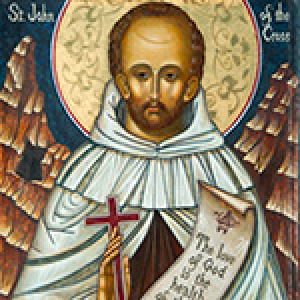
 14 December Feast
Saint John was born, probably in 1540, in Fontiveros, near Avila in Spain. In Medina in 1563 he was clothed in the Carmelite habit and, after a year's novitiate, was given permission to follow the unmitigated Carmelite Rule.
Bl. Bartholomew Fanti, Priest
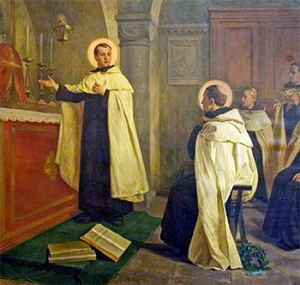
 5 December Optional Memorial
A native of Mantua, Italy, he was a Carmelite in the Mantuan Congregation and already ordained priest by 1452.
Bl. Denis (OCD), Priest and Martyr Bl. Redemptus (OCD), Religious and Martyr
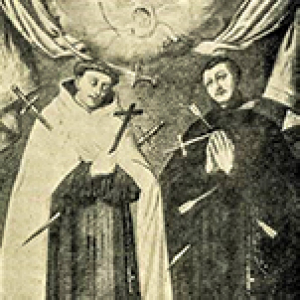
 29 November Optional Memorial
The two left Goa with the delegation on Sept. 25, 1638, and after a successful voyage arrived at Achén on Oct. 25. The joy with which they were received was feigned; they were soon made prisoners.
St. Raphael of St. Joseph (OCD), Priest

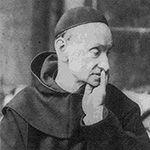 19 November Optional Memorial in the province of Poland
Raphael of St. Joseph (in lay life: Joseph Kalinowski) was born at Vilna to a Polish family on 1st September 1835 and died at Wadowice on 15th November 1907.
Commemoration of All Carmelite Souls
 15 November Optional Memorial
The Order of Carmel continues to grow and develop today because of the presence and contributions of all those who built upon its spiritual foundations, and not just its great saints.
All Carmelite Saints
 14 November Feast
"Like the prophet Elijah, all the Saints of Carmel have been shaped through a school of spiritual fire. They also intimated the example of Mary and made their truest expression in the experience of love and that love makes the history of the Order.


