Vice President of the Carmelite NGO
Let’s imagine for a moment that the house where you grew up, the one that holds your most sacred memories, is starting to crack. These are not just stains on the wall; the foundations are giving way.
This is the image Pope Francis presented to us in his 2023 apostolic exhortation Laudate Deum (LD), in which he warned: “The world that welcomes us is crumbling and may be approaching a breaking point” (LD 2).
We are no longer talking about distant climate change or cold statistics; we are talking about a system in clear decline that undermines the sustainability of life as we have known it. For decades, our economy has functioned as if the goods of the earth (“resources,” some call them) were infinite, trapped in what the Church calls the technocratic paradigm (Laudato Si' (LS), 101), believing that unlimited power and consumption are the only way forward.
But the Church, enlightened by Laudato Si’, tells us that faith cannot be indifferent to the type of energy that powers our world. Fossil fuels—coal, oil, and gas—which once powered an era, are now the chain that binds us to the destruction of our common home.
Pope Francis was categorical: “Technology based on highly polluting fossil fuels— especially coal, but also oil and, to a lesser extent, gas—needs to be progressively replaced without delay (LS 165).” The phrase is critical: “without delay.” It is not a suggestion for the next century; it is a moral imperative for today. Why? Because every degree of temperature rise is a direct blow to the poorest, those who have no air conditioning for extreme heat, no walls against flooding, and not enough crops to feed themselves.
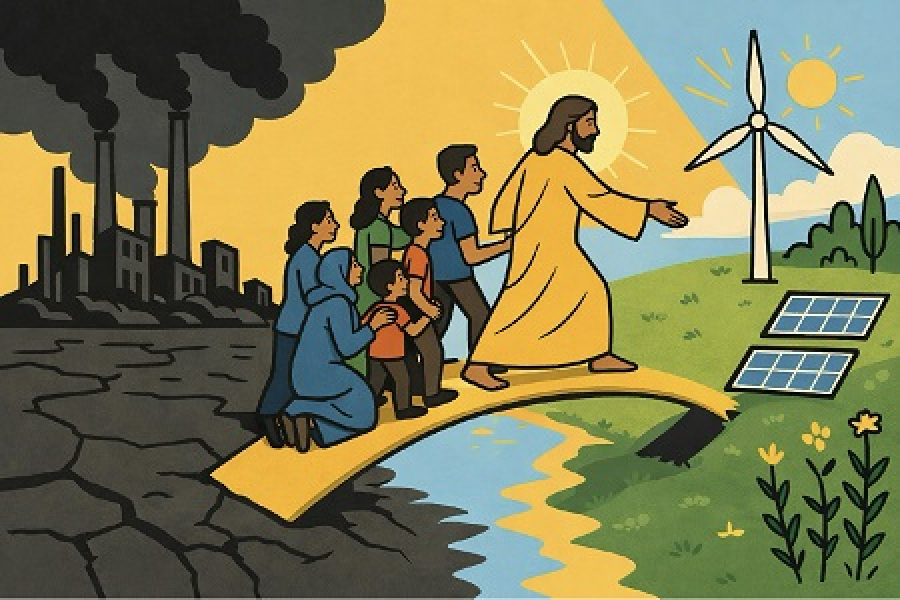
This is where our response as a Church must become prophetic, like that of the ancient Hebrew prophets, Jeremiah, Joel, or even Jesus himself. We are not simply seeking to replace a barrel of oil with hundreds of solar panels. That would be merely cosmetic. We seek a just transition.
What does this mean? It means a comprehensive transformation that goes beyond mere economic interest and places human dignity, global solidarity, and care for our common home at the center. It means, first of all, demanding the urgent abandonment of fossil fuels and a significant reduction in energy consumption by the richest nations, assuming their historical responsibility through concrete actions, such as the cancellation of the unpayable foreign debt of some countries in the Global South.
However, to ensure that this demand does not remain trapped in empty promises, we need a different international framework. Laudate Deum urges us to shape a “new multilateralism” (LD 37-43) that overcomes the slowness, blockages, and lack of binding mechanisms of the current UN negotiation system.
It is in this context that the upcoming Conference of Santa Marta in Colombia (April 24-29, 2026), the first international conference focused specifically on the transition from fossil fuels, stands out as a hopeful milestone. This meeting of countries marks the starting point for dialogue to draw up a real and effective roadmap towards the elimination of fossil fuels, driven by moral and civil diplomacy that demonstrates that another form of global governance, more agile and committed to the common good, is possible.
Second, it means protecting vulnerable populations and affected workers by guaranteeing, for example, retraining programs and unemployment benefits for those who currently depend on the oil or coal industry. Furthermore, this transition must not fall into a “new extractivism,” rejecting the idea that mining materials for solar panels or batteries will replicate the historical dispossession of lands and communities. Instead, a just energy transition entails an obligation to promote participatory governance in decisions on production, distribution, and consumption, such as the creation of local energy communities in which citizens take ownership of the change process.
Finally, it also means profound ethical and financial coherence, exemplified by the progressive divestment of Catholic institutions and individuals from fossil fuel or megamining companies, accompanied by intensive climate education (rather than “climate denial”) that promotes new sustainable lifestyles and ensures that new production infrastructures zealously protect biodiversity.
In short, it means that the “cry of the earth” and the “cry of the poor” (LS 49) are, in reality, a single cry that calls for a comprehensive approach to ecological transition, a profound transformation that overcomes the technocratic paradigm that tends to rely on false technical solutions and does not question the morality of actions. In Laudate Deum, the Church asks us to make this transition “mandatory and monitorable” (LD 59), because good will is no longer enough; we need just structures that guarantee respect for fundamental human rights and the natural environment that sustains them, through good practices of production, distribution, and consumption, democratic participation, and profound changes in lifestyles of overconsumption and waste.
Ultimately, “there can be no lasting change without cultural change [...] and there can be no cultural change without change in people” (LS 70). Abandoning fossil fuels is not just a technical challenge for engineers; it is a moral challenge for us.
As a Church, our social mission is to proclaim the Gospel and, based on it, to promote human dignity, the common good, and justice in social, economic, and political structures. If we proclaim life as a gift from the Creator, we cannot finance death or be indifferent to the suffering we cause.
In terms of energy, if we preach justice, we must promote the development of new technologies based on clean energy that, at the same time, allow the poorest communities to access them.
Let us move from an economy centered on extraction to one of care, which places human beings at its center. Let us move from carbon to communion. Because, at the end of the day, caring for creation is not a “green option,” but an act of love for the Creator and for every human being who inhabits this common home.