












Displaying items by tag: Carmelite NGO
Carmelite NGO Joins CSTIP to Fight Human Trafficking
Carmelite NGO Joins with CSTIP and Others to Fights Trafficking in Persons
The Carmelite NGO is joining with other NGOs at the United Nations to co-sponsor an event during the 80th Session of the UN’s Third Committee. The theme is Bankrupting the Business of Human Trafficking: Prevention Techniques to Reduce Prevalence and Illicit Profiteering. The event’s main sponsor is the NGO Committee to Stop Trafficking in Persons (CSTIP). The interview will feature leaders from government, business, the financial sector, law enforcement, media, and the NGOs who have implemented successful prevention programs that reduce trafficking prevalence. The session will be held on October 21 from 1-3pm (East Coast USA time).
CSTIP has been at the forefront in recognizing that the growth of human trafficking is driven by immense profits and little risk to perpetrators, enablers, and buyers. Because raising awareness in the community has not prevented human trafficking, especially of children, CSTIP proposes a new prevention model focuses on found strategic pillar designed to bankrupt the business of human trafficking: financial detection, ending impunity, ending demand, measuring and publicly displaying the results.
The event can be viewed via UN TV or Zoom on October 21.
Five Or Six Mass Extinctions? The Future Is Today
Fr. Simone Gamberoni, O. Carm.
It was lovely to take a walk and hear the cry of the swallows as they chased insects in the sky amid the summer heat, or perhaps to stroll after a summer storm and see the large, sly green lizards searching for a ray of sunshine, while frogs and toads hopped through the verdant countryside… and then, in the evening, to go out into the glow created by thousands of fireflies… They seem like stories from another time! Yet it is simply about when I was young and herded sheep on the hills around Florence.
The world is changing, and perhaps we don’t always realize it.
To promote awareness and sensitivity regarding ecological issues, an exhibition has been organized titled: “Five Or Six Great Mass Extinctions? The Future Is Today!” The exhibition, held inside the Casa di Accoglienza, adjacent to the Sanctuary of the Madonna del Carmine in San Felice del Benaco (BS), aims to allow people—and especially young students—to reflect on the importance of preserving Creation, offering a simple starting point for reflection, grounded in science, regarding climate change and its consequences for Creation itself. It is a mere drop in a vast ocean that would require much more attention.
The world is, after all, a closed system with limited resources, and every human being, regardless of their religious, political, or philosophical beliefs, should consider the future of the world in a perhaps slightly more prudent manner. Paleontology reminds us that after every mass extinction, life has recovered over the course of millions of years, but how many species have disappeared… To give a simple example, the Permian–Triassic mass extinction (about 252 million years ago), which is the greatest biological catastrophe ever to occur on Earth, saw the disappearance of between 90% and 96% of marine species, about 70–75% of terrestrial vertebrates, and about 30% of insect orders. Thus, approximately 57% of all families of living organisms existing at that time and about 83% of the genera disappeared. It took about 10 million years to reestablish complete and complex ecosystems.
After the sixth mass extinction, life will always recover, but will there be people capable of telling others about it? Following the geological eras that have marked the history of the Earth and life on it, many today speak of the Anthropocene, as a proposed new geological epoch in which human activity has such a profound impact that it alters the Earth’s climatic, environmental, and geological balances. The term combines the Greek words ànthrōpos (human being) and kainos (recent) and was coined in the early 1980s by biologist Eugene Stoermer and popularized in 2000 by Nobel Prize-winning chemist Paul Crutzen; it suggests the end of the previous geological epoch, the Holocene, which began approximately 11,700 years ago.
The exhibition was inaugurated on October 15, 2025, by His Excellency Monsignor Domenico Pompili, Bishop of the Diocese of Verona, approximately two years after the collection of materials began, along with the acquisition of permits and collaboration with scientific professionals. The roundtable discussion accompanying the inauguration featured the following speakers: Dr. Diego Sala, a paleontologist from Trento; Dr. Davide Grigoletto, a professor of Natural Sciences; and Dr. Gianmaria Pisani, a wildlife veterinarian. The roundtable was introduced by Fr. Simone Gamberoni, a Carmelite religious and the creator of the initiative, and was presided over by His Excellency Bishop Domenico Pompili, in the presence of more than sixty students from the Valtenesi school complex and many other people, including religious, civil, and military authorities.
As planned, the exhibition features original specimens and casts, displayed in special museum cases, accompanied by explanatory panels curated by three paleontologists from the University of Padua (Dr. Luca Giusberti, Dr. Mariagabriella Fornasiero, and Dr. Eliana Fornaciari), with contributions from a paleoanthropologist (Dr. Luca Pagani) and a climatologist (Dr. Paolo Tarolli), also from the University of Padua, as well as an archaeologist (Dr. Paolo Biagi) from the University of Venice. The exhibition also features an educational tour, curated by a paleontologist from Trento (Dr. Diego Sala) and a professor of natural sciences (Dr. Davide Grigoletto). The room also features multimedia content, which provides a detailed explanation of the artifacts on display, the 14 casts of hominid skulls, the five major mass extinctions, and some of the key animal species driven to extinction by human activity, as well as a diorama that deliberately recreates a “Jurassic Park”-style setting. As a final element, seven small display cases have been set up, presenting minerals classified according to the Nickel–Strunz system, which remind us of the primordial order and harmony that God has inscribed even “in the stones.” The exhibition was curated by Dr. Paolo Ferretti, a geologist at the Muse in Trento. The mineralogy section also features digital microscopes for magnified observation of the perfection of crystalline macrostructures. Other educational elements are also present to facilitate workshops and games for students.
In the cloister, as an introduction to the exhibition, panels have been placed featuring prayers, reflections, and texts drawn from the three major monotheistic religions, the teachings of the Church, and ancient and modern literature.
Recently, a collaboration has also begun with the Medi State-Recognized School in Salò (BS), represented by Ms. Elena Cancellerini, to expand the educational offerings by including students in the School – Work program, who will accompany various groups of visitors to the exhibition, and by developing differentiated educational programs tailored to the various age groups of students, from middle school to high school. Contacts have already been established with the Regional School Office and with a Regional Councilor, Ms. Claudia Carzeri, to involve both educational institutions and municipal administrations in Lombardy.
Humankind has placed itself within its environment, not always respecting it, but the tools we possess today have a destructive potential that no era has ever known since the human or humanoid foot first trod the earth!
“What is the ratio of one to a thousand? And yet it is a common proverb that a single man is worth a thousand, whereas a thousand are not worth a single man. Such a difference depends on the varying abilities of the intellects…”.
With this quote from Galileo Galilei’s Dialogue Concerning the Two Chief World Systems, we wish to remind you that anyone willing to commit to knowledge and collaboration can help improve the fate of our planet.
If you’d like to learn more:
The exhibition is located at: Casa per Ferie Il Carmine, Via Carmine 11A, San Felice del Benaco (BS).
The Casa per Ferie is adjacent to the Santuario del Carmine.
Phone: +393400547915
Email: This email address is being protected from spambots. You need JavaScript enabled to view it.
A Carmelite Named to the Pontifical Academy for Life
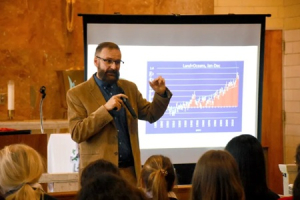
Eduardo Agosta Scarel, O. Carm., of the Carmelite NGO Named to the Pontifical Academy for Life
Eduardo Agosta Scarel, O. Carm., a member of the Dulce Nombre di Maria Carmelite Province and vice president of the Carmelite NGO, has been named as a corresponding member of the Pontifical Academy for Life by Pope Leo XIV.
“I accept this appointment with deep gratitude and a sense of responsibility, as a Carmelite friar, vice-president of the Carmelite NGO, director of the Department of Integral Ecology at the Spanish Episcopal Conference, and a researcher in climate variability and change,” responded Eduardo when contacted by the Carmelite Communications Office. “I accept this appointment as a call to serve through integral ecology and the Social Doctrine of the Church, bringing scientific rigor and ethical discernment to address the challenges affecting human life and our common home. My commitment is to translate technical knowledge on climate risks and their socio-ecological impacts into proposals and guidelines that promote justice, the protection of the most vulnerable, and the common good.”
Asked about his specific goals for his time with the Academy, Fr. Eduardo said, “I shall endeavor to foster interdisciplinary dialogue between science, theology and public policy, offer technical and ethical advice, and collaborate on training and advocacy initiatives that integrate sustainability and human dignity.”
Finally, he added, “I am grateful for the trust placed in me and place myself at the service of the Academy’s mission with humility and dedication.”
The Pontifical Academy for Life is made up of the Ordinary Members, Corresponding Members, Honorary Members and Young Researcher Members. The members of the Academy represent the various branches of the biomedical sciences and those that are most closely related to problems concerning the promotion and protection of life. There are 160 members in total. Corresponding Members are selected by the Governing Council and appointed by it for a term of five years, on the basis of their professional integrity and professional expertise and their acknowledged commitment to the promotion and protection of human life.
In the Motu Proprio Vitae Mysterium issued by St. John Paul II on February 11, 1994, the task of the Academy is “to study and provide information and training about the principal problems of law and biomedicine pertaining to the promotion and protection of life, especially in the direct relationship they have with Christian morality and the directives of the Church's Magisterium.”
Carmelite NGO | International No Waste Day
This year’s International Day of Zero Waste, places the focus directly on food: what we eat, what we waste, and how we can move towards a more “circular future.”
Every year we throw away about 1 billion tonnes of edible food. This represents a staggering one-fifth of all food available to consumers. From farm to consumer’s mouth, 20% of the food is wasted and this impacts both people and the environment.
Around 60 per cent of food waste happens at the household level. The rest comes mostly from food service and retail, the result of inefficient food systems – including production, distribution and consumption. Tackling this issue requires redesigning these systems, transitioning towards a more sustainable, circular approach grounded in efficiency, resilience and sustainability.
For this transition to succeed, we all have a role to play.
Governments can:
- Advance food waste prevention through climate and biodiversity plans and national policies on circularity, waste, food systems, agriculture and urban development and promote measurement and monitoring.
- Strengthen public–private partnerships.
- Signal leadership and take action by joining the Food Waste Breakthrough.
Businesses can:
- Set measurable food waste reduction targets and integrate them into existing sustainability commitments.
- Innovate to transition to circular food systems and improve efficiency across supply chains.
- Join the Food Waste Breakthrough to scale solutions and share progress.
Consumers can:
- Plan, buy, store and prepare food mindfully to cut waste and save resources.
- Support food recovery, redistribution and composting initiatives.
- Help make food waste socially unacceptable through everyday action.
A zero-waste future is possible when we all work together – do your part by consuming thoughtfully, recovering surplus food, and working to build circular food systems. Let’s ensure our food is valued, not wasted.
A Circular Food System moves from the traditional and linear “take-make-dispose” model into a regenerative approach that minimizes waste, optimizes resource use, and recycles nutrients back into the ecosystem.
________________________________
International days and weeks are occasions to educate the public on issues of concern, to mobilize political will and resources to address global problems, and to celebrate and reinforce achievements of humanity. The existence of international days predates the establishment of the United Nations, but the UN has embraced them as a powerful advocacy tool.
For a just transition from fossil fuels
Vice President of the Carmelite NGO
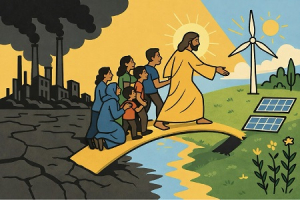
Let’s imagine for a moment that the house where you grew up, the one that holds your most sacred memories, is starting to crack. These are not just stains on the wall; the foundations are giving way.
This is the image Pope Francis presented to us in his 2023 apostolic exhortation Laudate Deum (LD), in which he warned: “The world that welcomes us is crumbling and may be approaching a breaking point” (LD 2).
We are no longer talking about distant climate change or cold statistics; we are talking about a system in clear decline that undermines the sustainability of life as we have known it. For decades, our economy has functioned as if the goods of the earth (“resources,” some call them) were infinite, trapped in what the Church calls the technocratic paradigm (Laudato Si' (LS), 101), believing that unlimited power and consumption are the only way forward.
But the Church, enlightened by Laudato Si’, tells us that faith cannot be indifferent to the type of energy that powers our world. Fossil fuels—coal, oil, and gas—which once powered an era, are now the chain that binds us to the destruction of our common home.
Pope Francis was categorical: “Technology based on highly polluting fossil fuels— especially coal, but also oil and, to a lesser extent, gas—needs to be progressively replaced without delay (LS 165).” The phrase is critical: “without delay.” It is not a suggestion for the next century; it is a moral imperative for today. Why? Because every degree of temperature rise is a direct blow to the poorest, those who have no air conditioning for extreme heat, no walls against flooding, and not enough crops to feed themselves.
This is where our response as a Church must become prophetic, like that of the ancient Hebrew prophets, Jeremiah, Joel, or even Jesus himself. We are not simply seeking to replace a barrel of oil with hundreds of solar panels. That would be merely cosmetic. We seek a just transition.
What does this mean? It means a comprehensive transformation that goes beyond mere economic interest and places human dignity, global solidarity, and care for our common home at the center. It means, first of all, demanding the urgent abandonment of fossil fuels and a significant reduction in energy consumption by the richest nations, assuming their historical responsibility through concrete actions, such as the cancellation of the unpayable foreign debt of some countries in the Global South.
However, to ensure that this demand does not remain trapped in empty promises, we need a different international framework. Laudate Deum urges us to shape a “new multilateralism” (LD 37-43) that overcomes the slowness, blockages, and lack of binding mechanisms of the current UN negotiation system.
It is in this context that the upcoming Conference of Santa Marta in Colombia (April 24-29, 2026), the first international conference focused specifically on the transition from fossil fuels, stands out as a hopeful milestone. This meeting of countries marks the starting point for dialogue to draw up a real and effective roadmap towards the elimination of fossil fuels, driven by moral and civil diplomacy that demonstrates that another form of global governance, more agile and committed to the common good, is possible.
Second, it means protecting vulnerable populations and affected workers by guaranteeing, for example, retraining programs and unemployment benefits for those who currently depend on the oil or coal industry. Furthermore, this transition must not fall into a “new extractivism,” rejecting the idea that mining materials for solar panels or batteries will replicate the historical dispossession of lands and communities. Instead, a just energy transition entails an obligation to promote participatory governance in decisions on production, distribution, and consumption, such as the creation of local energy communities in which citizens take ownership of the change process.
Finally, it also means profound ethical and financial coherence, exemplified by the progressive divestment of Catholic institutions and individuals from fossil fuel or megamining companies, accompanied by intensive climate education (rather than “climate denial”) that promotes new sustainable lifestyles and ensures that new production infrastructures zealously protect biodiversity.
In short, it means that the “cry of the earth” and the “cry of the poor” (LS 49) are, in reality, a single cry that calls for a comprehensive approach to ecological transition, a profound transformation that overcomes the technocratic paradigm that tends to rely on false technical solutions and does not question the morality of actions. In Laudate Deum, the Church asks us to make this transition “mandatory and monitorable” (LD 59), because good will is no longer enough; we need just structures that guarantee respect for fundamental human rights and the natural environment that sustains them, through good practices of production, distribution, and consumption, democratic participation, and profound changes in lifestyles of overconsumption and waste.
Ultimately, “there can be no lasting change without cultural change [...] and there can be no cultural change without change in people” (LS 70). Abandoning fossil fuels is not just a technical challenge for engineers; it is a moral challenge for us.
As a Church, our social mission is to proclaim the Gospel and, based on it, to promote human dignity, the common good, and justice in social, economic, and political structures. If we proclaim life as a gift from the Creator, we cannot finance death or be indifferent to the suffering we cause.
In terms of energy, if we preach justice, we must promote the development of new technologies based on clean energy that, at the same time, allow the poorest communities to access them.
Let us move from an economy centered on extraction to one of care, which places human beings at its center. Let us move from carbon to communion. Because, at the end of the day, caring for creation is not a “green option,” but an act of love for the Creator and for every human being who inhabits this common home.
Carmelite NGO Calls for Urgent Action on Poverty at UN
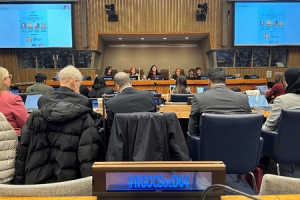
Carmelite NGO Urges Renewed Global Action on Poverty and Inequality at UN Social Development Meeting
I am writing this from the United Nations headquarters in New York just as the 64th annual meeting of the Commission for Social Development (CSocD64) approaches its conclusion. While here, I have attended various plenary sessions and side events.
A recurring theme during this year’s gathering was the importance of the Doha Political Declaration, the document that came out of the Second World Summit for Social Development, held in Doha, Qatar, this past November.
In a nutshell, the Doha Declaration was an agreement among nations to recommit their efforts to the cause of social development, including the eradication of extreme poverty, the enhancement of social protections for all people, and the promotion of universal human rights. The Summit and the Declaration were meant to jump-start a final push toward meeting the Sustainable Development Goals (SDGs, also known as the 2030 Agenda).
The Summit and CSocD64 have been about “leaving no one behind.” Sadly, progress on the SDGs has been mixed. Many people are, in fact, being left behind. A renewed and reenergized commitment and follow-up in the promotion of genuine social development is certainly needed.
The CSocD64 gathering this month saw many worthwhile conversations and expressions of solidarity and commitment to action. We heard about unpaid caregiving, which is mostly done by women across the globe. If this vital labor was paid, it would be one of the largest segments of the economies of many countries. This is something that must be addressed. (Author’s note: it is revealing and disturbing to contemplate all of the destructive work around the world that is generously paid, yet the critical work of caring for others can be unpaid without apology.)
We also heard at CSocD64 laments about the “overlapping global crises,” which includes growing inequality. Pope Francis called inequality “the root of social evil.” As a sociologist, I can attest to its destructive power. We must address the widening gap between the few very wealthy and the many across the globe who have so little.
It was also said—many times—at CSocD64 that taking action to expand access to education and healthcare and to protect the poor and vulnerable should not be looked upon as “costs,” but rather, they are “investments” in the future of individual countries and the world. The return on proper investments in such things is extraordinarily significant.
Finally, at the Civil Society Forum at CSocD64, it was said that civil society (including NGOs, religions, academic institutions and trade unions) have played and will continue to play a critical role in furthering social development. We are close to the people, so we know the struggles, and we are positioned to have real impact if we engage with our governments and demand action on social development in our own nations and in the world. We need to rise to the challenge!
Dennis Kalob, Ph.D.
Chief Administrative Officer of the Carmelite NGO
New Climate Multilateralism Emerges Post-COP30
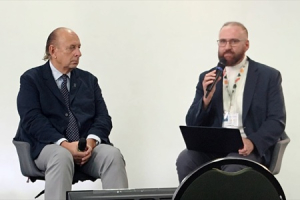
From the Silence of Belém to the Hope of Santa Marta: Reconfiguring Climate Multilateralism
— Eduardo Agosta Scarel, O. Carm.
Director of the Department of Integral Ecology, Spanish Episcopal Conference
COP30, held in Belém do Pará, Brazil, left behind a bittersweet taste. The Brazilian presidency managed to imbue the final document with a humanist narrative that recognized the rights of indigenous peoples, the vital importance of the Amazon, and the ecological debt derived from historical emissions. However, the summit once again stumbled over the usual obstacle: the consensus rule.
The result was a text that, despite its symbolic gestures, failed on two points essential to integral ecology. In terms of mitigation, the explicit reference to the need to abandon fossil fuels disappeared, replaced by vaguer goals of achieving carbon neutrality by mid-century. In terms of financing, although the scientific urgency of mobilizing $1.3 trillion annually was recognized, the political goal was set at a mere $300 billion, thus institutionalizing a financial gap that perpetuates injustice.
Faced with this deadlock in global diplomacy, where a single oil-producing country can veto the ambition of the entire planet, an alternative has emerged: the Santa Marta Conference in Colombia, convened for April 2026 by a bloc of 80 countries led by Colombia, the United Kingdom, Spain, and the Netherlands. Its purpose is clear: to move towards a Fossil Fuel Non-Proliferation Treaty and pave the way for a just transition, beyond the obstacles of the United Nations Framework Convention on Climate Change.
Santa Marta could become the checkmate to the fossil fuel blockade. As Pope Francis reminds us in Laudate Deum, when global institutions fail, it is up to civil society and intermediate countries to act. If these 80 nations agree to halt new exploration and coordinate their exit from fossil fuels, they will cause a massive contraction in demand. Sooner or later, even the large producers that do not join will see their markets shrink. The financial signal will be irreversible: the future will be renewable, not because of ideology, but for pure economic survival.
The strength of this coalition lies in the fact that it does not need the permission of Saudi Arabia or Russia to move forward. By operating as an alliance of will, it breaks the paralysis of consensus and forges its own path. Furthermore, the leadership of Colombia, a coal and oil-producing country, alongside European powers, gives it a unique ethical legitimacy. It dismantles the idea that climate action is a luxury of the North and presents it as a shared, albeit differentiated, responsibility.
One challenge remains, however: financing courage. For the Santa Marta route to be sustainable and fair, it is not enough to sign the end of fossil fuels. It is essential to put resources on the table and ensure that countries like Colombia do not collapse economically when the tap is turned off.
If Belém was the COP of conscience, recognizing the crisis in the heart of the rainforest, Santa Marta promises to be the conference of coherence. It is an opportunity to demonstrate that, even if global diplomacy progresses slowly, the political will of an organized majority can accelerate history and bring us closer, at last, to the comprehensive ecological conversion that the world needs at this immanent level. The key lies in “reconfiguring multilateralism” so that it is born “from below” (cf. Laudate Deum 37-40).
Carmelite NGO Highlights Just Transition at COP30
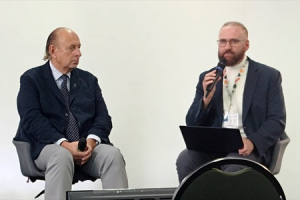
Carmelite NGO Presents at Socio-Environmental Dialogue for Peace: Adaptation and Just Transition
Ten years after Laudato Si’, the encyclical of Pope Francis that inspired a new environmental ethic and shaped the moral vision that accompanied the Paris Agreement, a renewed call emerges: there can be no lasting peace without harmony with nature.
At COP30 the organization Socio-Environmental Dialogue for Peace offered a meeting space to connect peace, climate adaptation, and a just transition, strengthening trust among communities, companies, and institutions. The objective is to move towards cooperation based on integrity and justice, reconciling people with one another and with the planet.
Carmelite NGO vice president, Eduardo Agosta, was one of the featured speakers. Fr. Eduardo is also director of the Department of Integral Ecology at the Spanish Episcopal Conference and senior advisor to the Laudato Si' Movement.
Other presenters were:
- José Luis Manzano, CEO of Integra Capital, physician and entrepreneur with experience in public policy, emerging markets, and strategic sectors such as energy and critical minerals;
- Ana Cabral-Gardner, co-chairperson and CEO of Sigma Lithium Corp, (Nasdaq:SGML), a global reference in sustainability and best practices in the lithium industry.
- Cardinal Leonardo Ulrich Steiner, archbishop of Manaus, who shared his vision from the Amazon on how to connect spirituality, science, and policy in the path towards a just transition.
- Juliano Assunção, professor of Economics at PUC-Rio, who addressed the economic dimension of a just transition and the cost of inaction.
The session was moderated by Emilce Cuda, secretary of the Pontifical Commission for Latin America, and Patricio Lombardi, executive director of the Environmental Markets Fairness Foundation (EMFF).
Carmelite NGO Has Active Presence at COP 30 in Brazil
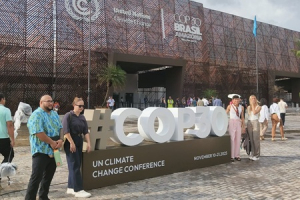
— Renato Rallo, Carmelite NGO Observer
We have arrived at COP30 in Belém, Brazil!
The first impression upon arrival is that logistics are not easy this year. The few hotels in the city are very expensive, so everyone has had to be "creative" with their plans. At the conference venue, there is a constant loud background noise from the air conditioners. In addition, from time to time, usually in the early afternoon, it starts to rain heavily and the raindrops rumble on the tents. You can hardly hear anything.
However, this "problematic background" is important for the participants: it allows all delegates to experience what it is like to live outside the world's major cities or developed countries. These small inconveniences can help them to put themselves in other people's shoes, in a process that is essentially cooperative, not competitive.
Expectations for this COP before it began were quite low. The international crisis and the weakening of multilateralism in the face of growing dualism (some call it G2) do not bode well. The main issues on which progress is expected are: biofuels (through the "Belém 4x" initiative); forest conservation; a common framework of criteria for evaluating adaptation initiatives (to climate change). Anything else will be a very welcome surprise.
In a climate of great uncertainty, which some see as the beginning of disenchantment, the Carmelite NGO is here to bear witness.
The Carmelite NGO is represented at the meeting (either in person or on-line) by Dr. Renato Rallo, Mechanical Engineer in Energy Resources and Environment; Alirio Cáceres, a deacon and eco-theologian from Bogotá, Colombia, working for CELAM; Abilio Peña from Bogotá, Councilor at SICSAL and the executive director of JPIC for the Franciscan Community of Our Lady of Lourdes; Sonia Olea Ferreras of the Caritas España Advocacy Team in Madrid; Environmental Engineer Miriam Montero Hidalgo, a researcher and lecturer at the Rey Juan Carlos University, Madrid; Dr. Dennis Kalob, the Carmelite NGO’s Chief Administrative Officer; and Dr. Eduardo Scarel, O. Carm., the Vice President of the Carmelite NGO and director of the Department of Integral Ecology of the Spanish Episcopal Conference.
COP 30 in Belém, Brazil: Just Another Summit?
The Carmelite NGO | Advocacy for a Just World
The Climate Summit in Belém, Brazil: Just Another Summit?
From November 6 to 21 this year, COP 30 will be held in Belém, in the heart of the Brazilian Amazon. Ten years after the Paris Agreement, this climate summit transcends the usual diplomatic calendar to become an event of profound symbolism. As stated by Brazilian President Luiz Inácio Lula da Silva, the summit will be an opportunity for the world to discuss the importance of the Amazon within the Amazon itself, listening directly to its peoples.
The conference agenda is anchored in crucial mandates that will define the trajectory of global climate action for the next decade. It inherits from COP 28 the task of responding to the first Global Stocktake, which concluded that current efforts are insufficient to limit warming to 1.5°C and called for the submission of a new and more ambitious round of Nationally Determined Contributions (NDCs), or national climate action plans by February 2025. It will also need to build on the financial commitments established at the last COP 29, particularly with regard to the New Collective Quantified Goal (NCQG), which will replace the target of $100 billion per year in aid to countries affected by climate change.
Heading up the Carmelite NGO delegation to the meetings in Brazil will be Renato Rallo, a long time member of the Carmelite NGO. He holds a Ph.D. in Mechanical Engineering in Energy Resources and Environment. Mari Carmen Molina, Chair of Biodiversity and Environmental Conservation, Universidad Rey Juan Carlos, Madrid, will participating as a delegate of the Carmelite NGO and will present a side event in the green zone. Five others will be participating virtually as part of the Carmelite NGO.
Eduardo Agosta Scarel, O. Carm., Director of the Department of Integral Ecology, Spanish Episcopal Conference and Vice President of the Carmelite NGO, published an article in VIDA NUEVA digital on Monday, November 3, 2025 before leaving for the conference. The article was originally published in Spanish. We provide here a translation in English.
To read the complete article ... The Climate Summit in Belém, Brazil: Just Another Summit? by Eduardo Agosta Scarel, O. Carm.


