










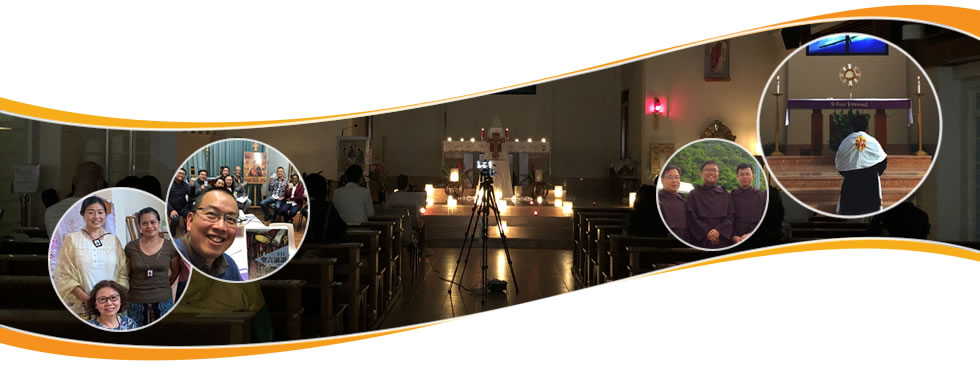





The Unification of the Two Provinces in Germany into One German Province
Recently, on the 28th of December, at a solemn event in the Carmelite house in Bamberg, Germany, the unification of the Provinces of Upper Germany and Lower Germany to form the one Province of Germany took place. The ceremony began with an historical overview by Dr. Edeltraud Klueting, Third Order Carmelite, of the presence of Carmelites in Germany for more than 750 years. The Prior General, Fr. Fernando Millan Romeral, O.Carm. then spoke. He pointed to the unification as a sign of vitality towards a better service of the people of God. Far from being a defeat this unification comes as a challenge to sow the seeds in Germany of the Carmel of the future. The decree of unification was read and then the two outgoing provincials in a symbolic gesture handed over the seals of their former provinces to the Prior General who gave the seal of the new Province of Germany to the Prior Provincial, Fr. Dieter Lankes, O.Carm.
The Archbishop of Bamberg, Ludwig Schick, the President of the German Conference of Religious, the Representative of the Minister for Culture of Bavaria, all addressed the gathering, offering their good wishes. The Prior Provincial of the Province of the Netherlands, Fr. Ben Wolbers, O.Carm. gave a gift of the artistic representation of the Carmelite Rule by the Dutch artist, Arie Trum, written in German. At that point there was a presentation of the Monasticon Carmelitanum, which describes each of the houses of the Carmelites in Germany since the Order first began there. The new website of the united province (www.karmeliten.de) was then presented.
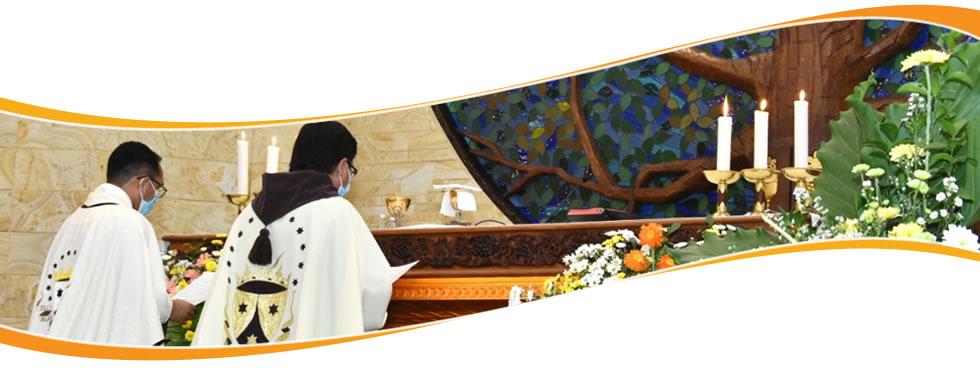
In the afternoon, the Prior General led the solemn celebration of the Mass of Thanksgiving. The concelebrants included, the Vice Prior General, Fr. Christian Kőrner, O.Carm., the Councilor General for Europe, Fr. John Keating, O.Carm., the two German provincials, Fr. Wilfried Wanjek, O.Carm., and Fr. Dieter Lankes, O.Carm. along with numerous German Carmelites and representatives of the Provinces of Britain, St. Thomas in India, the General Commissariat of Paraná, the communities of the Cameroon, all of these last three in different ways linked closely to the Province of Germany. In his homily, the Prior General spoke about Bl. Titus Brandsma, the Patron of the new province, as an important figure of reconciliation, unity and hope, and a shining example for the united province.
Lectio Divina January 2013
General prayer intention: "That in this Year of Faith Christians may deepen their dfdfdfdfdfdof the mystery of Christ and witness joyfully to the gift of faith in him".general prayer intention for January 2013 is: "That in this Year of Faith Christians may deepen their knowledge of the mystery of Christ and witness joyfully to the gift of faith in him".
Mission intention: "That the Christian communities of the Middle East, often discriminated against, may receive from the Holy Spirit the strength of fidelity and perseverance".
His mission intention is: "That the Christian communities of the Middle East, often discriminated against, may receive from the Holy Spirit the strength of fidelity and perseverance".
| Ipad-Iphone | Kindle | ||
| English | download ebook | download ebook | download PDF |
| Español | descargar eBook | descargar ebook | descargar PDF |
| Italiano | download eBook | download eBook | download PDF |
- Tuesday, January 1, 2013
- Wednesday, January 2, 2013
- Thursday, January 3, 2013
- Friday, January 4, 2013
- Saturday, January 5, 2013
- Sunday, January 6, 2013
- Monday, January 7, 2013
- Tuesday, January 8, 2013
- Wednesday, January 9, 2013
- Thursday, January 10, 2013
- Friday, January 11, 2013
- Saturday, January 12, 2013
- Sunday, January 13, 2013
- Monday, January 14, 2013
- Tuesday, January 15, 2013
- Wednesday, January 16, 2013
- Thursday, January 17, 2013
- Friday, January 18, 2013
- Saturday, January 19, 2013
- Sunday, January 20, 2013
- Monday, January 21, 2013
- Tuesday, January 22, 2013
- Wednesday, January 23, 2013
- Thursday, January 24, 2013
- Friday, January 25, 2013
- Saturday, January 26, 2013
- Sunday, January 27, 2013
- Monday, January 28, 2013
- Tuesday, January 29, 2013
- Wednesday, January 30, 2013
- Thursday, January 31, 2013
PORTA FIDEI
CHRISTUS INCARNATUS EST!
NATALE HILARE ET ANNUM FAUSTUM
25. XII. 2012
FERNANDO PRIOR GENERALIS
DOMUSQUE GENERALIS COMMUNITAS
IMAGO: Guido Reni, Adorazione dei pastori (1640-1642), Moskva, Pushkin Museum
The Elective Chapter of the Carmelite Monastery of Barcelona, Spain, was held 12-14 December 2012. The following were elected:
- Prioress: Sr. M. María Carmen Izquierdo Marín, O.Carm.
- 1st Councilor: Sr. María Pilar Simón Blasco, O.Carm.
- 2nd Councilor: Sr. M. Roser Ferrer Camps, O.Carm.
- 3rd Councilor: Sr. M. Carmen Ribas Colomer, O.Carm.
- Director of Novices: Sr. María Pilar Simón Blasco, O.Carm.
- Treasurers: Sr. M. Roser Ferrer Camps, O.Carm.
- Sr. M. Jacinta Mutio Muithya, O.Carm.
- Sacristan: Sr. M. Roser Ferrer Camps, O.Carm.
Electoral Chapter of the Monastery of Santa Ignacia, Tarlac, Philippines
The Elective Chapter of the Carmelite Monastery of Santa Ignacia, Tarlac, Philippines, was held 14 December 2012. The following were elected:
- Prioress: Sr. Arlene Marie Reporte, O.Carm.
- 1st Councilor: Sr. M. Teresa Margarita Medina, O.Carm.
- 2nd Councilor: Sr. Mary Ann Inosanto, O.Carm.
- Director of Novices: Sr. M. Teresa Margarita Medina, O.Carm.
- Treasurer: Sr. Lourdes Maria Viernes, O.Carm.
- Sacristan: Sr. Marie Gretel Lugtu, O.Carm.
Fr. Raúl Maraví, O.Carm.
The presence of Carmelite friars can be found in thirteen distinct countries in a very large territory that extends from Canada in the north to Argentina in the south where we have approximately 530 Carmelites.
The American continent is divided into two regions:
- The North American Region
- The Latin American and Caribbean region.
In this first triennium we visited the majority of the Carmelite places in this enormous continent. We tried to encourage greater interchange and mutual collaboration between both regions and between the existing entities. Likewise, we animated the friars to participate in various permanent formation programs, to continue studies in specialized areas after theology and to learn one of the official languages of the Order. These visits also included visits to monasteries of cloistered nuns and some convents of sisters affiliated with our Order when time and distance permitted us to do so.
During this time we had the opportunity to participate in four provincial chapters, four provincial commissariat assemblies and one general delegation meeting. Also, we were present at various celebrations, congresses and meetings among which we can highlight: the Beatification of Madre Candelaria de San José in Venezuela, the meeting of Superiors of the Americas in Brazil, the Golden (50th) Anniversary of Crespi Carmelite High School in the United States, The O.Carm-O.C.D. Latin American Congress (ALACAR) in Colombia, and three formation courses for Latin America in Peru, Bolivia and Brazil.
It should be noted that in the Meeting of Superiors of 2008, the group carefully studied the Global Plan of the General Council for the Order in distinct areas such as: formation, justice and peace and the integrity of creation, Carmelite schools and youth, Carmelite laity. The assistants, friars and some Carmelite sisters worked and analyzed the most viable ways to implement this plan in their communities.
On the other hand, it is also important to note that during the International Course for formators in August of 2010 in Brazil, the formators of the American continent met to discuss a plan to develop three single international novitiates in the continent (one in English, one in Spanish and one in Portuguese). The majority of the participants (around thirty formators) were in agreement to continue supporting this initiative in order to achieve a better interchange and to enrich the novices and students with a more international and diversified experience of our Carmelite Order.
More...
This article is from the Citoc Magazine.
The Citoc Magazine is published twice a year by the Order of Carmelites. Submitted news, information, feature, articles, letters, photos, and other materials become the property of the Citoc Magazine.
The Elective Chapter of the Carmelite Monastery of San Giovanni La Punta, Italy, was held 10 December 2012. The following were elected:
- Prioress: Sr. M. Rosalia Mangiarotti, O.Carm.
- 1st Councilor: Sr. M. Simona Nicita, O.Carm.
- 2nd Councilor: Sr. M. Angelica Panebianco, O.Carm.
- 3rd Councilor: Sr. M .Celina Atzei, O.Carm.
- 4th Couniclor: Sr. M. Gesualda Morreale, O.Carm.
- Director of Novices: Sr. M. Rosalia Mangiarotti, O.Carm.
- Treasurer: Sr. M. Simona Nicita, O.Carm.
- Sacristan: Sr. M. Angelica Panebianco, O.Carm.
The Carmelite NGO invites people around the world to join with the Carmelite Family to celebrate World Human Rights Day on December 10 with a day of prayer and reflection on human rights and the Christian faith.
Materials for individuals, organizations, or groups to use to celebrate the day can be obtained from the office of the Carmelite NGO or downloaded from the organization's website www.carmelitengo.org The booklet contains a prayer service containing passages from Scripture, statements from documents of the Catholic Church and the Carmelite Order, as well as other resources.
The Beatification of two groups of Carmelite Martyrs of the 20th Century in Spain
The November 2012 plenary assembly of the Conference of Spanish Bishops set the date and the venue for the beatification of the next group of 20th century Spanish martyrs. It will take place at the end of the Year of Faith, on the 27th of October 2013 in Tarragona, in Spain. Among the group there is Fr. Carmel Maria Moyano, O.Carm., and nine of his companions from the Betica province, along with Fr. Alberto Marco Alemán, O.Carm., and eight companions from the Province of Castile.
The statement from the Spanish Bishop’s Conference says that the office for the causes of the saints will be in contact with the the various people who are responsible for the different causes. The statement also invites everyone to engage in a spiritual preparation in each province, order or diocese, through a catechesis that may be offered to young people and other groups, so that the “witness and intercession of all these martyrs may contribute to the growth and to the joy and faith of the entire people of God”


