










O.Carm
Elective Chapter of the Monastery of Aracena
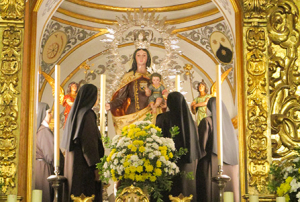
The Monastery of Santa Catalina in Aracena, Spain, held its triennial elective chapter on November 22.
The results of the elective chapter were as follows:
Prioress: Sr. Mª Remedios Álvarez Soriano
1st councilor: Sr. Elena Mª López Font
2nd councilor: Sr. Mª Leonor Parrilla de la Cruz
Formator: Sr. Elena Mª López Font
Bursar: Sr. Mª Victoria Escamilla Martín
Sacristan: Sr. Mª Leonor Parrilla de la Cruz
Elective Chapter of the Monastery of Ravenna
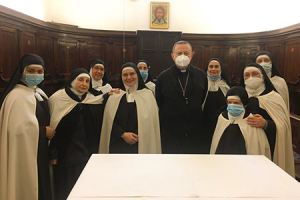
The Carmel of St. Stephen Protomartyr in Ravenna, Italy, celebrated its elective chapter on November 21 and 22, accompanied by the prayers of many brothers and sisters who share the beautiful experience of following Jesus.
On the Sunday of Christ the King, November 21, 2021, after the Eucharist celebrated together, the Archbishop, Mons. Lorenzo Ghizzoni, presided over the Chapter for the election of the prioress.
At the first ballot, Sr. M. Anastasia di Gerusalemme Cucca was elected and accepted, with an awareness of the grace of synodality, which in this time is given by the Spirit to the whole Church.
The following day, the Community proceeded with the elections for the other offices.
The results of the elective chapter are as follows:
Prioress: Sr. M. Anastasia di Gerusalemme Cucca
1st Councilor: Sr. M. Elisabetta Mambelli
2nd Councilor: Sr. Hilda M. Duran Polanco
3rd Councilor: Sr. M. Elena Pasca
4th Councilor: Sr. Betania Maria Silverio Taveras
Formator: Sr. M. Elisabetta Mambelli
Bursar: Sr. M. Anastasia Cucca
Sacristan: Sr. M. Barbara Stella
Advent Webinar on Titus Brandsma

The Advent 2021 Webinar: Traces of the Spirituality of Titus Brandsma will take place this upcoming Saturday, November 27, 2021.
Most of us are familiar with the basic outline of the life of Blessed Titus Brandsma. However, the lack of access to most of his writings, talks, and letters, in English has limited our understanding of his spiritual development from his own words.
Fr. Titus' spirituality-- his living in relationship to his loving God-- enabled him to accept and overcome the many challenges in his life.
During this webinar we will explore some of those moments and Brandsma's perpective. Reflecting on these moments can provide each of us with some illumination on challenges in our own lives and strategies for strengthening our own relationship with our God.
Presented by:
Fr. William J. Harry, O. Carm.
Cost: $ 10.00
Saturday, November 27, 2021
2:00 PM (Eastern Standard Time, US)
4:00 PM (GMT -3, Brazil)
7:00 PM (GMT, Greenwich UK)
8:00 PM (GMT +1, Europe)
Use this link to forward to a friend
Update on the Reform of the Institutum
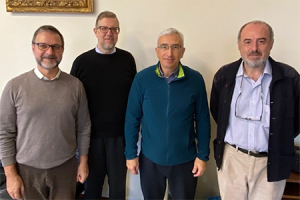
On November 15-16, there was a face-to-face meeting at the General Curia of the Commission for the Reform of the Institutum Carmelitanum. Present were Michael Farrugia, president, Fernando Millán Romeral, Giovanni Grosso, and Mario Alfarano.
The Commission has completed the revision of the Norms of the Institutum and will submit them to the General Council for its approval. These Norms, approved in the General Chapter of 1995, needed to be updated with regards to the aims of the Institutum, its components, and its administration.
The Commission also elaborated a series of proposals regarding: the procedure for implementing the new norms; the areas of Sant'Alberto International Center (CISA) for the use of the Institutum and its security; suggestions for the conservation and enhancement of the cultural heritage of the Order, in particular those useful for the research and transmission of the history and charism of Carmel.
New Leadership for the Province of Malta

The Provincial Chapter of the Maltese Province was held on November 15-19, 2021, at the Carmelite Retreat Center in Dar Tat-Talb, Lunzjata, Rabat.
Fr. Conrad Mutizamhepo, general councilor for Africa, was president of the Chapter.
The following were elected:
Prior Provincial: Fr. Joseph Saliba
First Councilor: Fr. Maurice Abela
Second Councilor: Fr. Renald Lofreda
Third Councilor: Fr. Jurgen Cucciardi
Fourth Councilor: Br. Vincent Rotin
Provincial Secretary: Fr. Ivan Scicluna
Celebrating At Home - Solemnity of Christ The King

A royal shepherd
On this last Sunday of the Church’s year we always celebrate the Feast of Christ, the Universal King.
The first reading from the prophet, Daniel, speaks of the coming of one who will rule in the name of God in an eternal kingdom. The second reading from the Book of the Apocalypse speaks of Christ as the ‘faithful witness’ to God and ‘ruler of the kings of the earth’. Here is a king who loves his people and sheds his own blood to save them.
The Gospel comes from the Passion of Jesus in St John’s Gospel. It is Jesus’ dialogue with Pilate about his kingship and the nature of his kingdom.
Jesus is anything but a traditional king. This King reigns, not from a golden throne, but a cross of rough wood; naked, with no rich, flowing robes; no bejewelled crown, just thorns; no orb and sceptre, just nails in his hands.
He comes among his people, not as a tyrant wielding weapons of suffering and death, but as a powerless baby.
Jesus says that his kingdom is ‘not of this world’. It is not a kingdom with geographical and national boundaries. It is not a kingdom in the earthly sense where power and oppression reign, but a kingdom where justice, love, mercy, truth and peace reign.
At the end of the day, the disciple is called to be the Kingdom (the living presence) of God in the world and to transform the suffering of its people into joy by deeds of loving kindness.
Virtuous disciples are the living presence of Jesus in the world. They realise that until Jesus comes again, the kingdom has been entrusted into their hands.
In the Kingdom of Jesus, the disciple is not master but ‘servant’.
The power of the spirit of Jesus fuels deeds of loving kindness – reversing horrible human conditions, and bringing healing and salvation.
Whenever we act like Christ the Kingdom of God (the reign of God’s grace) breaks into our world.
Whenever we are moved by the Spirit to proclaim the truth, to respond to need, to work for justice, to transform and heal our society, the Kingdom of God breaks into human reality and the grace of God becomes clearly visible in our words and actions.
- pdf Celebrating At Home - Solemnity of Christ The King [PDF](1.76 MB)
- default Celebrating At Home - Solemnity of Christ The King [ePub](5.53 MB)
- pdf Celebrando En Familia - Solemnidad de Cristo Rey(898 KB)
- pdf Celebrando In Casa - Solennità di Nostro Signore Gesù Cristo Re(882 KB)
...
Celebrating at Home is a Liturgy of the Word centred around the Gospel reading for each Sunday. It includes a reflection on the Gospel and prayers.
It can be used personally or with your family. Parts for all to pray are given in bold print and all the other parts can be shared among those present.
We hope that Celebrating at Home will be a source of nourishment and strength for all who use it.
In the room you decide to use for this prayer you could have a lighted candle, a crucifix and the Bible. These symbols help keep us mindful of the sacredness of our time of prayer and can help us feel connected with our local worshipping communities.
Causa Nostrae Laetitia - Oct/Nov 2021
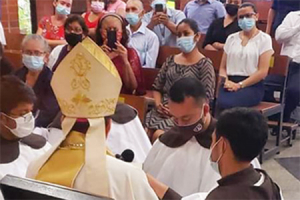
Professio Solemnis
15-11-21 José Ivanildo Justino (Flum) São Paolo, Brazil
Ordinatio Diaconalis
25-10-21 Jean de Dieu Kavunga (Ita-RPC) Kinshasa, Dem Rep Congo
25-10-21 Philéomon Kambale (Ita-RPC) Kinshasa, Dem Rep Congo
Ordinatio Sacerdotalis
25-10-21 Noël Kwaya (Ita-Cong) Kinshasa, Dem Rep Congo
25-10-21 Jean-Claude Isusi (Ita-Cong) Kinshasa, Dem Rep Congo
14-11-21 Andres Nono (Indo) Maumere-Flores, Indonesia
14-11-21 Andreas Yorenus Waji Rasi (Indo) Maumere-Flores, Indonesia
14-11-21 Mariano Puken (Indo) Maumere-Flores, Indonesia
14-11-21 Yeremias Geleta Huler (Indo) Maumere-Flores, Indonesia
14-11-21 Yohanes Palaama Belang (Indo) Maumere-Flores, Indonesia
Commemoration of all Carmelite Souls

On November 15th, we celebrate the Commemoration of all Carmelite Souls.
From the Collect of the Commemoration of All Carmelite Souls
Lord,
you are the glory of those who serve you.
Look lovingly on our departed brothers and sisters,
united in following Christ and his Mother
by the waters of baptism
and the bonds of Carmel.
In your mercy
grant them everlasting sight of you,
their Creator and Redeemer.
We ask this through our Lord Jesus Christ, your Son,
who lives and reigns with you and the Holy Spirit,
one God,
for ever and ever.
Amen.
Read here the list of those Carmelites who died during the past 12 months
Announcement for World Day of the Poor
This Sunday, the 33rd Sunday in Ordinary Time, November 14, is the Fifth World Day of the Poor. Its purpose is to set aside a Sunday every year and “reflect on how poverty is at the very heart of the Gospel.” The theme for the celebration in this year of 2021 is: “The poor you will always have with you” (Mk 14:7). These are the words of Jesus at the Anointing in Bethany just before his Passion, an incident described in the gospels of Matthew, Mark and John.
The Christian tradition is realistic about human beings. We are good, but flawed, wounded by sin. We do not believe in utopia in this life. There will always be poverty and injustice of some kind, but we are called to reduce its impact wherever we can.
The World Day of the Poor has been celebrated on the 33rd Sunday of Ordinary Time since 2017. It was established by Pope Francis in his Apostolic Letter Misericordia et Misera, issued on 20 November 2016 to celebrate the end of the Extraordinary Jubilee of Mercy. The practice was initiated by Pope Francis in 2017 with the theme of “let us love, not with words but with deeds.”
In response to the Holy Father, we have asked the provinces of the Order to highlight work that their members do among the poor. We will be bringing you these stories in the coming weeks.
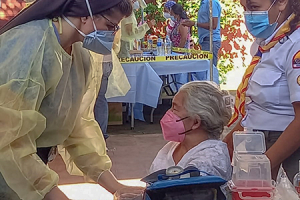
Today’s story comes from the Central American country of El Salvador. The Carmelites of the Province of the Most Pure Heart of Mary have been officially present in the country since June 2014. One of the formation houses is located 15 minutes walking distance from the Village of Nazareth. The young Carmelites worked with various groups in the village to organize a Medical Day, allowing the people, including shut-ins, to profit from medical experts without having to travel into the town some 18 km away. It is a testament to the miracle of what working together can do for those who lack the resources some of us take for granted.
Read pdf here(38 KB) the article about the Medical Day in the Village of Nazareth, El Salvador
Read here Pope Francis' Message for the Fifth World Day of the Poor
Memorial of Bl. Maria Teresa Scrilli

On November 13th we celebrate the memorial of Blessed Maria Teresa Scrilli.
Maria Scrilli, in religion Maria Teresa of Jesus was born in Montevarchi on May 15, 1825 and was called by the heavenly Father while in Florence on November 14, 1889.
She was beatified in Fiesole (Florence) on October 8, 2006.
The Blessed Mother was a devotee of the Florentine saint Maria Maddalena de' Pazzi whom she met while still an adolescent reading the lives of saints.
She is the foundress of the Congregation of the Sisters of Our Lady of Carmel.
Mother Maria Teresa's charism lives on in her Institute in the nations where it is present today: Italy, the United States, Canada, Poland, India, Brazil, the Czech Republic and the Philippines.
Prayer for Blessed Maria Teresa Scrilli
Lord Jesus,
Who in the evangelic testimony
of the Blessed Maria Teresa Scrilli
continue to show to the world that it is the gentle
who inherit your kingdom
and that only in You do those who are
tired and oppressed find rest
following her example, may we experience in our hearts
the desire to serve you in our brothers
and to be able to awaken, especially in young people,
a burning thirst for your love, Grant to us we pray you,
by her intercession, the favor we Confidently ask of you ….
You live and reign forever and ever. Amen .
Glory be.
Blessed Maria Teresa Scrilli.
Pray for us...
Read pdf here (47 KB) the Interview with Sr. Maria Stella Marzano, Superior General of the Institute of Our Lady of Carmel
Read pdf here (34 KB) "Maria Scrilli’s Presence in this Arduous Path" by Sr. Stephanie Gadalquivir, INSC
Read pdf here (34 KB) "Citizens of Heaven" by Sr. Lini Mathew, INSC
Read here a short bio of Bl. Maria Teresa Scrilli
Visit here to purchase The Autobiography of Maria Teresa Scrilli (available only in English), published by Edizioni Carmelitane


