












By Michelle Laviola, Joliet Catholic Academy
Evangelization is the process which seeks to spread the Gospel and the teachings of the gospel throughout the world. Jesus instructed his followers to go out and spread the Good News. As Catholics, this duty is required for us to develop an intimate and meaningful relationship with Christ. Though this task may seem somewhat impossible, many religious orders, such as the Carmelites, help educate us on how to promote the gospel to others. Unlike most religious orders, the Carmelites do not have a founder. The original order consisted of hermits who dedicated their life to God while residing on top of Mount Carmel. Without a founder, the Carmelites look to great figures in the Catholic Church such as Elijah and Mary for inspiration. This also means that God's founding gift, or charism, to the order is not found in a particular person, but within the community. The Carmelite charism consists of several different elements; the main one being contemplation, or a quiet meditative form of prayer. Contemplation helps the Carmelites develop a very• close relationship with the Father. They can now minimize the distractions from the outside world while in turn asking God to support the needs of the world through their prayer. Some Carmelites follow their vocations and become teachers of prayer or spiritual directors. Through these positions, Carmelite priests and nuns can expand their knowledge of the gospel and help promote evangelization amongst parishioners, and even the students that they teach.
Carmelite do more than solely dedicate their lives to God; they dedicate their lives to spreading God's moral teachings to those in need of His grace. The Carmelite as a whole are very involved with communities through-out the world. Members of the Order educate their followers on a firsthand basis. Many provinces of the Carmelite Order have opened up schools or parishes in which they can further expand their instruction of the faith. To have a strong bond with Christ, we must not only know his teachings, but also make known his teachings. This means that to prove our discipleship to God, we must send forth his good news to the world. Again, to many this may seem like a daunting task. However, God does not expect his followers to go to extraordinary means to proclaim his word. Oftentimes, it is the everyday deeds that reveal God in us all. Anytime God's love is present becomes an astonishing moment. The Carmelites are a perfect example of how ordinary people can perform extraordinary deeds wilt God's guidance. The simple act of providing a Carmelite education can change the world forever. Their students not only are educated on typical school subjects, but also on morals and God's teachings. Carmelite religion classes allow students to think at a more aesthetic perspective. Unlike math, English, or science classes, a religion class teaches students lifelong lessons that can be applied immediately to almost any situation. Carmelite teachings open up students' eyes to God's grace in the world. The lessons that the Carmelites offer are considered very valuable by most of their students. Though it may not seem like it at the time, a Carmelite education changes one's life for good. For some, it may take only a few days to realize that they should continue to pass on the values that they were taught. For others, it may take years. No matter how long it takes for someone to come to terms with their faith, the Carmelites have indeed touched another life and promoted evangelization throughout the world.
I personally have had the privilege of receiving a Carmelite education. Like with many others, it truly has changed my life. I have enjoyed exploring my faith and learning about all that God has to offer. My Carmelite education has inspired me to promote evangelization throughout my community Since starting my education at Joliet Catholic, I have decided to volunteer to try to teach others about the gospel. One of my most enjoyable opportunities was working a retreat for First Communicants to prepare them for the Sacrament of the Eucharist. It was such an amazing experience to educate the children about how sacred receiving Christ's Body and Blood really is. I loved seeing them start to comprehend how great God's love for us is, and helping them understand all that He has sacrificed for us. Even at school I help promote evangelization to my fellow students. I love discussing my faith with my religion teachers and often volunteer to lead prayer and retreats so I can help inform my peers about God's teachings.
The Carmelite Order truly has made a difference in our world today. Even amongst the modernization of our lives, the Order helps remind Jesus' disciples about the importance of our faith and our relationship with our Father. Carmelites not only teach us about our Catholic beliefs, but also how to spread them to others. I am very proud to have been brought up on Carmelite teachings and I plan to hold them and promote them both now and later on in my life.
* from Carmelite Review: Volume 51, Number 2 - Spring / Summer 2012
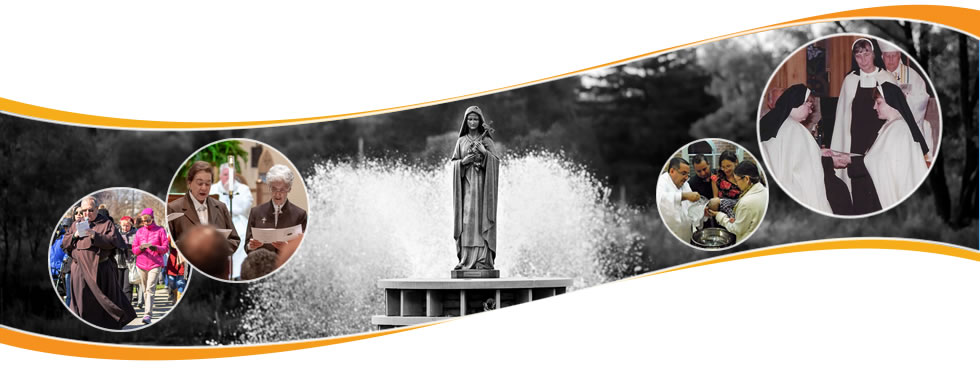
* Photo: Joliet Catholic Academy’s March For Life
BENEDICTUS PP. XVI
"Believing in charity calls forth charity"
“We have come to know and to believe in the love God has for us” (1 Jn 4:16)
Dear Brothers and Sisters,
The celebration of Lent, in the context of the Year of Faith, offers us a valuable opportunity to meditate on the relationship between faith and charity: between believing in God – the God of Jesus Christ – and love, which is the fruit of the Holy Spirit and which guides us on the path of devotion to God and others.
1. Faith as a response to the love of God
In my first Encyclical, I offered some thoughts on the close relationship between the theological virtues of faith and charity. Setting out from Saint John’s fundamental assertion: “We have come to know and to believe in the love God has for us” (1 Jn 4:16), I observed that “being Christian is not the result of an ethical choice or a lofty idea, but the encounter with an event, a person, which gives life a new horizon and a decisive direction … Since God has first loved us (cf. 1 Jn 4:10), love is now no longer a mere ‘command’; it is the response to the gift of love with which God draws near to us” (Deus Caritas Est, 1). Faith is this personal adherence – which involves all our faculties – to the revelation of God’s gratuitous and “passionate” love for us, fully revealed in Jesus Christ. The encounter with God who is Love engages not only the heart but also the intellect: “Acknowledgement of the living God is one path towards love, and the ‘yes’ of our will to his will unites our intellect, will and sentiments in the all-embracing act of love. But this process is always open-ended; love is never ‘finished’ and complete” (ibid., 17). Hence, for all Christians, and especially for “charity workers”, there is a need for faith, for “that encounter with God in Christ which awakens their love and opens their spirits to others. As a result, love of neighbour will no longer be for them a commandment imposed, so to speak, from without, but a consequence deriving from their faith, a faith which becomes active through love” (ibid., 31a). Christians are people who have been conquered by Christ’s love and accordingly, under the influence of that love – “Caritas Christi urget nos” (2 Cor 5:14) – they are profoundly open to loving their neighbour in concrete ways (cf. ibid., 33). This attitude arises primarily from the consciousness of being loved, forgiven, and even served by the Lord, who bends down to wash the feet of the Apostles and offers himself on the Cross to draw humanity into God’s love.
“Faith tells us that God has given his Son for our sakes and gives us the victorious certainty that it is really true: God is love! … Faith, which sees the love of God revealed in the pierced heart of Jesus on the Cross, gives rise to love. Love is the light – and in the end, the only light – that can always illuminate a world grown dim and give us the courage needed to keep living and working” (ibid., 39). All this helps us to understand that the principal distinguishing mark of Christians is precisely “love grounded in and shaped by faith” (ibid., 7).
2. Charity as life in faith
The entire Christian life is a response to God’s love. The first response is precisely faith as the acceptance, filled with wonder and gratitude, of the unprecedented divine initiative that precedes us and summons us. And the “yes” of faith marks the beginning of a radiant story of friendship with the Lord, which fills and gives full meaning to our whole life. But it is not enough for God that we simply accept his gratuitous love. Not only does he love us, but he wants to draw us to himself, to transform us in such a profound way as to bring us to say with Saint Paul: “it is no longer I who live, but Christ who lives in me” (cf. Gal 2:20).
When we make room for the love of God, then we become like him, sharing in his own charity. If we open ourselves to his love, we allow him to live in us and to bring us to love with him, in him and like him; only then does our faith become truly “active through love” (Gal 5:6); only then does he abide in us (cf. 1 Jn 4:12).
Faith is knowing the truth and adhering to it (cf. 1 Tim 2:4); charity is “walking” in the truth (cf. Eph 4:15). Through faith we enter into friendship with the Lord, through charity this friendship is lived and cultivated (cf. Jn 15:14ff). Faith causes us to embrace the commandment of our Lord and Master; charity gives us the happiness of putting it into practice (cf. Jn 13:13-17). In faith we are begotten as children of God (cf. Jn 1:12ff); charity causes us to persevere concretely in our divine sonship, bearing the fruit of the Holy Spirit (cf. Gal 5:22). Faith enables us to recognize the gifts that the good and generous God has entrusted to us; charity makes them fruitful (cf. Mt 25:14-30).
3. The indissoluble interrelation of faith and charity
In light of the above, it is clear that we can never separate, let alone oppose, faith and charity. These two theological virtues are intimately linked, and it is misleading to posit a contrast or “dialectic” between them. On the one hand, it would be too one-sided to place a strong emphasis on the priority and decisiveness of faith and to undervalue and almost despise concrete works of charity, reducing them to a vague humanitarianism. On the other hand, though, it is equally unhelpful to overstate the primacy of charity and the activity it generates, as if works could take the place of faith. For a healthy spiritual life, it is necessary to avoid both fideism and moral activism.
The Christian life consists in continuously scaling the mountain to meet God and then coming back down, bearing the love and strength drawn from him, so as to serve our brothers and sisters with God’s own love. In sacred Scripture, we see how the zeal of the Apostles to proclaim the Gospel and awaken people’s faith is closely related to their charitable concern to be of service to the poor (cf. Acts 6:1-4). In the Church, contemplation and action, symbolized in some way by the Gospel figures of Mary and Martha, have to coexist and complement each other (cf. Lk 10:38-42). The relationship with God must always be the priority, and any true sharing of goods, in the spirit of the Gospel, must be rooted in faith (cf. General Audience, 25 April 2012). Sometimes we tend, in fact, to reduce the term “charity” to solidarity or simply humanitarian aid. It is important, however, to remember that the greatest work of charity is evangelization, which is the “ministry of the word”. There is no action more beneficial – and therefore more charitable – towards one’s neighbour than to break the bread of the word of God, to share with him the Good News of the Gospel, to introduce him to a relationship with God: evangelization is the highest and the most integral promotion of the human person. As the Servant of God Pope Paul VI wrote in the Encyclical Populorum Progressio, the proclamation of Christ is the first and principal contributor to development (cf. n. 16). It is the primordial truth of the love of God for us, lived and proclaimed, that opens our lives to receive this love and makes possible the integral development of humanity and of every man (cf. Caritas in Veritate, 8).
Essentially, everything proceeds from Love and tends towards Love. God’s gratuitous love is made known to us through the proclamation of the Gospel. If we welcome it with faith, we receive the first and indispensable contact with the Divine, capable of making us “fall in love with Love”, and then we dwell within this Love, we grow in it and we joyfully communicate it to others.
Concerning the relationship between faith and works of charity, there is a passage in the Letter to the Ephesians which provides perhaps the best account of the link between the two: “For by grace you have been saved through faith; and this is not your own doing; it is the gift of God; not because of works, lest anyone should boast. For we are his workmanship, created in Christ Jesus for good works, which God prepared beforehand, that we should walk in them” (2:8-10). It can be seen here that the entire redemptive initiative comes from God, from his grace, from his forgiveness received in faith; but this initiative, far from limiting our freedom and our responsibility, is actually what makes them authentic and directs them towards works of charity. These are not primarily the result of human effort, in which to take pride, but they are born of faith and they flow from the grace that God gives in abundance. Faith without works is like a tree without fruit: the two virtues imply one another. Lent invites us, through the traditional practices of the Christian life, to nourish our faith by careful and extended listening to the word of God and by receiving the sacraments, and at the same time to grow in charity and in love for God and neighbour, not least through the specific practices of fasting, penance and almsgiving.
4. Priority of faith, primacy of charity
Like any gift of God, faith and charity have their origin in the action of one and the same Holy Spirit (cf. 1 Cor 13), the Spirit within us that cries out “Abba, Father” (Gal 4:6), and makes us say: “Jesus is Lord!” (1 Cor 12:3) and “Maranatha!” (1 Cor 16:22; Rev 22:20).
Faith, as gift and response, causes us to know the truth of Christ as Love incarnate and crucified, as full and perfect obedience to the Father’s will and infinite divine mercy towards neighbour; faith implants in hearts and minds the firm conviction that only this Love is able to conquer evil and death. Faith invites us to look towards the future with the virtue of hope, in the confident expectation that the victory of Christ’s love will come to its fullness. For its part, charity ushers us into the love of God manifested in Christ and joins us in a personal and existential way to the total and unconditional self-giving of Jesus to the Father and to his brothers and sisters. By filling our hearts with his love, the Holy Spirit makes us sharers in Jesus’ filial devotion to God and fraternal devotion to every man (cf. Rom 5:5).
The relationship between these two virtues resembles that between the two fundamental sacraments of the Church: Baptism and Eucharist. Baptism (sacramentum fidei) precedes the Eucharist (sacramentum caritatis), but is ordered to it, the Eucharist being the fullness of the Christian journey. In a similar way, faith precedes charity, but faith is genuine only if crowned by charity. Everything begins from the humble acceptance of faith (“knowing that one is loved by God”), but has to arrive at the truth of charity (“knowing how to love God and neighbour”), which remains for ever, as the fulfilment of all the virtues (cf. 1 Cor 13:13).
Dear brothers and sisters, in this season of Lent, as we prepare to celebrate the event of the Cross and Resurrection – in which the love of God redeemed the world and shone its light upon history – I express my wish that all of you may spend this precious time rekindling your faith in Jesus Christ, so as to enter with him into the dynamic of love for the Father and for every brother and sister that we encounter in our lives. For this intention, I raise my prayer to God, and I invoke the Lord’s blessing upon each individual and upon every community!
From the Vatican, 15 October 2012
BENEDICTUS PP. XVI
© Copyright 2012 - Libreria Editrice Vaticana
On Sunday the 3rd of February, 2013 a Mass of Thanksgiving was celebrated for the four hundred years of existence of the community of Carmelite nuns in the Monastery of Nuestra Senora de las Maravillas in Madrid. The solemn liturgy was led by the Prior General, Fr. Fernando Millan Romeral, O.Carm., assisted by the priors provincial of Castile and Aragon and Valencia, Frs. Miguel Angel Perez, O.Carm., and Luis Gallardo Ganuza, O.Carm., along with a number of other Carmelite friars. The Superiors General of the two Spanish congregations of Carmelite women, the Hermanas de la Virgen Maria del Monte Carmelo (HVMMC) and the Carmelitas del Sagrado Corazón de Jesús (HCSCJ) were also present with a number of their sisters and various groups of lay Carmelites. In his homily, the Prior General, on behalf of the Order, expressed his gratitude to this community for its fidelity to Carmel and to the Church, throughout these four hundred years, at times in very difficult circumstances, and for its very generous contribution to the founding of communities of Carmelite contemplatives in the Philippines and in the Dominican Republic.
On the occasion of this 4th Centenary the community published a book that contains the history of the Monastery, written by Sr. Maria Magdalena Carretero, O.Carm., and put together a programme of events that will take place throughout the year.
Sr. Vilma Seelaus
GOSPEL
JESUS SAID TO HIS DISCIPLES:
“The Son of Man must suffer greatly and be rejected by the elders, the chief priests, and the scribes, and be killed and on the third day be raised.”
Then he said to all, “If anyone wishes to come after me, he must deny himself and take up his cross daily and follow me. For whoever wishes to save his life will lose it, but whoever loses his life for my sake will save it. What profit is there for one to gain the whole world yet lose or forfeit himself?”
LUKE 9: 22-25
BLESSED ELIZABETH OF THE TRINITY
At the age of twenty Blessed Elizabeth wrote:
“My God, in union with Jesus crucified, I offer myself as a victim. I desire the cross as my strength and support, and wish to live with it, that it may be my treasure since Jesus chose it for my sake. . . . My Savior, I desire to return Thee love for love, blood for blood. Thou didst die for me, therefore I will daily endure fresh sufferings for Thee; every day shall bring me some fresh martyrdom because of my deep love for Thee.”
The Praise of Glory, 47
REFLECTION
Blessed Elizabeth’s passion for suffering was for her a fitting expression of her love. It reflected the attitude toward suffering common to her times. Trials were seen as an opportunity to expiate one’s sins and those of the world, but above all as an opportunity to grow in love. Trials were also considered a proof of God’s love. They were sent to special persons so God could reward them afterwards. Jesus was seen as the great example. By embracing the cross, He reconciled the world to His Father. In a less medically advanced era suffering was a fate to be endured. Elizabeth’s desire for suffering was not motivated by hidden masochism but rather was animated by love, along the desire to overcome egoism through self-sacrificing love.
Out of love, Jesus surrendered to the condition of our human, finite fragility and to the disorder of sin that eventually led to His suffering and death on a cross. God’s love for humankind, for each one of us, is at the heart of this mystery of our redemption. Pray for the grace that when the sufferings of life come your way that you may see them as windows of opportunity to mature in love and compassion for others in their sufferings and come to a deeper appreciation of Christ’s love and care for you.
As you reflect on the words of Jesus in today’s Gospel in the light of Blessed Elizabeth’s ardent desire to suffer with Jesus, ask myself: What is my attitude toward the sufferings each day inevitable brings? Does even the slightest pain plunge me into feelings of self-pity as I reach for a bottle of pain relievers? Does preoccupation with myself in my difficult moments leave me uncaring and indifferent toward the needs of others?
PRAYER
Jesus, in spite of recoiling in the face of suffering and inevitable death, impelled by the force of love, you said in prayer, “Not my will but Thine be done.” When life’s sufferings overwhelm me help me to find peace in uniting myself with You. Give me the courage to take up the cross in the many forms it comes to me and to those I love. I hold before you the world’s sufferings: physical pain, difficulty in relationships and between nations, struggles in family life, economic loss, world hunger, separation from loved ones through war, and the any other forms of human pain. United with you may your love draw me, with all who suffer, into quiet mindfulness of Your abiding presence, the source of strength and inner peace. In your name I pray. Amen.
Những kinh nghiệm sống đức tin của nhiều giáo dân sẽ giúp các linh mục tu sĩ hiểu thêm về linh đạo của họ vì chỉ có giáo dân mới có thể chỉ ra được linh đạo của chính mình. Xin quí vị để ra vài phút để trả lời những câu hỏi dưới đây, về kinh nghiệm đời sống đức tin của mình. Phúc đáp của quí vị sẽ giúp chúng tôi hiểu rõ hơn quí vị qua đó chúng tôi có thể giúp quí vị tốt hơn trong đời sống đức tin.
Nếu cảm thấy ngại, Quí vị không cần để tên và địa chỉ email...
The Elective Chapter of the Carmelite Monastery of Vetralla, Italy, was held 11 February 2013. The following were elected:
- Prioress: Sr. Marianna Caprio, O.Carm.
- 1st Councilor: Sr. M. Benedetta Succu, O.Carm.
- 2nd Councilor: Sr. M. Teresa Nguyen, O.Carm.
- 3rd Councilor: Sr. M. Rita Gugliara, O.Carm.
- 4th Couniclor: Sr. M. Pia Sammut, O.Carm.
- Director of Novices: Sr. M. Sabina Berneschi, O.Carm.
- Treasurer: Sr. M. Františka Bártoková, O.Carm.
- Sacristan: Sr. M. Teresa Nguyen, O.Carm.
The Elective Chapter of the Carmelite Monastery of Sutri, Italy, was held 11 February 2013. The following were elected:
- Prioress: Sr. M. Daniela Solustri, O.Carm.
- 1st Councilor: Sr. M. Martina Simeone, O.Carm.
- 2nd Councilor: Sr. M. Francesca Romana Gargano, O.Carm.
- Director of Novices: Sr. M. Daniela Solustri, O.Carm.
- Treasurer: Sr. Teresa Lupo, O.Carm.
- Sacristan: Sr. M. Francesca Romana Gargano, O.Carm.
from USCCB
Our observance of Lent begins on Ash Wednesday, which falls on February 13 this year, and is a a day of fast and abstinence for Catholics. At Mass on Ash Wednesday, the imposition of ashes replicates an ancient penitential practice and symbolizes our dependence upon God's mercy and forgiveness.
During this Lent, The Church is encouraging Catholics to make going to confession a significant part of their spiritual lives. During Lent, the baptized are called to renew their baptismal commitment as others prepare to be baptized through the Rite of Christian Initiation of Adults, a period of learning and discernment for individuals who have declared their desire to become Catholics.
The three traditional pillars of Lenten observance are prayer, fasting and almsgiving. The Church asks us to surrender ourselves to prayer and to the reading of Scripture, to fasting and to giving alms. The fasting that all do together on Fridays is but a sign of the daily Lenten discipline of individuals and households: fasting for certain periods of time, fasting from certain foods, but also fasting from other things and activities. Likewise, the giving of alms is some effort to share this world equally—not only through the distribution of money, but through the sharing of our time and talents.
The key to fruitful observance of these practices is to recognize their link to baptismal renewal. We are called not just to abstain from sin during Lent, but to true conversion of our hearts and minds as followers of Christ. We recall those waters in which we were baptized into Christ's death, died to sin and evil, and began new life in Christ.
From USCCB
More...
A Congregação das Irmãs Missionárias Carmelitas foi fundada em 25 de março de 1938, na Basílica do Carmo, na cidade de Recife-PE, por Frei José Maria Casanova Magret, natural da Espanha e estando no Brasil desde 1915 com este espírito altamente otimista e empreendedor, restaurou a Província de Pernambuco. Logo após, viajaram para Princesa Isabel-PB, berço da Congregação. Inspirado na vivência do carisma da Ordem do Carmo e movido pela carência do povo de sua época. Recebeu apoio direto de Dom João da Mata do Amaral, bispo diocesano de Cajazeiras, encontrou em Afra de Sá Ferraz (Madre Carmelita) a grande colaboradora no desenvolvimento da Congregação nascente. A segunda casa fundada foi o Carmelo em Cajazeiras PB e, com o passar do tempo, nossa presença foi crescendo na Paraíba e em outros estados como, por exemplo: Sergipe, Alagoas, Rio Grande do Norte, Pernambuco, Rondônia, Pará e Ceará (uma casa Intercarmelitana). Também já marcamos presença na Colômbia numa experiência de três anos. Cada lugar com suas necessidades: na pastoral, na educação, no meio social e saúde.
A Congregação das Irmãs Missionárias Carmelitas foi reconhecida como Congregação religiosa de Direito Diocesano por Zacarias Rolim de Moura, bispo de Cajazeiras, em 08 de outubro de 1960, agregada à Ordem do Carmo pelo Decreto do Prior dos Irmãos da Bem Aventurada Virgem Maria do Monte Carmelo em 29 de agosto 1949 e recebeu a aprovação da Santa Sé em 10 de agosto de 1960.
A missão assumida pelas Irmãs Missionárias Carmelitas, traduzida nos dias atuais, é: Viver em Fraternidade Orante e estar disponível para a missão, no meio dos pobres e excluídos da sociedade. A Congregação sempre recebeu apoio da Ordem do Carmo e somos felizes de fazermos parte desta Família preciosa que tem uma espiritualidade tão rica.
Institutio Congregationis: 25-03-1938
Cooptatio Ordini nostro: 29-08-1949
Curia Generalis
Sede do Governo Geral
Rua Vicente Bezerra, 1
Caixa Postal 40
58900-000 CAJAZEIRAS, PB
BRAZIL
Tel. 83-3531-1091
Fax 83-3531.6065
e- mail Questo indirizzo email è protetto dagli spambots. È necessario abilitare JavaScript per vederlo.
Consilium Generale electum 13 decembris 2010
Antistita Generalis: Soror Maria Sineide Almeida Ângelo
Prima Cons.: Soror Vilma Alves
Secunda Cons.: Soror Gilvânia Ferraz
Tertia Cons.: Soror Edenice Rufino de Carvalho
Quarta Cons.: Soror Edilene Pereira da Silva
Oeconoma Generalis: Soror Maria do Rosário da Conceição
Secretaria Generalis: Soror Edenice Rufino de Carvalho
Institutio Congregationis: 02-12-1899
Cooptatio Ordini nostro: 09-09-1913
Uma Congregação brasileira, nascida no Rio de Janeiro, em 02 de dezembro de 1899 pelo SIM da jovem viúva Rita de Cássia Aguiar (Madre Maria das Neves), que acreditou no chamado de Deus para que entregasse sua vida a serviço dos irmãos e irmãs empobrecidos, inicialmente na pequena cidade de Saquarema-RJ.
A Congregação cresceu e se expandiu em Minas Gerais desde o ano de 1912, quando um pequeno grupo saiu de Campos,RJ, para Cataguases,MG.
Hoje somos presença missionária em oito Estados do Brasil. Desde 1996 estamos no vicariato Apostólico de Puyo-região amazônica do Equador e há 08 anos na periferia de Buenos Aires, na Argentina.
COMO SERVIMOS?
- Inseridas nos meios populares, procurando servir preferencialmente os empobrecidos;
- cuidando dos doentes e idosos;
- educando crianças, adolescentes e jovens;
- Anunciando a Boa Nova da Libertação, conforme o Projeto de Jesus Cristo.
ESPIRITUALIDADE
Desde o início da fundação, afiliadas à Ordem do Carmo, nos saciamos na Fonte da Espiritualidade Carmelitana, mantendo vivo o desejo de ser uma Congregação contemplativa, missionária e marial, no seguimento de Jesus Cristo, na intimidade com sua Palavra, na oração, na fraternidade e no amor filial a Maria.
Ser da Divina Providência é para nós um compromisso, uma atitude vivencial de abandono ao Deus Providente, o Absoluto que orienta a nossa forma de ser e viver.
Curia Generalis
IRMÃS CARMELITAS DA DIVINA PROVIDÊNCIA
Casa Central
Rua Carraça, 648 Serra
30220-260 BELO HORIZONTE / MG
BRAZIL
Tel. 31-3225-4758
Fax 31-3287-0877
e-mail Questo indirizzo email è protetto dagli spambots. È necessario abilitare JavaScript per vederlo.
Pagina prima www.carmelitasdiviprov.com.br
Consilium Generale electum anno: 2007
Antistita Generalis: Soror Dazir da Rocha Campos
Secr. Generalis: Soror Arlette Louzada
Prima Cons.: Soror Maria Edurviges Teixeira
Secunda Cons.: Soror Leonor de Jesus Garcia
Tertia Cons.: Soror Arlette Louzada
Quarta Cons.: Soror Dahlia Peixoto de Resende Filha
On January 12, 2013, the Spiritual Center “Shanti Bhuana” (Land of Peace) was officially inaugurated by Mgr. Hieronymus Bumbun OFM Cap, the Archbishop of Pontianak, West Kalimantan, Indonesia, during a Eucharistic celebration. He was assisted by Mgr. Hadisumarto, O.Carm., Bishop emeritus of Sorong, West Irian, other bishops, Fr. Joko Purnomo, O.Carm. (Provincial) and Fr. Dionysius Kosasih, O.Carm. (Vice-Provincial). They were joined by many priests and about three thousands faithful coming from different parts of Indonesia.
“Shanti Bhuana” has a Retreat and Formation Center for the laity and a theological Institute named “St John of the Cross Theological Institute”, as they want to have an integral spiritual and theological formation open to seminarians and others. There will also be a convent for the Putri Karmel (Daughters of Carmel) sisters and the CSE (Carmelitae Sancti Eliae) brothers and dormitories for the other students. This Spiritual Center is owned and managed jointly by the CSE religious and by the Putri Karmel sisters, both affiliated to the Order in 2002.
The Elective Chapter of the Carmelite Monastery of Fisciano, Italy, was held 29 January 2013. The following were elected:
- Prioress: Sr. M. Arcangela Parisi, O.Carm.
- 1st Councilor: Sr. M. Regina Di Serafino, O.Carm.
- 2nd Councilor: Sr. M. Giuseppina Albano, O.Carm.
- Director of Novices: Sr. M. Giuseppina Albano, O.Carm.
- Treasurer: Sr. M. Regina Di Serafino, O.Carm.
- Sacristan: Sr. M. Arcangela Parisi, O.Carm.


