











Message from the Spanish Committee for the WYD
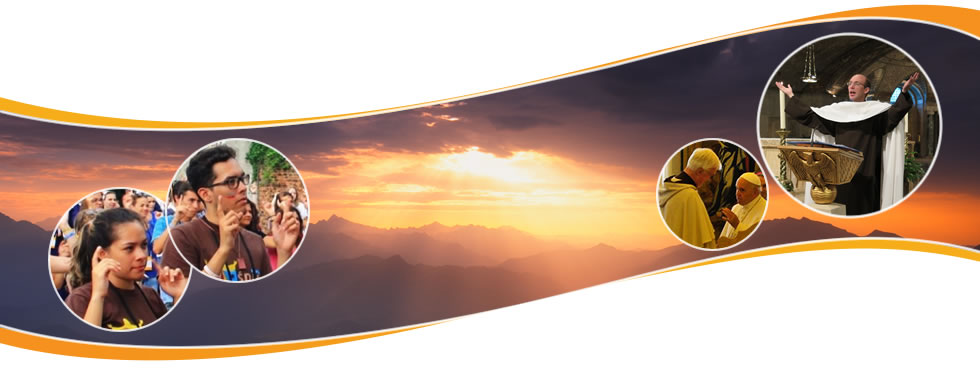
As you already know, on the 17th August next a gathering will take place for all Carmelite youth in Madrid. Those who cannot be present in Madrid may participate through The Place of Prayer (http://ocarm.org/madrid2011/) or via Facebook (Lugar de oración EJC: http://www.facebook.com/pages/Lugar-de-Oraci%C3%B3n-EJC/171363876267712. In this way, throughout the gathering on the 17th we will keep you informed of everything happening at the meeting. At 13.30h (Spanish time) we invite everyone to a moment of communion in prayer for our Carmelite young people that the Lord will grow in their hearts inviting them &ld quo;to live in allegiance to Jesus Christ".
Please, we need your participation! On the 17th we have a special moment and we are expecting thousands of Carmelite young people around the world to join with us.
Young Carmelites on Vatican Radio
In the light of the next World Youth Day a number of Carmelite youth from Latin America (Venezuela and Puerto Rico) spoke on Vatican Radio about their experiences in preparation for the WYD with regard to their expectations and dreams. Also interviewed were Brother Santos Martínez O. Carm. and Father José Oliveras, O.Carm., who will lead the group, outlining the programme for the “Carmelite Day” on 17th August in Madrid. This interview can be heard (in Spanish only) through the following link:
http://www.radiovaticana.org/spa/Articolo.asp?c=508774
November 2011
- Tuesday, November 1, 2011
- Wednesday, November 2, 2011
- Thursday, November 3, 2011
- Friday, November 4, 2011
- Saturday, November 5, 2011
- Sunday, November 6, 2011
- Monday, November 7, 2011
- Tuesday, November 8, 2011
- Wednesday, November 9, 2011
- Thursday, November 10, 2011
- Friday, November 11, 2011
- Saturday, November 12, 2011
- Sunday, November 13, 2011
- Monday, November 14, 2011
- Tuesday, November 15, 2011
- Wednesday, November 16, 2011
- Thursday, November 17, 2011
- Friday, November 18, 2011
- Saturday, November 19, 2011
- Sunday, November 20, 2011
- Monday, November 21, 2011
- Tuesday, November 22, 2011
- Wednesday, November 23, 2011
- Thursday, November 24, 2011
- Friday, November 25, 2011
- Saturday, November 26, 2011
- Sunday, November 27, 2011
- Monday, November 28, 2011
- Wednesday, November 30, 2011
October 2011
- Saturday, October 1, 2011
- Sunday, October 2, 2011
- Monday, October 3, 2011
- Tuesday, October 4, 2011
- Wednesday, October 5, 2011
- Thursday, October 6, 2011
- Friday, October 7, 2011
- Saturday, October 8, 2011
- Sunday, October 9, 2011
- Monday, October 10, 2011
- Tuesday, October 11, 2011
- Wednesday, October 12, 2011
- Thursday, October 13, 2011
- Friday, October 14, 2011
- Saturday, October 15, 2011
- Sunday, October 16, 2011
- Monday, October 17, 2011
- Tuesday, October 18, 2011
- Wednesday, October 19, 2011
- Thursday, October 20, 2011
- Friday, October 21, 2011
- Saturday, October 22, 2011
- Sunday, October 23, 2011
- Monday, October 24, 2011
- Tuesday, October 25, 2011
- Wednesday, October 26, 2011
- Thursday, October 27, 2011
- Friday, October 28, 2011
- Saturday, October 29, 2011
- Sunday, October 30, 2011
- Monday, October 31, 2011
September 2011
- Thursday, September 1, 2011
- Friday, September 2, 2011
- Saturday, September 3, 2011
- Sunday, September 4, 2011
- Monday, September 5, 2011
- Tuesday, September 6, 2011
- Wednesday, September 7, 2011
- Thursday, September 8, 2011
- Friday, September 9, 2011
- Saturday, September 10, 2011
- Sunday, September 11, 2011
- Monday, September 12, 2011
- Tuesday, September 13, 2011
- Wednesday, September 14, 2011
- Thursday, September 15, 2011
- Thursday, September 15, 2011
- Friday, September 16, 2011
- Saturday, September 17, 2011
- Sunday, September 18, 2011
- Monday, September 19, 2011
- Tuesday, September 20, 2011
- Wednesday, September 21, 2011
- Thursday, September 22, 2011
- Friday, September 23, 2011
- Saturday, September 24, 2011
- Sunday, September 25, 2011
- Monday, September 26, 2011
- Tuesday, September 27, 2011
- Wednesday, September 28, 2011
- Thursday, September 29, 2011
- Friday, September 30, 2011
August 2011
- Monday, August 1, 2011
- Tuesday, August 2, 2011
- Wednesday, August 3, 2011
- Thursday, August 4, 2011
- Friday, August 5, 2011
- Saturday, August 6, 2011
- Sunday, August 7, 2011
- Monday, August 8, 2011
- Tuesday, August 9, 2011
- Wednesday, August 10, 2011
- Thursday, August 11, 2011
- Friday, August 12, 2011
- Saturday, August 13, 2011
- Sunday, August 14, 2011
- Monday, August 15, 2011
- Tuesday, August 16, 2011
- Wednesday, August 17, 2011
- Thursday, August 18, 2011
- Friday, August 19, 2011
- Saturday, August 20, 2011
- Sunday, August 21, 2011
- Monday, August 22, 2011
- Tuesday, August 23, 2011
- Wednesday, August 24, 2011
- Thursday, August 25, 2011
- Friday, August 26, 2011
- Saturday, August 27, 2011
- Sunday, August 28, 2011
- Monday, August 29, 2011
- Tuesday, August 30, 2011
- Wednesday, August 31, 2011
Carmelite Spirituality - Prayer the Centre of our Lives
Bulletin of Lay Carmel, Irish Province
The Holy Trinity draws us into communion with themselves and with one another, in faith, in hope and in charity. These virtues are experienced, nourished and expressed in prayer, as we turn our attention to God, in adoration and in love, in obedient listening, in sincere contrition, and in hope-filled petition.
(Constitutions 64)
Prayer is a matter of communication. When we pray we communicate with God. We speak to him and he listens to us. He speaks and we listen to him. The model for this communication is the Blessed Trinity. The persons of the Blessed Trinity communicate with one another. The Father speaks to the Son and the Son listens to the Father and the Spirit is in the listening. The Son speaks to the Father and the Father listens to the Son, and the Spirit is in the listening. Through prayer, and in the power of the Holy Spirit, we are brought in to the conversation that goes on all the time between the Father and the Son. This is the insight we find in the experience of Mary Magdalen de’Pazzi, a Carmelite Mystic. It gives us the foundation for our understanding of prayer that we find in the Constitutions of the Carmelite Friars. It indicates how meaningful prayer can be and the ideal, which is offered to us in our faith.
Belief in the Blessed Trinity lies at the heart of Christian faith. The Christian believes in the God who is revealed as Father, Son and Holy Spirit, three persons in one God. Divinity is revealed as a relationship between persons in a love and knowledge that is extended to all that their love creates.
Prayer is exercised in Faith, in Hope and in Charity.
Faith and prayer are related in the way that God communicates with us. From the moment of our creation, and perhaps from even before that, we are in God’s intention and we become the children who communicate with God. This God goes on speaking his Word to us, even when we are not quite conscious of that fact. We recognise that word coming from God, and give it different names. The Christian believes that God’s clearest and most perfect word of communication is in the Son of God, Jesus Christ. Our prayer is our recognition of God’s presence in us and in our world. Faith is an acceptance of that presence and action, and that acceptance and the consequences of it are expressed in prayer. “Lord, I believe. Help my unbelief.” “Yes, Lord. I believe that you are the Son of God.” Hope is the virtue that confirms that it is worthwhile to pray because of the recognition that God is God, God is present and God is acting for our good, even though we cannot always see that. The possession of hope is the possession of an assurance that we are not lost, and that all things work for God in the world of God, or the Reign of God. If we did not possess this assurance, at least in some measure, we would never pray. Prayer is an act of love, because it is an act of loving communication with the God of love, and it is an act of love that we make on behalf or in favour of those whom we love. If we did not love, our prayer would be nothing more that a vocal or mental exercise, an empty drum, a clashing symbol. But because we love, and would like to love more, prayer helps us to go beyond ourselves in love for others and to link into the love that God has for those whom we love.
Prayer in Adoration, Thanksgiving, Petition and Repentance.
The more we accept the presence and action of God, the more we will try to respond. Adoration suggests the silent recognition on the part of the believers that they stand in the presence of God and do not have words with which to pray.
We believe that at that moment the Spirit gives us words with which to pray. We find words that allow us to thank God for his goodness to us. Once we recall all his acts of goodness and recognise them, we are moved to praise and thank him for them. We find words also that express our sorrow and repentance when we realise what we have done with the gifts that God has given us. Finally we find words to ask for God’s help, because of a very deep recognition that without God we can do nothing, neither for ourselves nor for others, and that with God’s help we can do ordinary things in an extraordinary way, as we become united with the mind and heart of God through our prayer. In this kind of prayer we learn more and more to see with the eyes of God, to listen with the ears of God and to love with the heart of God, and the experience brings communion and in that communion our joy becomes complete.
Letter from the Committee for the Carmelite Day during the WYD
From 16th to 21st of August next, young people will gather in Madrid, Spain, for the World Youth Day celebrations. These events have become an important feature in the life of the Church today. As previously indicated (citoc-online 75/2011) the Carmelite Order will host a Carmelite Day on 17th for young people from the Carmelite Family attending the gathering in Madrid. The Spanish team organizing this day are asking Carmelite communities around the world to join in prayer with our young people, creating a world-wide “place of prayer” on the 17th August and to share with each other on the Order’s website. Each community might find its own way to involve locally as many young people as possible in a moment of prayer together with all young people of the Carmelite Family gathering in Madrid.
The letter of the committee can be found in the attachment in different languages. A place to share this “place of prayer” will be activated on the website of the Order at the beginning of the World Youth Day gathering: www.ocarm.org/madrid2011.

Bishop Wilmar Santin, O.Carm.

Prelate of Itaituba, Para
The Carmelite Order is delighted to announce today, 8th December 2010, that the Holy Father, Pope Benedict XVI has nominated bishop of the Territorial Prelature of Itaituba, in Brazil, Fr. Wilmar Santin O.Carm., of the Commissariat of Paraná of the Upper German Province. Fr. Wilmar was born at Paranavaí in Brazil, on 21st October 1952. Following his profession in the Order on 2nd January 1973, he was ordained priest on 8th December 1979. Among his many responsibilities in the Order, from 1990 to 1995 he served as Commissary Provincial, from 1995 to 2001 as General Councillor and from 2005 to 2008 as Prior of the Centro Internazionale S. Alberto (CISA) in Rome. During these past few years he has worked in Parish in Manaus and has taught Church History at the "Instituto de Teologia, Pastoral e Ensino Superior da Amazônia".
Rua Getúlio Vargas, 235
68180-020, Itaituba, PA
BRASIL
Tel.: (+55 93) 3518.2820
Date |
Event |
Title |
21 Oct 1952 |
Born |
Nova Londrina |
2 Jan 1973 |
Simple Professed |
Order of Carmelites |
29 Aug 1976 |
Solemn Professed |
Order of Carmelites |
8 Dec 1979 |
Ordained Priest |
Order of Carmelites |
8 Dec 2010 |
Appointed |
Prelate of Itaituba, Para, Brazil |
19 Mar 2011 |
Ordained Bishop |
Prelate of Itaituba, Para, Brazil |
10 Apr 2011 |
Installed |
Prelate of Itaituba, Para, Brazil |
from Citoc News
Today, 8th December 2010, that the Holy Father, Pope Benedict XVI has nominated bishop of the Territorial Prelature of Itaituba, in Brazil, Fr. Wilmar Santin O.Carm., of the Commissariat of Paraná of the Upper German Province.
Fr. Wilmar was born at Paranavaí in Brazil, on 21st October 1952. Following his profession in the Order on 2nd January 1973, he was ordained priest on 8th December 1979. Among his many responsibilities in the Order, from 1990 to 1995 he served as Commissary Provincial, from 1995 to 2001 as General Councillor and from 2005 to 2008 as Prior of the Centro Internazionale S. Alberto (CISA) in Rome. During these past few years he has worked in Parish in Manaus and has taught Church History at the "Instituto de Teologia, Pastoral e Ensino Superior da Amazônia".

Archbishop Antônio Muniz Fernandes, O.Carm.

Archbishop of Maceió, Alagoas
Pope Benedict XVI has named Bishop Antônio Muniz Fernandes, O. Carm., currently Bishop of Guarabira, as the new Archbishop of Maceió in Brazil. This followed the pope’s acceptance of the resignation of Archbishop José Carlos Melo, C.M., because of age.Bishop Antônio Muniz Fernandes, O. Carm., was born in Princesa Isabel, Paraíba in Brazil on August 11, 1952. He completed elementary and secondary studies at the Carmelite minor seminary Nossa Senhora do Carmo in Camocim de São Felix.
He made his profession of Simple Vows on February 20, 1976 and was ordained a priest on May 24, 1980. In the years 1983-1986 he was a student at the Pontifical Gregorian University in Rome where he earned a Licentiate in Biblical Theology. He completed some studies in Jerusalem.He was nominated bishop on February 14, 1998 and was consecrated on the following May 24. That same day he took possession of the Diocese of Guarabira. As bishop, he has served in the following positions: Vice President of the Northeastern II Region of the CNBB (2003-2005), President of the Northeastern II Region of the CNBB (from 2005), Responsible for Prison Ministry.
Av. D. Antonio Brandao 559,
57020-630 Maceio, AL,
BRAZIL
Date |
Event |
Title |
11 Aug 1952 |
Born |
Princesa Isabel |
20 Feb 1976 |
Simple Professed |
Order of Carmelites |
09 Feb 1979 |
Solemn Professed |
Order of Carmelites |
24 May 1980 |
Ordained Priest |
Order of Carmelites |
4 Feb 1998 |
Appointed |
Bishop of Guarabira, Paraiba, Brazil |
24 May 1998 |
Ordained Bishop |
Bishop of Guarabira, Paraiba, Brazil |
22 Nov 2006 |
Appointed |
Archbishop of Maceió, Alagoas, Brazil |
4 Feb 2007 |
Installed |
Archbishop of Maceió, Alagoas, Brazil |


