












O.Carm
JPIC Holds First Meeting Since Covid

October 14-15, 2023
Carmelite General Commission for Justice, Peace and Integrity of Creation Holds First Meeting Since Covid
The members of the General Commission for Justice, Peace and Integrity of Creation met at the General Curia, Rome, from October 14-15, 2023. This meeting was the first in-person meeting for the members since the outbreak of the coronavirus in 2019. Our major task was to plan for the Justice, Peace, and Integrity of Creation International Carmelite Family Congress set for Casa Sao Nuno, Fatima, Portugal from July 18-25, 2024. The theme of the Congress will be: Carmelite Journey Towards Individual and Collective Ecological Conversion: Social and Environmental Challenges and Responses Today.
At the end of our deliberations we put out a statement on the current and ongoing world conflicts. (See CITOC online n. 145) In that statement we deplore war and the carnage that comes with it in terms of loss of human lives, many of them innocent, as well as the wanton destruction of homes and infrastructure. We called for cessation of acts of war and violence and pray that dialogue is given a chance so that nations and communities can return to justice and peace.
Celebrating At Home - 29th Sunday in Ordinary Time

The Image of God
(Matthew 22:15-21)
What is on display in this story from Matthew’s Gospel is not Jesus’ clever reply, but the image of God he presents.
Even knowing the plot of the Pharisees and Herodians, Jesus does not refuse to enter into dialogue with them. He is the Word of God always willing to be in conversation with human beings, even those plotting against him.
In not directly answering the question put to him, Jesus leaves the response in the hands of those who ask. Jesus does not come with a list of ready-made solutions to every human difficulty. Deep attention to the word and discernment (the gift of the Spirit) help us to respond, in the tradition of Jesus, when we are trying to figure out what the right thing to do is.
God is not about taking power form us, but about empowering us to live in God’s own image and likeness.
Perhaps Jesus’ words that the coin which bears Caesar’s image belongs to Caesar means also that those things which bear the image of God belong to God – including human beings and creation.
Maybe that is why Jesus didn’t walk away from his questioners. He recognises them for what they are – the image and likeness of God.
Thinking about the three parables we have heard over recent weeks we can say that the idea of giving back to God what belongs to God can be understood as giving back the love, generosity, justice and goodness we have received from God. Just as God did not lose anything by giving us these gifts, we don’t lose anything by making them real in our lives, so that others may also share in God’s life through us.
- pdf Celebrating At Home - 29th Sunday in Ordinary Time [PDF](2.78 MB)
- default Celebrating At Home - 29th Sunday in Ordinary Time [ePub](1.73 MB)
- pdf Celebrando en Familia - 29 Domingo del Tiempo Ordinario(544 KB)
- pdf Celebrando in Casa - 29 Domenica del Tempo Ordinario(538 KB)
- pdf Celebrando em familia - 29 Domingo do Tempo Comum(379 KB)
Synod Quietly Works at Vatican

Sometimes referred to as Pope Francis’ Vatican III, this year’s synod gathering bears little resemblance to Vatican II in appearance or content. General sessions for Vatican II were held in St. Peter’s Basilica with banks of seat constructed to allow the participants to face each other. Today’s synod is being held on Paul VI Hall which can hold over 6,300 people. The seats for the papal audiences have been replaced by 35 large round tables with 10-12 participants sitting in 365 seats. Prelates, religious, and lay are interspersed by language groups. Even past synods were held in a large theater style space with the pope and prelates sitting in the front and the few lay and religious auditors seated in the back.
According to some, this is the first synod to intentionally create a spiritual atmosphere. There are moments of prayer and silence after three or four people speak. This is also a synod with some of the latest technologies. There is simultaneous translation into the major languages. Touch screen tablets are available for each voting member. They provide easy access to the documents needed as well as for voting. There are also four monitors at each table, giving participants close viewing of the speakers.
In the Catholic Church today, a synod that is designated an “Ordinary General Assembly” synod meets every three years and has a theme. "Extraordinary" synods can be called to deal with specific situations. Both synods and Councils refer an authoritative meeting of bishops for the purpose of church administration in the areas of teaching (faith and morals) or governance (church discipline or law). Efforts were made at this synod to bring in input beyond just the bishops.
The synod’s work has been divided into the following modules: 1) On the nature, meaning, and experience of synodality (October 4–7, 2023); 2) On Communion, Co-Responsibility, and Participation (October 9–21, 2023); Developing the Final Draft of the Summary Report of the First Session of the Assembly (October 23–28, 2023. This final draft will be used as a roadmap for the following year.
Mons. Filippo Iannone, O. Carm., prefect of the Dicastery for Legislative Texts, is the only Carmelite participating. Some members of the synod have computers and space available at CISA, the Carmelite house of studies in Rome, near the Vatican.
Little actual news about the discussions has come out of the synod. Dr. Paolo Ruffini, Prefect of the Vatican’s Dicastery of Communications, said the information flow from the meetings will be “very limited.” He suggested that journalists can report instead on “the absence of news” according to Catholic Vote, who advertises themselves America’s Top Catholic Advocacy Organization. The Dicastery which Ruffini leads includes responsibility for the Vatican’s Internet, radio, and television services, as well as its daily newspaper, L’Osservatore Romano.
During the first synodal assembly, Pope Francis asked journalists covering the synod to “exercise an asceticism… a certain fasting” in their coverage of the synod. He said, “I ask journalists to please make people understand this, so that they know that the priority is listening. … This is why I ask you, communicators, to carry out your role well, correctly, so that the Church and people of good will – the others will say what they want – understand that the Church also has the priority of listening. Pass this on: it’s so important.”
Reactions to the synod have been across the spectrum. A sister from Guam was quoted in the National Catholic Reporter as observing, “I'm experiencing and witnessing the dismantling of the hierarchy," she said, describing the scene inside the synod hall — where cardinals, bishops, young and older lay Catholics, and women religious like herself are sitting together at roundtables, without hierarchical distinctions.
Perhaps the strongest conservative reaction to the synod was summarized by American Cardinal Raymond Burke. In July of this year, Cardinal Burke and other traditionalist cardinals sent a letter to Francis known as a “dubia” that conveyed their concerns about the Synod. According to a report in the New York Times, Cardinal Burke recently said, “The synod that will open tomorrow, clearly has the ‘harmful goal’ of reshaping the hierarchy of the church with radical, secular, and modern ideas. Cardinal Burke, who is not participating in the assembly, said he was doubtful that the actual participants were being upfront about their true motives.
Press Bulletins on the Synod from the Holy See’s Press Office – English
Apostolic Exhortation Issued on St. Thérèse
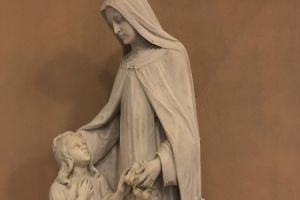
Apostolic Exhortation C’est la confiance Issued to Celebrate St. Thérèse of Lisieux
Pope Francis' latest exhortation’s title, C’est la confiance, in French, comes from a letter written by St. Thérèse of Lisieux. The full phrase is "It is confidence and nothing but confidence that must lead us to Love." As Thérèse herself communicated, she was committed to proclaiming Christ’s salvation to all. She wrote that "she had entered Carmel to save souls," and "she was able to define her mission with these words: “I shall desire in heaven the same thing as I do now on earth: to love Jesus and to make him loved."
An apostolic exhortation is a magisterial document, generally considered to be surpassed in importance only by apostolic constitutions and encyclicals. In general, exhortations encourage a particular virtue or activity. After releasing just five exhortations since becoming pope, Francis released two this month alone.
Pope Francis has a deep devotion to the French Discalced Carmelite nun and to the merciful love of God. To celebrate the 150th anniversary of Thérèse’s birth and the 100th anniversary of her beatification, the pope highlights the Saint’s “little way" of love, self-giving, concern for others and complete trust in the mercy of God as her teaching for us.
Throughout the document, the “missionary soul” of the saint (she was proclaimed co-patroness of the missions by Pope Pius XI in 1927 alongside Francis Xavier) is highlighted. According to Pope Francis, the last pages of Story of a Soul are a "missionary testament." There Teresa reflects on a verse from the Song of Songs recognizes that one can profess the name of Christ and draw other hearts to Christ not by efforts of mobilization and discourses of human wisdom, but only if one is drawn to Christ himself.
Issued on October 15, the exhortation is being seen by many as a needed message for these very complex and difficult times. "At a time of great complexity, she can help us rediscover the importance of simplicity, the absolute primacy of love, trust, and abandonment, and thus move beyond a legalistic or moralistic mindset that would fill the Christian life with rules and regulations and cause the joy of the Gospel to grow cold," the pope wrote.
Apostolic Exhortation C’est la Confiance – English
Statement of the JPIC on Current World Conflicts

Justice, Peace, and the Integrity of Creation Commission of the Carmelite Order
We members of the International Carmelite Commission for Justice, Peace and the Integrity of Creation, gathered in Rome from October 13-16 to plan the tasks for the coming year, would like to send you our message of peace, solidarity and fraternity for our brothers and sisters killed and wounded through acts of terrorism and war.
We make the Pope Francis' words our own:
Let the attacks and weapons cease, please, because it must be understood that terrorism and war bring no solutions, but only to the death and suffering of many innocent lives. War is a defeat, every war is a defeat.
The total siege of vulnerable civilian populations on either side only demonstrates the political incapacity and moral immaturity of governments and adds yet another failure to the history of the international community in building a peaceful and prosperous world through justice, global solidarity, respect for human dignity and the common good.
As Carmelites we never forget that righteousness and peace will embrace and, therefore, our work for justice contributes to the construction of a peaceful world (cf. Const. 120). “It is also an expression of “the little ones” (minores) of history, so that we may speak a word of hope and of salvation from their midst more by our life than by our words”. (Const. 24).
In times of pain and sadness due to the violence unleashed, let us pray to God for the Palestinian and Israeli peoples, for our Ukrainian and Russian brothers and sisters, the brutalized citizens of the Democratic Republic of Congo, the fratricides of peoples of the two Sudans, Myanmar and Haiti, and for so many peoples in our common home. We pray and call on the different sides of the conflicts to engage in dialogue and sue for peace in order to cease the escalation of death and horror and return to the path of justice and peace.
Conference on St. Titus Brandsma Held in Nijmegen

From October 3 to 6, the first congress of the newly established Titus Brandsma Circle was held at Radboud University. Approximately 70 people from 17 countries took part. The program of the congress can be seen here [https://www.ru.nl/
The Congress is part of the major project to publish the Collected Works of Titus Brandsma in seven volumes that Dr Elisabeth Hense, Associate Professor for Spirituality at Radboud University, is leading in collaboration with Joseph Chalmers S.T.L.
The project is funded by Radboud University and the British and Irish Provinces of the Carmelites as well as the General Council of the Carmelites in Rome.
Dr Elisabeth Hense organized the Congress in collaboration with Prof. Michael Plattig and Dr Edeltraud Klueting, both members of the German Carmelite Institute. The proceedings of the Congress will be published in the series of the German Carmelite Institute at Aschendorff.
The conference included talks by experts on the various facets of Brandsma’s life as well as a broader look at Dutch mysticism, Eastern mysticism, National Socialism, Carmelite Spirituality, and the Carmelite Rule.
The days also included a tour of the Carmelite monastery in Boxmeer where Brandsma made his novitiate. Today it houses the Dutch Provincial Archives and the Dutch Carmelite Institute. There was also a walk around the extensive Radboud University campus and “in the footsteps” of Titus Brandsma around the city of Nijmegen.
One night the composer Willibrord Huisman, Hendrik Jan Bosman, and a local choir performed works honoring the life and spirituality of Brandsma at the Titus Brandsma Memorial in Nijmegen.
The opening session was held in the theater in the Elinor Ostrom Building on the campus. There was an opening address by the Dean of the Faculty of Philosophy, Theology and Religious Studies, followed by presentations on “The Meaning of Titus Brandsma for the Dutch Church” by Bishop Gerard de Korte, bishop fo Den Bosch; “The Meaning of Titus Brandsma for the Carmelite Order” by the prior general of the Order, Míceál O’Neill; and “The Meaning of Titus Brandsma for the Dutch Carmelite Province” by Huub Welzen, the prior provincial of the Dutch Province. Between presentations, music was provided by composer Chris Fictoor and a clarinettist and 4 choral signers.
The evening concluded with a social hour in the campus bar/cafeteria.
Each day began with morning prayer in the University Chaplaincy. On the final day the members celebrated a Eucharist together led by the prior general. A festive meal followed at a local restaurant.
St. Teresa of Jesus, Virgin and Doctor of the Church

15 October Feast
Known to her family as Teresa de Cepeda y Ahumada, she became the reformer of Carmel, mother of the Discalced Carmelite nuns and friars, "spiritual mother" (as is engraved under her statue in the Vatican Basilica), patron of Catholic writers (from 1965) and Doctor of the Church (1970), the first woman with Saint Catherine of Siena to ever receive this last title.
Saint Teresa is among the most important figures of all time for Catholic spirituality. Her works - especially the four best known (The Life, The Way of Perfection, The Mansions and The Foundations) - together with her more historical works, contain a doctrine which encompasses the whole of the spiritual life, from the first steps right up to intimacy with God at the centre of the Interior Castle. Her Letters show her occupied with a great variety of everyday problems.
Read more about the life of St Teresa
To learn more about the life of St. Teresa and her work and legacy, we suggest reading the books both published by Edizioni Carmelitane:
- The Heirs of St. Teresa of Avila
- "I Consider the Labor Well Spent" A Mini-Course on the Interior Castle
Two Members of CISA Received Doctorates
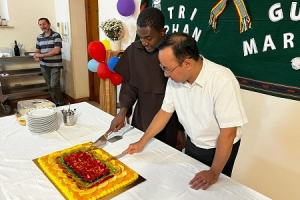
Two members of the CISA Community in Rome recently received doctorates from the Pontifical Gregorian University. Djomandji Zofiet Guy Martial, O. Carm., from Cameroun in the German Province, defended his thesis on Le retour à l’imagine et à la resemblance de Dieu dans les Exercices de dix jours chez Jean de Saint-Samson.
The second doctorate was awarded to Joseph Tri Phan, a member of the North American Province of St. Elias. His thesis was titled Toward a Fully Co-responsible Sharing in Evangelization and Ministry Specific to Carmel: The Impact of the Carmelite Reception of Vatican II's Ecclesiology and Theology of the Laity on the Secular Order of Carmelites in Asia.
Both men will now return to their respective countries to minister. We pray that their ministries may bear much fruit.
New Circle Promotes Research into Brandsma's Life

A new group is forming to promote continuing research into the life of Carmelite Saint Titus Brandsma. The group was formally introduced at the end of the conference on Titus Brandsma held at Radboud University in Nijmegen October 3-6, 2023.
The Circle is inviting all scholars interested in research on Titus Brandsma from around the world to join. Members will receive information about research being conducted and invitations to its congresses.
Fernando Millán Romeral, O. Carm., from Comillas University in Madrid, has been appointed the first president. Christian Körner, O. Carm., general bursar of the Carmelite Order, will serve as treasurer. Elisabeth Hense, T.O. Carm. will be the secretary.
The membership fee is €50.00 or US$50.00 for Europe and North America. The fee for members in Asia, Africa, and South America is €40.00. There is a €10 or US$10 discount for members of the Order. Deadline for joining is November 11, 2023.
For further information, contact This email address is being protected from spambots. You need JavaScript enabled to view it..
Celebrating At Home - 28th Sunday in Ordinary Time

Invitations Refused & Accepted
(Matthew 22:1-14)
The third of the parables addressed to the chief priests and the elders is our Gospel today. Told in the context of a wedding feast given by a great King it’s a parable in three parts.
The first part is about God’s gracious invitation and its indifferent and sometimes violent refusal by those invited first (the religious and lay leaders).
Second part: God’s invitation having been rejected by the first to whom it was offered, is now offered to others - good and bad alike (the sinners).
Third part: the story of the guest without a wedding garment (one who accepts the invitation but does not change - a little like the son in the first parable who said, “Yes”, but didn’t go to the vineyard).
The wedding garment is a symbol of a converted life full of good deeds.
The sense of the last line of the Gospel: “Many are called but few are chosen”, is that all are called to salvation, but it is only had by those who accept the invitation and who change and yield good deeds.
There is no room for complacency.
All three Gospel parables of the last three Sundays are about conversion. Conversion is not just turning away from sin but a radical reorienting of one’s life (turning) towards God. Repentance is not so much being sorry for past sins as a total change of direction. Conversion is impossible for the self-righteous because they don’t believe they need it. Hardness of heart and the refusal to listen are two great biblical sins.
In the three parables, St Matthew is urging his community to seek after true righteousness which comes from conversion and repentance, which flows from allowing the vision of God to fill their eyes and hearts. The kingdom has been entrusted to them, they are to produce its fruit of good deeds through a life of continual turning towards God.
Hard hearts, blocked ears, blind eyes, refusing to change are the path to death.
We are those who choose Life.
- pdf Celebrating At Home - 28th Sunday in Ordinary Time [PDF](2.85 MB)
- default Celebrating At Home - 28th Sunday in Ordinary Time [ePub](2.98 MB)
- pdf Celebrando en Familia - 28 Domingo del Tiempo Ordinario(573 KB)
- pdf Celebrando in Casa - 28 Domenica del Tempo Ordinario(572 KB)
- pdf Celebrando em familia - 28 Domingo do Tempo Comum(573 KB)


