














Carmelite, A Journey Of Transformation
Carmelite Ratio
1. Called to communion with God
God "loved us first"1, and he called us to participate in the communion of the Trinity. We recognise his call in the experience of his love. Moved by the Spirit, we listen to the Word of Christ, who is the Way that leads to Life. In his footsteps, entrusting ourselves to God's merciful love, we set out on the journey to the summit of Mount Carmel, the place where we encounter God and are transformed in him.
As we journey towards Mount Carmel, God leads us to the desert, as he led the prophet Elijah. There, the living flame of God's love transforms us, stripping away all that is not of him and all that obscures his gift, allowing the new self in the image of Christ, to emerge and shine forth in us.
Thus our minds and our hearts are gradually transformed, so that, in the light of Christ and in dialogue with the signs of the times, we may become more capable of cooperating with God in the work of transforming the world so that his Kingdom may come.
2. A call to community and mission
We are not alone on this arduous ascent of Mount Carmel: Mary, our sister and pilgrim in the faith, walks with us and encourages us, as mother and teacher.
We journey with others who have received the same gift and the same call. Together we strive to build a community modelled on that of Jerusalem; a community centred entirely on the Word, the breaking of bread, prayer, the holding of all things in common, and service.
We journey within the Church, and with the Church we journey throughout the world. Like Elijah, we journey side by side with the men and women of our time, trying to help them discover God's presence in themselves; for the image of God is present in every human being, and must be allowed to emerge in complete freedom, even when it is darkened by inner contradictions or by injustices perpetrated by others.
We are invited to this journey by the Rule, which for us echoes and mirrors the Gospel, and which is the expression of the founding experience of the first Carmelites. From this founding experience we receive our passionate love for the world, for its challenges, its provocations and its contradictions.
The first Carmelites came from a Europe in transition, a Europe evolving through the tensions between war and peace, unity and fragmentation, expansion and crisis. In the Holy Land, they met people of other cultures and religions; on returning to Europe, they chose to be witnesses to attentiveness to God, living a fraternal life among the people.
3.The world in which we live
For the first Carmelites, the world in which they were born and raised represented a challenge; in the same way, the world in which we live and work must be a challenge for us. It is a world rich in possibility and in opportunity, in a state of constant growth and evolution - but it is also a world full of contradictions.
Communication, facilitated by ever more sophisticated means, is both a promise and a challenge. The rapid development of science and technology makes life easier for many but oppresses others; rather than being respectful of the environment, it often exploits it mindlessly. Human rights have been solemnly affirmed many times, only to be violated again. It has been acknowledged that women's rights and functions are equal to those of men; yet many women are still victims of abuses. Some children are overindulged and spoiled, while others are abused and exploited to satisfy the greed of a few individuals lacking in any moral sense. Awareness of one's own rights increases sensitivity to the fundamental equality between individuals and between peoples; yet nationalistic and individualistic tensions continue to create reasons for new conflicts. Interaction among cultures, when it is not a source of conflict, becomes an incentive to dialogue, to mutual respect, to the search for new approaches to shared space. Economic and cultural globalisation can offer all of us opportunities for harmonious development; but it also raises serious questions concerning the destiny of the poorer nations. The growing thirst for spirituality contradicts the presumptions of secularism, but does not always succeed in expressing itself in an authentic life of faith: it can become an escape from the heavy burden of daily life into esoteric cults, pseudomystical movements, and sects. Faced with lack of meaning, lack of moral values and various theoretical and practical forms of atheism, contemporary men and women of faith are challenged to seek shared and coherent responses, beyond religious barriers. Alongside a sincere desire for interreligious dialogue, and concrete experiences of such dialogue, there are painful and even homicidal episodes of fundamentalism.
We are children of this world; we share in "the joy and hope, the grief and anguish" of our times.3 We belong to this world, we participate in its contradictions and we rejoice in its accomplishments.4 In this world we walk humbly, side by side with our brothers and sisters, attentively seeking to recognise, as Elijah did, the hidden signs of God's presence and of his work.
4. Unity in diversity
Carmelites receive and share a common charism to live a life of allegiance to Jesus Christ, in a contemplative attitude which fashions and supports our life of prayer, fraternity and service.
It is by virtue of this charism that Carmelites in every place and time belong to the Order of the Brothers of the Blessed Virgin Mary of Mount Carmel.
In its essential elements, the charism is one. Its universal application requires us to go beyond a limited, regional vision of the Order, in a constant effort to express and incarnate the charism concretely in various cultures, times and places.
There must be at all times an intimate link between the unity derived from identification with the essential aspects of the Carmelite charism and the pluralism derived from the different cultures, which enriches the charism's many expressions.
Citoc Magazine II-No. 1-2012
Christian Körner, O. Carm, Editor
The General Congregation, reflecting on the theme: “Qualiter respondendum quaerentibus sit?” - “What do you respond to those who ask?” was held from 5th to 15th September 2011 at the Mount Carmel Spiritual Centre in Niagara Falls, Canada. For the participants it was a very enriching meeting that offered a space for reflection on the identity and mission of Carmel in the Church today. The final message conveys profound considerations useful for further reflection in the Order. So we decided that the focus of this edition of CITOC would be a reminder of this important assembly.
The other submissions also offer a wealth of information on the present life of the Order. I would like to highlight a few. First of all, there are people who are expressing our charism, therefore it is a pleasure to share the news that Brazil has been able to celebrate the 100th birthday of Fr. Celestino Lui, O. Carm. In addition are other anniversaries, such as the 50th anniversary of the letter of the deceased Bishop Donal Lamont, O. Carm. against apartheid, remember the prophetic commitment of Carmelites. The Order, however, also mourns the death of some dear brothers. Thus we report the obituaries of P. Joachim Smet, O. Carm., the great historian of the Order, and P. Robert MacCabe, O. Carm., who have worked for many years as a doctor among the nomads in the desert of Kenya.
A constant theme at the General Congregation was that of hope. And surely it is the youth who are the hope of the Church and of the Order. Among the many participants of World Youth Day in Madrid there were more than 500 young people from Carmelite communities around the world. With the presence of a dozen nations, Carmelite Day on 17th August was a really wonderful event.
We hope you enjoy reading this issue of CITOC.
Lectio: Matthew 18,21-35 (edition 1)
you want us to live our faith
not so much as a set of rules and practices
but as a relationship from person to person
with you and with people.God, keep our hearts turned to you,
that we may live what we believe
and that we may express our love for you
in terms of service to those around us,
as Jesus did, your Son,
who lives with you and the Holy Spirit
for ever and ever.
'And so the kingdom of Heaven may be compared to a king who decided to settle his accounts with his servants. When the reckoning began, they brought him a man who owed ten thousand talents; he had no means of paying, so his master gave orders that he should be sold, together with his wife and children and all his possessions, to meet the debt. At this, the servant threw himself down at his master's feet, with the words, "Be patient with me and I will pay the whole sum." And the servant's master felt so sorry for him that he let him go and cancelled the debt.
Now as this servant went out, he happened to meet a fellow-servant who owed him one hundred denarii; and he seized him by the throat and began to throttle him, saying, "Pay what you owe me." His fellow-servant fell at his feet and appealed to him, saying, "Be patient with me and I will pay you." But the other would not agree; on the contrary, he had him thrown into prison till he should pay the debt. His fellow-servants were deeply distressed when they saw what had happened, and they went to their master and reported the whole affair to him. Then the master sent for the man and said to him, "You wicked servant, I cancelled all that debt of yours when you appealed to me. Were you not bound, then, to have pity on your fellow-servant just as I had pity on you?" And in his anger the master handed him over to the torturers till he should pay all his debt. And that is how my heavenly Father will deal with you unless you each forgive your brother from your heart.'
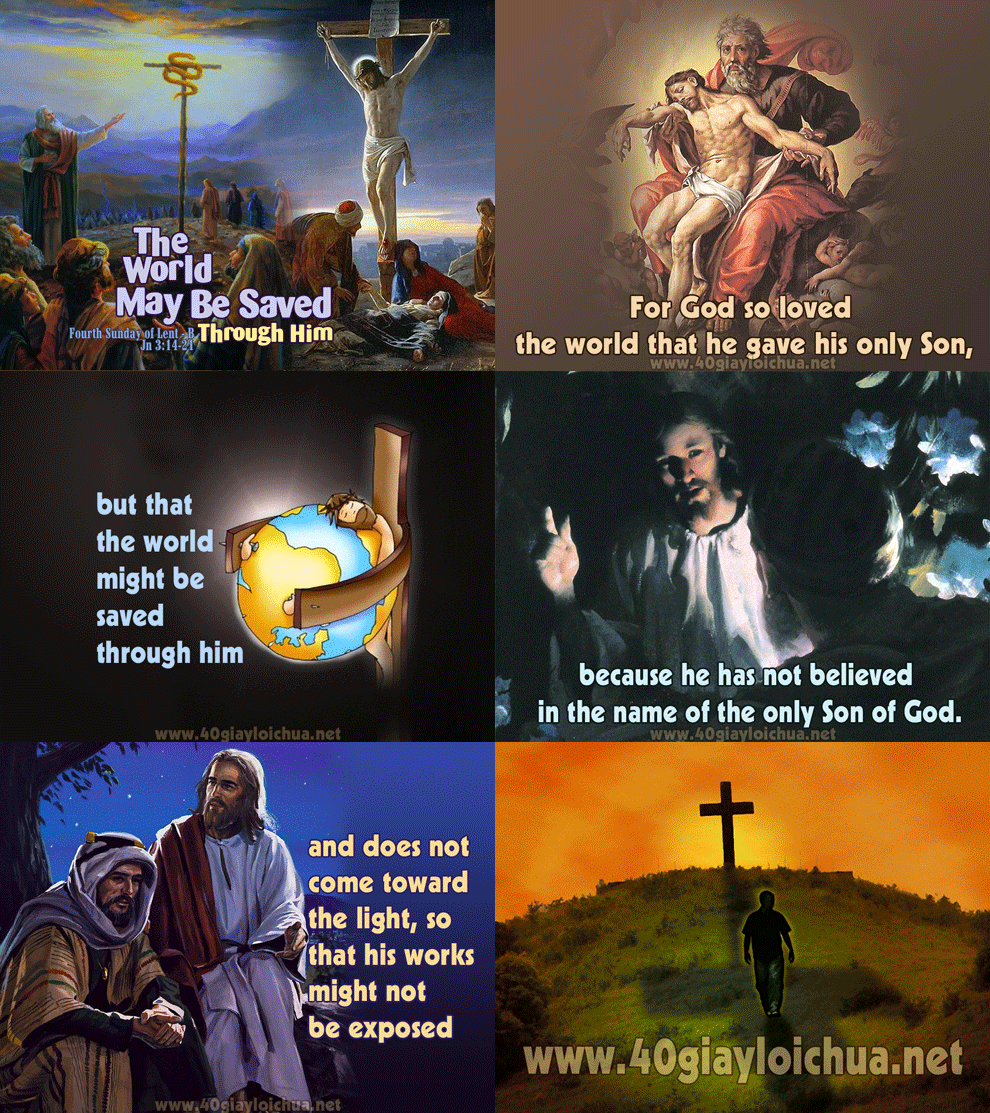
• Matthew 18, 21-22: To forgive seventy times seven! Jesus had spoken of the importance of pardon and of the need of knowing how to accept the brothers and sisters to help them to reconcile themselves with the community (Mt 18, 15-20) Before these words of Jesus, Peter asks: “How often should I forgive my brother if he wrongs me? As often as seven times?” Number seven indicates perfection. In this case, it was synonymous of always. Jesus goes far beyond the proposal of Peter. He eliminates any possibility of limitation to pardon: “Not seven I tell you, but seventy seven times!” That is, seventy times always! Because there is no proportion between the pardon which we receive from God and the pardon which we should offer to the brother, as the parable of pardon without limit teaches us.
• The expression seventy seven times was a clear reference to the words of Lamech who said: “·I killed a man for wounding me, a boy for striking me. Sevenfold vengeance for Cain but seventy-sevenfold for Lamech” (Gen 4, 23-24). Jesus wants to invert the spiral of violence which entered the world because of the disobedience of Adam and Eve, because of the killing of Abel by Cain and for the vengeance of Lamech. When uncontrolled violence invades life, everything goes wrong and life disintegrates itself. The Deluge arrived and the Tower of Babel appeared for universal dominion (Gen 2, 1 to 11, 32).
• Matthew 18, 23-35: The parable of pardon without limits. The debt of ten thousand talents was approximately around 164 tons of gold. The debt of one hundred denarii was worth about 30 grams of gold. There is no comparison between the two! Even if the debtor together with his wife and children set to work their whole life, they would never be capable to get 164 tons of gold. Before God’s love which forgives gratuitously our debt of 164 tons of gold, is more than just on our part to forgive gratuitously the debt of 30 grams of gold, seventy times always! The only limit to the gratuity of pardon of God is our incapacity to forgive our brother! (Mt 18,34; 6,15).
• The community, an alternative space of solidarity and of fraternity: the society of the Roman Empire was hard and without a heart, without any space for the little ones. They sought refuge for the heart and did not find it. The Synagogue was also demanding and did not offer them any place. And in the Christian communities, the rigor of some in the observance of the Law made life together difficult because they used the same criteria of the Synagogue. Besides this, toward the end of the first century, in the Christian communities began to appear the same divisions which existed in society between rich and poor (Jm 2, 1-9). Instead of making of the community a space of acceptance, they ran the risk of becoming a place of condemnation and conflict. Matthew wants to enlighten the communities, in such a way that these be an alternative space of solidarity and of fraternity. They should be Good News for the poor.
• In our community is there a space for reconciliation? How?
and teach me your paths.
Encourage me to walk in your truth
and teach me since you are the God who saves me.
For my hope is in you all day long. (Ps 25,4-5)
200th session of Lectio Divina in the Church of Santa Maria in Traspontina in Rome.
With the session that took place on the 9th of March last, Lectio Divina in the Church of Santa Maria in Transpontina reached its 200th edition. Under the guidance of Fr. Bruno Secondin, with the help of a group of collaborators, these sessions of prayerful reading of the Word of God began in the season of Advent in 1996. They have continued ever since with around fourteen sessions every year. Over the years, to guide the different sessions a number of important people have offered their services, among whom, the then Card. Joseph Ratzinger.
The 200th edition was guided by the Prior General, Fernando Millán Romeral, O.Carm. It was based on the text of the Gospel of the 3rd Sunday of Lent, “Zeal for your house has devoured me” (Jn 2,13-25). For further information on these Lectio divina sessions, see its own website, www.lectiodivina.it
In his words of introduction the Prior General expressed his gratitude for this service and for the perseverance of the organisers and participants. He further placed this initiative in the context of other such initiatives that are part of the life of the Order: a sign of the interest that people have in this service is the number of some 9.300,000 visits to the website of the Order www.ocarm.org since Lectio divina became part of what was on offer.
Carmelite reflections on Lectio Divina – the prayerful reading of the Bible
by Carlos Mesters, O.Carm.
translated by Míceál O’Neill, O.Carm.
Introduction
Lectio Divina (‘holy reading/listening’) is the ancient method of prayerfully reading the Bible, the Word of God. Originally cultivated by monastic orders – but now an important part of the lives of many Christians from different traditions – Lectio Divina enables us to contemplate God and God’s will in our lives. If prayed regularly, Lectio can deepen our relationship with God.
Each one of you is to stay in his own cell or nearby, pondering the Lord’s law day and night and keeping watch at his prayers... (Carmelite Rule: Chapter 10).
In the Carmelite Rule of Saint Albert we can glean how the first Carmelites, in fidelity to a long tradition, tried to nourish their lives with the Word of God.
Today, we Carmelites – brothers and sisters – face a challenge. While life makes us sense the need for a prayerful reading of the Bible, and the people look to us for direction, we still have difficulty in giving a response because we ourselves were never given a preparation for reading the Bible as prayer.
There are many difficulties: pastoral pressures lead us to read the Bible more for others than for ourselves; we have too little time to stop and allow the Word to penetrate into our lives; often, our way of reading smacks more of study and discussion than of meditation and prayer. Also, there is a certain rationalism in us and the remains of forms of fundamentalism, which disturb us with questions like: Did it really happen like that? And, how could God allow that to happen? All of this makes peaceful attention to the Word of God more difficult.
A prayerful reading of the Bible within what is traditionally called Lectio Divina is an urgent task if we are to be faithful to what God asks of us today. It is something like curing the veins where the blood which keeps us alive has to flow.
To this end we offer five helps:
1. A brief account of what the Rule of Saint Albert says, directly and indirectly, about Lectio
Divina or the prayerful reading of the Bible.
2. Ten words of advice about the ‘mystical’ life which must guide our prayerful reading of
the Bible; that is, the light which needs to be in our eyes when we do our Lectio Divina. In these words of advice, reference is made to the Carmelite Rule, written by Saint Albert of Jerusalem in the early thirteenth century (the paragraph numbering follows that agreed by the Carmelite and Discalced Carmelite Orders in 1999).
3. Ten points of orientation (the least possible) for personal and daily reading of the Bible
(each person will gradually develop his or her own way of communicating with the Word of God).
4. Seven suggestions for reading the Word of God in groups; in these there is a reflection of the tradition of the ‘four steps’ of Lectio Divina.
5. A set of Biblical texts relating to the two ‘foundational’ figures of Carmel: the prophet
Elijah, and Mary the mother of Jesus.
The Rule of Carmel and the Reading of the Bible
The way in which the Rule uses and presents the Bible
The Rule of Saint Albert appears to be a collection of phrases, almost all of which were taken from the Bible. It would be difficult to know how many times exactly the Bible is used to express the propositum presented by the first Carmelites to the Patriarch Albert. Some believe it is more than a hundred.
The author of the Rule knew the Bible by heart and he had made it so much part of his life that it is difficult to distinguish between his own words and those of the Bible. He uses the Bible without giving references. He quotes the Bible without checking the text. He joins and divides phrases at will, he changes and adapts texts to suit his own purpose, just as if he was dealing with his own word. This way of using the Bible is the result of long and assiduous reading, marked by familiarity, freedom and fidelity.
Even though Chapter XV shows a certain preference for the Letters of St. Paul, the Carmelite Rule uses, cites and evokes, without distinction, the Old Testament as much as the New. The explicit recommendation to read Paul’s Letters did not determine the spirituality of the Order. Its spirituality continued to be centred on the two Biblical figures - Mary and Elijah.
The framework in which the Rule uses and understands the Bible is:
1. The desire to live in the footsteps of Jesus Christ, expressed in the Prologue
2. The desire to imitate the ideal community of the first Christians, which we find throughout Chapters VII to XI. This was the point which inspired the renewal of the Church at the beginning of the 13th century.
The teaching of the Rule is not to be found only in what teaches about reading the Bible but also in the way in which the Rule itself uses the Bible. It is able to incarnate the Word of God even to the point of assuming it as its own. Paraphrasing the words of St Paul, it might say: I speak, but it is not I, but the Word of God which speaks in me (Gal 2:20).
How the Rule recommends that we use and read the Bible:
How the Rule recommends that we use and read the Bible
Directly and indirectly, the Rule of Saint Albert recommends eight times that we read the Bible:
- Listen to the Sacred Scriptures during meals in the refectory (IV)
- Ponder the Lord’s Law day and night (VII)
- Pray the psalms (the Hours) (VII)
- Take part in the daily Eucharist (IX)
- Be fortified by holy meditations (which come from prayerful reading) (XIV)
- The Word must dwell in your mouth and in your heart (XIV)
- Work at all times in accordance with the Word of God (XIV)
- Read frequently the Letters of St Paul (XV)
In these recommendations, our Rule shows the three doors through which the Word of God enters the lives of Carmelites:
- The door of personal private reading
Meditation in one’s cell. Pondering the Word which passes from the mouth to the heart. - The door of community reading
Listening to the Word during meals in the refectory and in the Eucharist (we do not know whether in that remote beginning on Mount Carmel the Divine Office was celebrated in common). - The door of ecclesial reading
The Carmelites followed the Divine Office and the Eucharist and, in addition to that, in their own lives they assimilated and assumed the renewal of the Church which was going on at that time.
In these recommendations we can also see the pedagogy which the Carmelites followed in order to learn and assimilate the Word of God in their lives. We can identify four points:
- First of all, the Word has to be heard or read
- in the refectory
- in the Eucharist
- in the Divine Office
- Afterwards, the Word which has been heard and read has to be pondered and ruminated - This meditation has to be done by day and by night, without ceasing, above all in the cell.
- By this mediation (rumination) the Word reaches from the mouth to the heart and produces holy thoughts.
- The Word, once it has been heard and pondered, has to be enveloped in prayer - It must turn into prayer in the Divine Office, and in the Eucharist - and in the cell where the Carmelite must keep vigil in prayer, day and night.
- As a result of this kind of reading the Word of God invades our thoughts, our heart and our actions and so everything is done in the Word of the Lord.
- These points of pedagogy, taken from the Rule, reflect that the age-old practise of Lectio Divina. Lectio divina, or the prayerful reading of the Bible, was always the spinal column of religious life, going right back to the very beginning. It was an important part of the life of the first Carmelites.
The reflections which follow have the purpose of showing the value of the practise of Lectio Divina for us today. This is with a view to better fulfilling our duty to meditate day and night upon the Law of the Lord.
The Process of Lectio Divina: Ten words of advice
1. When you begin a Lectio Divina of the Bible you are not concerned with study; you are
not going to read the Bible in order either to increase your knowledge or to prepare for some apostolate. You are not reading the Bible in order to have some extraordinary experience. You are going to read the Word of God in order to listen to what God has to say to you, to know his will and thus ‘to live more deeply in allegiance to Jesus Christ’ (Carmelite Rule: Chapter 2). There must be poverty in you; you must also have the disposition which the old man Eli recommended to Samuel: ‘Speak, Lord, your servant is listening’ (1 Samuel 3:10).
2. Listening to God does not depend on you or on the effort you make. It depends entirely
on God, on God’s freely-made decision to come into dialogue with you and to allow you to listen to the voice to God. Thus you need to prepare yourself by asking him to send his Spirit, since without the Spirit of God it is impossible to discover the meaning of the Word which God has prepared for us today (cf. John 14:26; 16:13; Lk 11:13).
3. It is important to create the right surroundings which will facilitate recollection and an
attentive listening to the Word of God. For this, you must build your cell within you and around you and you must stay in it (Carmelite Rule: Chapters 6 & 10), all the time of your Lectio Divina. Putting one’s body in the right position helps recollection in the mind.
4. When you open the Bible, you have to be conscious that you are opening a Book which
is not yours. It belongs to the community. In your Lectio Divina you are setting foot in the great Tradition of the Church which has come down through the centuries. Your prayerful reading is like the ship which carries down the winding river to the sea. The light shining from the sea has already enlightened the dark night of many generations. In having your own experience of Lectio Divina you are alone. You are united to brothers and sisters who before you succeeded in ‘meditating day and night upon the Law of the Lord and keeping vigil in prayer’ (Carmelite Rule: Chapter 10).
5. An attentive and fruitful reading of the Bible involves three steps. It has to be marked
from beginning to end, by three attitudes:
First Step/Attitude – Reading (Lectio): First of all, you have to ask, What does the text say as text? This requires you to be silent. Everything in you must be silent so that nothing stands in the way of your gleaning what the texts say to you (Carmelite Rule: Chapter 21) and so that you do not make the text say what you would like to hear.
Second Step/Attitude – Meditation (Meditatio): You must ask, What does the text say to me or to us? In this second step we enter into dialogue with the text so that its meaning comes across with freshness and penetrates the life of the Carmelite today. Like Mary you will ponder what you have heard and ‘meditate on the Law of the Lord’ (Carmelite Rule: Chapter 10). In this way ‘the Word of God will dwell abundantly on your lips and in your heart (Carmelite Rule: Chapter 19).
Third Step/Attitude – Prayer (Oratio): Furthermore, you have to try to discover What does the text lead me to say to God? This is the moment of prayer, the moment of ‘keeping watch in prayer’ (Carmelite Rule: Chapter 10).
6. The result, the fourth step, the destination of Lectio Divina, is contemplation
(contemplatio). Contemplation means having in one’s eyes something of the ‘wisdom which leads to salvation’ (2 Timothy 3:15). We begin to see the world and life through the eyes of the poor, through the eyes of God. We assume our own poverty and eliminate from our way of thinking all that smacks of the powerful. We recognise all the many things which we thought were fidelity to God, to the Gospel, and to the Tradition; in reality they were nothing more than fidelity to ourselves and our own interests. We get a taste, even now, of the love of God which is above all things. We come to see that in our lives true love of God is revealed in love of our neighbour (Carmelite Rule: Chapters 15 & 19). It is like saying always ‘let it be done according to your Word’ (Luke 1:38). Thus ‘all you do will have the Lord’s word for accompaniment’ (Carmelite Rule: Chapter 19).
7. So that your Lectio Divina does not end up being the conclusions of your own feelings,
thoughts and caprices, but has the deepest roots, it is important to take account of three demands:
First Demand: Check the result of your reading with the community to which you belong (Carmelite Rule: Chapter 15), with the faith of the living Church. Otherwise it could happen that your effort might lead you nowhere (cf. Galatians 2:2).
Second Demand: Check what you read in the Bible with what is going on in life around you. It was in confronting their faith with the situation existing around them that the people of God created the traditions which up to today are visible in the Bible. The desire to embody the contemplative ideal of the Carmelite Order within the reality of ‘minores’ (the poor of each age) brought the first Carmelite hermits to become mendicants among the people. When the Lectio Divina does not reach its goal in our life, the reason is not always our failure to pray, our lack of attention to the faith of the Church, or our lack of serious study of the text. Oftentimes it is simply our failure to pay attention to the crude and naked reality which surrounds us. The early Christian writer Cassian tells us that anyone who lives superficially – without seeking to go deeper – will not be able to reach the source where the Psalms were born.
Third Demand: Check the conclusions of your reading with the results of biblical studies which have shown the literal meaning of the words. Lectio divina, it has to be said, cannot remain chained to the letter. The Spirit’s meaning has to be sought (2 Corinthians 3:6). However, any effort to identify the Spirit’s meaning without basing it in the written word would be like trying to build a castle on sand (St. Augustine). That would be a way of falling into the trap of fundamentalism. In this day and age, when so many ideas are flying about, common sense is a most important quality. Common sense will be nourished by critical study of the written word. So that we will not go astray on this point, the Carmelite Rule tells us to follow the example of the Apostle Paul (Carmelite Rule: Chapter 24).
8. The Apostle Paul gives various bits of advice on how to read the Bible. He himself was an excellent interpreter. Here are some of the norms and attitudes which he taught and followed:
When you set yourself to read the Bible...
(a) Look upon yourself as the one to whom the word is addressed, since everything was written for our instruction (1 Corinthians 10:11; Roman 15:4). The Bible is our book.
(b) Keep faith in Jesus Christ in your eyes, since it is only through faith in Jesus Christ that the veil is removed and the Scripture reveals its meaning and tells of that wisdom which leads to salvation (2 Corinthians 3:16; 2 Timothy 3:15; Romans 15:4).
(c) Remember how Paul spoke of ‘Jesus Christ Crucified’ (2 Corinthians 2:2), a ‘stumbling block for some and foolishness for others’. It was this Jesus who opened Paul’s eyes to see how, among the poor on the outskirts of Corinth, the foolishness and the stumbling block of the cross was confounding the wise, the strong, and those who believed themselves to be something in this world (1 Corinthians 1:21-31).
(d) Unite ‘I’ and ‘We’: It is never a question of ‘I’ alone or ‘We’ alone. The Apostle Paul also united the two. He received his mission from the community of Antioch and spoke from that background (Acts 13:1-3).
(e) Keep life’s problems in mind, that is, all that is happening in the Carmelite Family, in the communities, in the Church, and among the people to which you belong and whom you serve. Paul began from what was going on in the communities which he founded (1 Corinthians 10:1-13).
9. When you read the Bible, be always aware that the text of the Bible is not only a fact. It
is also a symbol (Hebrews 11:19). It is both a window through which you see what happened to others in the past and a mirror in which you can see what is happening to you today (1 Corinthians 10:6-10). A prayerful reading is like a gentle flood which, little by little, waters the earth and makes it fruitful (Isaiah 55:10-11). In beginning to dialogue with God in Lectio Divina, you grow like a tree planted near streams of water (Psalm 1:3). You cannot see the growth but you can see its results in your encounter with yourself, with God, and with others. The song says: ‘Like a flood that washes clean, like a fire that devours, so is your Word, leaving its mark upon me each time it passes’.
10. One final point to be born in mind: When you do a Lectio Divina, the principal object is
not to interpret the Bible, nor to get to know its content, nor to increase your knowledge of the history of the people of God, nor to experience extraordinary things, but rather to discover, with the help of the written Word, the living Word which God speaks to you today, in your life, in our lives, in the life of the people, in the world in which we live (Psalm 97:5). The purpose is to grow in faith, like the prophet Elijah, and to experience more and more that ‘the Lord lives, and I stand in his presence’ (1 Kings 17:1; 18:15).
Ten points for personal Lectio Divina
The attitude of the faithful disciple:
The Lord God has given me the tongue of those who are taught, that I may know how to sustain with a word the one that is weary. Morning by morning God wakens, wakens my ear to hear as those who are taught. (Isaiah 50:4).
1. Opening prayer: an invocation of the Holy Spirit
2. Slow and attentive reading of the text
3. A moment of interior silence, to recall what I have read
4. Look at the meaning of each phrase
5. Bring the word into the present, ponder it in relation to my life
6. Broaden my vision by relating this text to other biblical texts
7. Read the text again, prayerfully, giving a response to God
8. Formulate my commitment in life
9. Pray a suitable psalm
10. Choose a phrase which captures the meaning and memorise it
The Lord God has opened my ear, and I was not rebellious, I turned not backward. I gave my back to the smiters... For the Lord God helps me; therefore I have set my face like a flint, and I know that I shall not be put to shame; he who vindicates me is near. (Isaiah 50:5-8).
Seven suggestions for group Lectio Divina
Jesus stood in their midst and said: Peace be with you. Then he opened their minds to understand the scriptures. (Luke 24:36, 45).
And Jesus said: the Holy Spirit, whom the Father will send in my name, will teach you all things, and bring to your remembrance all that 1 have said to you ... the Spirit will guide you into all the truth. (John 14:26; 16:13).
- Welcome and prayer
- A word of welcome and of sharing expectations.
- Opening prayer, asking for the light of the Holy Spirit.
- Reading of the text
- Slow and attentive reading, followed by a moment of silence.
- Remaining silent, allowing the Word to come.
- Repeating the text by asking each one to recall a word or phrase from it, until the
- whole text is heard again.
- What does the text say?
- Share impressions and questions as to what the text is saying.
- If necessary, read the text again and help one another to understand it. - A moment of silence in order to assimilate all that has been heard.
- Its meaning for us
- Ponder the text and discover its meaning for today.
- Apply the meaning of the text to the situation in which we live today.
- Broaden the meaning, by relating this text to the other texts in the Bible.
- Situate the text in God’s plan which is accomplished in human history.
- Pray with the text
- Read the text again with great attention.
- A moment of silence in order to prepare our response to God.
- Share, in the form of intercessions, the lights and strengths which have been received.
- Contemplation and commitment
- Formulate the commitment to which the prayerful reading has led.
- Choose a phrase which captures the whole message in order to take that phrase with you throughout the day.
- A psalm
- Pick a psalm which is in tune with all that has been experienced in the meeting. - Conclude the meeting by reciting the psalm.
And when they heard it, they lifted their voices together to God and said, ‘Sovereign Lord, who made the heaven and the earth and the sea and everything in them, who by the mouth of our father David, your servant, said by the Holy Spirit, ‘Why did the Gentiles rage, and the peoples imagine vain things? The kings of the earth set themselves in array and the rulers were gathered together, against the Lord and against his Anointed.’... And now Lord, look upon their threats, and grant to your servant to speak your word with all boldness...’ And when they had prayed, the place in which they were gathered together was shaken; and they were all filled with the Holy Spirit and spoke the word of God with boldness. (Acts 4:24-26, 29, 31).
A selection of Biblical texts linked to the foundational figures of Carmel
Biblical texts relating to the prophet Elijah
1 Kg 17:1-6 Depart from here ...
The Word of God intervenes, giving the order to depart.
1 Kg 17:7-16 Bring me a morsel of bread ... Sharing produces an abundance of goods.
1 Kg 17:17-24 1 know that you are a man of God ... The prophet is a life-giving instrument.
1 Kg 18:1-19 It is you, you troubler of Israel. Who is responsible for the ills of the people?
1 Kg 18:20-40 How long will you remain hopping from one foot to the other? Choose, again and again, the God of life.
1 Kg 18:41-46 Go up now, look toward the sea. Small signs which keep our hope alive.
1 Kg 19:1-8 It is enough, now, O Lord, take away my life. Crisis which reveals hidden defects.
1 Kg 19:9-14 1 have been very zealous ... The gentle breeze. God is present where we do not expect God to be.
1 Kg 19:15-21 Go and anoint Elisha to be prophet in your place. Know how to transmit the charism to future generations.
1 Kg 21:1-26 Have you killed, and also taken possession? Profit making produces injustices.
2 Kg 1:1-16 O man of God, come down quickly. So that life will have value for you.
2 Kg 2:1-7 The sons of the prophets. God will not abandon you.
2 Kg 2.8-18 Let me have a double portion of your spirit. The Spirit of Elijah rested on Elisha.
Ecc 48:1-14 His word flaring like a torch ... In Elijah’s word, God’s Word is at work.
Biblical texts relating to Mary the mother of Jesus
Lk 1:26-38 The Annunciation. Let it be done to me according to your word. To be open, so that the Word of God can take flesh.
Lk 1:39-56 The Visitation.
Recognise the Word of God in the events of life.
Mt 1:17-25 Mary and Joseph. Do not be afraid to take Mary as your wife. Accept the Word even when you do not expect it.
Lk 2:1-20 The Nativity She kept all these things in her heart. The marginalised recognise and accept the Word.
Lk 2:21-32 The Presentation. My eyes have seen your salvation. Many years of life purifies the eyes.
Lk 2:33-38 Simeon and Anna. A sword shall pierce your heart. To be Christian is to be a sign of contradiction.
Mt 2:1-12 The Wise Men came from the East. We saw a star in the East and we came. Recognise the saviour in a child.
Mt 2:13-23 The Flight into Egypt. The King wants to kill the child. The new and definitive exodus has begun.
Lk 2:39-52 In the Temple when Jesus was twelve years old. Did you not know that I must be in my Father’s house?
Obedience and disobedience go together.
Jn 1:1-12 The Wedding Feast at Cana. Do whatever he tells you. What did they do with the wine which was left over?
Lk 11:27-38 Jesus praised his mother. Blessed is the womb that bore you. Blessed is the one who hears the word and lives by it.
Jn 19:25-28 At the foot of the Cross. Behold your son. Behold your mother. New life is born at the hour of death.
Acts 1:12-14 In the Upper Room. They persevered in prayer, together with the women. The first community: seed and ideal.
Rev.12:1-17 A great sign in the heavens. A woman clothed in the sun. Fragile life conquered the power of death.
Scripture and Lectio Divina
by Carmelite.org
Attentiveness to God's Word in the Holy Scriptures, the Bible, is essential to all Christians. Throughout its 800 years, Carmelite spirituality has placed a particularly strong emphasis on pondering Scripture. Carmelites, whether lay or religious, are expected to spend some time each day taking up the Bible.
God's Word and the Carmelite Rule
Sometime around the year 1207 the Latin Patriarch (Roman Catholic Bishop) of Jerusalem, Saint Albert Avogadro, approved a text setting out the spirit of Carmelite life. That text, now known as the Rule of Saint Albert, stresses that God's Word in the Bible must have a central place in the life of all Carmelites. The Rule itself is said to embody this attentiveness to God's Word; though a short text, it contains over 200 references and allusions to Scripture.
The Rule states that Carmelites are to 'ponder the law of the Lord day and night' (Chapter 10), the 'law' being the Word of God in both the Scriptures and in the person of Jesus Christ.
The Rule encourages daily contact with the Scriptures through participation in the Liturgy of the Church, namely the Eucharist and the Psalms of the Divine Office (Chapters 11 and 14).
The Rule states that by pondering God's Word in the Scriptures and in silence, the Carmelite will find 'the sword of the spirit, the word of God' dwelling abundantly in his heart and on his lips (Chapter 19).
Inspired by the Rule of Saint Albert, the Carmelite Family has always shown a particular devotion to God through pondering the Scriptures in study and prayer.
God's Word in the Constitutions of the Order
The Constitutions of the Carmelite Friars elaborate on how the Rule of Saint Albert is to be lived in the present day. The latest edition was approved by the Order in 1995, and it continues to place the Word of God at the heart of Carmelite life, as this extract demonstrates:
Hearing, praying and living the Word - in silence, in solitude and in community, especially in the form of lectio divina - Carmelites are led, day by day, to know and experience the mystery of Jesus Christ. Inspired by the Spirit and rooted in Christ Jesus, abiding in him by day and by night, Carmelites allow every choice and every action to be guided by his Word. Inspired by the Word and in communion with the whole Church, the brothers come together to praise the Lord, and invite others to share in their experience of prayer. (§20)
The 1995 Constitutions speak of Mary and Elijah, the two great patronal figures of the Order, as people who pondered God's Word, from whom Carmelites take inspiration.
Lectio Divina
Lectio Divina is the Latin for 'Holy Reading' and was a form and approach to praying with Scripture that was common among medieval religious orders. The value of Lectio Divina was rediscovered by the Carmelite Family (and indeed the wider Church) in the twentieth century.
Essentially Lectio Divina involves taking a short passage of Scripture and pondering it. This can be done alone or in a group, and normally involves prolonged periods of silence.
Carmelites have been among the leading proponents for a revival ofLectio Divina. Friars such as Carlos Mesters in Brazil and Bruno Secondin in Italy have helped the Order to reconnect with God's Word through the regular practice of Lectio Divina.
Domus Carmelitana Advisory Commission
For the sake of convenience and economy, the Domus Carmelitana Advisory Commission always meets at the same time as the General Finance Commission: four members of the latter also advise on the Domus. Other members of the Domus Commission are John Lanahan (hotel finance consultant) and Janet Keeffe (tour operator). The Commission met on 2 March in the Domus to examine recent progress in the building works and to review the 2011 results. The area for customers outside the Domus is now almost completely finished and the next step will be to install an elevator from ground level down to reception. The Domus performed as well in 2011 as it had in 2010, which considering the weak demand in the tourist market is a commendable result. The first interest payment for 2012 will be made on 31 March and it is hoped to make a further capital repayment at the end of the year.
General Finance Commission 29 February & 1 March
The General Finance Commission of the Order met in the Curia on 29 February and 1 March. Present were Kevin Alban (Bursar General), Fintan Burke (Hib.), Michael Kissane (SEL), James Des Lauriers (Aust.), Antonio Monteiro (Lus.), Manuel Bonilla (Cat.), Mîceál O’Neill (CISA), Mark McBride (Bursar General TOR), Sireneo Jaranilla (Phil.), Jurek Borucki (financial consultant), Jeffrey Cull (fund raising consultant). Besides reviewing the results of the Curia and its entities for 2011, the main item of business was the planning of the Triennial Bursars’ Meeting. This will be held in Sassone, Italy from 15 to 20 October 2012 and is intended to gather all provincial, delegation and commissariart bursars (general and provincial), as well as bursars from mission areas which are not yet formed into entities. A letter will be sent shortly giving full details of the meeting.


