












The Role of MARY in Carmelite Formation
Rev. Paul A.M. Denault, O. Carm.
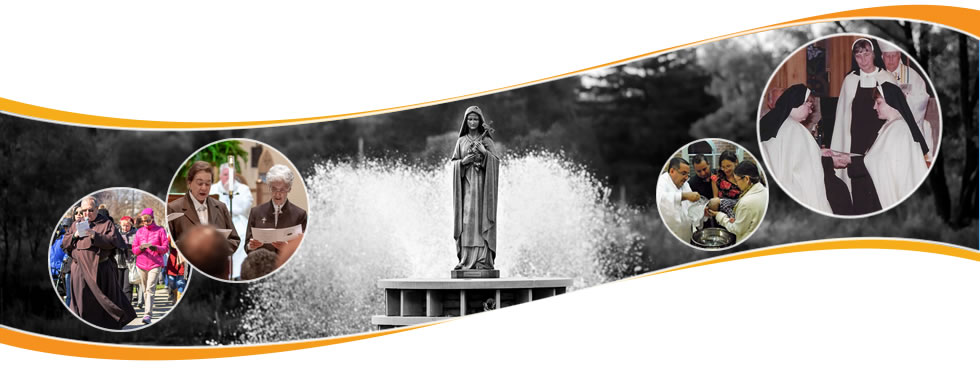
When the first Carmelites came together on Mount Carmel some 800 years ago, they were embarking on a new quest. They were seeking the presence of God by contemplating deeply the Scriptures along with their own experiences. In this quest for God, they came to see the Blessed Virgin Mary as their preeminent guide. The earliest Carmelites were attentive to the scripture passage that described Mary as keeping “all these things, reflecting on them in her heart.” And also, “his mother kept all these things in her heart.” (Luke 2:19, 51) Contemplation is this act of reflecting interiorly on the things that surround us, the activities we engage in along with the light that we gain from the Scriptures. The early Carmelites recognized, then, that in order to grow in prayer and contemplation, they needed to follow the example and guidance of Mary.
Mary is also described in the Scriptures as the person most attuned to doing God's will, after her Son, of course. Confronted with the call to serve God's plan, she replied, “Behold, I am the handmaid of the Lord. May it be done to me according to your word.” (Luke 1:38) When she asked her Son to help a wedding couple embarrassed by the lack of wine, and he seemed to rebuff her at first, she immediately told the servants, “Do whatever he tells you.” (John 2:5) Those simple words embody her own approach to the spiritual life, doing whatever the Lord God asks of her. The early Carmelites, then, took Mary as their example of living and acting in accordance with the will of God. She is seen by them as a woman of action.
Since Carmelite spirituality is so often identified with the silent life of interior prayer, it may seem strange to refer to Mary as a woman of action. The true fruit of deep authentic prayer is the desire to love others more. The early Carmelites spent much time in silent reflection of the Scriptures and so realized that at the heart of the mystery of God is a love that reaches out to help other people. Then they saw Mary acting the same way: out of love and concern for the good of other people. She became for them the model of both, intense prayer and loving action.
When a person comes to formation in the Carmelite Order today, he or she is asked to begin by gazing on the image of Mary that is found in the Gospels. The young Carmelite is asked to take on Mary as the model for life. Mary teaches us to reflect on the events of the days, the experiences we go through and signs of the times, all the while seeking the deeper presence of God in everything. She also teaches us to go out and “do whatever he tells you.” Moved by the love and compassion of Jesus, we are to respond with deeds of mercy and forgiveness. We are to bandage wounds and give hope even in the face of death. We are to work for what would promote true justice and peace.
The Constitutions of the Carmelites have this to say about Mary, “Mary is the Virgin of wise and contemplative listening who kept and pondered in her heart the events and the words of the Lord. She is the faithful disciple of wisdom, who sought Jesus God’s Wisdom and allowed herself to be formed and molded by his Spirit, so that in faith she might be conformed to his ways and choices.” The Constitutions go on to say, “Carmelites see in the Virgin Mary, Mother of God and archetype of the Church, the perfect image of all that they want and hope to be. For this reason, Carmelites have always thought of Mary as the Patron of the Order, its Mother and Splendor; she is constantly before their eyes and in their hearts as the Virgin Most Pure.” (Article 27)
Those who seek to learn the Carmelite life are asked to keep Mary before their eyes and hearts as the perfect image of the Carmelite: prayerful, contemplative, yet eager to help other people in their daily burdens. She gives to those who come to her not only the protection of her prayers, as she prays for all the Church, but also the support of a good model, a good guide, to the deepest parts of the Christian life. She is the Perfect Image of all that we hope to be in Christ Jesus.
Electoral Chapter of the Monastery of Onteniente, Spain
The Elective Chapter of the Carmelite Monastery of Onteniente, Spain, was held 11 December 2011. The following were elected:
- Prioress: Sr. M. Magdalena Pla Tortosa, O.Carm.
- 1st Councilor: Sr. M. Margarita Medina Armas, O.Carm.
- 2nd Councilor: Sr. M. Jesús Barahona Berzal, O.Carm.
- Director of Novices: Sr. M. Magdalena Pla Tortosa, O.Carm.
- Treasurer: Sr. M. Lourdes Font Font, O.Carm.
- Sacristan: Sr. M. Margarita Medina Armas, O.Carm.
Triennial Meeting for Bursars – 15 – 20 October, 2012
At a recent meeting of the General Finance Commission of the Order, it was decided to hold the Triennial Meeting of Bursars at “Il Carmelo”, Sassone from 15 to 20 October 2012. Arrivals will be on 15 and departures on 20 October, with the working sessions from 16 to 19. There will be a mixture of plenary sessions, including an address by the Prior General and reports from the General Councillors, as well as regional meetings. This meeting is intended for friars and lay people who work as:
• Provincial, general commissariat and general delegation bursars
• Assistant provincial bursars
• Finance directors/business managers
• Provincial commissariat bursars
• Bursars from mission areas not yet constituted as delegations or commissariats
• Members of the General Finance Commission
A formal letter of invitation will be going out to the above early in 2012.
Lectio Divina: The Sacred Family (B)
The one longed-for by all
The presentation of the Child in the Temple
Luke 2:22-40
1. Opening prayer
O God, our Creator and Father, you willed that your Son, generated before the dawn of the world, should become a member of the human family. Rekindle in us an appreciation for the gift of life, so that parents may participate in the fruitfulness of your love, old people may pass on to young ones their mature wisdom, and children may grow in wisdom, piety and grace, all giving praise to your holy name. Through Christ our Lord.
2. Reading: Luke 2:22-40 
22 When the time came for their purification according to the law of Moses, they brought him up to Jerusalem to present him to the Lord 23 (as it is written in the law of the Lord, "Every male that opens the womb shall be called holy to the Lord") 24 and to offer a sacrifice according to what is said in the law of the Lord, "a pair of turtledoves, or two young pigeons."
25 Now there was a man in Jerusalem, whose name was Simeon, and this man was righteous and devout, looking for the consolation of Israel, and the Holy Spirit was upon him. 26 And it had been revealed to him by the Holy Spirit that he should not see death before he had seen the Lord's Christ. 27 And inspired by the Spirit he came into the temple; and when the parents brought in the child Jesus, to do for him according to the custom of the law, 28 he took him up in his arms and blessed God and said, 29 "Lord, now lettest thou thy servant depart in peace, according to thy word; 30 for mine eyes have seen thy salvation 31 which thou hast prepared in the presence of all peoples, 32 a light for revelation to the Gentiles, and for glory to thy people Israel."
33 And his father and his mother marveled at what was said about him; 34 and Simeon blessed them and said to Mary his mother, "Behold, this child is set for the fall and rising of many in Israel, and for a sign that is spoken against 35 (and a sword will pierce through your own soul also), that thoughts out of many hearts may be revealed."
36 And there was a prophetess, Anna, the daughter of Phanuel, of the tribe of Asher; she was of a great age, having lived with her husband seven years from her virginity, 37 and as a widow till she was eighty-four. She did not depart from the temple, worshiping with fasting and prayer night and day. 38 And coming up at that very hour she gave thanks to God, and spoke of him to all who were looking for the redemption of Jerusalem.
39 And when they had performed everything according to the law of the Lord, they returned into Galilee, to their own city, Nazareth. 40 And the child grew and became strong, filled with wisdom; and the favour of God was upon him.
3. A moment of prayerful silence
- that the Word of God may dwell in us and that we may allow it to enlighten our lives;
- that before we pass any comments, the very light of the Word may shine and dominate with the mystery of the living presence of the Lord.
4. Some questions
to help us in our personal reflection.
a) Why should Jesus, Son of the Most High, and his mother Mary, conceived without sin, obey the prescriptions of Moses? Maybe because Mary was not yet aware of her innocence and holiness?
b) Is there special significance in the words and attitudes of Simeon and the prophetess Anna? Do not their actions and joy perhaps recall the style of the ancient prophets?
c) How can we explain this "sword" that pierces: is it a rending of the consciences before the challenges and richness of Jesus? Or is it only the inner pains of the Mother?
d) Can this scene mean anything to parents today: for the religious formation of their children; for the plan that God has for each of their children; for the fears and sufferings that parents carry in their hearts when they think of the time when their children grow up?
5. A key to the reading
for those who wish go deeper into the text.
a) As laid down in the law of Moses/of the Lord. This is a kind of refrain repeated several times. Luke mixes two prescriptions without making any distinction. The purification of the mother was foreseen in Leviticus (12:2-8) and was to take place forty days after the birth. Until then, the woman could not approach sacred places, and the ceremony was accompanied by the gift of a small animal. But the consecration of the first-born was prescribed in Exodus 13:11-16, and was considered a kind of "ransom" in memory of the saving action of God when he liberated the Israelites from slavery in Egypt. For this also the offering was a small animal. In all of this scene, the parents seem to be in the process of presenting/offering their son as was done with sacrifices and Levites, while through the persons of Simeon and Anna it seems rather God who offers/presents the son for the salvation of people.
b) Simeon and Anna: these are figures full of symbolical value. Their role is one of recognition, that comes from both the enlightenment and action of the Spirit and a life lived in expectation and faith. Simeon especially is defined as prodekòmenos, that is, one entirely absorbed in waiting, and one who goes forward to welcome. He, too, appears to be obedient to the law, the law of the Spirit, who leads him towards the child in the temple. The canticle he proclaims manifests his pro-existentia, he has lived in order to come to this moment and now he withdraws so that others may see the light and the salvation to come for Israel and the pagans. Anna completes the picture, by her very age (symbolical value: 84 equals 7x12, the twelve tribes of Israel; or 84 – 7 = 77, double perfection), but above all by her way of living (fasting and praying) and by her proclamation to all who "looked forward". She is led by the Spirit of prophecy, docile and purified in her heart. Besides, she belongs to the smallest of the tribes, that of Aser, a sign that the small and fragile are those more disposed to recognise Jesus, the Saviour. Both of these old persons – who look like an original couple – are symbols of the best of Judaism, of faithful and meek Jerusalem, that awaits and rejoices and that from now on allows the new light to shine.
c) A sword will pierce: generally these words are interpreted as meaning that Mary will suffer, a drama made visible of the Our Lady of Sorrows. Rather, we need to see the Mother as a symbol of Israel. Simeon feels the drama of his people who will be deeply torn by the living and sharp word of the redeemer (cf Lk 12:51-53). Mary represents the path: she must trust, but will go through times of pain and darkness, struggles and painful silences. The story of the suffering Messiah will be painful for all, even for the Mother. One does not follow the new light of the whole world without paying the cost, without being provoked to make risky choices, without being always born again from on high and in newness. But these images of the "sword that pierces", of the child who will "trip" and shake hearts from their lethargy, are not to be separated from the meaningful action of the two old persons: the one, Simeon, takes the child in his arms to show that faith is a meeting and an embrace, not an idea of theorem; the other, Anna, takes on the role of proclaiming and enkindles a bright light in the hearts of all who "looked forward" to him.
d) Daily life, an epiphany of God: finally, it is interesting to note that the whole episode emphasises the situation of the most simple and homely: the young couple with the child in their arms; the old man who rejoices and embraces, the old lady who prays and proclaims, those listening who appear to be indirectly involved. At the end of the passage, we also get a glimpse of the village of Nazareth, of the growth of the child in a normal context, the impression of a child extraordinarily gifted with wisdom and goodness. The theme of wisdom woven into the fabric of normal life and growth in a village context, leaves the story as if in suspense, and it will be taken up again precisely with the theme of the wisdom of the boy among the doctors in the temple. Indeed, this is the episode that follows immediately (Lk 2:41-52).
6. Psalm 122
I was glad when they said to me,
"Let us go to the house of the Lord!"
Our feet have been standing within your gates,
O Jerusalem!
Jerusalem, built as a city which is bound firmly together,
to which the tribes go up, the tribes of the Lord,
as was decreed for Israel,
to give thanks to the name of the Lord.
There thrones for judgment were set,
the thrones of the house of David.
Pray for the peace of Jerusalem!
"May they prosper who love you!
Peace be within your walls,
and security within your towers!"
For my brethren and companions' sake I will say,
"Peace be within you!"
For the sake of the house of the Lord our God,
I will seek your good.
7. Final Prayer
Father, we praise you and we bless you because through your Son, born of woman by the working of the Holy Spirit, born under the law, has ransomed us from the law and you have filled our life with light and new hope. May our families welcome and remain faithful to your designs, may they help and sustain in their children the new dreams and enthusiasm, wrap them in tenderness when they are fragile, educate them in love for you and for all creatures. All honour and glory to you, Father.
January 2012
General Intention: Victims of Natural Disasters.
That the victims of natural disasters may receive the spiritual and material comfort they need to rebuild their lives.
Missionary Intention: Dedication to Peace.
That the dedication of Christians to peace may bear witness to the name of Christ before all men and women of good will.
- Sunday, January 1, 2012
- Monday, January 2, 2012
- Tuesday, January 3, 2012
- Wednesday, January 4, 2012
- Thursday, January 5, 2012
- Friday, January 6, 2012
- Saturday, January 7, 2012
- Sunday, January 8, 2012
- Monday, January 9, 2012
- Tuesday, January 10, 2012
- Wednesday, January 11, 2012
- Thursday, January 12, 2012
- Friday, January 13, 2012
- Saturday, January 14, 2012
- Sunday, January 15, 2012
- Monday, January 16, 2012
- Tuesday, January 17, 2012
- Wednesday, January 18, 2012
- Thursday, January 19, 2012
- Friday, January 20, 2012
- Saturday, January 21, 2012
- Sunday, January 22, 2012
- Monday, January 23, 2012
- Tuesday, January 24, 2012
- Wednesday, January 25, 2012
- Thursday, January 26, 2012
- Friday, January 27, 2012
- Saturday, January 28, 2012
- Sunday, January 29, 2012
- Monday, January 30, 2012
- Tuesday, January 31, 2012
Christmas, consumerism and traditional celebrations
David Cheah
Friend of The Carmelites
I remember my first Christmas celebrations back in Malaysia where I grew up. As a child, I had always sensed the wonder of ‘holy’ days, knowing deep inside that every special day worth celebrating had spiritual roots.
Being Asian, food was always a big part of any celebration and that came as an added bonus. Those holidays were meaningful, significant and every childhood memory became seminal treasures. Dishes and types of food were unique to each celebration or season, which made the anticipation of celebrations so much more interesting and special.
Today unfortunately, consumerism and economic rationalization have all but killed the spiritual significance and integrity of such celebrations.
Political correctness has also crept in and insists on removing spiritual and religious significance of these ‘holy days’ - overtly and covertly. How absurd! Holidays have become days off from work, when you get a little bit of free time to do what you choose. Most would indulge in excess of all sorts the night before and sleep in the next morning. Gone are the holidays where celebrations are meaningful and significant.
For me and my family, I make it a point for my kids to know why we celebrate holidays - both spiritual and secular ones. Often we involve others. After all that’s what community is all about. For example, during the Christmas season, we would visit the city with friends and family and take in the celebration, the generosity, the gaiety and the visual experiences; anything that reinforces the spirituality and significance of the special day when we celebrate Jesus’ birth.
We sometimes seek out people from different cultures and celebrate with them, especially if it involves food. We had our first European Christmas with a dear friend and her family at their home a few years ago. There was so much love, food and joy; a real sense
of family. We feel the kids will never forget these occasions as they grow up in an increasingly hostile, adversarial and materialistic world.
There is a very wrong view that Christmas must either be religious or materialistic to be meaningful. I personally believe that if there is joy, peace and bonding in almost any context, we would have successfully celebrated Christmas the way it was meant to be, reconciling all creatures to God and each other. That is the true message of Christmas after all, isn’t it?
I like to teach my kids that true enjoyment comes from spiritual, community and family involvement rather that being swept up in the consumerism of such occasions. It is becoming more difficult to overcome the covetousness and craving for more stuff when all we need is grace, love and kindness.
Thankfully though, the world still celebrates Christmas as it should be. There are many opportunities to re-discover the true meaning of Christmas. Carols by Candlelight, Church plays, creative retail displays and Christmas themed movies are just a few examples of what we can engage with to show our kids what Christmas is all about.
May you seek and find the peace, joy and shalom with your loved ones this Christmas season.
David Cheah
Friend of The Carmelites
NATALE HILARE ET ANNUM FAUSTUM
Promulgated the Decree of the Congregation for Causes of Saints concerning the nine Martyrs of the Castilian Province
On 19th December 2011, the Holy Father, Benedict XVI, received in a private audience Cardinal Angelo Amato, Prefect of the Congregation for the Causes of Saints. During the course of the audience the Holy Father authorized the Congregation to promulgate the Decree concerning the Servants of God Alberto Maria Marco Aleman O.Carm. and eight friars of our Order; all killed by those who violently opposed their faith in the territory of the archdioceses of Madrid (Spain) between 1936 and 1937.
This group is to be added to those of the Province of Betica, Servants of God Carmelo M. Moyano and companions. Soon the date of the beatification of these two groups of martyrs will be decided with the authorities concerned. The Postulator General is still working on the process of the group of presumed martyrs of the Arago-Valentina Province.
Electoral Chapter of the Monastery of Moncorvo, Portugal
The Elective Chapter of the Carmelite Monastery of Moncorvo, Portugal, was held 16 November 2011. The following were elected:
- Prioress: Sr. M. Sagrada Família Costa, O.Carm.
- 1st Councilor: Sr. M. Imaculada Conceição Nevado, O.Carm.
- 2nd Councilor: Sr. M. Eucaristia Pires, O.Carm.
- 3rd Councilor: Sr. M. Imaculado Coração Martins, O.Carm.
- 4th Couniclor: Sr. M. Natividade Gomes, O.Carm.
- Director of Novices: Sr. M. Eucaristia Pires, O.Carm.
- Treasurer: Sr. M. Imaculada Conceição Nevado, O.Carm.
- Sacristan: Sr. M. Margaret do S.C.J. Njoroge, O.Carm.
Meeting of the Secretariat for Laity
A meeting of Secretariats for Carmelite Laity took place recently, from November 28 to December 2. The purpose of the meeting was to edit and finalize the Commentary to the Guidelines for Formation for Lay Carmelites. The new document is now ready for final comments and corrections. Many thanks are due to all who contributed to this work. This Commentary is seen as a starting point for the writing of the provincial Manual for Formation according to the specific situation in each country. It should also help to unify Formation for Lay Carmelites in both its themes and its form. The Commentary, finally, is meant to encourage Tertiaries to assume their responsibility in the area of their community life especially, where this may not yet be the norm.


