









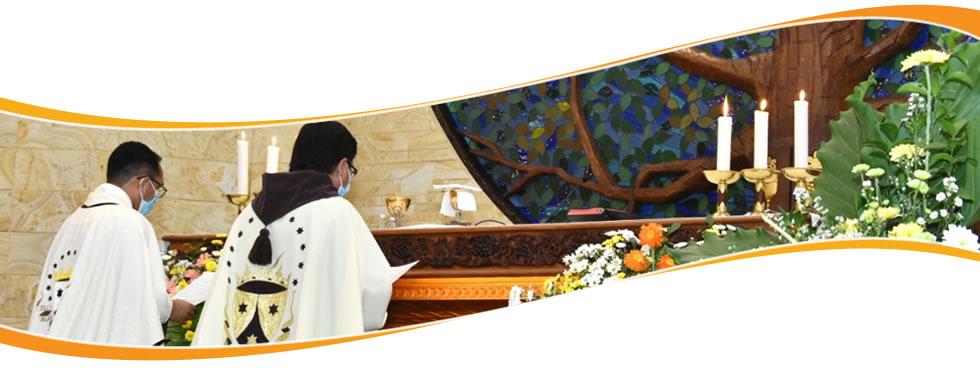




Electoral Chapter of the Monastery of Ntra. Sra. de la Asunción, Huesca, Spain
The Elective Chapter of the Carmelite Monastery of Ntra. Sra. de la Asunción, Huesca, Spain, was held 2 September 2011. The following were elected:
- Prioress: Sr. M. Inés Nthenya Nzyuko, O.Carm.
- 1st Councilor: Sr. M. Carmen Ibarra Lorea, O.Carm.
- 2nd Councilor: Sr .M. Concepción Durán Bestué, O.Carm.
- 3rd Councilor: Sr .M. Anastasia Kavuu Kiswili, O.Carm.
- 4th Couniclor: Sr .M. Jacinta Nthenya Wambua, O.Carm.
- Director of Novices: Sr. M. Anastasia Kavuu, O.Carm.
- Treasurer: Sr. M. Carmen Ibarra Lorea, O.Carm.
- Sacristan: Sr. M. Jacinta Nthenya Wambua, O.Carm.
Carmelite Life Renewed
Ernest E. Larkin, O.Carm.
A few years ago a fantasy on monastic life appeared called Brother Petroc’s Return. Brother Petroc went to sleep in one age and woke in another to find things in the monastery completely changed. In place of the old disciplina, the leisurely, relaxed, reflective atmosphere of the Middle Ages, he found exercises and bells, examinations of conscience and meditations, introspection, subjectivism, and individualism.
If a Carmelite had fallen asleep in the seminary in 1945 or 1955 and awakened now, what would he find? More important, what should he find, according to the ideals of renewal in Vatican II and the General Chapter, 1965?
First, the present situation: the winds of change have left their mark at every level in the seminary. I speak only for the major seminary. Instead of the shift from disciplina to observances, there has been a change from exercises to attitudes,. These attitudes are impossible to define and difficult to describe. They are summed up in a new vocabulary that is meaningful to the younger generation and equivocal to their elders. These new words are: interpersonal relationships, love, freedom, collegiality, authenticity, responsibility, commitment, and involvement. Actually these are fighting words in student-faculty relationships because they mean different things for the two groups. But whatever their meaning, the young see these new values as incompatible with the old forms in seminary life. To most of the students, it is impossible to pray “authentically” in La tin or to cultivate personal responsibility if one’s horarium is set out for him. We are still stuck with the old system; as a result we have a generation of questioning, critical people.
Very briefly, this is a summary of the young Carmelite today. He is anxious to attain and preserve the values of personalism but he is at sea in the old structures of religious and seminary life.
Now to the second question: what image is projected by Vatican II and our General Chapter? Both the Council and the Chapter try to state the religious and Carmelite ideal in terms of the modern mentality. They describe the Carmelite of the future in personalist characteristics. I single out three such qualities: he must be authentically Carmelite, truly human, and above all a man in and for the church.
Authentically Carmelite
The first quality refers to our identity as Carmelites. This is an old subject, and one not always satisfactorily resolved, but it seems to me that our identity crisis is well on the way to resolution through the documents of Vatican II and the General Chapter.
Vatican II describes the forms of religious life in the recent Decree on Adaptation and Renewal of Religious Life (October 28, 1965). By a process of elimination we can find where we belong in the mind of the Church. We are not among the exclusively contemplative orders lauded in n. 7; therefore, we belong to the communities devoted to the apostolic life in n. 8. But we are partly monastic (n. 9) because we join “ the apostolic life to choir duty and monastic observances” (n. 9). The decree wisely avoids abstract terms like active life and contemplative life or mixed orders, as did our General Chapter in delineating the Order’s purpose. The concrete terms provide a more practical and real definition of our life. The Council approves our “way of life” and urges us to be faithful to, it even as we adapt its “manner” to the demands to the apostolate (n. 9).
To list these two basic elements in our life is, not to solve the old problem of the integration of the apostolate and religious observance. Both the Council and the Chapter attempt to solve the tension between these two by emphasizing positive attitudes toward the apostolate.
The Council’s Decree speaks of apostolic love rather than apostolic action, This serves to place the apostolate squarely in the very structure of our religious life, which according to Lumen gentium is an evangelical and ecclesial witnessing. Religious are followers of Christ, but dynamic doers of the Word in imitation of Christ. In this way they mirror Christ “contemplating on the mountain, announcing the kingdom of God to the crowds, healing the sick and the maimed, converting sinners to a better life.” (Lumen gentium, n. 46). The actual works are less, important than the holiness the works manifest (Decree on Adaptation, n. 2, e). In fact, the works are charisms, or they are worthless (n. 8). The community must be flexible enough to adapt itself to the various apostolate and the work chosen must be in accord with the genius and vocation of each community. This means that the “ministries” of the Order should be constantly updated, pruned, revised (n.20).
The decree thus underlines the one consecration of our religious lives with its two facets of apostolate and community life. But is this a viable definition? Can apostolic involvement and faithfulness to religious practices live in unison? The decree obviously thinks so, with the necessary adaptations which it leaves, to the communities (nn. 3 and 4). Happily our General Chapter has taken some steps to update our practices.
The Chapter recognized that a detailed and demanding schedule of exercises must give way to flexibility (Relatio, prop. 306). It teaches that individual absences from community functions, which are often necessary in a busy house with different apostolates, must be compensated for by a strong emphasis on an “affective” community life. Perhaps the Chapter should have spoken out more clearly on the necessity of “effective” community, on the necessity of physical silence and solitude and community exercises. It preferred to stay with essential principles, so it emphasizes communal charity (prop. 301, 302, 303). The hope of the Order is this deepening of fraternal unity and charity in our communities (prop. 303). New forms must be created to encourage exchanges, reduce “secrets,” promote mutual trust and love. Group discussions, for example, or the technique of “revision of life,” which is, an adaptation of Jocist Catholic Action procedure, might well take the place of the old culpa (prop. 5).
With regard to nourishing prayer life, the first source must be Sacred Scripture and Liturgy. This is one of the basic insights of Vatican II, repeated in many decrees, including the one on Adaptation (n. 6). The Chapter applies this principle in many ways: by its postulation for the vernacular in choir, for a more fruitful exposure to the word of God (prop. 320); its principle of veritas temporis for the hours of Office, hence the postulation for the private recitation of two little hours, (prop. 318); its insistence on the central place of community Mass, (prop. 322). On the other hand, the Chapter encourages the private fulfilling of private devotions like meditation, examination of conscience, and the various forms of lectio divina such as spiritual reading or visits, thereby giving a vote of confidence to individual responsibility and freedom.
But, you may say, what has happened to contemplation in this aggiornamento? Have we become a modern congregation? The Chapter spoke but little about contemplation and the contemplative life, but not because it wished to minimize prayer. It wished to avoid the old dichotomies of the pars principabor and other abstractions that have become red herrings in discussions of Carmelite life. The Relatio does not abandon our tradition; it departs only from an excessively theoretical and artificial statement of that tradition. Carmelites must be men of prayer, deep prayer like contemplation. Carmelites of the Twentieth Century must seek “to present a pure heart to God ... and taste even in this life the sweetness of the divine presence” (Institution of the First Monks). They must put growth in union with Christ in the first place, but they must do this in the concrete conditions of the apostolate and community life. Prayer and contemplation is the soul, the life, the center of all that they do. It means finding God, and for Carmelites of the Ancient Observance in the mid-sixties this will take place less in the silence and solitude of the desert than in the apostolic involvement of city monasteries.
Truly Human
The second two qualities of the Carmelite of the future can be treated more summarily. The human quality means that he is seeking and finding self- fulfillment as well as sanctity. The spirituality presented by the Decree on Adaptation is both this-worldly, and incarnational spirituality, as well as otherworldly, an eschatological spirituality. The document makes every attempt to integrate culture and sanctity (n. 18), psychological development and spirituality. Adaptations, for example, are to take psychic as well as physical needs into account (n. 3). Emotional maturity and a right understanding are presupposed for chastity, and even then “true brotherly love in the common life of the community” is demanded for a successful outcome of celibacy (n. 12). Poverty must be real poverty, for the individual as well as the community, exemplified in one’s daily labor for his own support and the rejection of a legalistic reduction of poverty to getting permissions (n. 13). Obedience is a service, both on the part of superior and subject, and it demands mutual responsibility for decisions taken (n. 14). But above all the common life is the very heart of religious life. Religious, life is not even Christian if it is no t a community of love and adoration, a reflection of the one life of the Mystical Body (n. 14). This ideal of the Decree is concretized in our Relatio by the constant appeal to brotherly love, the attempt to equalize the position of the brothers with the clerics, in the community, and the philosophy that a deep community sense can supply for the lack of some of the lost monastic structures.
Man of the Church
When all is said and done, however, the Carmelite of the future is especially a man of the Church. His religious family was born in the Church and for the Church, and is nourished by the Church’s wisdom and grace. But over the years, centuries perhaps, a religious order can become a church within a church, especially where there is mistrust between the order and the hierarchy or the order and the secular clergy. The existence of real tensions in these areas, was brought to the floor of the Council by the Marist General, Father Buckley. In. Holland today attempts are being made for closer collaboration in the apostolate between the orders, and the seculars through conferences between provincials and bishops—something we might hope for in our land. The fact of the matter is this: whenever an order separates itself from the Church, even psychologically, it starts to think small, to be more concerned about its privileges than the great movements of the Holy Spirit in the Mystical Body. Have we involved ourselves sufficiently in the liturgical, biblical, ecumenical and social renewals going on in the Church today? Are we implementing these main thrusts of the Church’s action today in the schools and parishes and works that are our daily tasks? One might wish that our General Chapter had spoken at greater length about the great movements going on in the Church today. There is only one number (and it was an afterthought) on the ecumenical movement; there are only vague references to the other trends.
Lumen gentium in its chapter 6 on Religious has taught us to see ourselves as servants in the Church, men dedicated anew by their vows to the promises of their Baptism, hence Christians above all. Religious witness is special, but essentially it is the witness of the one calling all Christians have in Christ Jesus. The Decree on Adaptation repeats these perspectives. Religious bent on renewal are called upon to go back to the authentic sources of Christian life (Bible and Liturgy) and back to the original inspiration of their founder. Constitutions, by-laws, customs, even Canon Law are not normative for renewal; only origins and present-day needs, are to spell out the new image of the religious (nn. 2-3). A sign of this identity with the Mystical Body is, the fact that religious are urged to share their material wealth, not only within the order, but with the local Church itself (n. 13). 1 submit that the way we react to this suggestion is a good indication of how “ecclesial” our thinking really is. We can be grateful to the Chapter for moving in the healthy direction of “ecclesiality” when it declines, to emphasize exemption and underlines our disponibility in the Church (n. 1) and when it decrees that our youth should be schooled in the idea that we are in the service of the church (prop. 217).
Such then is the Carmelite of the future, the ideal we must strive to implement in ourselves and in our aspirants. We should not fear to develop an American brand of Carmelite. One of the most obvious trends of Vatican II and the General Chapter was decentralization and local differentiation. But however “American” he is, our Carmelite of the future must be the genuine article, a real man, and a man of the Church.
Walking in the footsteps of Jesus
Donald Buggert, O. Carm.
As Cicconetti notes, the phrase “in obsequio Jesu Christi,” drawn from 2 Cor. 10:5, takes on somewhat different meanings in differing situations. Valabek summarizes the Pauline meaning of this obsequium. A disciple of Christ is a doulos, a slave or servant who totally hands over one’s self, one’s thoughts, will, wishes to Christ, who becomes the most important person in one’s life. In turn the disciple shares in the very life of Christ and becomes a new self created in God’s way.
This Pauline notion of obsequium took on specific connotations in feudal times. What images or overtones did this Pauline expression evoke in the Hermits of Carmel during this feudal period?
The basic feudal meaning of “in obsequio” was that of service, the service which a vassal rendered to a sovereign. Cicconetti notes:
Following of or allegiance to another (obsequium) implied duties on the part of master and subject. Those living in the patrimony of a feudal lord promised good and faithful service, assistance in time of war and participation in resolution of problems or questions. In return the lord promised protection . . . to his subjects.
This secular meaning of “in obsequio” was transferred in the religious realm to service owed to God or (especially) Christ.
In the XII and XIII centuries, relationship with Christ was judged in similar terms; traditional feudal values of service . . . , of fidelity . . . , of allegiance or following (obsequium), of being bound to . . ., of dedication . . . , governed a man’s responsibilities to Christ with a pervading influence that colored every aspect of daily life.
All Christians were bound to this obsequium Christi. But during the period of the Crusades, the concept took on even greater specificity. Christ had been expelled from his own patrimony and had suffered an injustice. Hence popes evoked the concept to induce Christians to support the liberation of the Holy Land. Hence, the obsequium Jesu Christi had a very pregnant sense for Crusaders and others, such as the hermits on Mount Carmel, who pilgrima¬ged to or resided in the land of Christ. All such Christians became Christ’s special subjects, were especially dedicated to his service (obsequium) and were to be completely faithful to him.
Of course the patrimony of Christ was to be regained not only through military efforts. Since the fall of Jerusalem was attributed to the infidelity and sins of Christians, true interior conversion to Christ and spiritual arms (prayer, penance, fasting) were more important than the earthly weapons of the Crusader. The soldier of Christ had to arm himself with the disarming attitude of Christ. This was a spirituality founded on the passion of Christ and realized only by taking up the Cross, through which Christ himself had acquired the land. The obsequium Jesu Christi was, therefore, very much a following of the crucified Christ. .
In the case of the hermits of Carmel, therefore, their particular allegiance (obsequium) to Christ was very much defined by the then current theology of reconquering the land of Christ through spiritual combat in imitation of the suffering and Crucified Christ. They were to embrace poverty, penance, silence, solitude, prayer and fasting, “to follow Christ’s law, be available to do all things in his name, to vest themselves in spiritual armor” to disarm the forces of evil and above all to meditate upon the law of the Lord. In all of this, but especially through meditat¬ing upon the law of the Lord and the recitation of the psalms, they were to be transformed into Christ. It is this specific form of “walking in the footsteps of Jesus” which is signalled in the Prologue and further specified in their “formula of life.”
How the Obsequium Informs the Rule
I do not intend to analyze or comment upon each reference to Christ in the Rule. I merely wish first to make some general observations and then show how the very structuring of the rule is Christocentric.
From the above, one can see how the basic project of walking in the footsteps of Jesus, signalled in the Prologue, is then articulated in the Rule itself: faithful following of Christ through obedience to his represen¬tative, the prior (chapters I, XVII, XVIII), solitude (chapter III), meditating upon the law of Lord, vigilance in prayer, reciting psalms (chapters VII, VIII, X), poverty (chapter IX), penance as fasting and abstinence (chapters XII, XIII), vesting in spiritual armor for spiritual warfare (chapter XIV), doing all in the Word of the Lord (chapter XIV), willingness to undergo persecution (chapter XIV), silence (chapter XVI). In all of this Christ is present to the hermit community as model, teacher, savior and eschatological judge (chapter XVIII and Epi¬logue). Within this Christocentric perspective, Elijah and Mary, present only implicitly in the Rule, become subordinate models or symbols who serve to con-cretize the obsequium Jesu Christi.
Even more important than seeing how the various elements of the obse¬quium Jesu Christi are taken up in the chapters of the Rule is the Chris¬tocentric structuring of the Rule. And here we discover the role which the ideal Christian community of the Acts played for those first Carmelites in their walking in the footsteps of Jesus.
We saw above that the hermits on Carmel were part of a larger spiritual movement which espoused a return to the scriptures and the life of the Jerusalem community. Their walking in the footsteps of Jesus was not to be done in a solitary way but as a community. “Reechoing the insights of Luke, Albert enjoins on the hermits a following of Christ by following the ideals and values of the apostolic Christian community.” Hence it is no surprise that chapters VII-XI of the Rule parallel Acts 2:42-47;4:32-35 (fidelity to the Word, perseverance in prayer, sharing in goods, fraternal unity, the centrality of daily worship). Within the Rule, daily Eucharist is structurally central, i.e. it lies at the very center of the text (chapter X). This textual centrality reflects the spatial centrality of the Eucharis¬tic oratory in the midst of the cells. This textual and spatial centrality in turn indicate the theological center of the Rule, the Eucharist.
This structural approach to the Rule, with the Eucharist as its textual center, reveals that the center of this hermit community is, as it was for the Jerusalem community, Christ. The Rule now appears visually as an arc. At the two ends of the arc are the following of Christ (Prologue) and the awaiting of the return of the Lord (Epilogue). At its apex is the presence of Christ in the Eucharist. “Between these three reference points all the rest of the Rule rotates, either as a consequent actualization or as a dynamic referent.” Structurally the Rule is saying that the whole Chris¬tocentric project of the Rule, namely to walk in the footsteps of Jesus (Prologue) in anticipa¬tion of his return (Epilogue), is focused upon, celebrated in and subsumed into the Eucharist (Chapter X), in which Christ himself is sacramen¬tally present to the community and which itself anticipates his return.
In concluding this first part dealing with the Chris¬tocentricity of the Rule and by way of introducing the second part of this paper, I cite the words of Secondin:
In the Rule, then, we find a Christology which esteems dis¬cipleship and revolves around a “life in Christ,” prayerful listening to the Word, celebra¬tion of the Mystery, a vision of meditation as a way of imprinting Christ into one’s life . . . , and the awaiting of his return. The same way-of-life . . . as a dedication to the Lord in the Holy Land . . . is now transformed into an open journey to be under-taken in any place or time.
Guestbook
We invite you to share your experience when you visit this website. This could be an inspiration from Our Lady of Mount Carmel, The Scapular, Our Saints of Carmel, a Carmelite friar, cloistered nun or sister that you may know, or an article in this website. We also welcome your comment and suggestion so that this website can serve you better.
God bless
Carmelite Communication Office
Some Reflections of the General Congregation MMXI
Carmelite Curia
ORDER OF CARMELITES – GENERAL CONGREGATION
NIAGARA FALLS, CANADA, 5 – 16 SEPTEMBER 2011
QUALITER RESPONDENDUM SIT QUAERENTIBUS
1. The General Chapter of 2007 took as its theme “Praying and Prophetic Communities in a Changing World” and the speakers who addressed the assembly chose to concentrate on the figure of Elijah as an exemplar of contemplation, on the figure of Jesus Christ as the one we follow, or on the shifting sociological and demographic patterns of the contemporary world. The final message from the Chapter to the Carmelite Familiy described community as a place for authentic human values and respectful relationships.
2. The Council of Provinces held in S. Felice del Benaco, Italy, in September 2009 focussed more specifically and more intensively on the idea and the practice of community itself. The final message reflected this emphasis, characterising community as place of encounter and growth which gave rise to relationships of trust and a place to listen and be listened to.
3. In December 2010 the Definitory of the Discalced Carmelites met with our General Council on Mount Carmel to live together as a community for a few days, to visit some significant sites in the Holy Land and to reflect on the role of religious communities in the Church. In this last task we were aided and guided by Professor Gabino Uríbarri S.J. of Comillas University, Madrid. He noted that some of the reasons for the difficulties communities have in seeing a role for themselves in the Chuch stem from the renewed theology of the religious life propounded by Vatican II.
4. Before Perfectae caritatis, religious had an assured identity and mission in the Church to offer a model of a perfect way of life which was superior to the lay state. Every diocese, every church at the local level, “needed” religious communities to remind them of a higher ideal and a holier lifestyle than that of the laity. Indeed, lay sanctity was seen in terms of imitating a religious ideal and not possessing its own identity or character. This all changed with Vatican II.
5. The ecclesiology promoted by the Second Vatican Council stressed the importance and the efficacy of the lay vocation to holiness in its own right. The Church was no longer seen only as a one-way pyramid with the pope at the top and the laity at the base, with corresponding “degrees of perfection”. There was instead an emphasis on the vocation of all the people of God (lay and religious) based on the baptism of all believers and a share in Christ’s ministry of priest, prophet and king as part of a hierarchy of ministry. In a specifically Carmelite context, the letters and homilies of the former prior general, Fr. Joseph Chalmers, have done much to emphasise the centrality of contemplation in the Carmelite charism – whether lived by religious or by lay people.
6. Professor Uríbarri explained the situation of relgious communities in the church in terms of the evolution of the theolgy of the religious life according to the ecclesiological principles of Vatican II. On the one hand, the Council placed religious life in a relationship of complementarity to the church. Religious communities offer a charismatic presence to the church for its up building. On the other hand, communities feel that the church has failed to integrate religious in its pastoral plans and strategies. This has led to a certain sense of disappointment and disillusionment that the vision of Vatican II has not been realised in many cases.
7. Indeed it sometimes seems that bishops who were given the task of integrating the various gifts and charisms of religious into the life of their diocese, had turned away from the established institutes and congregations and were embracing many of the newer “ecclesial movements”in the Church today.
8. In the discussions that followed Professor Uríbarri’s conferences, it seemed that a common chord had been struck as members of the two councils shared their own experiences and gave further examples of religious communities whose presence in and contribution to the church had effectively been ignored.
9. It is in the context of an evolving understanding of community and the church from the 2007 General Chapter and the 2009 Council of Provinces that the General Council decided to propose the theme for the present General Congregation: “Qualiter respondendum sit quaerentibus”. These are the opening words of the so-called “Rubrica prima” which are found in the earliest Constitutions we possess, those of 1281. This paragraph may well date back in some form to 1247 when the Order took on a mendicant life style and apostolate. It represents an official answer to the question of how to reply to those who asked how the Order originated. The question today, of course, is not so much one of origins, but who we are and what we do in the church.
10. Professor Uríbarri did not confine himself to describing the problem of integrating religious life at a local level, but also offered some suggestions for ways forward in dialogue among ourselves and with the church. The topics for discussion he indicated were:
a. The idea of consecration
b. The vows
c. Prophecy
d. The eschatological dimension
e. Community living
f. The specific charism of the order, congregation etc.
g. Pastoral and apostolic tasks
h. Universality at a local level
11. These are only some ideas for further conversations and debate and each one of them could give rise to substantial reflection and friutful dialogue with the church. In order to help in the deliberations of the General Congregation, the Council has invited three experts to address us: Fr. Richard Rohr OFM, who will look at what the religious life has to offer to the Church today, Professor María Dolores López Guzmán from Spain who will address the topic from the point of view of a committed lay woman in the Church today and Fr. Michael Plattig O. Carm. who will examine what the Carmelite charism might offer.
12. Although time is now relatively short before the General Congregation begins, the Council would still like to encourage provincials and their councils to reflect on these brief considerations and bring the results of their discussions to the meeting.
5th Carmelite Communication Day event in the Philippines
On 24 August 2011 the Titus Brandsma Media Center, Manila, and the Center for Social and Pastoral Communications (the media ministries of the Order of Carmelites in the Philippines) held a successful 5th Carmelite Communication Day event. About 60 people attended the event from of religious orders/congregations, schools and media institutions.
This year the theme focused on “the impact of social medial and network gaming in the formation of youth”. In his presentation, Fr. Stephen Cuyos, O.Carm., pointed out how digital games can be used to proclaim God’s Word. He added “worship and morals can be embedded in the content of the game and games can be an instrument of inculcating friendship, solidarity, team-spirit and other positive values.” He showed the participants that network gaming could be used to evangelize today’s generation. Meanwhile, Mr. E stan Cabigas revealed some figures regarding the landscape of blogging and social networking in the Philippines.
The Titus Brandsma Center, founded in 2006, is a ministry of the Order of Carmelites (O.Carm.) in the Philippines. It serves the Church and the World in the pursuit of truth through Spirituality and Social Communication.
The Call of Carmel
Ernest E. Larkin, O.Carm.
Katie Rock invited me to be part of the project to reclaim the history of the St. Therese (D.C.) chapter of Lay Carmelites. She also suggested this topic. I am delighted to offer this spiritual reflection in the context of the chapter’s history and membership.
“We members are such a divergent group,” Katie wrote: “we are every kind of Catholic really. Yet we found common ground in Carmel. What is that call?”
I love the question. I think it is Katie’s question in a special way. She often used her considerable journalistic gifts to paint word pictures of our chapter for the public press or in talks to inquirers. She would seize on the rich variety of our membership and the commonality of the things that brought us together.
The question of Carmel’s call was asked more frequently in the early days than it is today. I served as director of the chapter in the decade of the’50’s. In those early years Carmel’s Call was the name of the manual of our prayers and practices; it was also the burning question of our identity and our reason for existence.
We were always trying to figure out what made us different. I suppose that was in order to justify our existence. After all, if we were not different, why should we be a Carmelite and not (“just”) Yo ung Christian Workers? Or why be Carmelites and not Dominicans? It was important to us to distinguish our third order from other lay organizations and from other third orders. We were quite doctrinaire in our convictions. Maybe this was because our chapter was associated with Whitefriars Hall, the major seminary of the First Order, where such theoretical questions were the object of study and surveillance. It was also in the spirit of the times. We like to have neat, boxed-in answers for all our questions. Today in the era of the experimental and the subjective we are more comfortable with individual differences, even in the same organization.
In accord with the traditions of the Order we identified our spirit as contemplative and Marian. We still do so. This is Carmelite identity. We spent a great deal of time and energy trying to figure out practical ways these ideals could be lived out in lay life. We also gave attention to other Carmelite values like asceticism and the lay apostolate, as the Christian life and the universal call to ministry were called in those days. These things were our priorities, and we were right on as far as Carmelite values are concerned. I do think we could have been more creative in our search for the implementation of these things. We sometimes became a bit legalistic and easily got hung up on the Little Office or the big brown scapular. That was in the spirit of the times.
With the winds of change in society and in the church in the ‘60’s questions of identity tended to raise more in terms of human experience than ideology. We became more concerned about being good human beings than a particular kind of human being. We went back to basics and our Christian vocation became the focus of our efforts.
In the process Carmel’s call has broadened out. We have been discovering new values, new aspects of the Carmelite charism, things that were there all along but in an implicit, taken- for- granted way. Some of these values are community and friendship: usually these values are called fraternity today. Our prophetic role is likewise highlighted: we are committed to establishing the kingdom of God on this earth. This puts us in touch with Elijah the prophet, our father and founder. Prayer and solitude and the struggle to allow full play to the Christ life within us are still the priorities in the Carmelite scheme. But today these values are like jewels set in the rich embodiment of Church. We are called to prayer, but also to community and to prophetic word and action. We are called to a full Christian life.
The whole family of Carmel, women and men, cloistered and active, calced and discalced, first, second and third orders find their places in, the one seamless mantle of Our Lady of Mt. Carmel. Each segment specializes in one or other gift, but each mirrors all the gifts, because on the level of spirit it is one order. That at least is the vision of Carmel that we find expressed more and more among play to the Christ life within us are still the priorities in the Carmelite scheme. But today these values are like jewels set in the rich embodiment of Church. We are called to prayer, but also to community and to prophetic word and action. We are called to a full Christian life. The whole family of Carmel, women and men, cloistered and active, calced and discalced, first, second and third orders find their places in, the one seamless mantle of Our Lady of Mt. Carmel. Each segment specializes in one or other gift, but each mirrors all the gifts, because on the level of spirit it is one order. That at least is the vision of Carmel that we find expressed more and more among Carmelites of all persuasions in the English speaking world. It flourishes elsewhere too. It is the ecumenical reality of Carmel.
It gives me great pleasure to reflect on all the wonderful lay Carmelites of the last four decades. How many friends we have in heaven today because of our association together in the old Whitefriars Chapel or the big barn of a library! Thank God for all of them. And may Our Lady bring a rich new harvest to Carmel. My prayer for now and the future is the Pauline sentiment borrowed into the old reception ceremony: May God who has begun a good work in us bring it to perfection.
World Youth Day in Madrid, 2011
Just over 500 young people from Carmelite communities around the world were among the enormous crowd who attended the World Youth Day in Madrid. The special Carmelite Day on the 17th August was a wonderful occasion with about twenty countries represented.
The day, which was organized by members of the General Curia and the Spanish Provinces, saw the presence of the Prior General, Fr. Fernando Millan Romeral, O.Carm. He invited all our participants to read a special letter he had written for the occasion (see the Order’s website: www.ocarm.org/madrid2011). This Carmelite day consisted of moments of prayer, the presentation of the different groups, discussion groups, workshops on different themes, exhibitions on the work of young people in Iberia (JUCAR), Karit (NGO), vocations, a prayer trail and a place of adoration. The icon of Our Lady of Hope (from the Rome Pilgrimage of Hope in 2010) was enthroned in a special place throughout the day. The next morning it was brought to the Carmelite Monastery at Maravillas in Madrid for a Mass for the Carmelite groups attending the WYD. This was indeed a Carmelite event, presided over by the Prior General and ending with a personal vocation witness by a young enclosed Carmelite sister of the Maravillas monastery, Sr. Brunilda de la Santisima Trinidad.
The icon of Our Lady of Hope will now travel throughout the Iberian peninsula in the coming year as a follow-up to the great success of the Madrid event. All are now looking forward to the WYD in Rio de Janeiro in 2013.
A "Diplomatic Summer" in the Carmelite Curia
On the 6th of July, the Assistant Ambassador and person in charge of the Political Office of the German Embassy to the Holy See, Dr. Bernhard Schlagheck, invited the Vice-Prior General, Fr. Christian Körner, O.Carm., to a working lunch in order to hear about the presence of the Carmelite Order in the world and about the central administration of the Order in Rome.
On the 11th of July Fr. John Keating, O.Carm., Councilor General for Europe was invited by the Ambassador of Austria to the Holy See, Dr. Alfons M. Kloss and his wife, together with the Rector of the Pontifical Gregorian University, the Directory of the Centre for Laity (Foyer Unitas) and a member of the Anglican community in Rome to a meeting in the Austrian Embassy.
Finally, on the 10th of August, the new Ambassador of Spain to the Holy See, Doña María Jesús F. López-Palop paid a visit to the Carmelite Curia. After a long conversation in private with the Prior General Fr. Fernando Millán Romeral, O.Carm., the Ambassador was welcomed by the other members of the Curia with whom she shared her first impressions of Rome and her projects for the cultural activities of the Embassy. The Prior of the community, Fr. Christian Körner, O.Carm., told her about the historical origin of the complex around the Curia (the Titulus and the Domus Ecclesiae in the time of the Roman Empire, the medieval basilica of S. Martino ai Monti and the new buildings, etc.) The whole visit took place in a very relaxed and cordial atmosphere and the Ambassador promised that it would not be her last visit to the Curia.

photo: the new Ambassador of Spain to the Holy See, Doña María Jesús F. López-Palop paid a visit to the Carmelite Curia.
The Congress of Carmelite Colleges in Asia and Oceania
Malang, Indonesia, from the 4th to the 7th of August, the first Congress of Carmelite Colleges of the Asia and Oceania region took place. The title of the congress was "Carmelite Schools Go Green". Its object was to create awareness of the importance of a culture of responsibility in relation to the environment in our colleges and surrounding areas. There were some forty participants including friars, sisters and lay people who represented our education institutes in Indonesia, the Philippines and Australia.
In the first part of the congress Sr. Jane Remson, O.Carm, principal representative of the Carmelite NGO at the United Nations was the speaker along with Fr. Eduardo Agosta , O.Carm., professor of physics and climatology. The two speakers helped the group to reflect on the lifestyle in our societies and the impact it has on the environment. The talks also gave interesting insights into the relationship that exists between Carmelite spirituality and the integrity of God’s creation. In the second part of the congress the participants focused their attention and their work on the practical things that people can do, such as recycling of plastics and paper, the production of carbon from residuals, and the production of natural foods and medicines etc..
Fr. Albertus Herwanta, O.Carm., Councilor General for Asia and Oceania, and Fr. Desiré Unen Alimange, O.Carm., Councilor General for Africa attended the congress and Fr. Raúl Maraví, O.Carm., Councilor General for Colleges and Youth, spoke at the beginning and at the end of the congress, encouraging the participants to continue to promote integral education and the knowledge of Carmelite identity in our centers of education.
This first Congress of Carmelite Colleges in the region of Asia and Oceania was organised by "SMA Katolik Santo Albertus" (Dempo), one of the three colleges that our order has in Indonesia. This was part of the celebrations of the 75th anniversary of their foundation.


