












Solemn “Rededication” in Olinda, Brazil, of the first Carmelite church in the American continent.
Solemn “Rededication” in Olinda, Brazil, of the first Carmelite church in the American continent.
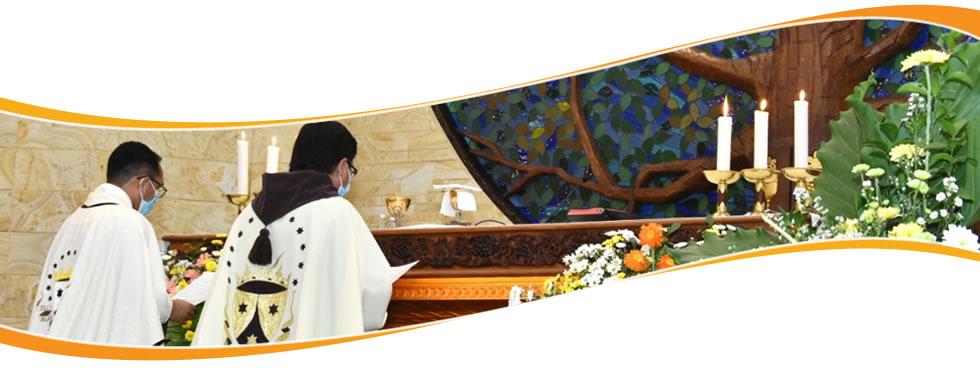
On the 5th of August of this year, the solemn rededication of the first Carmelite church in the American continent, took place in Olinda, Brasil. This church was founded by four portuguese Carmelites in 1580. The Metropolitan Archbishop of Olinda and Recife, Antonio Fernando Saburido presided at the celebration of the Eucharist. He was accompanied by five Carmelite bishops, (Vitalis Wilderink, Paolo Cardoso, Antonio Muniz, João José Costa and Wilmar Santin), by the Prior General, Fernando Millán Romeral, O.Carm., by the Councilor General for the Americas, Raul Maraví, O.Carm., the Prior Provincial of Pernambuco, Roberval Mendes Pereira, O.Carm., and a large number of Carmelites from all parts of Brazil. The Commissary General of Portugal, Agostinho Castro also took part in the celebration. He presented a relic of St. Nuno de Santa Maria, founder of the Carmelite house in Lisbon, from which the Carmelite founders in Brasil set out.
The celebration was preceded by a Triduum and by a congress on the history and significance of the Carmelite presence in Olinda. At that congress the Prior General introduced the official letter which will be addressed to the whole Carmelite Family on this occasion, with the title, “Carmel in America: past, present and future”. Furthermore, there was an official meeting with the civil authorities to whom the Carmelites expressed their gratitude for the handing over and restoration of this beautiful church, which had been in the hands of the Brazilian State since 1877 and which from now on will be the location of the residence of the Prior Provincial.
On Monday, the 6th of August, Vatican Radio broadcast an extensive interview with the Prior General and with Fr. Francisco de Sales Alencar (in Spanish and in Portuguese respectively) concerning the importance and significance of this occasion (This can be heard in Spanish at:
http://www.radiovaticana.org/spa/Articolo.asp?c=605143 and in Portuguese at
http://www.radiovaticana.org/bra/Articolo.asp?c=611019)
Finally, it is important to mention that His Holiness, Pope Benedict XVI sent a brief message of congratulations via the Secretary of State in which he referred to the historical and pastoral importance of this event.
M. Rev. Kilian Healy, O.Carm.
From the dawn of reason the heart of St. Thérèse was raised to God. As she grew in years she was blessed with insight into his merciful love. Her desire was to always do his will. At the reception of her first holy communion she told our Lord that she is giving herself to him forever.
After her entrance to Carmel at the age of fifteen she set full sail on her pursuit of holiness. She came to believe that God had bent down, lifted her up and embraced her in his loving arms (Story of a Soul, translated by John Clarke, O.C.D. 199; hereafter abbreviated as S).
In February 1895, two and one half years before her death she composed one of her most beautiful poems “Living on Love” (Poetry of Saint Thérèse, trans. by Donald Kenny, O.C.D., PN 17; hereafter PN). It was the fruit of an inspiration on an evening spent in the presence of the Blessed Sacrament during the Forty Hours devotion. In this poem she sings of the merciful love of God and of her desire to be aflame with love for him. She longs to live on love alone and to die of love.
“Loving you, Jesus, is such fruitful loss!
All my perfumes are yours forever.
I want to sing on leaving this world,
I’m dying of love!” (Ibid., St. 19).
A few months later on June 11, 1895 together with her sister Céline she made her Act of Oblation to the Merciful Love of God. She offered herself as a Victim, a holocaust of love. “Consume your holocaust with the fire of your Divine Love” (S 181).
As her spiritual life developed she was ravished with love and cried out: “O Jesus my love..., my vocation at last I found it....My vocation is Love” (S 194).
As we contemplate the heart of Thérèse aflame with love of God we ask: What were some of the devotions that served Thérèse on her journey to love? Throughout her life she had many devotions and shared in many spiritual exercises. We think of her devotion to the Holy Face and her love of the Divine Office. In this article we would like to focus our attention on three devotions that played a special role in her surrender to love, and that can become a vital influence in our spiritual development: the Bible, the Eucharist, and the Blessed virgin.
The Bible
Today reading and study of the Bible is a daily practice in convents. But in the nineteenth century this was not so. Thérèse came to Bible reading gradually, not at home but in the convent. We are told she did not have a copy of the complete Bible; she used Céline’s notebook which contained several passages from the Old Testament. Céline also gave her a copy of the Gospel and the Letters of St. Paul bound together. This little book she always carried over her heart. It is preserved today among the relics in the convent of Lisieux. Finally, we should remember that the nuns recited the Divine Office every day and among other Scripture passages it contained the Psalms, which gave her daily food for thought and prayer.
It was, then, the Vulgate form of the text that Thérèse knew. Had she been a priest, she said, she would have learned Greek and Hebrew in order to read the Bible in its original languages.
One book that gave her great nourishment was the Song of Songs, and her understanding of it came from the Catholic tradition, proposed by Origin (d. 254) the most influential commentator in the Christian community. For the Christian the Song refers to the love of Christ and the Church, Christ and the individual soul.
Thérèse received many spiritual insights from the Song, quoting it frequently especially in her letters to Céline. To one of her novices, Marie of the Trinity, she confided:
“If I had the time I would like to comment on the Canticle of Canticles (the Song); in this book I have discovered such profound things about the union of the soul with the Beloved” (quoted by Guy Gaucher, Story of a Life, 191).
In her Story she tells us of the spiritual enrichment gained from reading the Word of God. “Ah! how many lights have I not drawn from the works of our holy Father, St. John of the Cross! At the ages of seventeen and eighteen I had no other spiritual nourishment; later on, however, all books left me in aridity and I’m still in that state. If I open a book composed by a spiritual author (even the most beautiful, the most touching book), I feel my heart contract immediately and I read without understanding, so to speak. Or if I do understand, my mind comes to a standstill without the capacity of meditating. In this helplessness, Holy Scripture and the Imitation come to my aid; in them I discover a solid and very pure nourishment. But it is especially the Gospels which sustain me during my hours of prayer, for in them I find what is necessary for my poor little soul. I am constantly discovering in them new lights, hidden and mysterious meanings” (S 179).
We recall that in Carmel the sisters had two hours of silent prayer, one in the morning and the other in the evening. The daily reading and meditating on the Gospels led Thérèse to come to an understanding of God’s desire to flood the world with his merciful love, and prompted her to respond to his love. “Oh how sweet the way of love! How I want to apply myself to do the will of God always with the greatest self-surrender” (S 181).
Listening to Thérèse we can ask ourselves: What place do the Holy Scriptures hold in our life? Does God speak to us? Do we listen? To understand love, we must begin to love.
The Eucharist
Thérèse’s growth in understanding the merciful love of God and responding with love was also advanced by her love of the Holy Eucharist From her childhood Thérèse enjoyed going to Mass. She loved Sundays and Holy days. She doesn’t offer any special insights into the mystery of the Holy Sacrifice but she does have much to teach us about holy communion. She underwent a long and thorough preparation [or her first holy communion which she received at the age of eleven.
Her description of her first encounter with her Eucharistic King is edifying: “Afi! how sweet was that first kiss of Jesus! It was a kiss of love; I felt that I was loved, and I said: ‘I love You, and I give myself to you forever!’ There were no demands made, no struggles, no sacrifices; for a long time now. Jesus and poor little Thérèse looked at and understood each other, That day, it was no longer simply a look, it was a fusion; they were no longer two, Thérèse had vanished as a drop of water is lost in he immensity of the ocean. Jesus alone remained. e was the Master, the King. Had not Thérèse asked Him to take away her liberty, for her liberty frightened her? She felt so feeble and fragile that she wanted to be united forever to the divine Strength” (S 77).
Would this beautiful experience be repeated each time Thérèse received holy communion? No. Seldom would there be consolation and joy. Her communions would he acts of faith. She would think of the love of Jesus who longed to give himself to us in the host. She would recall his humility in condescending to come to us; his humility in coming hidden in the host. Her reaction was to try to please him who was so humble and loving.
Often she would seek Jesus in the tabernacle to keep him company. Daily reception of the Eucharist was not permitted in Thérèse’s time; a custom that displeased her greatly. She promised that once in heaven she would seek a remedy. In the meantime she would encourage frequent communion. In a letter to her cousin Marie Guérin, who would enter Carmel in 1895 as Marie of the Eucharist, Thérèse encouraged her to banish the scruples that kept her from receiving the Eucharist. “Dear little sister, receive communion often, very often. That is the only remedy if you want to be healed and Jesus hasn’t placed this attraction in your soul for nothing” (General Correspondence, v.1, translated by John Clarke, O.C.D., 569).
Pope Pius X in 1905 granted the whole church permission to receive daily communion; he was greatly pleased that he had done this after reading this letter of Thérèse. He said: “we must hurry this cause!” (Thérèse’s beatification) (Ibid.)
One night during her final illness Thérèse wrote a poem in preparation for holy communion: “You Who Know My Extreme Littleness” (PS 8, p. 233). Sister Thérèse of the Eucharist sang this song before Thérèse received holy communion on July 16, 1897. This was her last poem, a song of love, a cry of the heart to die of love. “Come into my heart, O white Host that I love. Come into my heart I long for you” (Ibid.).
During the last few months of her life Thérèse was so emaciated, so weak that she could no longer hold food in her stomach. Consequently, her last holy communion was on August 19, 1897, six weeks before her death. There is no indication that the last kiss of Jesus was similar to the first. This time there was no joy. She was immersed in the dark night of faith. After communion shed4ing tears she said to Mother Agnes, “I’m perhaps losing my wits. Oh! if they only knew the weakness I’m experiencing. Last night I couldn’t take anymore; I begged the Blessed Virgin to hold my head in her hands so that I could take my sufferings” (Last Conversations, translated by John Clarke, O.C.D., 54; hereafter LC).
Yes, the infirmary was her Calvary, her sick bed the Cross. With Jesus she was a victim of love.
As we meditate on Thérèse’s love of the Eucharist (she often thought how wonderful it would be to be a priest and offer the Eucharist) we ask: What place does the Mass and holy communion bold in our life? Do we share in the daily celebration of the Eucharist? Do we realize that Jesus in the host is manifesting his love for us, that he is asking to be loved? How do we respond to Jesus on days there is no consolation?
The Blessed Virgin
Along with the Bible and the Holy Eucharist, devotion to the Blessed Virgin accompanied Thérèse on her journey of surrender to love.
In her childhood Thérèse learned to honour Mary. At the age of three she prayed to Mary in words taught to her by her mother. When she made her first confession at the age of six her confessor encouraged her to practice devotion to the Blessed Virgin, and Thérèse promised herself that she would redouble her tenderness to Mary. When she was ten years old she came down with a mysterious nervous sickness. While lying sick in bed, she tells us, the Blessed Virgin with a ravishing smile appeared to her, and she was instantly cured. The following year, at age eleven in the afternoon of the day of her first holy communion Thérèse was chosen in the name of her companions to make the act of consecration to Mary. She tells us: “I put all my heart into speaking to her, into consecrating myself to her as a child throwing itself into the arms of its mother, asking her to watch over her. It seems to me the Blessed Virgin must have looked upon her little flower and smiled at her, for wasn’t it she who cured her with a visible smile? Had she not placed in the heart of her little flower her Jesus, the Flower of the Fields and the Lily of the valley?” (S 78).
In 1887 Thérèse accompanied her father and Céline on a pilgrimage to Rome. Along the journey they visited shrines of our Lady, and she felt that she was rewarded with great graces at Our Lady of Victories in Paris and Loreto in Italy. However, in Rome she was disappointed with her audience with Pope Leo XIII. Although he treated her with kindness, he did not grant her request to enter Carmel at age fifteen, leaving the decision to the will of God. Downcast she returned home, but her spirits were soon revived when the bishop granted her desire, a favour she believed was a gift of the Blessed Virgin.
Once she entered Carmel she took comfort in wearing our Lady’s mantle, and the Brown Scapular, our Lady’s gift, which for her was a sign of predestination. She also carried our Lady’s rosary, was faithful to the daily recitation, but, as she confesses, it was not without great difficulty.
In December 1894 she received an order from her superior, Mother Agnes (Pauline), to write her childhood memories. Always obedient Thérèse tells us: “Before taking up my pen, I knelt before the statue of Mary (the one that had given so many proofs of the maternal preferences of heaven’s Queen to our family), and I begged her to guide my hand that it trace no line displeasing to her” (S 13). Throughout the story of her life Our Lady figures prominently. But this is true in her poems, letters, religious plays and last conversations in which Mary appears as loving Mother and model.
As we reflect on the central role of Mary in the life of Thérèse we ask: Is there any writing in which she expounds her teaching on the Blessed Virgin? Fortunately, there is. To Céline she once confided: “I have always dreamed of saying in song to the Blessed Virgin everything I think about her” (S 217).
On May 1897, a few months before her death, she fulfilled this desire with a masterful poem, the favourite of many devotees, “Why I Love You, Mary” (PN 54, p. 215). In twenty five stanzas with thoughts drawn from the story of Mary in the Gospels she sings of her love for the Mother of Jesus and our mother.
It is not our intention to offer a commentary of the poem (there are some beautiful ones) but rather to offer a few thoughts that shed light on her profound devotion to Mary. In her poem she is guided by the portrayal of Mary in the Gospels. She tells us that Mary is not only the Mother of Jesus, our Saviour; she is our spiritual mother, But Mary is also our model. She led an ordinary life, similar to ours, a life of faith, hope, charity, obedience, humility, patience. It was a life of intense suffering. She experienced the pain of poverty, the cold, the heat, even exile. She endured the dark night of faith especially when she stood beneath the Cross and offered Jesus to appease the Father’s justice.
In her meditations on the Gospels Thérèse found in Mary not only a loving mother, hut a mother who had led an ordinary life, like our own, no ecstasies or miracles. She found a mother she could admire and imitate, a mother who could lead her to Jesus. In her joy she cried out: “You teach me to sing divine praises, to glory in Jesus my Saviour” (St. 7). This poem, Thérèse affirms, contains all that she would preach about Mary were she a priest.
During her final days in the midst of her trial of faith and intense physical suffering, Thérèse frequently prayed to the Virgin Mary. At times she was heard repeating the closing words of her beautiful poem to Mary: “You who came to smile at me in the morning of my life, Come smile at me again.... Mother.... it’s evening now” (St. 25, p. 220).
As the shadows of evening fell on September 30, 1897, and after two days of agony Thérèse, while gazing at her crucifix, died. Her last words:
“My God, I love you” (LC 206).
She had reached the goal of her life, eternal love. But on her journey, often fought with darkness and suffering she found guidance, comfort and great hope in the Bible, the Eucharist, the Blessed Virgin Mary. She points to us the way to love. From heaven she calls: “Come, follow my way.”
The Carmelite Librarians’ Association (CLA) met from July 24 to July 27, 2012, in the city of Prague, Czech Republic.
There were 22 participants, including two members of the General Council, Fr Josef Jancar (Procurator General) and Fr Desiré Unen Alimange (General Councillor for Africa). The meeting was welcomed and generously assisted by the General Delegate of Bohemia and Moravia, Fr Gorazd Pavel Cetkovsky.
In 10 working sessions, the meeting dealt with several issues pertaining to our Carmelite Libraries in various parts of the world. Particular attention was given to understanding some of the new, and future technologies and applications pertinent to library science. The Association is particularly committed to the formation of our young candidates by assisting new libraries in emerging parts of the Order. To this end, the Association is willing to send specifically requested books and is preparing a type of Manual for incipient, non professional librarians in the Order. Many of our libraries have catalogues which are now online and the service of digitizing rare books and manuscripts is available for all those who request it. In between working sessions, we were able to visit, under the very erudite leadership and guidance of Fr Gorazd, some of our former Carmelite churches and also the famous Premostratensian Strahov Library.
Since the Association meets every 18 months, it was decided that the next meeting will be January 6 (arrivals) to January 11 (departures) 2014, in the city of Nairobi, Kenya.
admin
A collection of quotes by St. Therese of Lesieux. Quotes from St Therese Story of a Soul and her letters.
“A word or a smile is often enough to put fresh life in a despondent soul.”
“And it is the Lord, it is Jesus, Who is my judge. Therefore I will try always to think leniently of others, that He may judge me leniently, or rather not at all, since He says:
"Judge not, and ye shall not be judged.”
“Do you realize
that Jesus is there
in the tabernacle
expressly for you-
for you alone? He
burns with the
desire to come into
your heart… don’t
listen to the demon,
laugh at him, and
go without fear to
receive the Jesus of
peace and love…”
“Each prayer is more beautiful than the others. I cannot recite them all and not knowing which to choose, I do like children who do not know how to read, I say very simply to God what I wish to say, without composing beautiful sentences, and He always understands me. For me, prayer is an aspiration of the heart, it is a simple glance directed to heaven, it is something great, supernatural, which expands my soul and unites me to Jesus.”
“For me, prayer is a surge of the heart; it is a simple look turned toward heaven, it is a cry of recognition and of love, embracing both trial and joy.”
“Holiness consists simply in doing God's will, and being just what God wants us to be.”
“I am convinced that one should tell one's spiritual director if one has a great desire for Communion, for Our Lord does not come from Heaven every day to stay in a golden ciborium; He comes to find another heaven, the heaven of our soul in which He loves to dwell.”
“i can nourish myself on nothing but truth”
“I choose them all! I want them all!”
“I know now that true charity consists in bearing all our neighbours' defects--not being surprised at their weakness, but edified at their smallest virtues.”
“I say nothing to him I love him”
“I understood that every flower created by Him is beautiful, that the brilliance of the rose and the whiteness of the lily do not lessen the perfume of the violet or the sweet simplicity of the daisy. I understood that if all the lowly flowers wished to be roses, nature would no longer be enamelled with lovely hues. And so it is in the world of souls, Our lord's living garden.”
“If every tiny flower wanted to be a rose, spring would lose its loveliness.”
“If I did not simply live from one moment to another, it would be impossible for me to be patient, but I only look at the present, I forget the past, and I take good care not to forestall the future.”
“It is there for each and every one of us.”
“Let this presence settle into your bones, and allow your soul the freedom to sing, dance, praise and love.
“Let us not be justices of the peace, but angels of peace.”
“May today there be peace within.
“May you be content knowing you are a child of God.
“May you not forget the infinite possibilities that are born of faith.
“May you trust God that you are exactly where you are meant to be.
“May you use those gifts that you have received, and pass on the love that has been given to you.
“Miss no single opportunity of making some small sacrifice, here by a smiling look, there by a kindly word; always doing the smallest right and doing it all for love.”
“My whole strength lies in prayer and sacrifice, these are my invincible arms; they can move hearts far better than words, I know it by experience.”
“One word or a pleasing smile is often enough to raise up a saddened and wounded soul.”
“Sufferings gladly borne for others convert more people than sermons.”
“The loveliest masterpiece of the heart of God is the heart of a mother.”
“The splendor of the rose and the whitness of the lily do not rob the little violet of it’s scent nor the daisy of its simple charm. If every tiny flower wanted to be a rose, spring would lose its lovliness.”
“The world's thy ship and not thy home.”
“Trust and trust alone should lead us to love”
“When I die, I will send down a shower of roses from the heavens,I will spend my heaven by doing good on earth.”
“When one loves, one does not calculate.”
“Without love, deeds, even the most brilliant, count as nothing.”
admin
A collection of quotes attributed to Spanish mystic and Carmelite nun Saint Teresa of Avila (1515-1582).
“ Accustom yourself continually to make many acts of love, for they enkindle and melt the soul.”
“ Always think of yourself as everyone's servant; look for Christ Our Lord in everyone and you will then have respect and reverence for them all.”
“All things must come to the soul from its roots, from where it is planted.”
“Be gentle to all and stern with yourself.”
“It is love alone that gives worth to all things.”
“Let nothing disturb thee;
Let nothing dismay thee:
All thing pass;
God never changes.
Patience attains
All that it strives for.
He who has God
Finds he lacks nothing:
God alone suffices.”
“Never affirm anything unless you are sure it is true.”
“Never compare one person with another: comparisons are odious.”
“Never exaggerate, but express your feelings with moderation.”
“O my God, what must a soul be like when it is in this state! It longs to be all one tongue with which to praise the Lord. It utters a thousand pious follies, in a continuous endeavor to please Him who thus possesses it.”
“Our body has this defect that, the more it is provided care and comforts, the more needs and desires it finds.”
“Pain is never permanent.”
“Reflect upon the providence and wisdom of God in all created things and praise Him in them all.”
“The feeling remains that God is on the journey, too.”
“There are more tears shed over answered prayers than over unanswered prayers.”
“To have courage for whatever comes in life — everything lies in that.”
God gave us faculties for our use; each of them will receive its proper reward. Then do not let us try to charm them to sleep, but permit them to do their work until divinely called to something higher.”
"God has been very good to me, for I never dwell upon anything wrong which a person has done, so as to remember it afterwards. If I do remember it, I always see some other virtue in that person.”
"I do not fear Satan half so much as I fear those who fear him.”
"It is here, my daughters, that love is to be found - not hidden away in corners but in the midst of occasions of sin. And believe me, although we may more often fail and commit small lapses, our gain will be incomparably the greater.”
"Christ has no body now, but yours.
No hands, no feet on earth, but yours.
Yours are the eyes through which
Christ looks compassion into the world.
Yours are the feet
with which Christ walks to do good.
Yours are the hands
with which Christ blesses the world."
“I am afraid that if we begin to put our trust in human help, some of our Divine help will fail us.”
“I would never want any prayer that would not make the virtues grow within me.”
“It is love alone that gives worth to all things.”
“Mental prayer in my opinion is nothing else than an intimate sharing between friends; it means taking time frequently to be alone with Him who we know loves us.”
“One must not think that a person who is suffering is not praying. He is offering up his sufferings to God, and many a time he is praying much more truly than one who goes away by himself and meditates his head off, and, if he has squeezed out a few tears, thinks that is prayer. “
“Our greatest gain is to lose the wealth that is of such brief duration and, by comparison with eternal things, of such little worth; yet we get upset about it and our gain turns to loss.”
“Remember that you have only one soul; that you have only one death to die; that you have only one life, which is short and has to be lived by you alone; and there is only one Glory, which is eternal. If you do this, there will be many things about which you care nothing. “
“Suffering is a great favor. Remember that everything soon comes to an end . . . and take courage. Think of how our gain is eternal.”
“The most potent and acceptable prayer is the prayer that leaves the best effects. I don't mean it must immediately fill the soul with desire . . . The best effects [are] those that are followed up by actions-----when the soul not only desires the honor of God, but really strives for it. “
“The tree that is beside the running water is fresher and gives more fruit.”
“To reach something good it is very useful to have gone astray, and thus acquire experience.”
“Truth suffers, but never dies.”
“Vocal prayer . . . must be accompanied by reflection. A prayer in which a person is not aware of Whom he is speaking to, what he is asking, who it is who is asking and of Whom, I don't call prayer-----however much the lips may move.”
“We can only learn to know ourselves and do what we can - namely, surrender our will and fulfill God's will in us.”
“We shall never learn to know ourselves except by endeavoring to know God; for, beholding His greatness, we realize our own littleness; His purity shows us our foulness; and by meditating upon His humility we find how very far we are from being humble.”
“What a great favor God does to those He places in the company of good people!”
“You pay God a compliment by asking great things of Him.”
“As for what concerns our relations with our fellow men, the anguish in our neighbor's soul must break all precept. All that we do is a means to an end, but love is an end in itself, because God is love.
“Every true prayer is a prayer of the Church; by means of that prayer the Church prays, since it is the Holy Spirit living in the Church, Who in every single soul 'prays in us with unspeakable groanings'.”
“I told our Lord that I knew it was His cross that was now being placed upon the Jewish people; that most of them did not understand this, but that those who did would have to take it up willingly in the name of all. I would do that. At the end of the service, I was certain that I had been heard. But what this carrying of the cross was to consist in, that I did not yet know.”
“If anyone comes to me, I want to lead them to Him.”
“In order to be an image of God, the spirit must turn to what is eternal, hold it in spirit, keep it in memory, and by loving it, embrace it in the will.”
“My longing for truth was a single prayer.”
“On the question of relating to our fellowman - our neighbor's spiritual need transcends every commandment. Everything else we do is a means to an end. But love is an end already, since God is love.
“One could say that in case of need, every normal and healthy woman is able to hold a position. And there is no profession which cannot be practiced by a woman.”
“The limitless loving devotion to God, and the gift God makes of Himself to you, are the highest elevation of which the heart is capable; it is the highest degree of prayer. The souls that have reached this point are truly the heart of the Church.”
“The nation... doesn't simply need what we have. It needs what we are.”
“Things were in God's plan which I had not planned at all. I am coming to the living faith and conviction that - from God's point of view - there is no chance and that the whole of my life, down to every detail, has been mapped out in God's divine providence and makes complete and perfect sense in God's all-seeing eyes.”
“Those who join the Carmelite Order are not lost to their near and dear ones, but have been won for them, because it is our vocation to intercede to God for everyone.”
More...
Brother Lawrence - The Practice of the Presence of God ( Audio Book Reading )
Daily Lectio Divina for August
| Ipad-Iphone | Kindle | ||
| English | download ebook | download ebook | download PDF |
| Español | descargar eBook | descargar ebook | download PDF |
| Italiano | download eBook | download eBook | download PDF |
- Wednesday, August 1, 2012
- Thursday, August 2, 2012
- Friday, August 3, 2012
- Saturday, August 4, 2012
- Sunday, August 5, 2012
- Monday, August 6, 2012
- Tuesday, August 7, 2012
- Wednesday, August 8, 2012
- Thursday, August 9, 2012
- Friday, August 10, 2012
- Saturday, August 11, 2012
- Sunday, August 12, 2012
- Monday, August 13, 2012
- Tuesday, August 14, 2012
- Wednesday, August 15, 2012
- Thursday, August 16, 2012
- Friday, August 17, 2012
- Saturday, August 18, 2012
- Sunday, August 19, 2012
- Monday, August 20, 2012
- Tuesday, August 21, 2012
- Wednesday, August 22, 2012
- Thursday, August 23, 2012
- Friday, August 24, 2012
- Saturday, August 25, 2012
- Sunday, August 26, 2012
- Monday, August 27, 2012
- Tuesday, August 28, 2012
- Wednesday, August 29, 2012
- Thursday, August 30, 2012
- Friday, August 31, 2012
Message of His Holiness Benedict XVI to The Bishop of Avila (Spain) on The Occasion of The 450th Anniversary of The Monastery of San José In Avila And The Beginning of The Reform of Carmel
BENEDICTUS PP. XV
To my Venerable Brother
Bishop Jesús García Burillo of Avila
1. Resplendens stella: “a star shining in great splendour” (Libro de la Vida, [The Book of My Life] 32, 11). With these words the Lord encouraged St Teresa of Jesús to found the Monastery of San José in Avila. This was the beginning of the Reform of Carmel which will be celebrating its 450th anniversary next 24 August. On this happy occasion I would like to join in the rejoicing of the beloved Diocese of Avila, of the Order of Discalced Carmelites and of the People of God on pilgrimage in Spain, as well as of all those in the universal Church who have found in Teresian spirituality a sure light for men and women to attain a true renewal of their life through Christ. In love with the Lord, this illustrious woman did not want anything other than to please him in all things. Indeed, it is not those who do great things based on the excellence of their human qualities who are holy; on the contrary, holy people are those who humbly let Christ penetrate their soul and act through them, who truly allow him to play the lead in all their actions and aspirations, inspiring every project and sustaining every silence.
2. Only those who have an intense prayer life are able to let Christ lead them in this manner. The Saint of Avila says that a life of prayer consists in “being on terms of friendship with God, frequently conversing in secret with him who, we know, loves us” (Libro de la Vida 8, 5). The reform of Carmel whose anniversary fills us with inner joy was born from prayer and is inclined to prayer. By distancing herself from the Mitigated Rule in order to further a radical return to the primitive Rule, St Teresa de Jesús wished to encourage a form of life that would favour the personal encounter with the Lord, for which “we have only to find a place where we can be alone and look upon him present within us. Nor need we feel strange in the presence of so kind a Guest” (Camino de perfección [the Way of Perfection] 28, 2). The Monastery of San José came into being precisely in order that all its daughters might have the best possible conditions for speaking to God and establishing a profound and intimate relationship with him.
3. St Teresa proposed a new way of being a Carmelite in a world that was also new. The “times were dangerous” (Libro de la Vida 33, 5) and in these times, as this spiritual teacher said, “the friends of God should be strong, in order that they may support the weak” (ibid., 15, 5). And she eloquently insists: “the world is on fire. Men try to condemn Christ once again, as it were, for they bring a thousand false witnesses against him. They would raze his Church to the ground.... No, my sisters, this is no time to treat with God for things of little importance" (Camino de perfección, 1, 5). Does not this most luminous and challenging reflection made by the holy mystic more than four centuries ago seem familiar to us in the situation in which we are living?
The ultimate aim of the Teresian Reform and of the creation of new monasteries in the midst of a world devoid of spiritual values was to strengthen apostolic work with prayer; and to propose an evangelical lifestyle that might serve as a model to those in quest of a way of perfection, based on the conviction that every authentic personal and ecclesial reform passes through reproducing, ever more faithfully, the “form” of Christ (cf. Gal 4:19) within us. The Saint and her daughters strove to do exactly this and this was the exact commitment of her Carmelite sons who endeavoured solely to “advance in virtue” (Libro de la vida, 31, 18). In this regard Teresa writes: “He [Our Lord] prizes one soul which of his mercy we have gained for him by our prayer and labour more than all the service we may render him” (Libro de las Fundaciones [The Book of the Foundations] 1, 7). In the face of forgetfulness of God the Holy Doctor encourages prayerful communities that protect with their fervour those who proclaim Christ’s name everywhere, so that they may pray for the Church’s needs and bring the cry of all the peoples to the Saviour’s heart.
4. Today too, as in the 16th century and also among rapid changes, trusting prayer must be the soul of the apostolate so that the redemptive message of Jesus Christ rings out with deep clarity and vigorous dynamism. It is urgently necessary that the Word of life be harmoniously vibrant in souls, with resonant and attractive tones.
Teresa of Avila’s example is a great help to us in this exciting task. We can say that in her time the Saint evangelized without mincing her words, with unfailing ardour, with methods foreign to inertia and with expressions haloed with light. Her example keeps all its freshness at the crossroads of our time. It is here that we feel the urgent need for the baptized to renew their hearts through personal prayer which, in accordance with the dictates of the Mystic of Avila, is also centred on contemplation of the Most Holy Humanity of Christ as the only way on which to find God’s glory (cf. Libro de la Vida, 22, 1; Las Moradas [Interior Castle] 6, 7). Thus they will be able to form authentic families which discover in the Gospel the fire of their hearths; lively and united Christian communities, cemented on Christ as their corner-stone and which thirst after a life of generous and brotherly service. It should also be hoped that ceaseless prayer will foster priority attention to the vocations ministry, emphasizing in particular the beauty of the consecrated life which, as a treasure of the Church and an outpouring of graces, must be duly accompanied in both its active and contemplative dimensions.
The power of Christ will likewise lead to the multiplication of projects to enable the People of God to recover its strength in the only possible way: by making room within us for the sentiments of the Lord Jesus (cf. Phil 2:5), seeking in every circumstance a radical experience of his Gospel. This means, first of all, allowing the Holy Spirit to make us friends of the Teacher and to conform us to him. It also means accepting his mandates in all things and adopting such criteria as humility in behaviour, the renunciation of the superfluous and giving no offence to others or proceeding with simplicity and a docile heart. Those who surround us will thus perceive the joy that is born from our adherence to the Lord and see that we put nothing before his love, being ever ready to account for our hope (cf. 1 Pet 3:15) and, like Teresa of Jesus, living in filial obedience to our Holy Mother, the Church.
5. Today, this most illustrious daughter of the Diocese of Avila invites us to this radicalism and faithfulness. Accepting her beautiful legacy at this moment in history, the Pope asks all the members of this particular Church, and especially youth, to take seriously the common vocation to holiness. Following in the footsteps of Teresa of Jesus, allow me to say to all who have their future before them: may you too, aspire to belong totally to Jesus, only to Jesus and always to Jesus. Do not be afraid to say to Our Lord, as she did, “I am yours; I was born for you, what do you want to do with me?” (Poem 2). And I ask him to obtain that you may also be able to respond to his call, illuminated by divine grace with “determined resolve” in order to offer “that little” which is in you, trusting in the fact that God never abandons those who leave everything for his glory (cf. Camino di perfección 21, 2; 1, 2).
6. St Teresa knew how to honour with deep devotion the Most Holy Virgin, whom she invoked with the sweet name of Carmel. I place under her motherly protection the apostolic aspiration of the Church of Avila so that rejuvenated by the Holy Spirit she may find appropriate ways for proclaiming the Gospel with enthusiasm and courage. May Mary, Star of Evangelization, and her chaste spouse, St Joseph, intercede so that this “star” which the Lord set alight in the universe of the Church with the Teresian Reform, may continue to shine with the great splendour of the love and truth of Christ for all humankind. With this wish, Venerable Brother in the Episcopate, I send you this message. I ask you to make it known to the flock entrusted to your pastoral care and, especially, to the beloved Discalced Carmelites of the Convent of San José in Avila so that they may perpetuate in time the spirit of their Foundress. I am ever grateful to them for their fervent prayers for the Successor of Peter. To them, to you and to all the faithful of Avila I impart the Apostolic Blessing as a pledge of abundant heavenly favours.
From the Vatican, 16 July 2012


