





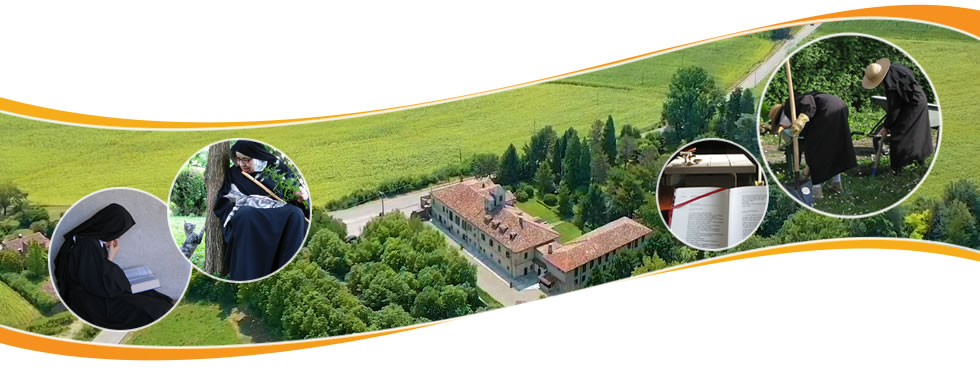





The Elective Chapter of the Carmelite Hermits of Monteluro, Italy, was held 30 March 2012. The following were elected:
- Prioress: Sr. Teresa M. Lonardoni, O.Carm.
- Director of Novices: Sr. M. Morena Ciullo, O.Carm.
- Treasurer: Sr. Maria Faroldi, O.Carm.
Lectio Divina
General Intention: Vocations. That many young people may hear the call of Christ and follow him in the priesthood and religious life.
Missionary Intention: Christ, Hope for Africans. That the risen Christ may be a sign of certain hope for the men and women of the African continent.
- Sunday, April 1, 2012
- Monday, April 2, 2012
- Tuesday, April 3, 2012
- Wednesday, April 4, 2012
- Thursday, April 5, 2012
- Friday, April 6, 2012
- Sunday, April 8, 2012
- Monday, April 9, 2012
- Tuesday, April 10, 2012
- Wednesday, April 11, 2012
- Thursday, April 12, 2012
- Friday, April 13, 2012
- Saturday, April 14, 2012
- Sunday, April 15, 2012
- Monday, April 16, 2012
- Tuesday, April 17, 2012
- Wednesday, April 18, 2012
- Thursday, April 19, 2012
- Friday, April 20, 2012
- Saturday, April 21, 2012
- Sunday, April 22, 2012
- Monday, April 23, 2012
- Tuesday, April 24, 2012
- Wednesday, April 25, 2012
- Thursday, April 26, 2012
- Friday, April 27, 2012
- Saturday, April 28, 2012
- Sunday, April 29, 2012
- Monday, April 30, 2012
Relection on Con Gen 2011
Reflection cards on the final message of the 2011 General Congregation.
por favor, dar parte de su información
si prega di fornire alcune delle vostre informazioni
Con Gen 2011
“Qualiter respondendum sit quaerentibus”
“How shall we respond to those who are seeking?”
To all the Members of the Carmelite Family: Peace and the Grace in the Lord .
“As you therefore have received Christ Jesus the Lord, continue to live your lives in Him, rooted and built up in Him and established in the faith, just as you were taught, abounding in thanksgiving .” (Col 2:6-7). With these words of the Apostle Saint Paul, proclaimed in the liturgy of the first day, and praying for the wisdom of the Holy Spirit, Prior General Fr Fernando Millán Romeral inaugurated the 2011 General Congregation.
1. The General Congregation was celebrated at Mount Carmel Spiritual Centre, Niagara Falls, from the 5th to the 15 th September, 2011. The theme was “ Qualiter respondendum sit quaerentibus ” (“How shall we respond to those who are seeking? ”). These are the opening words of the Rubrica Prima which can be found in our 1281 Constitutions, the oldest Constitutions that we have. This document can be traced back to 1247, w hen the Order, while migrating to Europe, adopted a mendicant life style. The Formula vitae and our Rule already presented an implicit ecclesiology. The Rubrica Prima, from an ecclesiological point of view, was the official answer to those who asked us about the origins of our Order. The present question, we suppose, has nothing to do with how we were born or about our origins, but it challenges us to ask ourselves: “Who are we? What are we doing here? (cfr 1 Kings 19:10), and why do we do what we do in the Church?”
2. Following the directives given by our General Council, we dealt with the second part of a reflection already begun at the 2007 General Chapter: “ In obsequio Jesu Christi. Praying and prophetic communities in a changing world.” We dealt with the first part of this theme (“ Praying and prophetic communities”) at the Council of Provinces meeting at San Felice del Benaco in 2009. During these past days, using an ecclesiological criterion, we dealt with the second part: “in a changing world”. Three experts helped us, from different points of view, to deepen our Carmelite identity. Fr Richard Rohr, OFM, a Franciscan friar, proposed some areas which religious life can offer to the Church and to the world. Professor María Dolores López Guzmán, from the point of view of a committed lay woman in the Church, described to us the hope that religious life offers in dialogue with other states of life. Fr Michael Plattig, O.Carm ., highlighted certain questions and practical examples of how our Carmelite spirituality can contribute to the Church.
3. We recalled during the past few days how throughout our history and in our spiritual tradition, contemplation is not only the heart of the Carmelite charism, but also the best gift, the hidden treasure, the precious pearl (cfr Mt 13:44 -46) that we can offer to the world and to the Church. One is a contemplative where love becomes active. Contemplation is a process of gradual transformation from the false self (the old person) to the true self (the new person) hidden in Christ (cfr Col 3:3), and realized in us by the Holy Spirit to achieve union with God in love (RIVC, 1). It is love which transforms our works, our thoughts, our feelings (cfr Const. 17, RIVC, 23): that love which comes from God and with which we serve humanity. It is love which purifies our thoughts, heals our wounds, unites us to our brothers and sisters, alleviates our sufferings, denounces injustice and opens ways to reconciliation. Certainly, it is love which changes and transforms our world. Our mystics remind us not to forget that it is love which gives value to all of our works, since “ God looks only on the love with which you do what you do” (St Teresa of Avila , Exc., 5). Love is the vocation of the contemplative: “ to love you and to make you love d” (St Therese of Lisieux, Letter 119).
4. What is the specific characteristic of Carmelite religious life? Religious life itself already refers to and speaks of the goodness of the Lord, and visibly offers to the world a clear message: “ God alone suffices” (St Teresa of Avila, Poetry) . One need do nothing special, except just to be, since “ the dignity of the religious vocation has an intrinsic value in the bosom of the Church, beyond its connection to any ministry or service (cfr. RIVC, 112). The best icon of Religious Life is the very presence of the consecrated person. Consecrated life, as LG 44 points out , invites us Carmelites to live our contemplative attitude, imitating “ much more closely (pressius) that life form which the Son of man undertook by coming into the world...” The comparative pressius, translated into our vernacular languages as “ much more closely” loses the intensity of the Latin term. Pressius is derived from the verb presso, which means “to press”, “to squeeze”, “to unite more tightly”. Inspired by this image, our consecration “ conforms” us better to the life style of Jesus of Nazareth. We better understand who we are when we enter into permanent dialogue with all God’s people, because no single vocation in the Church can fully fathom the depth of the mystery of Christ. “Carmel understands its life according to the evangelical counsels, as the most appropriate means of moving towards full transformation in Christ” (RIVC, 7, 9, 1 , 9c; 25) and towards liberty (RIVC, 16). Hence the exercise of the evangelical counsels, rather than being “ the renouncing of something” or a means of moral perfectionism, “ is rather a means of growing in love and so reaching the fullness of life in God” (RIVC, 25). We become a gift for God (“in obsequio Jesu Christi vivere debeat, ” Rule 1) and for others, rendering our lives as an offering.
5. The question which we have been examining in the past few days is not so much “What do we hope for?”, but rather “ What does God hope for us?” Our hope and our joy are based in Jesus Christ, the beginning and the end of all reality. The present, even if filled with burdens, can be lived with enthusiasm; it is moving towards an end, but this goal is so great that it justifies the effort needed (cfr Spes Salvi, 1). Christian hope is God-centered. The Apostle Saint Paul reminds us that the community of Ephesus was without hope because they lived in this world as if they were “without God” (Eph 2:12). Our hope is rooted in knowing God, the true God (cf . 1 Kings, 18), the crucified Lord, the Risen Lord (cfr Lk 24:5-6). Amongst the things that we can hope for, even if it leads to rejection, is the cross of the Lord. Only by being friends with the cross of the Lord (cf. Phil 3:18-19), will we live contentedly and give hope to the weak. Our saints remind us that the principal cause of not advancing in the spiritual life, is that we are sometimes enemies of the cross of the Lord: “There will be many who will begin but they will never end. And I think the main reason is that they do not embrace the cross from the very beginning.” (St Teresa of Avila , Life, 11, 15). Curiously enough, our motto “ Zelo zelatus sum pro Domino Deo exercituum” is not a triumphal cry of the prophet Elijah, but rather a “prayer of complaint ” in which the prophet recognizes his impotence and expresses his crisis and doubts, addressing himself directly to God. We should not consider our poverty and our limitations as failures, nor simply resign ourselves to them, but rather we should see them as an authentic school of transformation and of contemplation. Moreover it is necessary to recognize our weakness in order to be able to better know who God is and to let ourselves be saved by Him (cfr 2 Cor 12:9). The God of revelation, who showed Himself so powerful in creation, wanted to manifest Himself as weak and powerless in redemption. It is only in this way that He can be our Redeemer and our Hope.
6. The experience of God lived in fraternity urges us to take owner ship of “the mission of Christ” to be prophets of hope. The authentic contemplative is the bearer of the light of the Risen Christ in the midst of the darkness of the night of humanity. There are many forms of desert in the midst of the night: the desert of poverty and of abandonment, of loneliness and of destroyed love. There is also the desert of God’s darkness, that of forgetting the dignity of the person. The external deserts are multiplied in the world because they have extended the dark nights of the interior deserts. Our mission does not consist in passive hope, but rather in hastening the coming of the kingdom of God (cfr 2 Pt 3:12). All that we have received in our Carmelite charism, our history, our spirituality, by the very logic of gift, does not belong to us , because we have received it “to donate it” and “to give it in the same way that it was given to us ” (cfr John of the Cross, The Call, 3,78). And it was given to us without interest and in abundant measure (cfr Lk 6:38). Benedict XVI in conversation with the Prior General during the Pilgrimage of Hope at Castelgandolfo in August 2010 reminded us that “The Carmelites teach us how to pray” . Any Carmelite apostolate or mission should teach us not to accumulate prayers, turning devotions into pure superstition and magic or mere collectors’ items, but to really pray, that is, to nurture a mature relationship with God and with others. The expressions with which the mystics speak of the relationship with God enjoy a great freshness and simplicity, and precisely because of this, they connect powerfully with the hear t of God and with the essentials of life.
7. In these days we also recalled how the practice of living in the presence of God ( cfr 1 Kings 17:1), the mystery of allowing God to be God, the rediscovery of the spirituality of the cell, the balance between silence and words, solitude, “ vacare Deo” , the “dark night” and our mendicant life style are t he yeast which nourishes the Church and our world and which offers us food for thought in our pastoral ministry. We are aware that we are rich in tradition and theological models. But perhaps we need to revitalize our mystic al journeys which, in practice , serve to transmit to others the wealth of Carmel and the beauty of having seen the Lord. The Carmelite in the midst of the world is at the service of the cultivation of God’s garden, Carmel, creating sacred places, mystical spaces where God can shine. Our ministry should present us with a series of questions: a) Do we respect and presuppose the maturity of the faithful in our preaching? Do we tell them only what they should or should not do? b) Does our work for justice and peace really flow from our contemplative dimension? Are we politicians or prophets and people of God? c) How do we celebrate the Eucharist? Is i t only a duty, a place to instruct the people? Is it a service that we give to God or rather a service which God gives to His people? d) In spiritual accompaniment, do we seek to lead people to moral perfection ism or to spiritual freedom ? Carmelites work without appropriating the results of their work. They must decrease so that Go d can increase (cfr Jn 3:30). They enlighten without eclipsing the action of God, fully aware that if in our mission we belittle God, we belittle ourselves. We do not announce to the world a spirituality of efficiency, of success and of productivity, but rather a spirituality of the little way and humility where our trust is placed in God.
8. Blessed Titus Brandsma, from this very place in 1935 during his tour of North America (Washington, Chicago, New York, Allentown, etc.) was deeply moved by the spectacle of Niagara Falls. He wrote in his diary: “I am contemplating the imposing Niagara Falls... from the high channel, I see them rushing down ceaselessly. What is surprising is the marvelous and complex possibility of the waters... I see God in the work of his hands and the marks of his love in every visible thing. I am seized by a supreme joy which is above all other joys.” Certainly Fr Titus did not reduce contemplation to a mere private and narcissistic self -complacency, but felt that he was in solidarity with the men and women of his own time. In fact, in his famous speech on the occasion of his investiture as Rector of the Catholic University of Nijmegen, on the 17th of October 1932 , he asked: “ Why has the image of God become so obscured to the point that it no longer says anything to so many? Among the many questions that I have, none disturbs me more than the enigma of why so many learned and proud people, engulfed by progress, alienate themselves from God.” We also share the doubts and concerns of the people of our own time.
9. We Carmelites salute Mary the Mother of God, as the “Star of the Sea”. Life is like a voyage through the sea of history in which Mary shows us the way. Holy Mary, Mother of Hope, teach u s to believe, to hope and to love. Ave Maris Stella enlighten and guide us on our path.
Mount Carmel Spiritual Centre,
Niagara Falls, Canada, 15th September, 2011
Reflection on Con Gen 2011
Reflection on the Final Message of the General Congregation
“How to respond to those who ask” (Niagara Falls, 2011)
3. [...] IN THE MIDST OF THE PEOPLE.
• The material is for guidance only and can be adapted by each community.
1. Distribution of this leaflet.
2. Personal reading of the final message of the General Congregation 2011
3. Personal reading, before the community meeting, of the talk given by Michael Plattig: Practical examples of the meaning of Carmelite spirituality for the Church (Niagara 2011). This can be downloaded from the web site of the Order. The questions and issues raised in this reflection may serve to guide the dialogue of the community meeting.
COMMUNITY MEETING
4. Opening prayer. 1 Kings 17,1-16 (Vg.). "The Lord lives in whose presence I stand."
"The Order has always regarded contemplation as the heart of our calling or vocation." [1] In fact, "we are faithful to our charism if we confront different situations and cultures with a prophetic sense and an attitude of faith, to discover the God who lives and speaks in history. Each option for the service of our neighbour should proceed from and refer to this contemplative attitude." [2] For the contemplative, who experiences the total being of God, our service among the people is not a circumstantial addition to our charism, but is a logical consequence of contemplation. According to our history and spiritual tradition, any ministry emerges from the personal relationship with God (cf. 1 Kings 17, 1; Institutio I, 2). We cannot leave our prophetic mission or apostolic work to chance, spontaneity and dispersal. Our RIVC in fact insists that training for service, which is also an essential element of our charism is to be undertaken with the same dedication as for contemplation, prayer and fraternity (cf. RIVC 45).
What do lay people expect of us? Professor M.ª Dolores López Guzmán in her reflection "The hope of the religious life from the perspective of a lay woman” presented at the General Congregation (Niagara Falls 2011), noted some challenges that a lay person would see for religious “What do I seek from a religious ...? After the reflection so far, this question is easier to ask. This is so because it should only come from heart knowledge. For this reason most of my observations can only be understood correctly in the light of the previous reflection.[3] I will point out in brief the aspects which seem to me to be good to think about in order to increase the hope for a better future for all of us:
a) That you be what you are called to be, that your calling excites you and that you believe in it. It is a shock and not all encouraging to meet with religious who are constantly downcast and moody.
b) That you believe profoundly in God. It is not so easy to find "men and women of faith" and the world needs them.
c) That you like to talk about the "things of God". Be people of spiritual conversation. St. Teresa wrote, "To speak of God or hear about Him almost never tired me" (Life 8, 12). People need different words than those which the world offers us. The Lord offers a different language that opens us to a new understanding of reality. It is essential to help people to grow in friendship with God, but this needs people who are experienced in the spiritual life and in spiritual discernment.
d) That you become aware that you are a sort of touchstone that generates peace in people. In the film "Of Gods and Men" [Xavier Beavois 2010], about the martyrs of Tibhirine, it is moving to hear the locals say that for them “the monks were the branches of the tree where they could rest." This creates accountability because in part it obligates you to be examples. Jesus said it clearly: I have given you an example that you should do as I have done to you (Jn 13.15).
e) That you be open to the signs of the times. This is essential, so that you do not get bogged down by money or particular people, or specific apostolates ... and thus maintain that universal outlook that characterises you.
f) That you live simply because, among the three vows, poverty is the one with the greater visibility and is the first that people detect if it is not a stable part of your lives. A poor lifestyle leads to gratitude, because to the one who has nothing, everything seems a lot.
g) That the style you cultivate in your shared mission is a style that contributes to an increase of mutual trust between lay people and religious; that you know how to appreciate professionalism (and not require from lay people that they be volunteers working 24 hours a day), and that you do not forget to value the lay vocation."
5. Reading of Final Message, No. 7-8.
6. Community discussion
• In our preaching do we respect and assume that people are mature? Do we just tell them what they are to do and not to do?
• Does work for Justice and Peace truly spring from the contemplative dimension of our charism? Are we politicians or prophets and people of God?
• What are our Eucharistic celebrations like? Are they just a precept, a place to instruct people? Is the Eucharist a service we offer to God, or is it a service that God offers people?
• In our spiritual accompaniment, do we lead people to moral perfectionism or spiritual freedom?
7. Our Father.
8. Marian Antiphon.
[1] CHALMERS, J., The God of Our Contemplation, (Rome 2003) nº 7.
[2] THUIS, F.J., In wonder at the Mystery of God (Rome 1983) 40.
[3] Whoever wishes can download the talk from the Order’s website: “The Hope of the Religious Life, From a Lay Woman’s Perspective”, given by Professor M.ª Dolores López Guzmán at the General CongRegation (Niagara Falls 2011).
Reflection on Con Gen 2011
Reflection on the Final Message of the General Congregation
“How to respond to those who ask” (Niagara Falls, 2011)
2. [...] AND PROPHETS OF HOPE [...]
- This material is only to give some ideas and can be adapted as each community decides.
1. Distribution of handout
2. Personal reading of the Final Message of the General Congregation 2011.
COMMUNITY MEETING
3. Opening prayer (mosaic of biblical texts)
• Is 52: 7-10: "The feet of the messenger."
• Is 26, 1-6: "The feet of the poor."
• Jn 13: 3-14: "The feet of the disciples."
• Jn 12: 1-3, Lk 24, 36-40: "The feet of Jesus."
A Caravaggio painting: "The feet of the pilgrims"
- Anyone who wishes can go the web site of the Order and view pictures of the Caravaggio painting "The Madonna of the Pilgrims."
In the Church of S. Augustine, in Rome, where Saint Monica is buried, there is a painting attributed to Caravaggio, entitled "The Madonna of the Pilgrims" (1604-1605). The sanctuary of Loreto, for some time, had become a centre of pilgrimage. The Augustinians, to honour the village to which, according to tradition, the house of Our Lady had been moved, commissioned the artist to paint a picture of Mary as Queen, enthroned as a heavenly being. The artist completed the work but, when it was time for payment, he found that the friars neither wanted to pay, nor did they want the picture, because it seemed irreverent to them to have represented the Mother of God as a village woman. [1]
The painting in question depicts Mary at the door of her house carrying Jesus in her arms. Kneeling in front of Mary, are two pilgrims, barefoot and dirty from the dusty road. [There were those who said that the dirty feet of the beggars were so well painted and were so real that they even seemed to smell!] “The pilgrim's feet” started such a commotion that a cleric branded the genius "indecent", stating that such details should be removed from art, especially art which was intended to awaken "elevated devotion to Our Lady." Caravaggio, however, did not yield, and stated categorically that there can be no higher devotion that that given to the Mother of God by the tired and aching feet of the poor. The white foot of the Madonna, shaped like that of a ballerina, enhances the contrast with the corns and calluses of the "pilgrim's feet."
The painter tried to convince the Augustinians that Mary exercised her royal role by the closeness and intimacy of the woman who is known as sister and companion to the weary. Caravaggio realised that the humanity of Mary was glorified by the feet.[2] Luther, in one of the most beautiful commentaries ever written on the Magnificat, portrayed Mary's humanity, saying of her: "She claimed for herself no action, no honour, no fame [...]. She claimed no honour for herself but continued as before to be devoted to her normal work, milking cows, cooking, washing dishes, sweeping the floor. She behaved the same as a maid or housekeeper dedicated to insignificant chores [...].”[3] Mary stoops down to humanity. Stooping down is a prophetic trait, as well as being maternal and fraternal, at the same time. Mothers crouch down looking for their children, and their backs are early signs of it. Mazzolari Primo says: "That stoop in your body is the proof of your love, the unmistakable sign of motherhood that bends down to the level of the children."
The true prophet of the Church of the future will be the one who comes from the "desert" like Moses, Elijah, John the Baptist, Paul and especially Jesus, people of God and with that special glow that only those who are used to talk with God face to face have.
4. Reading of Final Message, No. 5-6.
5. Community discussion.
• John XXIII in his opening address to the Second Vatican Council (October 11, 1962) stated: "In the daily exercise of our pastoral ministry, there sometimes come to our ears, the voices of some, who, though are very zealous for religion, seem to have too little discretion and judgement. Such are those who in our modern times seem to see nothing but lies and ruination ...It seems necessary to say that we disagree with these "prophets of doom" who are always announcing upcoming dreadful events as if it were the end of time ... ". What does it mean to you personally, that a Carmelite is a "prophet of hope" in our world?
• "The true contemplative is carrying the light of the risen Christ in the middle of the nights of humanity" (No. 6). What are the “deserts” that affect our society and the people we serve in our ministries? What does your community do in order to be a "light" in those dark nights? What more could it do?
• Pope Benedict, in the dialogue he had with the Prior General, Fr Fernando Millán, in August 2010, during the Pilgrimage of Hope, in Castelgandolfo, reminded us: "The Carmelites are the ones who teach us to pray ...". How do you relate this statement of the Pope with our prophetic Elijah dimension of our charism? What does this statement mean to you?
7. Our Father.
8. Marian Antiphon.
[1] Some specialists on Caravaggio affirm that the row became more acute when it became known among the ecclesiastical hierarchy that the model who posed for the painting (Lena Antognetti), was in fact the lover of the painter, and was a well known Roman prostitute. Others disagreed. Whatever the truth, it is certain that the life of the painter swung between the churches and palaces of the cardinals and the bordellos, gambling dens and taverns of the less salubrious parts of Rome. The great artist, by means of his work, tried to unite these two worlds. It was not without its arguments and dangers. However, it is certain that “the feet of the pilgrims”, finally passed the exam of orthodoxy and they remain for eternity.
[2] MILLÁN ROMERAL, F., “Et humiles victoria ornat (Sal 149,4)”, in Fonte 2 (2005) 112. The theology that lies behind the coronation of Our Lady is quite significant: “On may think, on a first superficial reading, that it is possible to crown Our Lady like a divine being far from the human condition […] Really, it is the complete opposite: in Mary we crown redeemed humanity, we recognise in Her what humanity can become and what we are called to be”.
[3] LUTHER, M., Luther’s Works. http://www.godrules.net/library/luther/NEW1luther_c5.htm.
Reflection on Con Gen 2011
Reflection on the Final Message of the General Congregation
“How to respond to those who ask” (Niagara Falls, 2011)
1. CONTEMPLATIVE RELIGIOUS […]
- This material is only to give some ideas and can be adapted as each community decides.
1. Distribution of handout.
2. Personal reading of the Final Message of the General Congregation 2011.
COMMUNITY MEETING
3. Prayer: St. John of the Cross, 2 Ascent 5, 6-7. “The ray of sunshine upon a smudgy window” (contemplation, transformation, union and purification).
On 12th January 2007, The Washington Post carried out an unusual experiment to try to discover the artistic taste and perception of beauty of the average North American citizen. For this purpose they convinced Joshua Bell, a famous violinist to disguise himself as a beggar, with dirty jeans and a baseball cap. He went to one of the Metro Stations of Washington, and played music from the wonderful concert that a few days previously he had played in the Boston Symphony Hall. Bell declared that it was a strange sensation as he was completely ignored. However, he was quite amused at the whole experience. First of all, playing his Stradivarius, worth about three and a half million dollars, he had managed to earn only 32 dollars and 17 cents. Secondly, Bell learned that sometimes “the most extraordinary things can be happening right beside us and we are not aware of it”. The contemplative is a sentinel who knows how to be aware of the presence of God.
We need, perhaps today more than ever, poets, mystics, and contemplatives, who are able to discover the signs of God's presence. «If union, in its most profound meaning is “God's gazing on the human being”, contemplation will be the “gaze of the human being towards God” and “at every work of God that comes from His hands” […] The loving gaze of God transforms our eyes and our heart so that we can contemplate his mystery»[1], This includes where apparently there are only the outward trappings of ugliness: «One day beauty and ugliness went to bathe in the river. Both took off their clothes and left them on the bank. Ugliness was the first to get out of the water, and being very astute, put on beauty's clothes. When beauty emerged from the water, there was nothing else to do but to put on the clothes left by ugliness. Until today, both beauty and ugliness go about disguised and only contemplative eyes know how to distinguish them».
Contemplation is a window on to beauty, truth and goodness. There are many types of aesthetic surgical operations, varnishes, that can hide a great deal of ugliness, lies and evil (cf. O. Wilde, The Picture of Dorian Gray). Vice versa, there can be apparent ugliness, sufferings, and desert experiences that can hide the beauty of the Lord[2].
“Carmel understands the life lived according to the evangelical counsels as the best adapted way to walk towards full transformation in Christ.” (RIVC 7, 9, 19c, 25). The evangelical counsels are a transformative way that leads the Carmelite progressively from the slavery of the “old man” to the freedom of the “new man” (cf. RIVC 16): from the necessity of “survival” to the hope of “poverty”; from the necessity of “control” to the faith of “obedience”; from the necessity of “affectivity” to the love of “chastity”. In the evangelical counsels the “substance” is the transforming love of God, which brings about union and the purification of the individual. In the religious life, Richard Rohr, O.F.M. reminded us, during the General Congregation, that it would be dangerous to mix up “contemplation” with “observation”, or with “introversion”. From one point of view, to contemplate is not the same as to “observe” from a distance or to “look all around”. In “observation” God is reduced to a specimen who is simply analysed in the “laboratory of ideas”. From another perspective, contemplation is a just a desire for introversion, or a type of pseudo-spiritual evasion of reality. Religious consecration, “unites more closely”, and “conforms” us more strictly to the style of life of Jesus of Nazareth (cf. LG 44).
The River Negros and the River Solimões are two tributaries of the Amazon. The River Negros, as its name indicates, has black water. The Solimões, however, is a river of brownish-red water. When the waters of these two rivers meet to flow into the Amazon, they produce a wonderful spectacle. For more than six kilometres, the waters flow together but in parallel fashion, not mixing, forming a highway of two colours. There is black water on the left and ochre on the right. Near the city of Manaus, the great miracle of the union of the two colours takes place. Swirls and small waterfalls act as the mixer and together they form a new chocolate-coloured river: the Amazon. Contemplation never moves on a parallel track to God without ever resulting in a real encounter with Him. Contemplation brings about the meeting, the actual encounter with Christ.
4. Reading Final Message, No. 3-4.
5. Community dialogue.
OPTION A
• What does contemplation mean for you? What can our contemplative spirit give to the Church and the world?
• "Thus the practice of the evangelical counsels is not a renunciation but a means by which we grow in love so as to attain fullness of life in God" (RIVC 25). The evangelical counsels are not just a way of "deification" but also a way of "humanisation". Do the evangelical counsels make us more credible, more human, happier, both personally and as communities? In the community and the Province do we promote a type of poverty that liberates, an obedience that opens us to each other and a kind of chastity that is full of compassion and tenderness? Are there among us personal, communitarian, and Provincial forms of poverty, obedience and chastity that do not come from the Gospel?
OPTION B
• Read and comment on in community Michael Plattig’s conference, "Vivit Dominus Deus Israel in cuius conspectu sto" (Vulgate, 1 Kings 17, 1).
[1] MILLÁN ROMERAL, F., Letter of the Prior General to young Carmelites gathered at the World Youth Day in Madrid 2011, in http://www.ocarm.org/madrid2011/content/.
[2] RATIZINGER, J., "The Feeling of Things, the Contemplation of Beauty" (Rimini; August 2002). In this article he tries to clarify this paradox (beauty-ugliness) when he comments on the antiphons that precede Psalm 44 in the Liturgy of the Hours (Monday, Week II, Lent and Easter). How can we reconcile these two realities? How is it that «the most handsome of men» (Ps. 44 (45), 2), is «without beauty, without majesty…his face disfigured by suffering (Is 53, 2)?
by Christopher O’Donnell, O.Carm.
Wonder
There is a special revelation of God’s majesty in the helplessness of a child. It is a revelation of love, the same love that would leave Jesus no less helpless on the Cross. It is in part the depth of God’s love, shown in his costly involvement with humanity that is a new and radiant vision of his glory. The verb used in the preface ‘caught up’, is not precise, nor should it be. Christmas is not a matter of cold reassuring but most profoundly a matter of wonder, amazement and awe.
Mystery
It is of course the crib that will help us to appreciate the mystery. But there are several ways of approaching a crib. In Rome there is the custom of visiting the cribs in the various churches; there we find exuberance of imagination, a variety of ways of presenting the scene, often with dozens of figures and buildings which allow us to recapture the miracle that is taking place in the very ordinariness of daily life in Palestine, even if it is a Bethlehem often with strong Italian colouring. But any crib, even the simplest, can speak to us. ‘Speak’ is somehow the right word. A crib is silent, nothing moves. But even as we allow ourselves to be drawn into its silence, it speaks to our hearts. It takes time for a crib to address us. We need to stay before it, not saying prayers, but allowing the sense of wonder and astonishment to take us over. To be ‘caught up in the love of the God we cannot see’ is to allow the crib to speak to our hearts rather than to our heads, its very stillness having a resonant eloquence.
Message
Clearly the crib speaks to us of that peace which the world cannot give, and which is at the heart of the Christmas message. The very stillness of the crib breaths a peace that can still the anxieties and cares of our hearts, and draw us upwards towards a vision of ourselves enveloped by the love of the God who came to us as a baby. Human wisdom, personal ambitions, the selfish grasping of people and things, are humbled and healed in the silence of the crib. In the presence of this new revelation of God’s glory we can only remain in silence to allow his peace some greater entry into our lives, that peace which in the end is the only thing that will ever satisfy our restless hearts.
In a lovely little booklet on St Joseph, Cardinal Suenens wrote:
“It has been said that the worst thing we can do to the saints is to put them on pedestals. In Joseph’s case, we might criticise not only the pedestal, but also the image of him with which we are all too often presented.”
More...
"... that the soul must empty itself of self in order to be filled with God, that it must be purified of the last traces of earthly dross before it is fit to become united with God. ... for Christ's sake, it must desire to enter into complete nakedness, emptiness, and poverty in everything in the world." St. John of the Cross
All-powerful and ever-living God, your only Son went down among the dead and rose again in glory. In your goodness raise up your faithful people, buried with him in baptism, to be one with him in the everlasting life of heaven, where he lives and reigns with you and the Holy Spirit, one God, for ever and ever. – Amen.

Death cannot be bitter to the soul that loves, for in it she finds all the sweetness and delight of love. The thought of death cannot sadden her, for what she finds is that gladness accompanies this thought. ... She thinks of death as her friend and bridegroom, and at the thought of it she rejoices as she would over the thought of her betrothal and marriage, and she longs for the day and the hour of her death more than earthly kings long for kingdoms and principalities. St. John of the Cross.

"O God, You know my weaknesses, that I am poor and destitute, that I cannot do, nor even think any good without You. Arise up then; strengthen me with grace, that I may fervently execute what I have firmly resolved, and not only avoid all evil You forbid, but also perform all the good You command, through Jesus Christ our Lord. Amen.


