











Warning: Creating default object from empty value in /home/jtthoc/public_html/ocarm.org/components/com_k2/views/itemlist/view.html.php on line 743
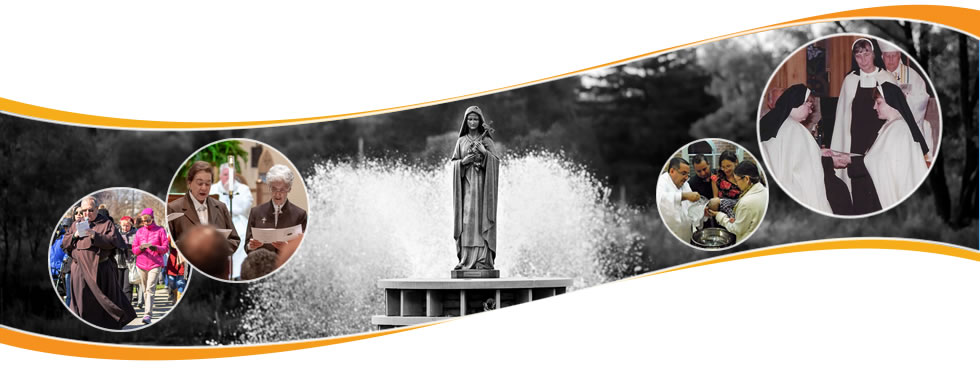
The Missionary Family Donum Dei was founded by a French priest, Fr. Marcel Roussel-Galle, who was born in 1910 in a little village in the Franche-Comté region and who died in Rome on 22 February 1984.
Having been ordained at Besançon in 1934, Fr. Roussel became intensely preoccupied with the issues facing the Church at that time. Cardinal Suhard had stirred the Church in France to become conscious of the profound de-christianisation of the country. Fr. Roussel was deeply distressed when Fr. Godin published his book, “France, A Mission Country”.
 For Fr. Roussel, Thérèse is second only to the Blessed Virgin as his confidante, his constant friend. It was with Thérèse that he would build a spiritual Family. It was also with her that he would discover the burning thirst of God : to pour his love into the hearts of all people.
Fr. Roussel also understood that his mission was greater than him and that ultimately his mission was to found a Spiritual Family which, following Thérèse, would live the offering to Merciful Love in the world and would be its apostle.
As Parish Priest in the little village of Doubs from 1942 to 1947, he wrote : “the pagan masses attract me : I would love to evangelise them through young women who have given themselves and consecrated themselves totally to God …”
Fr. Roussel went to Paris in 1947 and very quickly he succeeded in bringing together a number of young women who were attracted by the ideal that he proposed. On the 11th February 1950 he gathered them together and gave them the name “Missionary Workers of the Immaculate”.
What was their vocation ? Like Thérèse, their vocation consisted in offering to Jesus their virginity, their entire love and to offer themselves to his Merciful Love.
What was their mission ? To help others to rediscover Christ as he showed himself to the Samaritan woman at Jacob’s Well, and to reveal to the whole of humanity Jesus as God’s gift.
 The first people to whom the Missionary Workers carried their faith in the Merciful Love of Christ were the prostitutes in the Pigalle district of Paris. They also ministered to the workers in the large factories on the outskirts of Paris, to secondary school students, to the sick in hospital and to other workers in various different types of work.
As the years went by, the Family grew : the number of foundations increased and vocations came from different parts. After their time of formation in France and Rome, the Missionary Workers offered themselves to Jesus as spouses through the same offering to Merciful Love as that made by the little Thérèse.
Their communities are always international in order to show that Merciful Love wants to unite people of all races in one family.
They live their vocation in many different ways : as individuals working in the work place ; the Eau Vive restaurant chain ; centres for prayer ; apostolates to prisoners, poor areas and hospitals, as well as catechetical and chaplaincy services in colleges, etc.
In 1981, some mothers approached the Missionary Workers requesting that they be given spiritual help in order to strengthen their life as spouses and mothers. Faced with the world-wide crisis that was undermining the human family, Fr. Roussel felt called to found a movement of mothers to be apostles in their own homes and in the homes of others. These mothers, called Missionary Mothers, became organised and the formation meetings brought them into contact with the way of Thérèse. They too, with their husbands, offered themselves to Merciful Love.
In 1984, Fr. Roussel found that his Spiritual Family had different faces : Missionary Workers, mothers, families, and young people. Despite different ways of living, the same spirit of love was in their hearts. Father Roussel decided that all the members should be grouped together into one spiritual family to be called the Donum Dei Missionary Family. “If only you knew the gift God is offering you”. He understood that this Family could not remain faithful to its mission to live the message of little Thérèse in the world if it was not – like Thérèse – rooted in the Carmelite Order. Shortly before his death on the 22nd February 1984, Fr. Roussel entrusted the Donum Dei Missionary Family to the Carmelite Order so that it would be incorporated into the International Tertiary Secular Order.
This was finally realised on the 22nd February 1987. At this moment, there are about 30 groups of the Donum Dei Family spread across the five continents.
The Missionary Family is present in Lisieux since November 1995 at the invitation of the Diocese. Its mission is to maintain the Louis and Zélie Martin Foyer – 15 Avenue Sainte Thérèse – as a centre of prayer and accommodation at the service of the pilgrim to Lisieux. The Missionary Workers of the Immaculate also participate in the liturgical life of the Saint Thérèse Pilgrimage by leading the singing at Mass and by organising prayer liturgies at the request of groups coming to Lisieux.
The Donum Dei Missionary Family is also present at Lisieux through its members who often gather with the Missionary Workers of the Immaculate for days of spiritual reflection and family sharing.
Revenir en haut
Electoral Chapter of the Monastery of Santiago de los Caballeros, Dominican Republic
Written byThe Elective Chapter of the Carmelite Monastery of Santiago de los Caballeros, Dominican Republic, was held 19 February 2016. The following were elected:
- Prioress: Sr. Grecia del Carmen Abreu Báez, O.Carm.
- 1st Councilor: Sr. María del Carmen García Collado, O.Carm.
- 2nd Councilor: Sr. M. Ramona Ramos Hernández, O.Carm.
- 3rd Councilor: Sr. Silveria María García Durán, O.Carm.
- 4th Couniclor: Sr. M. Concepción Solano Ureña, O.Carm.
- Director of Novices: Silveria María García Durán, O.Carm.
- Treasurer: Sr. M. Nieves Tavárez Tavárez, O.Carm.
A Web page for the 450th anniversary of the birth of St. Mary Magdalen de'Pazzi
Written byOn the Order's website a webpage has been opened that is dedicated to the 450th anniversary of the birth of St. Mary Magdalen de'Pazzi, at the following address: http://ocarm.org/mmp450/en
The page will be updated throughout the year with information and material for formation, dealing not only with this saint, but also the events and celebrations organised by the General Curia and the various sectors of the Carmelite Family. To begin, readers can find already on the page the lastest news and check some recent publications concerning St. Mary Magdalen de’ Pazzi.
In this issue of CITOC-magazine, we get a special sense of the internationality of our Order, on account of meetings held recently in various geographical areas. Here you will find an article on the present situation of the life of Carmelites in Latin America, especially the formation course for Carmelite students and young formators held in Peru, and on the 4th congress of ALACAR (the Association of American Carmelites) held in El Salvador, an important initiative for the colaboration between the members of the Carmelite Family in Latin America and its development.
Meanwhile in Europe, last Summer, a meeting of the Awakening project took place. Through a number of experiences and working sessions the young participants came to a greater awareness of their belonging to Carmel.
Still with young people, another article talks about the activities of young Carmelites in the countries of Asia-Australia-Oceania. They met in Indonesia for ongoing formation which allowed them to reflect on their first five years in ministry.
Moving around the geographical areas, there is an article on the Carmelite presence in Papua New Guinea. All of this is further enriched by the impressions offered by the respective Councillors General in relation to their work and the projects they are following, for example, those of the Councilor for Africa writing about the assembly of the superiors and directors of formation from the whole of Africa that took place in Tanzania.
This issue dedicates space also to the various celebrations going on in the Carmelite world, such as the Dedication of the city of Palestrina, Italy, to Our Lady of Mount Carmel, and the celebration of the IV centenary of the foundation of the Carmelite monastery in Zaragoza, Spain.
It is obvious that without money none of these events could ever happen: it is appropriate then that this issue includes a report on the triennial meeting of the bursars of the Order, held in Fatima.
In addition to all of that, we offer a selection of main news items, some of which appeared in CITOC-online.
We wish all our readers an enjoyable reading of this latest issue of CITOC-magazine.
Caryll Houselander
As to your Lent...I can only tell you my own experience. A mass of good resolutions, I think, are apt to end up in disappointment and to make one depressed. Also direct fault-uprooting: it makes one concentrate too much on self, and that can be so depressing. The only resolution I have ever found works is: "Whenever
want to think of myself, I will think of God." Now, this does not mean, "I will make a long meditation on God," but just some short sharp answer, so to speak, to my thought of self, in God. For example:
"I am lonely, misunderstood, etc."
'The loneliness of Christ at his trial; the misunderstanding even of his closest friends."
Or:
"I have made a fool of myself."
"Christ mocked—he felt it; he put the mocking first in foretelling his Passion—The Son of Man shall be mocked, etc.'—made a fool of, before all whom he loved."
Or:
"I can't go on, unhelped."
"Christ couldn't. He couldn't carry the cross without help; he was grateful for human sympathy—Mary Magdalene—his words on that occasion—other examples as they suggest themselves—just pictures that flash through the mind." This practice becomes a habit, and it is the habit which has saved me from despair!...
Different people have different approaches to Christ. He has become all things—infant, child, man—so that we all can approach him in the way easiest for us. The best is to use that way to our heart's content, and not to trouble about any other.
Caryll Houselander
We do not pray in order to improve our talents, to develop more clearly an intellectual synthesis, or widen our culture, religious or otherwise. We pray in order to tell God once again that we love him and know that he loves us, and to relate ourselves to the plan of mercy that is his.
We run still greater risks in the realm of sensibility, and in believing that our prayer has value only when we have "felt" something. The modern world takes special interest in "experiences," descriptions, states of the soul; there is a kind of cult for everything that can yield some kind of "interior witness." We delight in working out a projection of ourselves that arises from the senses.
Prayer is an extremely favorable opportunity for realizing such a projection. But this will always be the great difference between Christian and non-Christian prayer: the former does not contain its own end. A person does not pray primarily in order to find himself, but to give himself, to enter into a plan of salvation that goes beyond himself. In Christian prayer, what matters above all is not the quality of the interior experience, which can sometimes be very shallow, but the Person who is the "object" of this experience. Saint Paul speaks of "groanings" (Rom 8:26) or of a "cry" (Gal 4:6). What is important is not our experience but the gift we make of ourselves. We should enter into prayer, not to receive, but to give, to give ourselves and lose ourselves. And if friendship with God is to remain pre-eminent in our prayer, we must enter into prayer in order to give ourselves as a free gift, with the knowledge that we may not always really give what we are giving, and yet without being concerned about what we are giving.
Father Bernard Bro, o.p.

Dom Anscar Vonier, o.s.b.
The sins of Christians are offenses against a state, the state of the redeemed. By committing sin we walk unworthily of our calling, we prove ourselves to be bad children, people who are unmindful of their election. We sin against Christ, we hurt him in his brethren. Whether we be conscious or not of those implications, we cannot avoid having that kind of guilt on our souls every time we transgress. In his repentance the Christian has to think of many things which are exclusive to him. He has to remember his baptismal robe, he has to bear in mind his adoption as a child of God, the seal of the Spirit, the sweetness of the Bread of Life, the Blood of the Lamb, all of which mysteries he has more or less trampled under foot every time he has sinned grievously. He has saddened his brethren, he has brought shame on the Church, he has made the infidel blaspheme the name of the Lord, he has made the work of the Holy Spirit more difficult, he has been a dead weight on fervent men and women to whom nothing is dearer than the glory of Christ.
All these results and many more are infallibly associated with our sins. Therefore when we repent hosts of invisible powers are set in motion, all demanding to be satisfied and to be vindicated. Now it is the special merit of the Christianas poenitens that he is determined to make full amends for all past outrages, to give satisfaction to the whole hierarchy of the supernatural order, and to repair the gap he has made in the life of Christ's mystical Body. His repentance is more than a sorrow; it is a hunger and thirst after justice; it is an effort to fill up those things that are wanting to the Body of Christ through his guilty acts.
Dom Anscar Vonier, o.s.b.

Sister Ruth Burrows, o.c.d.
We find it hard to accept how involved God is with us, how vital we are—by his free choice—to his complete happiness. Scripture encourages us to find our analogies in human images. We are adopted children. Consider a blissfully happy couple finding all they need in one another. For no other reason than generosity and the desire to share their happiness, they decide to adopt children as their own. From then on their life undergoes a profound change. Now they are vulnerable; their happiness is wrapped up in the welfare of the children; things can never be the same again. If the children choose to alienate themselves and start on the path to ruin, the couple are stricken. They will plead, humble themselves, make huge sacrifices, go out of themselves to get their loved ones to understand that the home is still their home, that the love they have been given is unchanging. This perhaps gives us some insight into redemption. In a mystery we cannot fathom, God "empties," "loses" himself, in bringing back to himself his estranged, lost children. And this is all the Father wants. This is the only remedy for his wound. God is no longer pure God, but always God-with-humanity- in-his heart.

Father Gabriel of Saint Mary Magdalen, o.c.d.
There is no limit to God's mercy. He never rejects us because of our sins, he never grows weary of our infidelities, he never refuses to forgive us, he is always ready to forget our offenses and to repay our ingratitude with graces. He never reproaches us for our offenses, even when we fall again immediately after being forgiven. He is never angered by our repeated failures or weakness in the practice of virtue, but always stretches out his hand to us, wanting to help us. Even when men condemn us, God shows mercy to us; he absolves us and sends us away justified....
How far does our mercy go? How much compassion do we have for the faults of others? The measure of our mercy toward our neighbor will be the measure of God's mercy toward us....
God does not require us to be sinless that he may shower upon us the fullness of his mercy, but he does require us to be merciful to our neighbor, and moreover, to be humble. In fact, to be sinners is not enough to attract divine mercy; we must also humbly acknowledge our sins and turn to God with complete confidence. "What pleases God," said Saint Therese of Lisieux, "is to see me love my littleness and poverty; it is the blind hope I have in his mercy. This is my sole treasure." This is the treasure which supplies for all our miseries, weaknesses, relapses, and infidelities, because by means of this humility and confidence we shall obtain the divine mercy. And with this at our disposal, how can our wretchedness discourage us?


