














O.Carm
Causa Nostrae Laetitiae
PROFESSIO SOLEMNIS
14-03-26 Randy Fernando Romero Morillo (Baet-Ven) La Victoria, Venezuela
19-03-26 Kacper Galiński (Pol) Krakow, Poland
19-03-26 Piotr Grudziński (Pol) Krakow, Poland
ORDINATIO DIACONALIS
21-03-26 Horacio Antonio Vargas Cáceres (Baet-Ven) La Concepción, Venezuela
ORDINATIO SACERDOTALIS
07-03-26 Manuel Antonio Villarreal Franco (Baet-Ven) Mucunchies, Venezuela
25-03-26 Davi Maria Santos (Pern) Recife, Brasil
11-04-26 Daniele Di Filippo (Ita) Roma, Italia
11-04-26 Eduardo Antonio Díaz Esinoza (PCM-Perú) Miraflores, Lima, Perú
Whitefriars in Donvale, Australia Celebrates 65 Years

Whitefriars College celebrates 65 years since its foundation this year. The first group of students was welcomed to the College on February 14, 1961. Carmelite Frank Shortis was the founding principal. The school is located in Donvale, a suburb of Melbourne.
The College was founded by the Carmelite Order of Priests and Brothers as a Catholic secondary school for boys. This was in response to a strong demand from local Catholic families who wanted an educational institution grounded in their faith.
The Carmelite tradition has deep roots, stretching back to the late Twelfth Century in the Holy Land. There, a small group of Christian hermits settled on Mount Carmel, inspired by a spirit of prayer and reflection. Despite challenges that led them to leave Mount Carmel, they carried the essence of their way of life, spreading it across the world.
Today, the Carmelites continue to witness God’s presence in people, nature, the Word of God and within the human spirit. Their mission is to cultivate a spirit of prayer, reflection, justice and peace—values which are central to our educational approach. At Whitefriars, these values are embraced through service, respect for individuals and fostering a strong sense of community. We live in allegiance to Jesus Christ, drawing inspiration from Mary, the Prophet Elijah and other holy figures who have followed the Carmelite way.
The College is structured around a house-based, Vertical Pastoral Care system, with each house dedicated to a Carmelite saint or blessed figure. These figures serve as inspirations for our students as they pursue excellence in education based on deeply human and Christian values.
The College has produced a series of 6 short videos to tell something of the story of the last 65 years. These can be viewed at: https://www.youtube.com/results?search_query=whitefriars+college
Baptist Spagnoli: The Christian Virgil
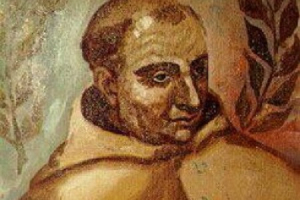
17 April Memorial
Baptist Spagnoli was a literary genius. He devoted the fruitfulness of his extraordinary literary ability to the service of the Order and the Church. His Apologia pro Ordine Carmelitarum (Apology for the Order of Carmelites) stands as the principal testimony to his love for Carmel, while his total devotion to the Church is attested not only by his poems in honor of Innocent VIII, Julius II, and Leo X, but also by all those writings that reveal his active engagement with the issues most deeply felt by Christendom at the time, such as, for example, the Obiurgatio cum exhortatione ad capienda arma contra infideles, ad reges et principes christianos (Admonition and Exhortation to Christian Kings to Take Up Arms Against the Infidels).
The events that were then disrupting the life of the nation also caused him to write. His verses Pro pacata Italia post bellum ferrariense (To Italy at Peace After the War of Ferrara), those of In Romam bellis tumultuantem (Against Rome in Turmoil from Wars), the poem Debello veneto commentariolus (Brief Commentary on the Venetian War), the Trophaeum pro Gallis expulsis produce Mantuae (Victory Ode on the Expulsion of the Gauls by the Duke of Mantua), and above all the De calamitatibus temporum (The Calamities of the Times), reprinted nearly thirty times between 1489 and 1510 alone, demonstrate how deeply the Mantuan felt the drama that was tormenting Italy in those years.
The friendships that bound him to distinguished figures of the time is proof of his high prestige in the world of culture. He was one of the most celebrated figures of the humanist movement, especially for his work Bucolica: seu adolescentia in decem aeglogas divisa (Bucolica or Adolescence Divided into Ten Eclogues), of which there are nearly 150 editions, more than a hundred of them in the 16th century alone, which is why his contemporaries, including Erasmus of Rotterdam, proclaimed him the Christian Virgil.
His poetic work, whose fame reached as far as Shakespeare with some even included in his play Love’s Labour’s Lost—influenced English literature in particular: Alexander Barclay paraphrased his eclogues, Edmund Spenser imitated him in The Shepheardes Calender (twelve pastoral eclogues), and John Milton in the Ode on the Morning of Christ’s Nativity.
The work required by the various offices entrusted to him and his intense literary activity did not distract him from the Carmelite ideals of the interior life and a tender devotion to the Blessed Virgin.
The practice of the virtues and renunciation of the world form the theme of his De vita beata (The Blessed Life), a dialogue he wrote when he was barely sixteen years old; the aspiration to solitude and the desire for the presence of God are constantly found in his works and in his correspondence. In honor of Mary, he composed several odes and a three-volume poem, the Parthenices Mariana (Songs to the Virgin), which spread rapidly throughout Europe, as some seventy editions were published, fifteen in the fifteenth century and nearly fifty in the sixteenth. He worked to have the custody of the sanctuary of Loreto entrusted to his Congregation, which he obtained, albeit for only a few years, in 1489.
The six Parthenices composed in honor of the martyrs Catherine, Margaret, Agatha, Lucy, Apollonia, and Cecilia, and the poems in honor of St. John the Baptist, St. George, and other saints, constitute, together with the twelve books of the De sacris diebus (The Sacred Days), another example of his religious piety.
Impressed by the growing corruption of the clergy and the people, he expressed his reformist aspirations not only through his insightful literary works, such as the IXth eclogue De moribus curiae romanae (On the Customs of the Roman Curia), but also through a passionate speech delivered in the Vatican Basilica in 1489, before Innocent VIII and the cardinals. Some of his particularly harsh statements led Luther himself to rely on the authority of Baptist to take a stand against Rome. And in an Anthologia... sententiosa collecta ex operibus Baptistae Mantuani (Anthology of Sentences Collected from the Works of B.V.M.), published in Nuremberg in 1571, the Protestants went so far as to point to the Carmelite as a precursor of the German reformer. But it is worth noting the essential difference between the reformist spirit of Blessed Mantuano, who sought to work within the Church, and that of Luther, which was to lead to schism.
Adapted from the entry for Baptist Spagnoli by Edmondo Coccia in Santi del Carmelo, a cura di Ludovico Saggi Ocarm, Institutum Carmelitanum, Roma, 1972.
To read more ...
Celebrating At Home - Third Sunday of Easter
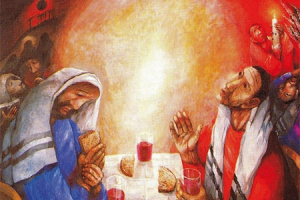
Strangers Share a Journey, Hearts Begin to Burn
and They Recognised Him (Lk 24:13-35)
It is a heart-warming story and we can easily identify with the two disciples feeling crushed by the weight of their shattered dreams. They don’t believe the story of the women that Jesus is alive.
They don’t recognise the stranger when he walks beside them. Perhaps that’s because they are so
involved in their own hurt and disappointment, and doesn’t that sometimes happen to us, too?
What does Jesus do? First, he invites them to share with him their story, he lets them talk it out. Then he draws them into the bigger story of his life, death and resurrection by unfolding the scriptures for them. In other words, he gives them a sense of perspective. He puts their story in touch with the bigger story of God’s purpose.
Their hope is being rebuilt and their hearts are beginning ‘to burn’ as Jesus talks. They are beginning to ‘catch fire’ again. When they arrive at Emmaus, Jesus makes as if to go on, but the disciples beg him to stay.
At table Jesus takes the bread, says the traditional Jewish blessing (like Grace Before Meals) and breaks the loaf and the eyes of these faithful, yet blind, disciples are opened to recognise him.
The disciples can scarcely contain themselves and set out immediately to return to Jerusalem, eager to share their story. To travel at night in the ancient world was to risk robbery and death, but, they just can’t wait.
From being two sad, depressed, down-hearted, grieving men the disciples have been transformed into impatient, enthusiastic heralds of good news through their encounter with Jesus.
It is the same Jesus whom we encounter in our hearts and in the Eucharist.
Maybe we could spend a little time sharing with Jesus our story and listening more deeply to his.
- pdf Celebrating At Home - Third Sunday of Easter [PDF] (3.74 MB)
- default Celebrating At Home - Third Sunday of Easter [ePub] (2.84 MB)
- pdf Celebrando en Familia - Tercer Domingo de Pascua (924 KB)
- pdf Celebrando in Casa - Terza Domenica di Pasqua (923 KB)
- pdf Celebrando em família - Terceiro Domingo da Páscoa (919 KB)
Flowers for Easter Mass a Blessing from St. Titus
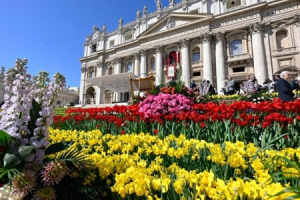
Flowers for Easter Mass a Blessing from St. Titus Brandsma to the Church
When Titus Brandsma was beatified as a martyr by Pope John Paul II on November 3, 1985, St Peter’s was alive with thousands of flowers from the martyr’s home country of the Netherlands. This set off a tradition of Dutch florists providing the flowers for the decoration of St. Peter’s Square and the basilica each Easter Sunday. The flowers are also part of the backdrop for the Urbi et Orbi blessing delivered by the pope from the balcony at the center entrance to St. Peters.
The NL Times reports that the tradition started following Pope John Paul II’s visit to Utrecht on May 12, 1985. The floral display during that visit is thought to have left such a powerful impression that the Dutch flower industry was asked to supply flowers for the beatification of Brandsma. They have been an annual Easter gift since 1986.
In 2026 there were 65,000 tulip bulbs, daffodils, hyacinths, and mini-daffodils; 220 white and orange violets; 7,800 flowers, including roses, delphiniums, anthuriums, chrysanthemums, gerberas, and mathiolas; 600 branches of plumosa; 80 azaleas and 600 long branches of willow catkins, long branches of eucalyptus, as well as various types of foliage,” according the Vatican.
Before leaving the Netherlands, all the plants were blessed by the president of the Dutch Bishops’ Conference.
Paul Deckers, in an online article in Thursd reminisced about his involvement in the floral decorations of St. Peter’s Square for Easter. He had been the “Head Arranger” for the Vatican donation for many years until 2021. His arrangements are noted for including branches, roots, leaves, mosses, and other natural materials, creating compositions that are symbolic, emotional, and often spiritual in character. His philosophy is “doing more by using less.” His efforts resulted in audiences with Popes John Paul II, Benedict XVI, and Francis.
For pictures of the flowers at the Vatican, go to: https://thursd.com/posts/thank-you-for-the-flowers-from-the-netherlands
On Easter Sunday afternoon, an article from the same NL Times pointed out the pope’s message on global conflict and his urging world leaders to “choose peace” as there is a growing public indifference to violence. But he failed to include a “Bedankt voor de bloemen (“Thank you for the flowers”) which ended a 40-year tradition in the papal address. The article also noted that his address included Arabic, Polish, and English among the 10 languages but not Dutch among the 10 languages he spoke.
New Province in Spain Holds First Chapter
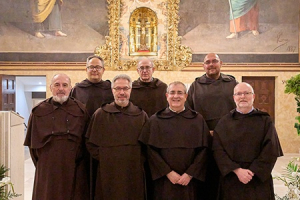
New Province of El Dulce Nombre de María in Spain Holds First Chapter in Salamanca, Spain
The first provincial chapter of the Province of “El Dulce Nombre de María” was held from April 7-9, 2026, in the Centro de Espiritualidad «San Ignacio» in Salamanca, Spain.
This new province was erected on the April 7, 2026, and is the result of a combination of the Province of Aragón Castille and Valencia of Saint John of the Cross and the Province of Bética of “El Dulce Nombre de María.” The new province will not to be called a Spanish Province as it goes beyond Spain, having presences in Argentina, Burkina Faso, Spain, Puerto Rico, the Dominican Republic, and Venezuela.
Over the last three years, much work had been done to prepare for this moment including, most especially, a joint assembly of the members of both combining provinces held in Madrid in 2025. As a result, there was already much consensus about the decisions that the first chapter had to formally take.
The prior general, Desiderio García Martínez, O. Carm., concluded his opening address with the words that Brother Pablo María de la Cruz, O. Carm., a young Carmelite who made his profession in articulo mortis and died at the age of 21, addressed to Pope Francis on the occasion of World Youth Day 2023 in Lisbon: “In Carmel, the Garden of God, the antechamber of Heaven, Mary grows, the Sunflower of God, whom I like to call and imagine as the Virgin of Spring. I ask her to transform the deserts of pain into gardens of consolation, and in her hands I place the evangelization of young people.”
During the chapter, the forty-four gremiales participating at the chapter spent time considering the reports of the outgoing provincials, provincial councilors, delegates for the nuns, and the commission for the schools. Time was also spent considering the statutes for the new province and especially the statutes for the two provincial commissariats (Las Antillas, Venezuela), and the provincial project for the next three years.
Bishop José Luis Retana Gozalo, the bishop of Salamanca, presided at the closing Eucharist of the Chapter which was held in the Carmelite convent, of “El Carmel de Abajo” which is also the international novitiate house for Europe. Following the Eucharist, Bishop José Luis blessed the newly finished Carmelite Spirituality Centre “John of the Cross.”
During the Chapter of the new province, the following leadership elected or confirmed:
Prior Provincial | Prior Provincial | Priore Provinciale
Salvador Villota Herrero, O. Carm.
1st Councilor | 1er Consejero | 1o Consigliere
Fernando Millán Romeral, O. Carm.
2nd Councilor | 2do Consejero | 2o Consigliere
David del Carpio Horcajo, O. Carm.
3rd Councilor | 3er Consejero | 3o Consigliere
Francisco Javier Beauvais de La Motte, O. Carm.
4th Councilor | 4to Consejero | 4o Consigliere
Vicente Aranda Guillén, O. Carm.
Confirmed / Confirmados / Confermati
Commissary Provincial of the Antilles | Comisario Provincial de las Antillas | Commissario provinciale delle Antille
Jorge Rafael Betancourt Ramírez, O. Carm.
Commissary Provincial of Venezuela | Comisario Provincial de las Antillas | Commissario provinciale delle Antille
Alexio Enrique Ordóñez, O. Carm
Pope Leo Calls for a Worldwide Prayer Vigil for Peace
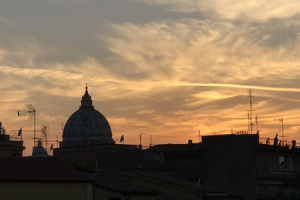
International Prayer Vigil for Peace
Saturday, April 11, 2026 – St Peter’s Basilica
6 PM (Rome)
Pope Leo XIV has invited all people around the world to join him in praying for peace on Saturday, April 11, at 6pm (Rome time). The Prayer Vigil for Peace will be held in St. Peter’s Basilica, but everyone can participate via Vatican Communications (vatican.va)
The pope and various Catholic organizations as well as individuals have expressed grave concern that the war between the US/Israel and Iran is not only causing massive suffering and death but that the war is unjust.
In his Easter Sunday message, the pope highlighted that Jesus walked the path of dialogue and that the power with which Christ rose is entirely nonviolent— rejecting revenge, choosing compassion, praying for one another and seeking the common good rather than private interests.
“Let those who have weapons lay them down! Let those who have the power to unleash wars choose peace. Not a peace imposed by force but through dialogue! Not with the desire to dominate others, but to encounter them! We are growing accustomed to violence . . . and becoming indifferent . . . The peace that Christ gives us is not merely the silence of weapons, but the peace that touches and transforms the heart of each of us!” (Leo XIV)
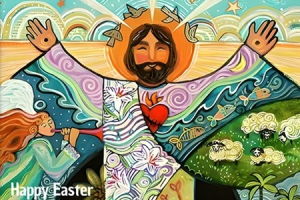
2026 Easter Message from the Prior General
Fr Desiderio García Martínez, O. Carm. -- 2026
Easter Message from the Prior General
Dear brothers and sisters of the Carmelite Family: Christ is risen!
We joyfully celebrate the resurrection of Christ, which is the cornerstone of the Christian faith. Faith is born of a personal encounter with the Risen Christ and becomes a source of courage and freedom that leads us to proclaim to the world: Jesus is risen and lives forever!
The Midrash on Genesis recounts: “A king built a house. He then invited his friends to celebrate with a splendid feast. Everything seemed to be going well; the evening was proceeding perfectly, and everyone was happy. But as the hours passed, night fell. Then panic set in. They could not see one another, nor could they even enjoy the banquet. The king said: ‘What use is all this to me if I have no light to enjoy it?’ Then God said, ‘Let there be light, and there was light. And God saw that the light was good.’ And alongside the light there was eternal joy, an eternal feast, an eternal celebration...” (Bereshit Rabah / Gen 1:3). Christ is the Light that has conquered the darkness. With the Resurrection, the day of God enters the night of history. The Resurrection of Christ, a historical truth, is more than a mere biological reanimation of the corpse; it is the most decisive ontological leap of the human race. The Resurrection is an outpouring of love that broke the tragic bond between birth and death, transforming it into a blessed sequence: birth, death and life. God’s boundless love makes us immortal. Martín Descalzo, a Spanish writer, put it this way. “Throughout my life, I have dreamed of countless things. Now I know that… only by loving will I live forever; that the only parts of my soul that will have truly been alive will be those I devoted to loving, serving and helping others. And it’s taken me fifty years to realise it!”
The Paschal Mystery has ushered in a new era, a new world (cf. 2 Cor 5:17). Christ’s Resurrection has opened a new chapter in history, which will come to an end when all things are brought together in Christ, the one Head. Through baptism we have been buried with Christ in death so that we might rise to new life. And why rise? Let us recall Teresa of Ávila. “To rise, only to die again in the trials of love.” Only if we are risen can we give life! Alive to serve each day at work… Alive to care for our sick brothers and sisters… Alive to be sowers of justice and peace around us… This is the purpose of our lives: to rise, so that we may die again, every day, in love.” The world will believe if it sees that the Body of Christ is risen. And we are the members of the Body of Christ. Now more than ever we need an army of the risen, immune to death, to sadness, to discouragement… who heal broken hearts, comfort the afflicted, sow hope, and have a sense of humor; who recognize his presence in the Eucharist; who proclaim him as the one Lord of Life… It took only one night for the Lord to bring Israel out of Egypt; but it took forty years for the Lord to bring Egypt out of the heart of Israel.” What is there still in our lives that needs to be brought back to life?
May Mary, Mother of Mount Carmel, help us to understand this mystery of love that transforms hearts, and enable us to fully savor the joy of Easter, so that we, in turn, may share it with the men and women around us.
Celebrating At Home - Second Sunday of Easter
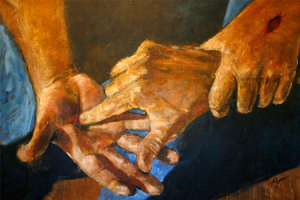
A Joyful Meeting, the Spirit Received,
Doubts Transformed (John 20:19-31)
The Gospel of each Sunday is a meditation on Jesus as: the resurrected Christ, made known in the scriptures and the breaking of the bread, the bearer of life in all its fullness, our way, truth and life, pledge of God’s love.
In today’s Gospel reading there are two stories of transformation through encounter with the risen Jesus.
Firstly, Jesus appears to a group of frightened and bewildered disciples hiding in a room. His first words are, ‘Peace be with you’. Fear and bewilderment turn into joy as the disciples recognise the presence of the Risen Jesus with them. But that’s not all. He then sends them out to be missionaries of peace and forgiveness. In receiving the Holy Spirit they are transformed from a group of frightened people, hiding in a room, to bold proclaimers of God’s love and mercy.
The second story in today’s Gospel is the one we all know as doubting Thomas, though, really, it should be known as believing Thomas - doubt is only the beginning of the story.
Jesus doesn’t scold or rebuke Thomas. If Thomas is looking for proof, he has only to touch Jesus to see he is real. But Thomas doesn’t do that. It is his personal encounter with Jesus which transforms him from doubter to believer.
It is yet another Gospel reminder that faith is not about believing with our minds or in looking for proof. It is found only in our living relationship with Jesus.
Perhaps these days give us a bit more time just to sit and chat with Jesus, to recognise him already present in our hearts, to allow our fears and doubts to be overcome by love, to find new, creative ways of transforming darkness into light, peace and joy for others.
May the new life we celebrate over the next fifty days bring us the creativity of Spirit we need to be the living heart of God in our world today.
- pdf Celebrating At Home - Second Sunday of Easter [PDF] (3.18 MB)
- default Celebrating At Home - Second Sunday of Easter [ePub] (2.25 MB)
- pdf Celebrando en Familia - Segundo Domingo de Pascua (791 KB)
- pdf Celebrando in Casa - Seconda Domenica di Pasqua (783 KB)
- pdf Celebrando em família - Segundo Domingo da Páscoa (773 KB)
Fr. Dimas Appointed Delegate General for Formation
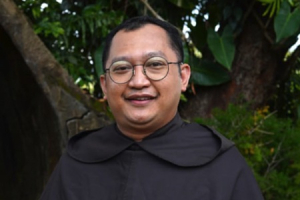
Dimas Pele Alu Appointed New Delegate General for Formation
Alexander Romualdus Dimas Pele Alu, O. Carm., has been appointed the Delegate General for Formation by the General Council.
He was born in Batu, Indonesia, on June 19, 1988. He completed his secondary education at the Seminari Menengah Roh Kudus in Tuka, Bali. He made his temporary profession at the Chapel of the Regina Apostolorum Monastery in Batu on July 12, 2009, and later his solemn profession at the Sacred Heart of Jesus Parish in Kayutangan, Malang, on July 9, 2015. He was ordained a priest at the Maria Bunda Karmel Cathedral in Malang on August 25, 2016.
Alexander pursued higher education in philosophy and theology, earning a Bachelor’s Degree in Philosophy and Theology from STFT Widya Sasana in Malang (2009–2013) and a Master’s Degree in Philosophy and Theology from the same institution (2014–2016). He further specialized in biblical studies, completing a Master’s Degree in Sacred Scripture at The Catholic University of America in Washington, DC (2018–2020). Currently, he serves as a lecturer at STFT Widya Sasana in Malang and as a formator for post-novitiate friars at the St. Titus Brandsma Friary in Rajabasa-Malang.


