



















O.Carm
Celebrating At Home - Sixth Sunday of Easter

Remembering & making present
(John 14:23-29)
Our reading of The Farewell Discourse in John’s Gospel (13:31-17:26) continues in the Gospel for today as Jesus makes a number of promises to the disciples.
The opening words say that those who love Jesus will keep his word. This is not like keeping road rules. It is about allowing the word of Jesus to form our hearts and shape our lives. Throughout John’s Gospel the word that Jesus speaks is about his boundless affection for the Father and the disciples.
Another favourite theme of John is that, just as the Father and Jesus abide together in love, they will also come to abide in the heart of the disciple.
It is this bond of love that creates the ‘dwelling place’ for God in the heart of the disciple. There is no separation from the Father; the disciple does not need to look to a heavenly place in order to experience the presence of God.
Jesus promises that the Father will send the Advocate, the Holy Spirit, to help the disciples ‘remember’, that is, to understand more deeply the words and actions of Jesus, especially his death and resurrection. This remembering will make Jesus present to them.
Abiding in the love of Jesus and the Father brings a peace that cannot otherwise be found in this world, so the disciples have no need to be afraid of the future, not even the impending departure of Jesus. In fact, if they are already truly abiding in the presence of God and Jesus in their hearts, why should his physical departure disturb them?
Jesus does not speak these words in the sense of foretelling the future, but rather to prepare the disciples for their daily ‘remembering’ of, and making present, his words and actions in their own lives.
This Gospel begs us ask ourselves if we are truly people who remember Jesus and allow his Spirit to shape our words, thoughts and actions so that he may remain present to us and to those around us.
- Celebrating At Home - pdf Sixth Sunday of Easter [PDF] (3.05 MB)
- Celebrating At Home - default Sixth Sunday of Easter [ePub] (3.01 MB)
- Celebrando En Familia - pdf Sexto Domingo de Pascua (447 KB)
- Celebrando In Casa - pdf Sesta Domenica di Pasqua (455 KB)
Texts for Masses of Thanksgiving and Prayers of the Faithful

Readings/liturgies for the Masses of Thanksgiving for the Canonization of Titus Brandsma and Prayers of the Faithful.
Texts for Masses of Thanksgiving for Canonization of Titus Brandsma
Download the Saint Titus Brandsma - Mass of Thanksgiving - English version pdf here (290 KB)
Download the San Titus Brandsma - Messa di ringraziamento - Italian version pdf here (326 KB)
Download the San Tito Brandsma - Misa de Acción de Gracias - Spanish version pdf here (189 KB)
Prayers of the Faithful
Download the Saint Titus Brandsma - Prayer of the Faithful - English version pdf here (119 KB)
Download the San Titus Brandsma - Preghiera dei Fedeli - Italian version pdf here (116 KB)
Download the San Titus Brandsma - Oración de los fieles - Spanish version pdf here (120 KB)
Texts for Masses of Thanksgiving and Prayers of the Faithful
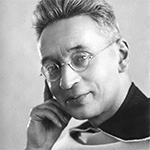
Readings/liturgies for the Masses of Thanksgiving for the Canonization of Titus Brandsma and Prayers of the Faithful
International Hymn for the Canonization of Titus Brandsma
Mr. Ephrem Feely was commissioned by the Steering Committee to write a hymn for the Order for the canonization of Titus Brandsma. It is a re-working of the traditional hymn Adoro te which Titus Brandsma used to sing when he was unable to celebrate Mass during his time of arrest.
Five versions are available: English, Italian, Spanish, Dutch and International.
Download the Adoro Te Devote - English version pdf here (313 KB)
Download the Adoro Te Devote - International version pdf here (310 KB)
Download the Adoro Te Devote - Dutch version pdf here (308 KB)
Download the Adoro Te Devote - Italian version pdf here (304 KB)
Download the Adoro Te Devote - Spanish version pdf here (308 KB)
International Hymn for the Canonization of Titus Brandsma
Mr. Ephrem Feely was commissioned by the Steering Committee to write a hymn for the Order for the canonization of Titus Brandsma.
11. A tale of two cells
 When Titus Brandsma was arrested by the Gestapo on January 19, 1942, he was locked into a solitary cell.
Like many other Dutch patriots, he was taken to a prison nicknamed the “Orange Hotel” in Scheveningen so called because of the royal House of Orange, and the Queen’s government in exile. Many fellow prisoners may have sunk into despair that their normal lives were at an end. But for Titus, it was just a beginning.
Friar Brandsma had lived his life in total faithfulness to the Carmelite Rule. One essential element of that Rule stated that the individual should “stay in his own cell, or near it, pondering the Lord’s law day and night and keeping watch at his prayers unless attending to some other duty.”
Titus had always been a joyful model of regularity to prayer with his community. No matter how busy his life was, he tried to be present at all prayer and community activities. But his “other duties” were electrifying! In addition to his University activities, he worked for the reunification of the Eastern Churches, and organized a Marian congress, and one on Dutch medieval mysticism. He contributed to activities honoring St Boniface and Frisian saints. He went on a lecture tour of Ireland, Canada, and the United States in 1935. His lectures were published as “Carmelite Mysticism: Historical Sketches.” At the request of the Dutch bishops, he was also spiritual liaison for the Catholic schools and their delegate for the Catholic journalists.
The seven weeks Titus spent at Scheveningen were relatively easy, as prisons go. It was a normal civilian facility which had been taken over by the SS, and was home to Titus during his interrogation by SS Sergeant-Major Paul Hardegen. It was a stark existence, but not actively cruel, as the concentration camps would be later in that year. He was allowed to have books, writing materials and tobacco. The meals were simple, but fairly healthy. He was allowed to wear his own clothes. In fact, it seemed to be such an “ordinary” prison that he never let go of the idea that he might be released any time.
And so it was that Titus immediately went to work turning his prison cell into a monastic cell. All of his busy, frantic activity in the service of church and state had come to a sudden end. There was nothing that he had to hurry off to do. There was nowhere to go. So with his traditional optimism Titus decided to embrace the more spiritual side of Carmelite life, if only to catch up with the prayerful reflection that he had been “too busy” for.
He set up a simple prayer altar using holy cards from his breviary. He displayed cards of the Sacred Heart, St Teresa, and St John of the Cross. His breviary was open to a beautiful picture of Our Lady of Mount Carmel.
He remained conscious of what his brother Carmelites were doing at any hour, and tried to match his activity with theirs. He coordinated both liturgical and devotional prayers with his community. Times for eating and sleeping were beyond his control, but he managed to schedule regular times for prayer, meditating, exercise, study and writing, relaxing, and tidying up his cell. He even worked on a biography of Teresa of Avila.
With all this in mind, Titus was able to write: “Blessed solitude! I am already quite at home in this small cell.
I have not yet got bored here, quite the contrary. I am alone, certainly, but never was Our Lord so close to me.
I could shout for joy because he made me find him again entirely, without me going to see people, nor people me. Now he is my only refuge, and I feel secure and happy. I would stay here for ever, if he so disposed.
Seldom have I been so happy or content.”
In his next prisons, circumstances would not be so pleasant, but his days at Scheveningen may have been God’s blessing as a spiritual preparation for what came next.
Download the Leaflet 11. A tale of two cells pdf here (3.76 MB)
11. A tale of two cells

When Titus Brandsma was arrested by the Gestapo on January 19, 1942, he was locked into a solitary cell. Like many other Dutch patriots, he was taken to a prison nicknamed the “Orange Hotel” in Scheveningen so called because of the royal House of Orange, and the Queen’s government in exile.
Titus Brandsma: Lessons for Living with Illness?
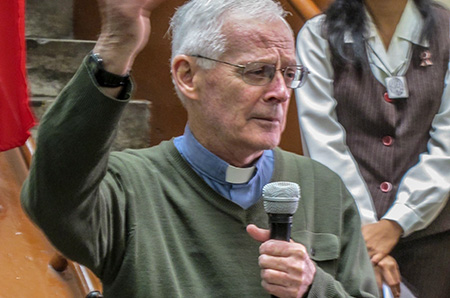 A reflection by
Gregory James Geaney, O. Carm.
Pucusana, Perú
Not for a minute would I dare to compare myself to Titus Brandsma, Carmelite, about to be canonized a Saint. The only thing we have in common is our “Carmeliteness,” nothing more. But I can't help seeing some parallels in our lives' journeys, parallels that are comforting to me as I grow older and finally must face death in real time as Titus did. The parallels are unforeseen gut punches (or passive dark nights of the spirit) occasioned by 1) forced time spent all alone in one's cell, and 2) the prospect of untimely death hanging over one's head. Both experiences lead to an overpowering sense of uselessness and an overwhelming sense of powerlessness.
Maybe Titus saw coming his incarceration in Holland of the 1940's, but I didn't see coming the Covid Pandemic in Peru of the 2020's. In March of 2020 I found myself going from busy pastor in Pucusana, a fishing town just south of Lima, to life in prison in the Pucusana parish house. It was a strict lockdown, the mother of all lockdowns in South America at the time. Suddenly my cell became more than just a day-time refuge from pastoral obligations or a night-time place to lay my head. It became an honest-to-God 13th century style hermitage, the type you would find on Mount Carmel in 1207 or so.
On January 19th, 1942, Titus's normal life, full of vehement activity, changed drastically. He ended up all alone in a real cell with bars and locks, and his first reaction was: "I am now getting what I always wanted in life. I am going to a cell where I will finally become a true Carmelite. "It was almost with a sense of joy that he embraced the solitude of his cell and focused in on the real presence of God accompanying him at every moment, day and night. In the silence of his cell, he would have to deal with a deeper sense of self and give a new meaning to the way he spent his days, no longer feeling useful as was his wont when fighting for peace and justice and equality in his job as University Rector.
My pandemic lockdown in the Pucusana parish was not so joyful, although I did experience a deeper sense of the presence of God in my life. I also had some good spiritual reading to keep my spirits up, like the book on Titus titled Encountering God in the Abyss by Constant Dölle. At the same time, I was experiencing a lot of real guilt (shut up in my room like a coward while the people in town went to work - nurses and doctors with Covid patients, people tending to stores in the market place, bus drivers and fishermen, essential workers). However, unlike Titus, I was not powerless. I asked my Superior for a change of venue, ending up in our Novitiate teaching some classes to the Novices...somewhat of a relief.
The relief lasted a couple of months. Then the Spirit struck again with a second gut punch (second passive dark night of the Spirit). One night, after preparing classes, I began to urinate blood. Several exams and operations later the doctor diagnosed malignant cancer in the bladder. After removal of the tumor i had to move to our main house in Miraflores, once again confined to my cell during therapy, experiencing not only uselessness, but powerlessness and, like Titus, having to be realistic about the possibility of dying in the not too distant future. I soon would be 88 years old.
As luck would have it, my therapy began to work, and I went back to the Pucusana Parish in a limited capacity. The challenge now was how to keep working without becoming bitter. Titus again showed the way. On his way to Dachau via Kleve he was thrown into smaller and more crowded cells. It was a time of terrible physical and spiritual suffering. for Titus, an awful passive dark night, but a night of enormous consolation for those who had the luck of sharing their lives with his. Titus could foresee the suffering to come in Dachau, no longer in a private cell, but thrown into the common barracks with thousands of other prisoners. In one of his poems, he wrote: ¨But pain for me is a blessing for my heart, for pain makes me become like You." The dark night would transform him, as did the time spent in his cell, into the God of compassion and mercy of Dachau. His focus would no longer be on God and himself, but on God and his brother prisoners by incarnating in himself the arcane but accurate definition of love: "when the needs of others are greater than my needs." No matter how much he suffered on work details or getting physically punished by sadistic soldiers, he would always be there for his brothers whose needs were greater than his. He visited each one each day in their common quarters, a consoling word to keep their spirits up, a friendly hug to renew their faith in love, a timely prayer to give them strength to get through the day, while he himself walked blindly in a pitch black night of the soul.
The transformation of Titus was subtle but total. His mentor, John of the Cross, would have it in his Spiritual Canticle: "No flocks are now my care, no other toil I share, and only now in loving is my duty." He no longer had a flock to care for in Holland. He was no longer looked up to as a distinguished scholar who could solve educational problems or give profound theological talks or write profound newspaper articles. Only love was left attending to the needs of his brother prisoners whose needs were greater than his. And so, Titus prepared for death by injection by humbly accepting his present state of dejection and subsequent rejection: "pati and contemni" --to suffer at the hands of the guards and be despised, becoming nothing, no-thing, just a number 30492. But at the same time, he was fusing with the God of Love and Compassion and Mercy, becoming love, which was everything.
As I said at the beginning, I would never dare to compare my life to Titus's life. But how he inspires me to end my Carmelite journey here on earth as nobody, no-thing, not looked for, not consulted, not needed, leaving only love, as Thomas Keating would say. Love is the only thing that matters in the long run. Titus shared God's love with his fellow prisoners right up to the end, and finally, with his nurse, Tizia, who reluctantly had to administer his final lethal injection. He felt so sorry for her and tried to ease her sense of guilt- her need being greater than his at the very last moment of his life. Wow!
God knows how many months or years I have yet to live. The only thing I know now is how to die. Saint Titus, we pray, please show us the way.
Titus Brandsma: Lessons for Living with Illness?
 Not for a minute would I dare to compare myself to Titus Brandsma, Carmelite, about to be canonized a Saint.
10. Clash of Ideas
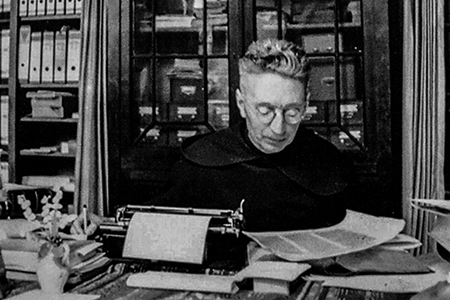 As a University Professor with a specialty in Philosophy, Titus Brandsma would have been acutely aware of the ideas and propaganda circulating in neighboring Germany during the 1930s. The Nazi party promoted a broad spectrum of basic principles which enshrined raw power and violence, especially at the expense of the weak. Friedrich Nietzsche’s celebration of the “superman” glorified the violent exploitation of others as the only path to survival and success. One can only rise to the top of a struggle by stepping on those inferior people below. In such a mindset, Christianity was ridiculed for its care and attention to the poor, sick, elderly, and handicapped. In Brandsma’s own Netherlands, the Dutch Nazi party (the NSB) reflected the same toxic views, although in a somewhat milder form before the war broke out.
In December 1935, following the harsh anti-Jewish Nuremberg Laws, Titus contributed an essay to a collective work by Dutch intellectuals. His contribution, The Delusion of Weakness, suggested that the root of discrimination was envy. The Nazi myth of the Superman grew out of an imagined feeling of inferiority because of success and accomplishments within the Jewish community in Germany. He proposed instead that anyone who was uncomfortable with Jewish contributions should see them as a motivation to create his own success without rancor. In a quick response, Nazi writers in Germany called him a crafty professor, a Jew lover, and even a Communist.
Even though Titus did not respond or hit back at these accusers, he continued to deliver carefully crafted lectures criticizing Nazi ideology. It was enough for him to speak the truth and allow it to be accepted by serious listeners. He spoke frequently about the Nazi distortion of the Aryan race, the Volk, as a near substitute for God. Any sort of criminal activity could be justified if it was rooted in the advancement of the perfect racial purity, with Adolf Hitler as its prophet.
On July 16, 1939, he delivered a sermon honoring the Saints Boniface and Willibrord. He pointed out that the old Germanic paganism which was based on powerful forces was not as serious as the Neo-paganism of the Nazis. Pretending that smashing one’s enemies was a form of high civilization had nothing to do with Nordic culture or centuries of Christian tradition and spirituality. The value of the human person was paramount in the eyes of God. “See how these Christians love one another.”
At each step of his truth-telling, Titus was recorded by meticulous agents of the Security Service of Hitler’s SS.
Even before the outbreak of war or the invasion of the Netherlands, Titus was well known to agents who added their reports to a thickening dossier of his activity. Titus told his friends that there were 2 young men who attended his classes at the University, but were not registered as students. They took detailed notes on whatever he said, but never asked questions or took exams.
After Holland was invaded in May 1940, Nazi administrators took over the civil government and slowly molded the details of Dutch life to reflect Nazi ideology. The points of conflict between Titus and the occupation forces became clear. As the NSB worked to tighten their hold on ordinary life, Titus laid plans to protect Jewish students, maintain the freedom of Catholic schools, and strengthen the Catholic press.
It was his tireless work on behalf of the bishops to defend the Catholic journalists that finally got him into conflict with the Nazis. His ironclad refusal to allow “fake news” to contaminate the integrity of Catholic newspapers marked a point of no return. His fate had already been decided in Berlin. Titus was too intelligent and methodical to be convinced to accept propaganda. He was too courageous and stubborn to be swayed by threats and intimidation.
Nothing remained to the authorities except his arrest and ultimate death. And so it was.
Download the Leaflet 10. Clash of Ideas pdf here (4.97 MB)


