













O.Carm
Vitam Coelo Reddiderunt

Fr. John Benedict Weber (PCM)
11-10-21
Ortus: 25-04-50
P. Temp.: 22-08-70
P. Soll.: 30-03-75
Ord.: 21-05-77
Bishop Michael LaFay Bardi (PCM)
20-10-21
Ortus: 11-11-34
P. Temp.: 26-08-54
P. Soll.: 26-08-57
Ord.: 04-06-60
Consecrated: 15-10-99
P. Honorè Kamate Kombi (Ital-RPC)
01-11-21
Ortus: 16-06-74
P. Temp.: 08-09-00
P. Soll.: 22-10-06
Ord.: 18-04-10
Update From the Postulator General On Titus Brandsma
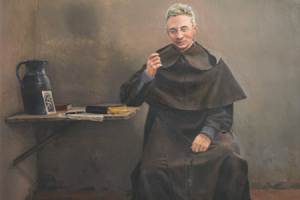
On November 9, 2021, the Ordinary Session of the Cardinals and Bishops who are members of the Congregation for the Causes of the Saints met with a positive result for the cause of the canonization of Blessed Titus Brandsma, O. Carm.
Soon the Prefect of the Congregation, Cardinal Marcello Semeraro, will submit the conclusions of the Ordinary Session to the Holy Father for approval. The Holy Father, if he confirms the conclusions of the Ordinary Session, will then convoke the Ordinary Consistory in which he would official announce the canonization of the Blessed.
We give thanks to God for the positive results obtained so far. We continue to pray to the Lord, hoping that the canonization of Blessed Titus Brandsma will soon be achieved.
Read our post entitled Brandsma Writings Now Available in English here
Celebrating At Home - 33rd Sunday of Ordinary Time

When the Son of Man appears
With the approach next Sunday of the Feast of Christ the King and the end of the Liturgical Year, our readings this Sunday take on an ‘end times’ feel.
In the Gospel Mark presents a vision of the full establishment of the Kingdom and the coming of Christ as the final proof of God’s victory. The language is necessarily that of symbol and myth as it describes something yet to come, not an historical reality. But this does not mean that it has no relationship with reality.
The vision is set against the background of a time of distress. Early Christian communities, like Mark’s, certainly endured much distress through persecution and suffering and their struggles to follow the teachings of Jesus.
The coming in glory of the risen Jesus together with the great gathering of his people from every corner of the earth, were meant as reassurance to a weary and frightened community of believers.
They have followed the way of discipleship, sharing in Jesus’ suffering, some to the point of death. One day the final victory will be God’s and they will enter with Jesus into the fullness of the Kingdom.
In the meantime, however, disciples have to learn to read the signs of the presence of Jesus in everyday life. Jesus is not sitting passively at God’s right hand. Through the Holy Spirit he continues to be actively present in the hearts and lives of believers, and in the universe.
Neither are the disciples to wait passively for the final coming. We wait in patient hope, but not in idleness, because the ministry of making Christ present in every thought, word and action, and every moment of history, continues.
The Gospel ends on a note of uncertain certainty: Christ will come, but we don’t know when.
- pdf Celebrating At Home - 33rd Sunday in Ordinary Time [PDF] (2.17 MB)
- default Celebrating At Home - 33rd Sunday in Ordinary Time [ePub] (2.27 MB)
- pdf Celebrando En Familia - 33 Domingo del Tiempo Ordinario (242 KB)
- pdf Celebrando In Casa - 33 Domenica del Tempo Ordinario (263 KB)
- pdf Celebrando Em Familia - 33 Domingo do Tempo Comum [Português] (243 KB)
...
Celebrating at Home is a Liturgy of the Word centred around the Gospel reading for each Sunday. It includes a reflection on the Gospel and prayers.
It can be used personally or with your family. Parts for all to pray are given in bold print and all the other parts can be shared among those present.
We hope that Celebrating at Home will be a source of nourishment and strength for all who use it.
In the room you decide to use for this prayer you could have a lighted candle, a crucifix and the Bible. These symbols help keep us mindful of the sacredness of our time of prayer and can help us feel connected with our local worshipping communities.
Memorial of Saint Elizabeth of the Trinity (OCD)

On November 8th we celebrate the memorial of Saint Elizabeth of the Trinity (born Elizabeth Catez).
Elizabeth Catez was born on 18th July 1880 in Campo d'Avor near Bourges, France, and she was baptized four days later.
On 2nd August 1901, she entered the Carmel at Dijon where she was clothed in the habit on 8th December 1901. She made her religious profession on 11th January 1903 and 21st January the same year she was given the monastic veil.
The five years that she spent in religious life brought her ever closer to God although the Lord tested her with many spiritual trials and severe physical suffering due to Addison's disease which finally brought about her death. She died on 9th November 1906 at the Carmel of Dijon at the age of twenty-six.
On October 16, 2016, Pope Francis declared her a saint.
St Elizabeth's prayer to the Trinity
O my God, Trinity whom I adore, help me to forget myself entirely that I may be established in you as still and as peaceful as if my soul were already in eternity. May nothing trouble my peace or make me leave you, O my unchanging one, but may each minute carry me further into the depths of your mystery. Give peace to my soul; make it Your heaven, Your beloved dwelling place and Your resting place. May I never leave You there alone, but be wholly present, my faith wholly vigilant, wholly adoring and wholly surrendered to your creative action.
O my beloved Christ, crucified by love, I wish to be a bride for Your Heart! I wish to cover You with glory; I wish to love You – even unto death! But I feel my weakness and ask You to clothe me with Yourself; to identify my soul with all the movements of Your soul, to overwhelm me, to possess me, to substitute Yourself for me that my life may be but a radiance of Your life. Come to me as Adorer, as Restorer, as Saviour. O Eternal Word, Word of my God, I want to spend all my life in listening to You, to become wholly teachable, that I may learn all from you. Then through all nights, all voids, all helplessness, I want to gaze on you always and remain in Your great light. O my Beloved Star, so fascinate me that I may not withdraw from Your radiance.
O Consuming Fire, Spirit of Love, come upon me and create in my soul a kind of incarnation of the Word; that I may be another humanity to Him in which He can renew His whole mystery. And You, O Father, bend lovingly over Your poor little creature; cover her with Your shadow, seeing in her only the Beloved in whom You are well pleased. O my Three, my All, my Beatitude, infinite Solitude, Immensity in which I lose myself, I surrender myself to You as your prey. Bury Yourself in me that I may bury myself in You until I depart to contemplate in Your light the abyss of Your greatness.
To read more click here
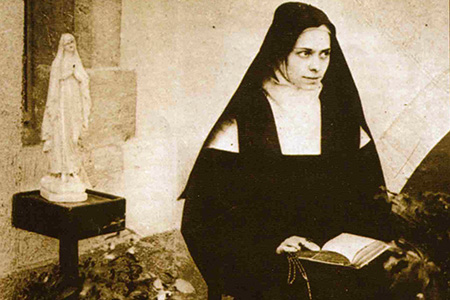
Memorial of St. Nuno Alvares Pereira
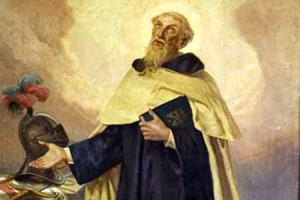
On November 6th we celebrate the memorial of St. Nuno Alvares Pereira.
What would become the Carmelite Province of Portugal, which appears for the first time at the general chapter of 1425, owes its existence to St. Nuno Alvares Pereira, national hero of Portugal. He built a house in Lisbon for the Carmelites and later entered the Order as a semifrater (a sort of lay brother), residing in that house until his death.
Although he wanted to live simply, this was not always possible. Former soldiers under his command also entered the Order and found it difficult to address their former Constable as just another fellow Carmelite. Because he belonged to the royal family of Portugal, the king forbid him as unseemly Nuno’s practice of walking about town in his Carmelite habit handing out money to the poor.
While the monastery now serves as the headquarters for the National Republican Guard (GNR) of Portugal, there are many remembrances to Nuno inside, including his supposed cell. The Church, also a gift from Nuno to the Order was mostly destroyed in the earthquake of 1755. Ancient authors are extravagant in their praise of this structure. It consisted of three naves and a transept, the naves divded by five Gothic arches. The sanctuary was the richest in the court, its retable commissioned by a distinguished scripture scholar. The tribune was flanked by life-size statues of Elijah and Elisha, the former bearing the sword of Nuno himself. The statue of Our Lady of Mount Carmel was also provided by the Constable and the clothing for the statue by King John V.
His epitaph read:
"Here lies that famous Nuno, the Constable, founder of the House of Bragança, excellent general, blessed monk, who during his life on earth so ardently desired the Kingdom of Heaven that after his death, he merited the eternal company of the Saints. His worldly honors were countless, but he turned his back on them. He was a great Prince, but he made himself a humble monk. He founded, built and endowed this church in which his body rests."
On April 26, 2009, Pope Benedict XVI, having recognized the miraculous cure of a blind woman by Nuno's intercession, declared him a saint, 578 years after his death in the same year that Joan of Arc was burned.
The Carmelite house in Fatima, Portugal, which host pilgrims to the site of the Marian apparitions is named in honor of Nuno, Portugal’s greatest military hero and one of the Order’s most dedicated sons.
To read more click here
Memorial of Blessed Frances d’Amboise
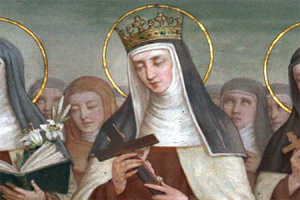
On November 5th we celebrate the memorial of Blessed Frances d’Amboise.
Frances d’Amboise, duchess of Brittany, was friends with the Carmelite prior general, John Soreth. One of those warm and human friendships between saints ensued. She introduced Carmelite nuns into her domains and eventually joined one of the monasteries herself.
Much of what we know about her comes from an unpublished life of D’Amboise written by John de Montay. In addition, some of her conferences given to the nuns survive today in the form of notes taken by one of the sisters. In these she stresses obedience, silence, and charity, especially in speech. A kindly and humorously despairing patience shines through these admonitions to correct constantly repeated faults. In 1621 Christopher LeRoy, a Carmelite provincial, wrote Les Saintes Ardeurs de la Mère Françoise d'Amboise, the first published biography of Blessed Frances, with a series of meditations.
Her husband’s successor as Duke of Brittany testified that Frances “always concerned herself with the public good and the preservation of the unity of our country and duchy.” Her husband, on his deathbed, gave testimony of Frances’ “good and agreeable services of great obedience and humility she has shown us in health and sickness.”
As a former duchess, she insisted on being treated as any of the other nuns. Later, as prioress, she taught, “We are all sisters wearing the same habit and making the same profession. The Rule is not longer for one than for another. … To consider and be concerned with who is the grandest lady and comes from the noblest and richest family is the doctrine of the devil.” These are strong words for a Frenchwoman in the age of Burgundian splendor.
In the 1866, Frances d’Amboise was recognized by the Church as a blessed. Ironically, there is no other period of time when the liturgical calendar was so enriched by so many new Carmelite beati as this period of time when the Order was on the point of extinction.
Prayer
All loving God, you called Blessed Frances d’Amboise
to seek your kingdom in this world
by serving Jesus Christ and his Blessed Mother.
With her prayers to give us courage
help us to go forward with joyful hearts in the way of love.
We ask this through our Lord Jesus Christ.
Amen.
To read more click here
Watch the video Carmelite Saints - Blessed Frances d'Amboise, by the Irish Province of Carmelites, here
Celebrating At Home - 32nd Sunday of Ordinary Time
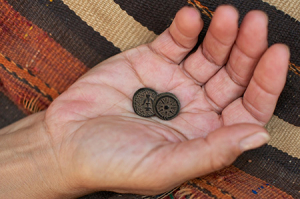
The way of generous service
Our readings this weekend should shape our response to those in need. It is two widows who show us the way to live according to the mind and heart of God.
The first reading tells of a poor widow’s generosity to Elijah the prophet. Even though she was down to her very last portion of food, which she was saving for her son and herself, she was prepared to share it with Elijah. Her reward was a never-ending supply of flour and oil.
The same generosity is shown by the widow (but not by the scribes) in the Gospel. Her dedication and generosity in the midst of her poverty was a real sacrifice.
The widow is a contrast to the wealthy scribes who parade around in long robes and make a show of lengthy prayers. Jesus condemns them for their insincerity, their use of religious show to enhance their status and their unjust exploitation of widows.
Jesus does not want his disciples imitating the showy religiosity of the corrupt scribes, but rather the sincerity and generosity of the widow who gave ‘her all’ just as Jesus will shortly give ‘his all’ on the Cross. It is a reinforcement of the messages about ‘coming to serve, not to be served’ which have dominated the last four weeks of readings.
The way of Jesus is not about show, but about sincere dedication and generosity in our service of God and one another. Remember the contrasting stories about James and John and Bartimaeus over the last couple of weeks.
Following Christ is not about giving the ‘left overs’ but giving everything. The two widows gave all they had to live on. Jesus will give his life for our salvation.
It is the kind of dedication and selfless generosity we see in people who put their own lives at risk while attempting to rescue others from disaster. Disciples are called to give all in their following of Jesus and in their generous service of others.
- pdf Celebrating At Home - 32nd Sunday in Ordinary Time [PDF] (3.18 MB)
- default Celebrating At Home - 32nd Sunday in Ordinary Time [ePub] (3.64 MB)
- pdf Celebrando En Familia - 32 Domingo del Tiempo Ordinario (240 KB)
- pdf Celebrando In Casa - 32 Domenica del Tempo Ordinario (249 KB)
...
Celebrating at Home is a Liturgy of the Word centred around the Gospel reading for each Sunday. It includes a reflection on the Gospel and prayers.
It can be used personally or with your family. Parts for all to pray are given in bold print and all the other parts can be shared among those present.
We hope that Celebrating at Home will be a source of nourishment and strength for all who use it.
In the room you decide to use for this prayer you could have a lighted candle, a crucifix and the Bible. These symbols help keep us mindful of the sacredness of our time of prayer and can help us feel connected with our local worshipping communities.
Meeting Of The Liturgy And Prayer Commission

On Saturday, October 16, 2021, the Liturgy and Prayer Commission of the Order met for their 10th meeting since the General Chapter in 2019. All the meetings, so far, have been held via Zoom. It is hoped to have a first physical meeting in March of next year, expected to last a full week.
The commission has addressed a number of issues over these past two years. The previous liturgy commission (2013-2019) left two important documents ‘The Ritual for the Third Order’ (a completed document) and ‘The Profession Ritual for Religious Profess in the Order’, which the present commission has been working towards a final approval in the near future. Much of this work has been detailed work regarding language and translation.
Considerable time was taken up on the discussion on liturgical scholarship and formation within the Order. The Prior General responded positively to a letter from the commission in this regard. The members will work towards collaboration with the Formation Commission in this area. There are now three scholars doing post graduate work in liturgy. The groundwork for a pastoral liturgical congress in the next few years is being worked on, also a ‘colloquium’ within the coming year.
It has noted that this remit is twofold, both liturgy and prayer. The Liturgical Calendar is expected to be approved by the Congregation for Divine Worship and the Discipline of the Sacraments in the near future. The document of Pope Francis, Traditionis Coustodes and an Address recently by the Prefect of the Congregation, Archbishop Arthur Roche at Sant’ Anselmo were discussed. Among others topics discussed were, the dignity of liturgical books, shrines and pilgrimages, and the giving of the habit in initial formation (CON 162).
The members of the Commission are: Richard Byrne, O. Carm (Curia), John Keating, O. Carm., (Hib), Robert Manik, O. Carm. (Indo), Sr. Nerina de Simone, CMSTBG, Désiré Unen Alimange, O. Carm. (Ita/Congo), Alexander Vella, O. Carm. (CISA/ Mel). The next meeting will take place on November 6, 2021.
Book Review: Walk With Us

This work of 176 pages collects some of the presentations given at the 2016 International Course for Formators and Vocation Promoters of the Order in Batu, Malang, Indonesia. So one would logically think it is for those involved in Carmelite formation programs. And you would be correct.
The title however, with its subtitle Growing in the Contemplative Dimension of One’s Life, would indicate its focus on something much larger than topics in Carmelite formation programs. And you would be correct. In fact, I picked the book up because of its apparent focus on how to develop one’s contemplative side. I was not disappointed.
This book really has four possible audiences: formators but not necessarily of Carmelite programs; those interested in the Bible as a source of contemplation and specifically the Carmelite history of contemplation; some of the psychological aspects of human development; and vocation ministry. There is something for people of each focus in one or the other parts of the book.
The schedule of the conference called for conferences to be held in the morning and practices of contemplative prayer in the afternoon—a purposeful integration of theory and practice.
I wish to focus here on the first two talks. The first talk, The Bible as the Source of Contemplation, is, as its author Carmelite Berthold Pareira states upfront, “not about contemplation in the Bible but about the Bible as the source of contemplation.” Fr. Pareira takes the reader through a myriad of examples to bring home this point. What is most appreciative is that it a practical guide to liturgy, the psalms, the Song of Songs, and contemplation.
The second talk is a historical review of contemplation in Carmelite history by German Carmelite Michael Plattig. But do not let yourself fall into thinking this is just another history lesson. I have had the pleasure of hearing Plattig “live” on a couple of occasions. But his written word is just as engaging. The material he presents is thought provoking even for those who have heard conferences before on the Order’s long history with the practice of contemplation.
Other chapters in the book focus on two talks by Quinn Conners, O. Carm.: “The ability to give love and give of oneself” and “The capacity for responsible are and stewardship, expressed in ‘service in the midst of the people;’” and two talks by Spanish Carmelite Desiderio García Martínez: “With other eyes: accompanying formandi in a multicultural community that grows through contemplation” and “We are going to build ourselves a city: accompanying formandi growing in contemplation in the presence of the influence of technology.” The book concludes with two chapters on vocations ministry. One is by Daryl Moresco on “The theological basis of vocation promotion.” The other is by Irvin Mangmang on “Rising to the Challenge of Vocation Ministry in the 21st Century: the Philippine Experience.”
The book is published by Edizioni Carmelitane, and the price is 10 euros.
Click here to access this and other many fine publications at Edizioni Carmelitane.
To place your order please contact:
Libreria Nardecchia
TEL.: (+39) 06-5373901
FAX: (+39) 06-5373902
E-mail: This email address is being protected from spambots. You need JavaScript enabled to view it.
Edizioni Carmelitane
TEL.: +39-0646201807
FAX: +39-0646201808
C.C.P.: 14069009
BIC/SWIFT: BPPIITRRXXX
IBAN: IT67 Z076 0103 2000 0001 4069 009
E-mail: This email address is being protected from spambots. You need JavaScript enabled to view it.
Lectio Divina November 2021

Lord, the meaning of our life is to seek your Word, which came to us in the person of Christ. Make me capable of welcoming what is new in the Gospel of the Beatitudes, so that I may change my life. I would know nothing about you were it not for the light of the words spoken by your Son Jesus, who came to tell us of your marvels. When I am weak, if I go to Him, the Word of God, then I become strong. When I act foolishly, the wisdom of his Gospel restores me to relish God and the kindness of his love. He guides me to the paths of life. When some deformity appears in me, I reflect on his Word and the image of my personality becomes beautiful. When solitude tries to make me dry, my spiritual marriage to him makes my life fruitful. When I discover some sadness or unhappiness in myself, the thought of Him, my only good, opens the way to joy. Therese of the Child Jesus has a saying that sums up the desire for holiness as an intense search for God and a listening to others: «If you are nothing, remember that Jesus is all. You must therefore lose your little nothing into his infinite all and think of nothing else but this uniquely lovable all...» (Letters, 87, to Marie Guérin).


