













O.Carm
Rio celebrated Our Lady of Mt Carmel in Solidarity

The Rio de Janeiro Province provides a variety of significant outreach programs. But the covid pandemic and the resulting food shortage has required the Carmelites to become grocers to the masses.
Thanks to Cançao Nova, a religious news service in the Portuguese language, we are able to show the solidarity between the province and the people in honor of the feast of Our Lady of Mount Carmel on July 16th. (A translation is provided.)
Watch here
Feast of Isidore Bakanja
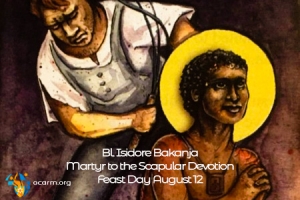
A devoted catechist, Isidore Bakanja did not hesitate to offer his life to God, filled with the certain beliefs he found in his faith and in his regular praying of the rosary. A witness for his canonization testified that a Belgian overlord accused Bakanja of teaching prayers and “all sorts of stupidities to my workers, to my servant-boys, and even to the villagers. If that does not stop, no one will want to work anymore for me.” His tirade ended with another beating for Isidore.
The Belgian possession of the Congo since 1885 was no more than crass, unjust exploitation of the native people. Bakanja was employed as a servant-boy, eventually returning to his native village. Mild, honest, respectful by nature, Isidore worked conscientiously and prayed faithfully, as many non-Christian witnesses attested. Often with rosary in hand, he looked for opportunities to share his new-found faith with others, to the extent that many thought of him as a catechist.
Working again for agents of a Belgian company, Isidore was told to discard his scapular. When he did not, he was twice flogged. The second time, the agent flew into one of his rages. He jumped at Isidore, tore the scapular from around his neck and threw him to the ground. He had two servant boys hold Isidore by his hands and feet and a third domestic flogged him. The whip was made of elephant hide with nails protruding at the end. The writhing Isidore asked for mercy. "My God, I'm dying", he muttered. But the colonizer kept kicking Isidore in the neck and head, and ordered his domestic to scourge him harder still. After 100, those assisting lost count of the number of blows.
An inspector for the company physically prevented the worker from killing Isidore. He took Isidore to his own settlement, hoping to help him heal. But Isidore felt death in his bones. He told someone who had pity on him: "if you see my mother, or if you go to the judge, or if you meet the priest, tell them that I am dying because I am a Christian". Two missionaries spent several days with him. He devoutly received the last sacraments.
He told them the reason for his beating: "The white man did not like Christians.... He did not want me to wear the scapular.... He yelled at me when I said my prayers". The missionaries urged Isidore to forgive the agent; he assured them that he had already done so and that he nursed no hatred for him. "Certainly I shall pray for him. When I am in heaven, I shall pray for him very much."
Isidore’s agony, his own cross, lasted six months. He died on either August 8 or 15, 1909, rosary in hand and the scapular of Our Lady of Mt Carmel around his neck.
Feast of Saint Teresa Benedicta of the Cross

Edith Stein was born on October 12, 1891, the Day of Atonement, into an observant Jewish family. She later wrote: "My mother laid great emphasis on the occurrence, and I think more than anything else, it made her youngest child especially dear to her... The Day of Atonement is the most solemn of all Jewish holidays, the day when the high priest entered the Holy of Holies, taking along the sacrifices to be offered in atonement for himself and all the people, after the scapegoat, burdened with the sins of the nation, had been driven into the wilderness."
Edith Stein was clearly a high strung, independent young child, possessing a precocious mind. As a teenager she struggled with her faith. She studied philosophy and became associated with Edmund Husserl, the father of phenomenology. In 1922 she converted to Catholicism. She entered a Discalced Carmelite monastery, professing final vows in April of 1938. She took the religious name Teresa Benedicta of the Cross, in honor of St. Teresa of Avila and St. Benedict of Nursia.
Because of the Nazi program to liquidate the Jews in Europe, Edith and her biological sister, Rosa, were moved from their monastery in Cologne, Germany to the Discalced monastery in Echt, Netherlands for safety. Following the pastoral letter of the Dutch bishops complaining about the Nazis’ treatment of the Jews, all baptized Catholics of Jewish origin were arrested. The Stein sisters were sent to Auschwitz concentration camp near Krakow, Poland. They were murdered on August 9, 1941, in the so-called “Little White House” gas chamber at the rear portion of the camp on August 9, 1942.
With the witness of her life, Sister Teresa Benedicta enfleshes the words of St. Teresa of Avila: "I do not regret having given myself to Love." She was given the title “martyr of love” when she was canonized in 1998.
Her final testament says in part: "I joyfully accept in advance the death God had appointed for me, in perfect submission to his most holy will. May the Lord accept my life and death for the honor and glory of his name, for the needs of his holy Church - especially for the preservation, sanctification and final perfecting of our holy Order and in particular for the Carmels of Cologne and Echt - for the Jewish people, that the Lord may be received by his own and his kingdom come in glory, for the deliverance of Germany and peace throughout the world, and finally, for all my relatives living and dead and all whom God has given me: May none of them be lost."
Feast of Saint Albert of Trapani
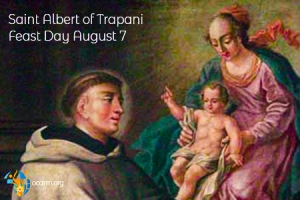
Born in Trapani (Sicily) in the 13th century. He is also known as Albert of Sicily or Albert degli Abati. He distinguished himself for his dediction to mendicant preaching and the notoriety of his miracles. In the years 1280 and 1289 he was in Trapani and shortly afterwards in Messina. In the year 1296 he was prior provincial of the Carmelite Province of Sicily.
He was celebrated for his passionate love for purity and prayer. He became noted for his austerity in his lifestyle. He traveled around preaching and evangelizing, and maintained a relationship with people of the Jewish faith. He intervened in the siege in Messina that threatened hundreds with starvations and was credited for ending it.
He died in Messina, most likely in 1307.
He was the first saint who received devotion in the Carmelite Order, and was even considered it patron and protector (or “father”), a title he shared with another saint of his time, Angelo of Sicily. In the 16th century, it was decided that every Carmelite church would dedicate and altar to him. Later Carmelite saints Teresa of Jesus and Mary Magdalene de’ Pazzi were devoted to him.
He is often depicted holding a lily or receiving the Christ Child from Our Lady.
Lectio Divina August is available
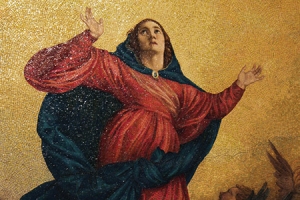
Lord Jesus, send your Spirit to help us to read the Scriptures with the same mind that you read them to the disciples on the way to Emmaus. In the light of the Word, written in the Bible, you helped them to discover the presence of God in the disturbing events of your sentence and death. Thus, the cross that seemed to be the end of all hope became for them the source of life and of resurrection.
Download English
Celebrations of the Feast of Our Lady of Mount Carmel
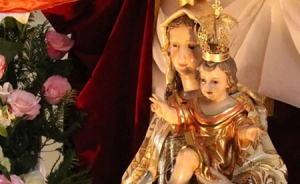
Celebrations of the Feast of Our Lady of Mount Carmel
The Rio de Janeiro province of Carmelites will celebrate the Feast of Our Lady of Mount Carmel in solidarity with those affected by the COVID-19 pandemic in Brazil. Read more
Connect to One of the Oldest Devotions
General Delegation of Kenya
Novena in English
P. Denis Omae, O. Carm.
To participate
Behold Your Mother
Carmelite Institute of North America (CINA)
Novena in English
Fr. Christopher LaRocca, OCD
To participate
9 Days of Prayer for You
Province of Australia and Timor-Leste
Novena in English
To participate
We will be posting news of additional celebrations in the coming days. Please check back to the News section of the Order's website: Announcements (CITOC)
Laudato Si' impacts quality of life in Indonesia
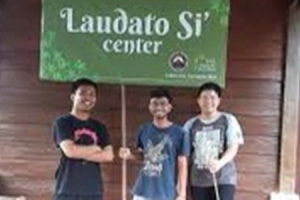
To celebrate Earth Day 2021 on April 22, 2021, the Indonesian Carmelite NGO launched vertical farming project at Karmel Syanti Argo ("syanti" means "peace" and "argo" means "mount"). The center is also the Laudato Si' Centre in Pasuran, East Java, Indonesia.
The purpose of this project is to teach poor urban people to grow vegetables even though they live in a limited space. By growing these vegetables themselves, they will spend less money for their food. Moreover, by doing this themselves, they help reduce their carbon footprint because of the decrease in the use of fuel to transport vegetables from the villages to the cities.
Furthermore, oxygen produced in the photo-synthesis process of the vegetables also helps maintain the quality of the air in the cities. Finally they sustain the environment.
For more information about the Carmelite NGO visit here
Apart from our presence at the United Nations, Carmelites have established other organisations working for justice, peace and integrity of creation issues throughout the world.
Visit Indonesian Carmelite NGO here
JUCAR America Brings Youth to Jesus Christ
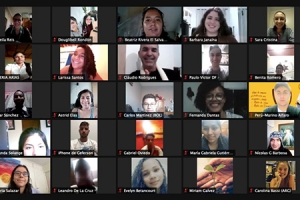
As reported earlier in CITOC (36/2021), the young people in the Americas did not let covid restrictions stop them from coming together and “hearing the voice of Jesus Christ.” And they never left their homes!
On July 4, approximately 600 people, including 400 young people in Brazil, Venezuela, Bolivia, Perú, El Salvador, México, Argentina, Chile, the United States of America, the Dominican Republic, Puerto Rico, Italy, and Spain connected via the internet to celebrate “The Youth of Jesus.”
The prior general, Fr. Míċéal O'Neill, spoke to the group about the Carmelite charism assisting their spiritual journey, to become young in prayer, contemplation, and compassion—ultimately inspiring them to work on building a more just world.
For Fr. Luis Maza, General Councilor of the Americas, the day was “exciting, full of joy with a sense of family. There was also a deep sense of hope.”
Argentina had 22 members participating. They came away from the day with a sense of urgency to further develop the Carmelite Youth in their country. The leadership in Venezuela, with 55 participants, reacted to the exuberance of the meetings. “I was very happy to see the enthusiasm of the young people, the fraternal atmosphere. It was interesting to put faces to JUCAR America.
The day touched many of the youth as well. For Nair Cinthia Ortega Daza from Tarija, Bolivia, it was her first experience with Jucar América. She said she felt motivated discovering that many young people do live the Carmelite charism, growing in prayer, contemplation, and compassion. “The goal is to better our spiritual lives with the guidance of Our Lady of Mount Carmel in order to follow the way of Jesus,” said Nair.
For Charly Aguilar from Ilobasco, El Salvador, the day was an opportunity to experience the excitement of being with young people from all around the Americas. “Given the tough times we are living in because of the Covid-19 pandemic, God allowed us to be part of this great event. For me it was a wonderful learning experience as we shared the theme of the youth of Jesus.”
For Eduar González it was a truly spiritual experience. “The love and grace of the Most Holy Trinity was present each minute of the delivery of love experienced through JUCAR. It was God, young and alive, that flooded into my life, to be able to see so many brothers and sisters in Carmel giving the same response that Mother Mary gave when she said “Yes” to God."
“It has been fascinating to meet other young Carmelites. It was like a small Pentecost, because we are from different countries, speak different languages and live in different cultures. Yet we prayed, laughed, sang, and learned together as one,” said César Díaz from José Galvez, Perú. “I felt that “cozy warmth” of the Carmelite Family. My feeling only increased when our prior said of JUCAR 'they are here because in Carmel they have found their spiritual home.’ The whole meeting has been fascinating!”
 “Seeing each face and listening to people thousands of miles away who share the same goal … we were excited to be there, with our hearts on fire and joyful, sharing opinions and feelings for Carmel, feeling the embrace of the brothers at a distance. Seeing their big smiles said everything,” wrote Alessandra Judith Mireles Atilano from Torréon, México. “It was a most beautiful experience, sharing my feelings and listening to others share. The experience taught me that my JOCARM (Young Carmelites of Mexico) is not alone, that we have brothers and sisters in many other places. Above all, we are in a common project. Seeing Carmel flower in each person was an experience that I would like to repeat many more times!”
At a follow-up meeting of the directors of JUCAR America on July 23, the evaluation of July 4 was basically positive. There was a high level of participation by the young people. The theme of the day, “The Youth of Jesus,” appeared interesting and engaging to the young people.
The coming months will be very busy as additional gathering get planned. JUCAR will be participating in the FOCAM (Formation of Carmelites in the Americas) meeting on August 28. On September 2-4 the Carmelites in Venezuela will hosting a Carmelite Youth Meeting. (This is intended for young lay men and women.) A Meeting of JUCAR on the American Continent will be held on November 14. Details remain to be worked out but three youth from each country will be chosen to work on organizing the event.
Coordinators of formation for JUCAR America, reflecting on the future, see the possibility of the young people becoming true protagonists in their communities. “There will be a much more active participation, as well as energy and commitment to transform our America into a home of fraternity, prayer, and contemplation. This will not only be in the religious realm but in the social, cultural, and political as well. Other see this youth movement firming up the ties between the various national groups. “It would be beautiful to celebrate Carmel together like this! We could exchange cultures, languages, and more.”
“Unquestionably, the movement is of the Spirit. In five years I see a consolidated movement throughout the Americas. The young people speak with prophetic voices. Perhaps in the future there will be matrimonies, or priestly and religious vocations that emerge from this movement.” It is a work of the Spirit.
The World Celebrates Our Lady of Mount Carmel
July is definitely the month of Carmel. Of course, the focus appropriately is on July 16th each year. The solemn feast of Our Lady of Mount Carmel is celebrated literally around the world. Wherever Carmelites are, the feast is a major celebration. We saw that this year, even in our covid world, with special Masses celebrated live and livestreamed over the internet.
Some of those—from Brazil, Kenya, North America, Australia-Timor Leste— were listed in the July 7 CITOC email. Carmelites were good enough to send us news about additional celebrations which we would like to highlight here.
In the Philippines, the members of the Province of Titus Brandsma had a novena and series of Masses. These were streamed over the province’s Facebook page (CarmelitesPhCom) as well as on the Facebook page of Dominus Est, the new evangelization website of the Archdiocese of Manila. The page was started by Cardinal Tagle.
One of the first Carmelite foundations in Europe, Aylesford, also joined in celebrating Mary with a Pilgrimage of Our Lady of Mount Carmel on Sunday, July 11. An 11:30 Mass was held at the main shrine and included Third Order professions and renewal of promises. Later in the day a Holy Hour was celebrated.
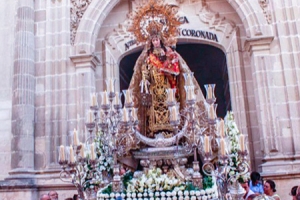
In southern Spain, the Province of Bética transmitted an online novena from July 7-15 from the Minor Basilica of the Crowned Virgen of Carmel in Jerez de la Frontera. The prior provincial, David del Carpio Horcajo, preached. At midnight on July 15, the people of Jerez joined together to greet the day of Our Lady. Later in the morning, a series of Masses were celebrated. Then at 8:30 PM the beloved statue of Our Lady of Mount Carmel in the Carmelite church was processed through the streets of the city. Some of these celebrations can be viewed on the Facebook page of the Real Hermandad de Damas y Caballeros de Ntra. Sra. del Carmen Coronada (HdadCarmen) which livestreamed some of the celebrations. See the picture courtesy of Real Hermandad de Damas y Caballeros de Nuestra Señora del Carmen Coronada.
 Perhaps the most dramatic of all the celebrations is that held in Naples, Italy— the Incendio del Campanile di fra’ Nuvolo. The ancient tradition calls for the lighting of explosive fireworks contained in and around Carmine Maggiore’s bell tower which, at 75 meters high, is the tallest in the city. The result is a colorful and noisy rain of fiery explosions. This continues until a painting of Our Lady, under the title “La Bruna,” arrives to extinguish the fire.
Recalling a real fire and the salvation of the city by the Carmelites’ Madonna, the annual celebration the night before the feast of Our Lady of Mount Carmel is a testimony of the entire city’s devotion to “Mamma d’o Carmene.” See the pictures courtesy of napolidavivere.it
The Province of Malta provided a novena to Our Lady of Mount Carmel. While the Masses were not livestreamed, the homily for each day was posted on the Facebook page of the Carmelite priory in Valletta. On the app NITOLBU prayers in Maltese were available each day of the novena. In addition, the app daily provided an excerpt from the book Forty Days of St. Mary Magdalene de’ Pazzi. On July 15th and 16th, a number celebrations took place which were livestreamed. Among these were the solemn translation of the relic with Vespers and a Eucharistic blessing. On the morning of the feast, the Carmelite prior provincial, Joseph Saliba celebrated a solemn Mass. Later in the evening, Archbishop Charles J. Scicluna, the archbishop of Malta, celebrated the Mass. Following that Mass, there was a solemn prayer vigil which concluded the feast day with the singing of the Flos Carmeli and a Eucharistic blessing.
Many Carmelites find themselves traveling to conduct novenas and to accompany the people on the actual day of the feast. Fernando Milán, our former prior general, found himself in Tomelloso a town of La Mancha. The Carmelites of the Province of Bética sponsored a school there from 1942-1987. Today the Carmelite presence continues in Tomelloso through a very active and flourishing Third Order. Each year someone from the province goes for the novena and the assemblies of the Carmelite Third Order. The statue of Our Lady of Mount Carmel is now in the main parish of Tomelloso. The town continues to reflect the Carmelite presence, perhaps most concretely with a neighborhood named for Our Lady— barrio del Carmen—which has a procession with the statue of Our Lady each year.
In addition to the celebration of Mary under the title of Our Lady of Carmel, the Church and Carmelites in particular celebrate Blessed Maria Crocifissa Curcio (July 4), foundress of the Carmelite Sisters of Sr. Thérèse of the Child Jesus (Suore Carmelitane Missionarie di S. Teresa del Bambino Gesú); Blessed Jane Scopelli (July 9) an Carmelite mantellata who formed an early community of Carmelite women; St. Elijah (July 20), along with Mary, a major inspiration to the lifestyle and spirituality of the Carmelites; Blessed John Soreth (July 24) reforming prior general and “founder of cloistered Carmel and the Third Order”; Sts. Joachim and Anne (July 26) protectors of the Order; and Blessed Titus Brandsma (July 27) martyr for the faith in the Dachau concentration camp.
Blessed Titus Brandsma, Carmelite & Martyr

On 27th July, we celebrate our annual memorial of a famous Carmelite martyr.
Anno Sjoerd Brandsma was born at Bolsward, The Netherlands, in 1881, and joined the Carmelite Order in 1898 taking the name ‘Titus’, being ordained priest in 1905. In time he became a professor and then Rector Magnificus at the Catholic University of Nijmegen. He was also a journalist.
During the 1930s he gave a famous series of lectures in the United States on Carmelite mysticism. Throughout the 1930s Nazi propaganda was on the rise but Fr Titus refused to support or print anything in support of the Nazi regime.
Fr Titus was arrested by the Gestapo on January 19, 1942, and imprisoned in his native country before being sent to the concentration camp at Dachau where he brought comfort and peace to his fellow prisoners. In Dachau he was experimented on in the medical wing and was finally put to death by lethal injection on July 26, 1942.
He was beatified in 1985 and the cause for his canonisation continues which, we pray, will soon be successful.
Please avail yourself of the resources prepared for the celebration of Blessed Titus Brandsma on July 27th.
Liturgical Resources Blessed Titus Brandsma
- pdf Letter to the Carmelite Family (400 KB)
- pdf Mass Leaflet (287 KB)
- pdf Prayers of the Faithful (216 KB)
- pdf Homily Notes (81 KB)
- pdf Newsletter/bulletin insert (253 KB)


