













O.Carm
The Commission for the Protection of Minors Meets
April 25-27, 2024 | Rome
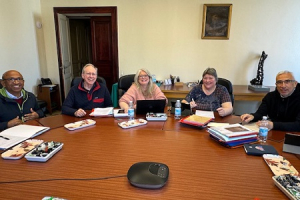
Meeting of the General Commission for the Protection of Minors and Vulnerable Persons Held in Rome
The members of the General Commission for the Protection of Minors and Vulnerable Persons held their second meeting at the General Curia in Rome on April 25-27, 2024. Members of the Commission are Fr. Michael Farrugia O. Carm., president and General Procurator of the Order; Ms. Julie McCullough (Hib-lay); Ms. Julie Courtney (Brit-lay); Fr. Quinn Conners, O. Carm., (PCM); and Fr. Babu Payikkattu, O. Carm., (Ind)
The Commission was encouraged to have received a 95% return rate of the safeguarding questionnaire circulated to the entire Order earlier this year. The members would like to thank everyone who responded to the questionnaire.
At this meeting, the Commission focused on reviewing the safeguarding policies implemented throughout the Order; identifying safeguarding delegates appointed within the Order; and developing an understanding of the ministries involving children and adults at risk in the entire Order. This analysis sets the foundation for the development of a universal safeguarding policy with specific standards.
Blessed Aloysius Rabatà, Priest

May 8, 2024 | Optional Memorial
Bl. Àloysius Rabatà, priest
Information about the Blessed comes from witness statements gathered for the Acts of the 1533 diocesan process for the beatification of Aloysius Rabatà. The Acts do contain, as expected, details about his character, the works he performed, and his death as well as his physical appearance and his eating habits. Five out of eleven witness knew the Blessed personally, so the information is considered quite accurate. Later hagiographies merely repeat that information and give other details that are less cetain to be accurate.
Reading the various testimonies in the Acts of 1533 makes it clear Luigi Rabatà was considered an extremely virtuous man and a saint already during his life. Indeed, there are many references to his “sanctity” and his life filled with the practices of fasting and works of charity.
In 1756 the General Chapter of the Order decreed that the approval of his cult "ab immemorabili" be sought. This was granted on December 10, 1841, by Pope Gregory XVI.
Read more ...
From the book by Marco Papasidero, "A Laudi Deu." Luigi Rabatà tra storia, memoria e pratiche devozionali. (Edizioni Carmelitane, 2019) €14.00
Celebrating At Home - Ascension of the Lord

Called, Chosen, Sent
to be God’s Heart in the World (Mark 16:15-20)
The feast of the Ascension commemorates the return of Jesus to the Father. Jesus leaves in body but remains with us through the gift of the Spirit. We will celebrate the gift and presence of the Holy Spirit in next Sunday’s feast of Pentecost.
The true meaning of our feast today is not found in Jesus’ leaving, but in the way he calls his disciples back together, to re-form them as a new community entrusted with the spread of the Gospel. Jesus sends the disciples out to make disciples of all nations and to teach them his way. But the disciples are not left to do all that on their own. Jesus promises that he is with them always.
Jesus has called the ragged, group of disciples, scattered after his crucifixion, back to himself to form them, fragile and doubtful as they are, into a community for mission in the name of God. The task of the historical Jesus is complete; the task of the church as the living Body of Christ has just begun. It is comforting to recognise that Jesus doesn’t insist on perfection before he calls us and entrusts us with his mission.
This mission is authorised by God and passed on to us through Jesus. It is not about authority over others. It is actually a call to act as God would act, true to God’s heart as Jesus has taught us.
Ever since Easter, we have been proclaiming that Jesus is alive. The feasts of the Ascension and Pentecost help us to realise that we are part of a long tradition of faithful disciples. We have our faults and failings, but our call is to witness to and teach the way of Jesus by the kind of people we are, the values and attitudes we hold, in thought, word and action - to be the living presence of God in the world today.
- pdf Celebrating At Home - Ascension of the Lord [PDF] (2.88 MB)
- default Celebrating At Home - Ascension of the Lord [ePub] (2.28 MB)
- pdf Celebrando en Familia - Ascensión del Señor (458 KB)
- pdf Celebrando in Casa - Ascensione del Signore (458 KB)
- pdf Celebrando em família - Domingo da Ascensão (440 KB)
New Book on Elijah and Elisha in the Latin Middle Ages

New from Edizioni Carmelitane | Author: Sr. Éliane Poirot, OCD
Les prophètes Élie et Élisée au Moyen Âge Latin:
Tome 1, 2, 3 et 4
In the preamble to the Constitutions of the London Chapter in 1281, for the first time in a Carmelite document preserved to this day, mention is made of the two prophets Elijah and Elisha. In this Rubrica prima, which answers the question of the origins of the Order, we find a statement that would be constantly repeated and developed in the centuries that followed: the Order of Carmel goes back to the prophets Elijah and Elisha, and Carmelites are the successors of all those who led a monastic life on Mount Carmel.
What was the background to this assertion? In an attempt to answer this question, we looked at Christian literature as a whole, and saw how the patristic tradition saw the prophet Elijah as an archetypal monk, with Elisha as the disciple par excellence. We now turn our attention to written sources from the Carolingian period to the 13th century, mainly through biblical commentaries on the Elijah and Elisha cycles, on the Transfiguration of Christ recounted in the Synoptic Gospels and on the two witnesses of the Apocalypse (Rev 11), as well as sermons. Most of these texts have been translated into French for the first time.
About the Author:
Sr Éliane Poirot, O.C.D., entered the Carmel de Nancy in 1965, and made solemn profession in 1970. She co-founded the Byzantine-rite Carmel of Saint-Remy in 1974, the Fraternité Saint-Élie in 1991, and the Romanian skite of Stânceni in 1994.
She holds a doctorate in Catholic theology and a university diploma in medieval Latin from the University of Strasbourg, as well as a diploma from the Saint-Serge Institute of Orthodox Theology in Paris.
She is the author of over a hundred articles and a dozen books, including several on the prophets Elijah and Elisha.
Tome 1: Vllle-IXe siècles. L'époque carolingienne
For more information
Tome 2: Xe-début-XIIe siècle. Des commentaires carolingiens à la Glossa ordinaria
For more information
Tome 3: La renaissance et le tournant du XIIe siècle
For more information
Tome 4: XIIIe siècle. L'essor des universités
For more information
Purchase a boxed set all four volumes (€150.00 value)
For more information
Vitam Coelo Reddiderunt

|
04-04-24 |
|
|
|
|
|
29-04-24 |
|
|
|
|
|
11-04-24 |
|
|
|
|
|
20-04-24 |
|
|
|
|
|
25-04-24 |
|
|
|
|
|
25-04-24 |
|
|
|
|
Memorial of Bl. Àngel Prat Hostench and 16 Companions

May 4, 2024 | Optional Memorial | Obligatory Memorial in Spain
PRAYER
Almighty God, you who gave your blessed Ángel Maria Prat Hostench, Lucas de San José Tristany Pujol, presbyters, and companions, the grace to confront death so to confess your word and bear witness to Jesus, grant us the power of the Holy Spirit, to remain steadfast in faith and strong in the confession of your name. Through our Lord Jesus Christ, your Son, who lives and reigns with you and the Holy Spirit, God, for ever and ever.
International Workshop on John Baconthorpe
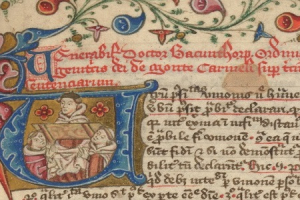
Despite his importance in the history of the Carmelite Order, John Baconthorpe (c. 1290 – c. 1350) is still relatively unknown to modern scholars of medieval thought. Active in the Universities of Oxford, Paris, and Cambridge, Baconthorpe was later chosen by his order as a doctrinal guide, which resulted in multiple printings (from the late 15th to the mid-18th centuries) of his Parisian questions on I-III Sentences, a later version of his IV Sentences, and his Quodlibeta. Although only a handful of experts have delved into his works, whether in print or in manuscript, Baconthorpe’s intellectual project was ambitious and fascinating in the context of fourteenth-century philosophy and theology, with surviving commentaries on Matthew (in a Cambridge manuscript) and (in Paris, BnF, lat. 9540) on Augustine’s De Trinitate and De civitate Dei and on Anselm’s De incarnatione and Cur Deus homo. In his writings, the Doctor Resolutus employed an impressive variety of sources and engaged in dialogue with towering contemporary figures, such as Peter Auriol, Thomas Bradwardine, and some of his Carmelite confrères, while he was critically independent of the leading mendicants and seculars of previous generations, such as Thomas Aquinas, Henry of Ghent, Giles of Rome, Godfrey of Fontaines, and John Duns Scotus. In addition, Baconthorpe was sensitive to Averroes’s thinking but also to ideas from Jewish sources.
Sponsored by INSTITUTUM CARMELITANUM
Taking place: CISA, Rome, MAY 9-11 2024
THURSDAY 9 May 2024
16:00 – 17:30
16:00 – 16:30
WELCOME
16:30 – 17:00
Monica BRINZEI:
(IRHT, Paris)
Presentation of the Project
17:00 – 17:30
Stephen METZGER
(Biblioteca Apostolica Vaticana)
The Manuscripts of John Baconthorpe in the Vatican Apostolic Library
FRIDAY, 10 May 2024
9:45 - 17:00
9:45 – 10:30
Christopher SCHABEL
(IRHT, ERC Debate n° 771589, Paris)
The Carmelite John Baconthorpe's Parisian Questions on the Sentences
10:30 – 11:15
Wouter GORIS
(Bonn University, Bonn)
Baconthorpe on the First Adequate Object of the Intellect
Coffee Break: 11:15 – 11:30
11:30 – 12:15
Maria SOROKINA
(IRHT, Paris)
John Baconthorpe on Celestial Causality: A Dialogue with Henry of Ghent
12:15 – 13:00
Monica BRINZEI
(IRHT, ERC Debate n° 771589, Paris)
Seduction, Blasphemy, Heresy and the Danger of Exercitatio Sophistica according to John Baconthorpe
LUNCH
14:30 – 15:15
Ioana CURUT
(Babes-Bolyai University, RABY-MSCA
Seal of Excellence Project, PNRR-III-C9-2022-I9, No° 760130, Cluj-Napoca)
Jewish Authorities in John of Baconthorpe's Questio determinata in Ms. Paris, BnF, lat. 16 523
15:15 – 16:00
Andrei MARINCA
(Babes-Bolyai University, ERC Nota n°948152, Cluj-Napoca)
John Baconthorpe and Avicenna
Coffee Break: 16:00 – 16:15
16:15-17:00
Sylvain ROUDAUT
(KU Leuven, Leuven)
John Baconthorpe on the Intension of Forms
SATURDAY 11 May 2024
10:00 - 15:45
10:00 – 10:45
Niccolò BONETTI
(Università degli Studi di Udine)
Essence and Being in Baconthorpe
Coffee Break: 11:00 – 11:15
11:15 – 12:00
Mădălina PANTEA
(Babes-Bolyai University, ERC Nota n°948152, Cluj-Napoca)
The Definition of Vestigium Trinitatis in John Baconthorpe’s Commentary on Augustine’s De Trinitate
LUNCH
14:00 – 14:45
Matteo ESU
(EPHE-PSL, LabEx-Hastec, Paris)
The Theologian’s Pigeon. Baconthorpe’s Discussion of a Feudal Matter in Quodlibet III, question 4
14:45 – 15:30
Alfredo STORCK
(Universidade Federal do Rio Grande do Sul, Porto Alegre)
Bartolomeu do Pilar and the Reception of Baconthorpe in Colonial Brazil
Coffee Break: 15:30 – 15:45
Conclusions
Organized by: Monica BRINZEI
Mario ALFARANO, O. Carm.
Giovanni GROSSO, O. Carm.
Connexion Zoom: contact This email address is being protected from spambots. You need JavaScript enabled to view it.
May Schedule of the Prior General

May 2024
1-3: completion of the canonical visitation in the DR Congo
7-8: plenary meeting of the General Council
10-12: centenary celebrations of the foundation of the Hermanas Carmelitas del Sagrado Corazón de Jesús, by Madre Asunción Soler Gimeno, 13th of May, 1924, in Malaga.
13-17 plenary meeting of the General council
15: celebration of the second centenary of the birth of Madre Teresa Scrilli,15th of May, 1825, Montevarchi, Florence, Foundress of the Institute of Nostra Signora del Monte Carmelo.
20 - 23 provincial chapter of the Polish Province, Krakow.
26 - 31 canonical visitation in the Province of Rio de Janeiro, second part.
Celebrating At Home - Sixth Sunday of Easter

Love Among Us, Love Within Us (John 15:9-17)
As we approach the coming feasts of the Ascension and Pentecost, the Gospel today helps us understand that Jesus is our bond of love with the Father and with one another.
Jesus shows us the way to live full and happy lives by living in love: “I have told you this so that my own joy may be in you and your joy be complete.” The commandments of Jesus are always about love - love of God and love of neighbour. Those who live by these commandments of Jesus abide with him, others and the Father in love.
Jesus is the reign of God in person. He is both the image of God and the model of the redeemed human being that each of us is called to be.
When Jesus says he has told the disciples everything he has learned from the Father it reminds us that Jesus was human as well as divine; that his life was a journey of learning, too; a path of facing choices and challenges. Jesus tells his disciples that they are his friends. They have become his friends because he has shared his knowledge and understanding and love of the Father with them.
We remain in Christ by remaining in his love and loving one another just as Christ has loved us. We are no longer servants but friends of Jesus because he has made known to us everything he learnt from God.
Jesus has chosen us and commissioned us to be love and to do love in the heart of the world.
- pdf Celebrating At Home - Sixth Sunday of Easter [PDF] (2.89 MB)
- default Celebrating At Home - Sixth Sunday of Easter [ePub] (2.56 MB)
- pdf Celebrando en Familia - Sexto Domingo de Pascua (453 KB)
- pdf Celebrando in Casa - Sesta Domenica di Pasqua (458 KB)
- pdf Celebrando em família - Sexto Domingo da Páscoa (452 KB)
Meeting of the General Economic Commission

From April 8-12, 2024, the General Economic Commission met in Rome, whose members are: Javier Domingo Garmón i Calvo (Cat), Günter Benker (Ger), Shiju Njaralampuzha (Ind), Nixon Jacobus Silfanus (Indo-laica), and Christian Körner, General Economist. Anna De Giglio (Neap-laica) was unable to attend. Also present were Elisabetta Berardi (Curia) and as translator Tobias Kraus (Curia).
The meeting began with the review of the Curia's Economic Report 2023 and continued with the discussion of the following items: the submission of economic reports and payment of the contribution by some provinces, the revision of the Economic Directory, the criteria of investments, and the reconsideration of the percentages to be presented at the bursars' meeting and discussed together. The Commission also continued to prepare for the 'meeting of all bursars of the Order to be held, from November 11 (arrivals) to November 16 (departures) 2024 at the Casa São Nuno Hotel in Fatima.
The next meeting will be held during the bursars' meeting in Fatima.


