











O.Carm
Carmelite Hermits Visit the General Curia
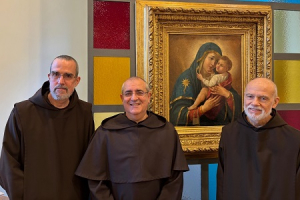
During January 2026, two Carmelite hermits (Father John Mary, prior and Brother Chrisopher) from the Carmelite Hermitage of the Blessed Virgin Mary in Lake Elmo, Minnesota in the USA, spent some time at the General Curia of the Order in Rome on their way to Venice, Italy.
Their hermitage, founded on May 14, 2003, has run out of room and cannot accept any new vocations. As a result, they are building more hermitages and a larger chapel. For this purpose, the two hermits travelled to Italy in order to go to Venice and procure tesserae (glass tiles) which will be used to create the mosaics for the new chapel.
Photo: Desiderio García Martínez O. Carm., (prior general) with Fr John Mary (prior of Lake Elmo) and Brother Christopher.
Celebrating At Home - 2nd Sunday in Ordinary Time

The Gentleness of the Lamb
(John 1:29-34)
Ordinary Time in the church’s year begins with the Feast of the Baptism of the Lord which celebrates his identity as the ‘beloved Son’. On this second Sunday in Ordinary Time we move from the baptism to the mission of the one baptised.
John the Baptist names Jesus as, ‘the lamb of God that takes away the sins of the world.’ In doing so, he links Jesus with a number of Old Testament passages about the lamb of sacrifice and the suffering servant of God. As the first reading this Sunday says, this servant has a universal mission to gather and restore God’s people, to be the ‘light of the nations’ and to proclaim God’s salvation ‘to the ends of the earth’.
In speaking about Jesus, John also tells us about his own mission: to proclaim that someone greater than he is was coming, one who would baptise with the Holy Spirit - the Chosen One of God.
Perhaps our reflection on the identity and mission of Jesus also tells us something about who we are meant to become as his disciples.
There is a gentleness we associate with lambs. They are not regarded as aggressive creatures. They do not kill, even to eat. In a world which often praises and rewards violence and aggression, the Lamb calls us to a different way of life.
Elective Chapter of the Carmelite Monastery in Biella
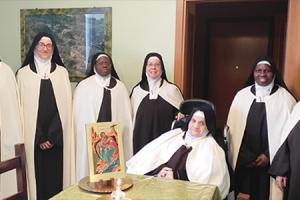
First Elective Chapter of the Carmelite Monastery Mater Carmeli in Biella, Italy
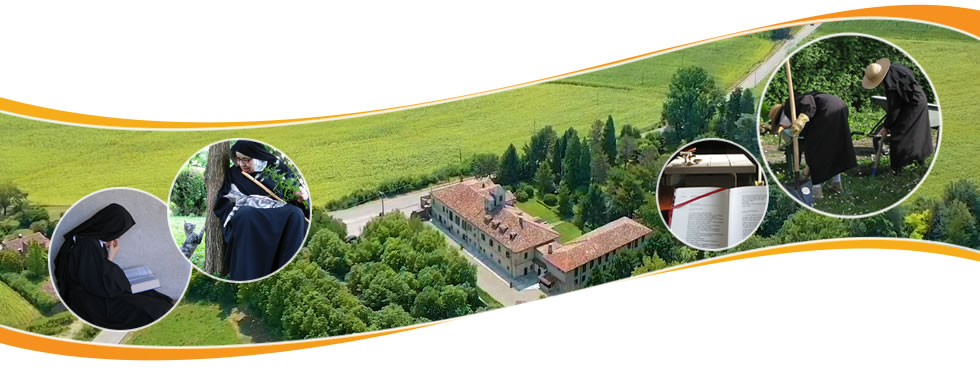
The Carmelite community of the Mater Carmeli monastery in Biella, Italy, held its first elective chapter on January 9, the feast of St. Andrew Corsini. The monastery was founded on June 4, 2005, from the monastery of Carmelo S. Anna in Carpineto Romano, Italy. On June 4, 2025, the foundation received the Decree of Canonical Erection.
The monastery's website is www.carmelitanebiella.it
Those elected to leadership are:
Prioress | Priora | Priora:
Sr. Maria Aurora della Risurrezione, Pierconti
1st Councilor | 1ª Consejera | 1ª Consigliera:
Sr Rita Mary dello Spirito Santo e di S. Elia, Otorho
2nd Councilor | 2ª Consejera | 2ª Consigliera:
Sr. Maria Cristiana del Crocifisso, De Gaspar
Treasurer | Ecónoma | Economa
Sr. Maria Rosa dell'Eucarestia, Fois
Formator | Formadora | Formatrice
Sr. Maria Aurora della Risurrezione, Pierconti
Sacristan | Sacristana | Sacrestana:
Sr. Maria Veronica del Volto dell'Amore, De Simoni
New Delegate for the Third Order Nominated
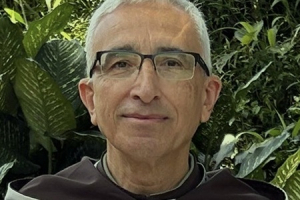
The prior general and his council nominated Fr. Michael Farrugia, O. Carm., general procurator as the general delegate for the Third Order.
During the last General Chapter, held during September 2025, Fr. Michael Farrugia was re-elected as the Order’s procurator general for a six-year term, from 2025 to 2031. Fr. Michael is also the president of the General Commission for the Protection of Minors and Vulnerable Persons.
He previously served as Prior Provincial of the Maltese Province.
“The Cross Is My Joy, Not My Sorrow” Docu-Premiere
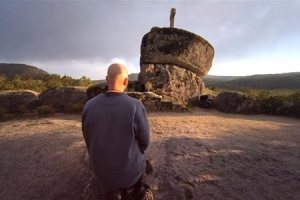
“The Cross Is My Joy, Not My Sorrow” Documentary on Spanish Carmelite Pablo María de la Cruz Premiers
The Carmelite Order begins the new year with the premiere of a documentary entitled: The Cross Is My Joy, Not My Sorrow’ the story of Pablo María de la Cruz, a young Carmelite from Salamanca who died in July 2023 at the age of 21. His death came a few weeks after making his religious profession as a Carmelite at the priory of St. Andrew (El Carmen de Abajo) in Salamanca.
The production narrates the young man's life through the testimonies of family members, friends, priests, friars, and monks who had a close relationship with him and were direct witnesses to the work that God in him. It also includes several excerpts from an interview with Pablo that was recorded a few days before his death.
“Heaven exists, Jesus is alive” is the main message that Pablo conveys in this documentary. He makes this clear in the words he speaks openly to the camera: “Through suffering in illness, I found God, and through death in illness, I will go to Him. And that makes me immensely happy.”
Pablo offered his life to God for three intentions: for the conversion of young people through their encounter with Jesus in the Eucharist; for the unity of the Church; and so that the offering of his life might help us all to overcome our fear of death.
The premiere of the documentary will take place in the St. John Paul II Auditorium at the Pontifical University of Salamanca on Friday, January 16th, at 7:30 pm. This production is suitable for all audiences, as the life of this young man will captivate both believers and non-believers alike.
The original audio of the video is in Spanish, but we have added English subtitles. To see a preview of the documentary is on the Carmelite YouTube, go here:
Vitam Coelo Reddiderunt
|
05-12-25 |
|
|
|
|
St. Andrew Corsini, Bishop
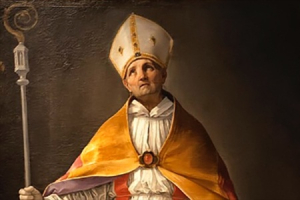
January 9th | Feast
Born in Florence at the beginning of the 14th century, St. Andrew Corsini entered religious life in the Carmelite house in his native city. He was appointed Provincial of Tuscany in 1348 by the General Chapter meeting in Metz and the following year he was named bishop of Fiesole, near Florence. He governed his diocese well, becoming a model of charity and an eloquent preacher.
He was distinguished by his zeal for the apostolate, his wise judgement and his love for the poor.
Prior General's Schedule for January 2026
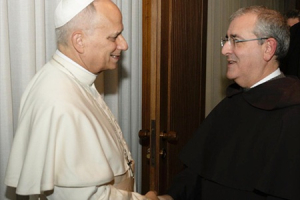
Fr. Desiderio García Martínez, O. Carm., the prior general, has the following schedule planned for the month of January 2026:
January 8: Visit to the Carmelite monastery of Carpineto Romano. Meeting with Sr. M. Valentina Rita Rossin, president of the St. Mary Magdalene de' Pazzi Federation of the Order's monasteries in Italy.
January 12-13: Meeting of the priors provincial, commissaries general, and the general delegates of Europe.
January 18-23: Provincial Chapter of the Province of Pernambuco (Brasil)
January 25-30: Provincial Chapter of the Rio de Janeiro Province
St. Peter Thomas, bishop
January 8th | Feast
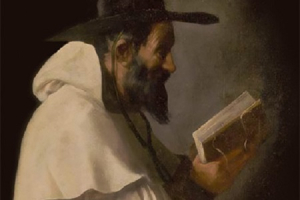
Peter Thomas was a true Carmelite, not only in his relationship to Mary as the Queen and Decor Carmeli, but also in the way he lived his life according to the customs of the Order. However, his special commitment and concern was primarily for the unity of Christians. He constantly strove for reconciliation between the Church of Rome and the Orthodox Christians who had separated from the See of Peter in 1054. He developed an intensive apostolic activity as a peacemaker and defender of the popes. He always preached reconciliation. Miracles and extraordinary signs accompanied his eventful life.
A fresco created in 1880 by the Munich painter Max Fürst in the Carmelite church in Straubing shows St. Peter Thomas surrounded by confreres caring for the needy and giving communion to the sick. However, the painting also points to an essential characteristic of the saint's piety: his fervent devotion to Mary, who appears to him with the infant Jesus in her arms, accompanied by angels, and assures him of her protection and blessing. Tradition also credits him with writing a treatise on the Immaculate Conception of Mary (De Immaculata Conceptione BMV). Four volumes of his sermons have also been preserved.
In 1366, his chancellor and friend Philippe di Mézières, of whom he was also a spiritual director, wrote the biography of Petrus Thomas. Noted Carmelite historian, Joachim Smet, edited the Latin text from hitherto unpublished manuscripts. (The introduction and notes are in English.)
For more on St. Peter Thomas and his work, click here
Books Available from Edizioni Carmelitane:
The Life of Saint Peter Thomas by Philippe de Mézieres (Latin)
Introduction and Notes by Joachim Smet, O. Carm.
The Bollandist Dossier (1643) on St. Peter Thomas, O. Carm.
Edited and translated by Patrick Mullins, O. Carm.
The Revised Bollandist Dossier (1659) on St. Peter Thomas, O. Carm.
Edited and translated by Patrick Mullins, O. Carm.
Lectio Divina January, 2026

Opening Prayer
Lord Jesus, send your Spirit to help us to read the Scriptures with the same mind that you read them to the disciples on the way to Emmaus. In the light of the Word, written in the Bible, you helped them to discover the presence of God in the disturbing events of your sentence and death. Thus, the cross that seemed to be the end of all hope became for them the source of life and of resurrection.
Create in us silence so that we may listen to your voice in Creation and in the Scriptures, in events and in people, above all in the poor and suffering. May your word guide us so that we too, like the two disciples from Emmaus, may experience the force of your resurrection and witness to others that you are alive in our midst as source of fraternity, justice, and peace. We ask this of you, Jesus, son of Mary, who revealed to us the Father and sent us your Spirit. Amen.


