












O.Carm
International Conference on John of St. Samson
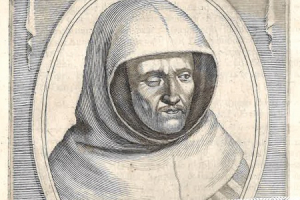
The first ever conference devoted to John of St. Samson (1571-1636), author of abundant spiritual and mystical works, will be held September 28-October 1, at the Auditorium Paul Ricoeur of the Archives départementales d’Ille-et-Vilaine. Its organization is the fruit of joint efforts between the Archives, the Université Rennes 2/Tempora, Cellam, the Maltese Carmelite Institute (CIM), the University of Malta (UOM), TBI/Radboud University and the CEHS Grands Carmes and is sponsored by Le Departement Ille & Vilaine, Metropole Rennes, Région Bretagne, UOM, CIM and CEHS.
The colloquium is intended to be a genuine rediscovery of John St-Samson as Carmelite, mystic, and poet. The conference will bring together specialists of the spiritual literature of the 17th century and historians of Catholicism in the modern period, both French and from other countries including Belgium, the Netherlands, Italy, Portugal, and Malta.
The publishing house of the Carmelite Order, Edizioni Carmelitane, is planning a modern edition of the Complete Works, with four of eleven planned volumes completed.
The conference will be held at the Archive of Ille-et-Vilaine, which preserves an exceptional collection of St. Samson’s manuscripts. The first session will be devoted to a presentation of the collection and challenges with the edition. The volumes published in the 17th century, twenty years after John's death, were sometimes very different from the manuscripts preserved at the Archive. The latter are not autographs, because Jean de Saint-Samson was visually impaired and dictated his teachings. The manuscripts in Rennes are the most complete. All the speakers at the colloquium had access to digital copies and working transcriptions.
A second session will attempt to appreciate the historical role of Jean de Saint-Samson. Originally from Sens in Burgundy, Jean Du Moulin came to Paris in 1597 and was admitted to the Carmelite priory of Dol-de-Bretagne in 1606 and took his religious name there. Although a "lay brother,” he acquired a strong influence over the novices and, in 1612, was called to Rennes by the prior. From then on, historians consider him to be the "spiritual master" of the Touraine Reform Movement, a reforming current of which Rennes was the focus.
The focus will then shift to St. Samson’s writings to consider their reception and his influence. A central point is the link of Jean de Saint-Samson's spirituality to the "abstract" mysticism of Rheno-Flemish origin. The theme of love in his writings, the best-known today being the Epithalamium, will be addressed.
The poetry of Jean de Saint-Samson, almost entirely unpublished, will be a volume in itself in the current edition of the Complete Works. The poetry will also receive a full day of examination at the colloquium.
Causa Nostrae Laetitiae - Iulius/September

PROFESSIO TEMPORANEA
27-07-22 Nelson Anciano Jr. (Phil) Quezon City, Philippines
27-07-22 Johny Rebosquillo (Phil) Quezon City, Philippines
27-07-22 Sanny Gie Calacar (Phil) Quezon City, Philippines
27-07-22 Alvin Evangelista (Phil) Quezon City, Philippines
27-07-22 Lolito Noja Jr. (Phil) Quezon City, Philippines
27-07-22 Sunday Buling(Phil) Quezon City, Philippines
27-08-22 Patrick (Louis-Marie) Mingard (Gal) Nantes, France
03-09-22 Anderson Bruno Nana Barh (Baet-BF) Efoulan, Cameroon
03-09-22 Fernand Yameogo Arzouma (Baet-BF) Efoulan, Cameroon
03-09-22 Éric Bahati Kodjo (Ita-Congo) Efoulan, Cameroon
03-09-22 Bertrand Gang On (Ger-Cam) Efoulan, Cameroon
03-09-22 Alphonse Marie Deligiri Engal III (Ger-Cam) Efoulan, Cameroon
03-09-22 Benjamin Yutcha Tedonang Yemele (Ger-Cam) Efoulan, Cameroon
03-09-22 Achille Ango (Ger-Cam) Efoulan, Cameroon
08-09-22 Mary Veronica Katei of the Holy Spirit (MAC) Machakos, Kenya
08-09-22 Mary Virginia Ndungwa of Sacred Heart of Jesus (MAC) Machakos, Kenya
11-09-22 Laurentiu Francu (Ita) Albano Laziale, Italia
11-09-22 Marco Figuccio (Ita) Albano Laziale, Italia
PROFESSIO SOLEMNIS
27-07-22 Mechael Tateng Jr. (Phil) Quezon City, Philippines
27-07-22 Romualdo Delos Reyes Jr. (Phil) Quezon City, Philippines
27-07-22 Rolando Mamites (Phil) Quezon City, Philippines
27-07-22 Alexander Martinez (Phil) Quezon City, Philippines
27-07-22 Michel San Juan (Phil) Quezon City, Philippines
27-07-22 Adrian Vergel Ballares (Phil) Quezon City, Philippines
27-07-22 Petronilo Flores (Phil) Quezon City, Philippines
27-07-22 Dave Malinao (Phil) Quezon City, Philippines
27-07-22 Jaynor Mike Gomez (Phil) Quezon City, Philippines
20-08-22 AnaMihaela del Santissimo Sacramento (CAR) Lucani, Romania
03-09-22 Miriam Therese Albeza (BUR) Burgos, Philippines
ORDINATIO SACERDOTALIS
03-09-22 Paolo Guerrini (Ita) Pisa, Italia
XI Meeting of the Carmelite Family in Perú
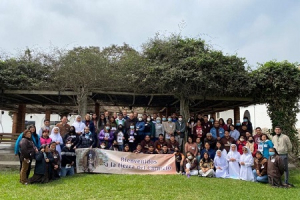
On August 12-14, the Carmelite Family of Peru gathered at Villa Carmelitas to celebrate the XI Meeting of the Carmelite Family.
After two years of not meeting due to the Covid 19 pandemic, the members came together again and celebrated as family. The gathering was marked by pain and sadness from what was experienced together during the pandemic. For the 2022 celebration, it was decided to reflect on the experience of God in everyday life.
The main theme of our reflection was: Holiness in Daily Life Following the Example of St. Titus Brandsma. Member of the Carmelite Family gathered from all parts of Peru and beyond: lay people, religious, students in formation, novices, lay people from Bolivia, “the whole family gathered with our eyes fixed on Jesus.”
“We gave thanks to God because the Villa Carmelita retreat center had become the place where we could recreate our experiences of God, or as someone said, it became our little Mount Carmel. We also give thanks for these spaces of fraternity because they reinforced our identity as Carmelites.” Luis Maza, general councilor for the Americas, and Enrique Laguna, director of the Centro de Espiritualidad Carmelita San Juan de la Cruz in Lima, Peru, facilitated the meeting. “They helped us to understand what it means to be saints in the challenges of daily life. We thank the whole team for the preparation of the meeting.”
Celebrating At Home - 25th Sunday in Ordinary Time

Investing in the future
(Luke 16:1-13)
When bad things happen to us we are apt to spend a great deal of time being angry at what has taken place – especially if we feel that what has happened is unjust, unfair or unreasonable.
Today’s Gospel episode is often called the ‘Parable of the Unjust Steward’. But perhaps he is the one who is being treated unjustly. After all, the Master hears a rumour that the steward has been ‘wasteful with his property’. Without conducting an investigation to find out if the rumour is true, the Master decides to dismiss the steward.
The steward spends only a little time trying to decide what he will do once he loses his job. Knowing he is too weak to dig and too ashamed to beg, he sets about altering the contracts of sale for his masters’ debtors.
Is the steward stealing from the Master? No. In the ancient world such stewards were not directly paid by the master. Their ‘wage’ came from the commissions they added to bills of sale. So the steward is giving up his commission for the sake of his long-term future; to build goodwill among the debtors that they might return the favour in the steward’s coming hour of need.
For astutely investing in his future the steward is praised by the Master. Jesus uses this allusion to advise the disciples that they, too, should invest in their future through the sharing of all that they have.
The term mammon refers not only to money, but to all that a person has. The disciples, says Jesus, should be prepared to give away all that they have to the poor so that when the kingdom comes, in which the poor have the privileged places, the disciples will be welcomed into the ‘tents of eternity’.
The final sayings of this Gospel presuppose that Christian life is a stewardship in which the wealth that one handles is wealth God wishes the whole world to share, not one’s personal possession. Disciples must choose wisely and act decisively. When it comes to wealth, they must choose between the interests of God and their own self-interest.
If disciples do not share possessions, they will not be entrusted with the true riches of the kingdom. If they do share possessions, which are on loan from God, they will be given the treasure of heaven as their own. The disciples must give exclusive loyalty to God or succumb to the enslavement of mammon.
- pdf Celebrating At Home - 25th Sunday in Ordinary Time [PDF] (2.88 MB)
-
default
Celebrating At Home - 25th Sunday in Ordinary Time [ePub]
(2.84 MB)
- pdf Celebrando en Familia - 25 Domingo del Tiempo Ordinario (465 KB)
- pdf Celebrando in Casa - XXV Domenica del Tempo Ordinario (302 KB)
- pdf Celebrando em Família - 25 Domingo do Tempo Comum (474 KB)
Feast of St. Albert of Jerusalem

17 September Feast
There are very few facts known about the birth of Albert. The first biographical data comes from the Canons of Mortara. Albert entered into this order around 1170. Around 1180 Albert began developing connections with the pope and the Roman curia. Between 1181 and 1183 he undertook two missions at the behest of Alexander III and Lucio III. The following year he was nominated bishop.
He was bishop of Vercelli for 20 years but continued to be involved in diplomatic activity on behalf of the popes. Some of his work was settling conflict between people or cities. But he was also very active in the area of legislation and organizational structure. He would ultimately provide these gifts in service to the hermits on Mount Carmel.
In 1204 the Canons of the Holy Sepulchre elected Albert as patriarch of Jerusalem. Pope Innocent III added the responsibilities. Of papal legate for the Holy Land and Middle East. Albert arrived in Palestine in 1206, residing at Acre since Jerusalem was occupied by the Saracens. Here too Albert became the mediator of various disputes. In fact, this role as mediator has led some to conclude that Albert became involved with the hermits on Mount Carmel because of a dispute among the members.
When exactly Albert wrote his formula vitae for the hermits is open for discussion. This document was addressed to someone named “B” which later traditions named “Brocard.” Albert becomes referred to in the Carmelite Order as “the lawgiver” for his development of a rather short document outlining the life of the hermits on Mount Carmel. Albert’s formula vitae which will eventually become the Rule of the Order.
By the 16th century Albert’s feast was celebrated on April 8. Later it was customary to celebrate his feast on September 17. There were attempts to have Albert proclaimed as a martyr but the Order continues to celebrate him as “bishop and legislator of our Order.”
Read more here
Watch here the Reflections on St. Albert of Jerusalem with Br. Patrick Mullins O. Carm.
Watch here the Interview with Br. Patrick Mullins O. Carm, an expert on St. Albert.
List of Books From Edizioni Carmelitane on St. Albert of Jerusalem.
La Regola del Carmelo: Origine, Natura, Significato – Seconda Edizione. Carlo Cicconetti, O. Carm.
Italian. 2018. 856 pages. Euro 59.00.A cornerstone of formation for members of the entire Carmelite Family today as in the past is the Rule.
Alberto Patriarca di Gerusalemme. Tempo – Vita – Opera. Vincenzo Mosca, O. Carm.
Italian. 1996. 780 pages. Euro 50.00.The book opens with a broad sweep covering the historical and religious environment of the eleventh to thirteenth centuries.
The Life of St Albert of Jerusalem – A Documentary Biography – Part 1. Patrick Mullins, O. Carm.
English. 2016. 604 pages. Euro 45.00.
The large number of extant documents concerning the early thirteenth-century Latin Patriarch of Jerusalem, Albert degli Avogadri (c. 1150-1214), demonstrate both his impact on his times and the ways in which his life was shaped by his historical circumstances. Divided into two volumes, each of twelve chapters.
The Life of St Albert of Jerusalem – A Documentary Biography – Part 2. Patrick Mullins, O. Carm.
English. 2017. 603 pages. Euro 45.00.These and more books can be purchased directly from Edizioni Carmelitane or from other webstores around the world.
Click here to access these and other many fine publications at Edizioni Carmelitane.
To place your order please contact Edizioni Carmelitane at This email address is being protected from spambots. You need JavaScript enabled to view it.
A Family Reflection on St. Titus Brandsma
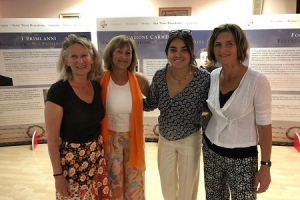
When we were growing up in the 60'd and 70's, we were aware that our grandmother's cousin Titus was a holy man. We knew of his history, as well as the strong Catholic heritage that we have comes from our father's side of the family. Many of our relatives went into Catholic ministry.
Growing up in America with Dutch parents, there was always a standard that was very important for us to live by: that was respect, honesty, helping others, and standing up for what was right. Our father, Jouke, was a strong impetus behind our way of thinking. He was a very kind, helpful man. He was always helping neighbors. He was very active in the Church, looking for ways the Church could better serve people in need. He was not, with his tendency towards activism in social justice, always the favorite of monsignor.
Our father lived what he believed; his life was his teaching for us. In 1954, he was recruited to come to the United States by Zenith Radio Corporation. He was an electrical engineer, living at the time in Eindhoven, Holland. All of his children were born and raised in the Chicago area.
He was very successful in his career, but also worked very hard to support those who were underserved.
He volunteered through Project HOPE, a fair housing not-for-profit organization founded by Bernie Kliena, a former priest. This organization was focused on the western suburbs of Chicago and helped immigrants obtain housing.
Our parents were sponsors (through our Church) of a family of Vietnamese refugees. My parents tutored them, helped them to assimilate into work and schools and supported them for many years. I think because my mother and father were immigrants, they could relate to the difficulties and were empathetic to their needs.
Our parents were also foster parents to two troubled teens. They took them into our family of six children without any hesitancy.
Our father and mother were also involved in religious education through the Catholic Church. Our father taught a high school morality class. I will always remember that my peers found his classes so interesting! I was very proud of my father. I knew what a good man he was and that he often saw things from a different lens. The fact that high school teenagers were excited to come to his class was special!
We traveled back to Holland as a family a few times when we were young children. These trips would always include going to Friesland and visiting relatives. There was often conversation about Titus and his life, as well as the rest of my grandmother's family, Fr. Titus’ sister, that became nuns and priests and the impact each of them made. In later years we would go to Oss, to the priory honoring Father Titus. Our uncle was very involved in overseeing this as he lived in Oss. But I must say, our family did not overemphasize their life stories. It was more like a discussion of someone in the family who had a good life and lived the values that were expected of all of us. It was all seen as "normal.”
In 1985, our cousin Mainse (his father is Joghem and the other little boy with my father Jouke in the family portrait) went to Rome and was present for the beatification of Titus. He described that event as life changing and profoundly spiritual for him. Our family in America discussed it, mostly at dinner, because we were all together then. We honored Father Titus, but again, his life was not glamorized. We all just strove to be better in our daily lives.
For me, I feel very humbled, proud of Saint Titus, and inspired to live my life as Pope Francis said “as a saint.” Daily I think of Saint Titus. I think of the common family roots that he and I share. And I am encouraged that I too can make a positive impact on our world, however small, one day at a time.
∗∗∗
Pictures and captions
St. Titus Celebrated in Australia
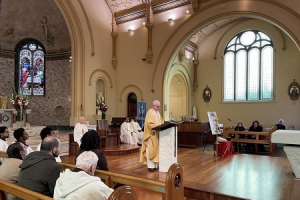
Carmelites, Lay Carmelites, parishioners, students, parents, and staff from Whitefriars College, and those for whom Titus Brandsma holds a special place in their lives, gathered at the National Shrine of Our Lady of Mount Carmel, Middle Park (VIC), on July 31 for a Thanksgiving Mass celebrating his canonization.
Students from Brandsma House at Whitefriars College joined the Entrance Procession carrying the relic of Titus Brandsma, the Brandsma House banner and a typewriter and camera. One of the students welcomed the assembly and gave a personal reflection on Titus Brandsma at the beginning of Mass. Students, staff and parishioners shared the readings and Prayers of the Faithful. Fr Paul Cahill, the prior provincial presided.
In his homily, Fr Paul called Titus Brandsma, “a gift to the world, the Church and the Carmelite Order.” He added, “Throughout his life, whilst exercising and sharing his intellectual gifts through his studies and his teaching, preaching and writing, he was also down to earth, connected with people in their everyday struggles, and keen to assist them in whatever practical ways that he could.”
Stressing the relevance of Titus for us today, Fr. Paul quoted the words of Pope Francis during his homily at the Mass of canonization when the pope observed that we have “turned holiness into an unattainable goal. We have separated it from everyday life, instead of looking for it and embracing it in our daily routines, in the dust of the streets, in the trials of real life and, in the words of (another great Carmelite Saint) Teresa of Avila to her Sisters, “among the pots and pans.”
He also quoted the Cardinal Archbishop of Utrecht in Titus’ native Netherlands, during his homily in the first Mass of Thanksgiving, celebrated in St. Peter’s Basilica the day after the canonization. “Titus didn’t become a saint because he was a martyr, but he became a martyr because he was already a saint”.
Celebrating 600 Years of Carmine in Florence
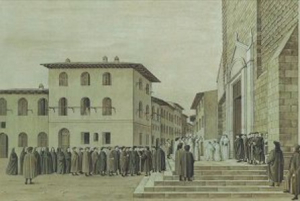
1422-2022
The Carmelite Community celebrates 600 Years of the Dedication of the Basilica of the Carmine in Florence, Italy, on Sunday, September 18.
The celebration will include a greeting of the Carmelite prior general, Míceál O’Neill at 9:30 AM. At 9:45 the Mayor of Florence, Dario Nardella; the Prefect, Valerio Valenti; and the Superintendent of Florence Andrea Pessina will speak. This will be followed at 11AM with Eucharist celebrated by Cardinal Giuseppe Betori, the Archbishop of Florence. A reception follows.
Through a donation from the will of Cione Tifa Vernaccia, the Carmelites became the seventh and final mendicant community to establish themselves in Florence, which by the end of the thirteenth century was becoming the financial and cultural capital of Europe. While the Carmelites alone did not profoundly alter the history of the city, together the mendicant communities played key part in shaping the religious and social life of Florence.
The church the Carmelites from Pisa established in the Oltramo district of the city of Florence was named in honor of the Blessed Virgin Mary of Mount Carmel (Beatæ Virginis Mariæ de monte Carmelo). Construction began in 1268 creating a church in the form of a Latin cross. By the 14th century, the church was the seat of a number of lay fraternities.
The church and adjacent convent grew dramatically over the years. By 1400 there was a new novitiate wing, a prison, a granary, sheds, and stalls for animals, and a stable for horses. Building continued in the fifteenth century with the construction of the second cloister (1469), a new infirmary, a guest house with its own kitchen (1440), and a novitiate, capitular hall and refectory (1464).
The church structure contains the Corsini family chapel containing the remains of the 14th century Carmelite, St. Andrea Corsini. The church is also home to the famous frescoes by Masaccio and Masolino, considered the first masterwork of the Italian Renaissance. Masolino, commissioned by a wealthy merchant, Felice Brancacci, began work on the chapel in 1425. His pupil, Masaccio soon joined him in the project. The cycle of scenes by Masolino were completed by Filippino Lippi, son a a member of the Carmelite community in Florence.
A fire in 1771 left little more than the shell of the gothic church building. It was rebuilt in the eighteenth-century style.
“While the Carmine of Florence did not compare in size or wealth to some churches of that city, its position in the economic and cultural hub of Western Europe made the Carmine one of the cardinal houses of the Order. Its history gives us a fascinating window into the life and structure of a friars' convent and enables us to see how the mendicant orders evolved from their original inspiration to become part of the ecclesiastical and social establishment against which they had originally rebelled,” according to a study of the Florentine foundation entitled Servants of Two Masters: The Carmelites of Florence 1267-1400.
To appreciate the role that the Carmine played in Florence it is necessary to examine the three major purposes which the church and convent served. The Carmine was the Carmelite community in the city of Florence, the residence of the Carmelite provincial of Tuscany, and a studium generale of the Carmelite Order.
The church was consecrated on April 19, 1422, substantially finished, but still awaiting much of the internal decoration.
∗∗∗
Pictures and captions
Masaccio painting the Sagra recalls the Consecration of the Basilica del Carmine, which took place on April 19, 1422, and was attended by an "infinite number of citizens in cloaks and hoods, who go behind the procession." (Vacari, Le Vite, 1550)
XX General Chapter of the Carmelites Sisters in Málaga
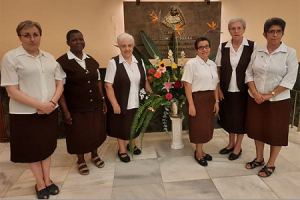
From August 8-29, the XX Ordinary General Chapter of the Hermanas Carmelitas del Sagrado Corazón de Jesús was held at their motherhouse in Limonar, Málaga, Spain.
This Institute was founded by Servant of God Asunción Soler Gimeno (1882-1959) on May 13, 1924 in Spain. Her goal is to live, according to the spirit of Carmel, in and with the people. She was particularly interested in helping the poor and needy.
While diocesan approval was granted in 1938, the Institute was affiliated to the Carmelite Order on June 7, 1947.
The sisters commit themselves to the education of the youth, social action, and to the sick, as well as to the needs of the Church. Their presence has greatly increased in Spain, Portugal, the Dominican Republic, Cuba, Venezuela, and Mozambique.
The following sisters serve on the new General Council:
General Superior | Superiora General | Superiora Generale:
Hna María Teresa Delgado Aguado, HCSCJ
Councilor-Secretary | Consejera-Secretario | Consigliera-Segretario:
Hna Luz Marina Materano Perozo HCSCJ
Councilor | Consejera | Consigliera:
Hna María Lopes Nivurucha, HCSCJ
Councilor | Consejera | Consigliera:
Hna Mercedes Espinal de Jesús, HCSCJ
Councilor | Consejera | Consigliera:
Hna María del Rosario González Domínguez, HCSCJ
Councilor-Treasurer | Consejera-Ecónoma | Consigliera-Economa:
Hna María Dolores Calvo López, HCSCJ
Update on the General Congregation
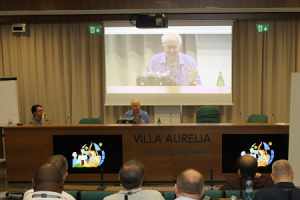
Fr. Timothy Radcliffe has been speaking to the members of the General Congregation, giving them some ideas to be discussed together regarding the core of the gathering’s theme: The Radical Witness of Consecrated Carmelites in the World of Today.
The General Congregation began on Monday, September 5 and continues through next week.
Fr. Radcliffe was the master general (superior) of the Dominican Order from 1992-2001. He is a member of the English Province. He taught scripture at Oxford and has become a popular speaker and author. He addressed the 2007 General Chapter of the Carmelite Order.
Here we summarize what he has been speaking about during his presentations:
These meetings [General Congregations, Chapters, etc] are a time, in my experience, for us to rediscover together just how liberating is our mad way of life. It really is a way to happiness and freedom. I also believe that religious life speaks to our world. We are friars, fratres, brothers, and we have sisters too. The world is desperately in need of living symbols of fraternity.
Pope Francis wrote Fratelli Tutti, ‘All brothers’, because our world is in danger of losing the old dream of universal brother and sisterhood. Now we see war in Ukraine, and China flexing its muscles. For the first time for sixty years, there is the threat of nuclear war. Millions of people are on the move trying to escape violence and poverty. Everywhere walls are going up to keep strangers at bay. The world order into which I was born seems to be crumbling. Many fear that we are entering a time of chaos.
In the face of this disintegration, we friars embody something wonderful and desperately needed: brotherhood. These are the oldest Christian titles and the only important ones: brother and sister. Not just brothers and sisters of each other in the Order, but as living symbols of the human family, children of Our Father, gathered into Christ’s kinship.
It is also of immense importance for the Church. Pope Francis is summoning us to leave behind stifling clericalism. Most Carmelites are priests. But how can we be priests without being clericalist? We friars can embody just what the Church is looking for, a brotherly way of being a priest. It was in hearing confessions that I began to embrace priesthood. Here I was beside people in their sorrow, one of them. If I had not committed their sins, I had probably thought of doing so. I was their brother.
But what about the brethren who aren’t priests? When I became a Dominican, a third of the brethren were lay brothers. Now they are a tiny minority. In recent chapters we have constantly sought to recover the vocation of the lay brother as an intrinsic part of our life. We have endlessly discussed their identity. What does it mean to be a brother in a clerical institute? I have always argued that the real question is the other way around: What does it mean to be a priest in an order of brothers? What does it mean to a priest in “the Brothers of the Blessed Virgin Mary of Mount Carmel.”
So I wish to open up a discussion of the pillars of our religious life, our vows, and search for how they may be live with joy and freedom. I will begin with obedience, then look at chastity, how we live our sexuality. Then leadership. I will not devote a special lecture to poverty. This is because religious orders have such deeply different ideas of poverty. I confess that I have no idea as to what is a Carmelite understanding of poverty!
But I think that the other vows each imply a profound poverty. The vow of obedience invites us to a more radical form of poverty than not just owning things. We do not own our lives. With chastity we learn not to own other people. And leadership is a sort of dispossession of oppressive power. So I hope that we shall see how poverty certainly includes a simplicity of life, but it is also much more radical than. It is a poverty of spirit. ‘Blessed are the poor in spirit, for theirs is the Kingdom of heaven’. (Matthew 5.3).


