











O.Carm
Carmel Mission Gathers in the Amazon Region
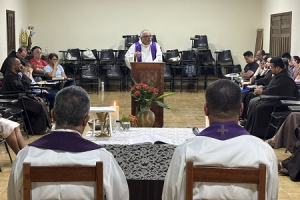
Between March 22 and April 1, the Carmelite family held the "Carmelo Mission" meeting in Itaituba, Pará State - Amazon region - Brazil. The meeting is a response to the exhortations, from Pope Paul VI to Francis, that "Christ points to Amazonia" (Doc. Santarem 1972; Querida Amazonia 2020). The gathering brought together around 40 missionaries from the various branches of Carmelite life: friars, sisters, consecrated lay men and women and those who draw inspiration from Carmel.
The meeting took place in three important moments: (1) to see: the Amazonian reality. Bishop Wilmar Santin, O. Carm., shared a historical overview of the Carmelite presence; Father Ivair shared his deep knowledge of the Amazonian reality in the context of ecclesial presence and in the light of the Magisterium; and the brothers and sisters, consecrated men and women, who live and work in the region spoke of their experience. (2) judging: in which we went out, in the sunlight of Holy Week, to the regions of the communities to carry out visits and Easter celebrations. (3) acting: in which the members of the General Curia, Luis Maza and Tobias Kraus, who were present, met with prior provincials and superiors to draw up courses of action to work towards the goals of a continuous response of the Latin American Church to the call on behalf of Amazonia.
The seeds, therefore, have been sown: moments of fraternity, prayer and mission in Amazonian lands, favored by the feeling of unity as a Carmelite family around the goal of bringing the spirit of Elijah, prophecy, contemplation and service, to the people who challenge us in the Amazon region. Time will bring forth the fruits in each one of us and in what we leave behind as a mission. In everything, we give thanks!
JPIC Conference Deadline Approaches

Reminder: April 30th Deadline for Registering for the July 2024 JPIC Conference
The General Commission for Justice, Peace, and the Integrity of Creaction wishes to remind interested members about the JPIC Congress to be held in Fatima, Portuga in July 2024. The deadline for registration is April 30, 2024.
The theme of the Congress is The Carmelite Journey Towards Individual and Collective Ecological Conversion: Social and Environmental Challenges and Responses Today. It is an opportunity to study recent pronouncements in Catholic Social Teaching which calls each person to both individual and collective integral ecological conversion. As Christians and Carmelites we are invited to contribute to the search for an understanding of the world around us and to seek ways of journeying in solidarity with the suffering of the poor.
There are three main objectives for holding this JPIC Congress for the Carmelite Family:
- to come together, listen to one another, discern and learn from Scripture, the Carmelite Spirituality, Catholic Social Teaching and one another on the social and environmental issues;
- to engage with the Carmelite JPIC Handbook in responding to the social and environmental challenges;
- to build JPIC network in the Carmelite Family
The International Congress is scheduled to be held at Casa São Nuno in Fatima, Portugal July 18 (day of arrival) through July 25 (day of departure), 2024. The Congress is open to members of the Order and the members of the affiliated Congregations and Institutes.
The cost of the event is €827. Payment can be made via IBAN to the Carmelite Curia in Rome. (Information for sending payment is below.) Participants are responsible for their travel. Those who need a visa to enter the EU should contact Fr. Ricard dos Reis Raiho at Casa São Nuno (This email address is being protected from spambots. You need JavaScript enabled to view it.).
Conrad Mutizamhepo, O. Carm., is the praeses of the General JPIC Commission. Other members are: Christian Buenafe (Phil), Eduardo Agosta Scarel (ACV), Franciscus X. Hariawan Adji (Indo), José Luis Gutierrez Berrendero (Laico-Baet).
To pay for the Congress:
Name of Bank: BANCA POPOLARE di SONDRIO Ag. 11Via Carlo Alberton. 6/a00185 Roma, ItaliaBank account holder: Curia Generalizia dei CarmelitaniVia Giovanni Lanza, 13800184 Roma, ItaliaBank Account Number: 3147X53IBAN CODICE: IT58 R056 9603 2000 0000 3147X53 (Internationale)BIC-SWIFT: POSOIT22Celebrating At Home - Third Sunday of Easter

Disciples Share a Story, Jesus Appears
and Peace is Given (Lk 24:35-48)
“Peace be with you” - so important are these words of Jesus that we hear them three times in the Gospel. Last week we heard St John’s account of one of Jesus’ appearances to the disciples in the days after his death and resurrection. “Peace be with you,” Jesus said as he breathed the strength of the Holy Spirit on his fearful and doubting followers. In doing this, Jesus echoed what he had said to the disciples at the Last Supper after he had washed their feet: “The Holy Spirit will teach you everything, and remind you of all that I have said to you. Peace I leave with you; my peace I give to you. Do not let your hearts be troubled, and do not let them be afraid” (Jn.14:26-7). But Thomas still doubted and needed to place his hands on the wounded body of Jesus before he could believe.
St Luke’s account of the appearance of Jesus starts on the third day after the crucifixion, the day when his tomb was found empty.
On the road to Emmaus a stranger walks with two of the disciples and finally they recognise Jesus “in the breaking of the bread” (Lk.24:35). This week’s Gospel tells what followed. Jesus appears amongst all the disciples, again greeting them with: “Peace be with you.” He reassures them he is not a ghost, is still with them in the flesh. And as they stand dumbfounded, Jesus asks the very human question: “Have you anything here to eat?” Once again, he shares a meal with his followers.
And as they share the food, he opens their hearts and minds to understand what they have seen and heard.
As we share the food of our Eucharistic meal each time we gather at mass, we recall that whenever Jesus shared a meal with his followers he opened their hearts and minds. Jesus said: “Touch me and see for yourselves.” We may not be there in Jerusalem in that room with the disciples reaching out to touch Jesus, but we can touch and see Jesus in all the good things around us in our world: in the food that nourishes us, the water that revives us and washes us clean, in the love of God, family and friends that sustains us. All these are part of the Peace that we have been given and in these words we feel our call to be Peace in our families, communities, workplaces and world.
- pdf Celebrating At Home - Third Sunday of Easter [PDF](2.84 MB)
- default Celebrating At Home - Third Sunday of Easter [ePub](2.06 MB)
- pdf Celebrando en Familia - Tercer Domingo de Pascua(446 KB)
- pdf Celebrando in Casa - Terza Domenica di Pasqua(447 KB)
- pdf Celebrando em família - Terceiro Domingo da Páscoa(443 KB)
Carmelite Church in Nantes, France, Received New Organ

The Carmelite foundation of Notre-Dame de Lumières, located on the Île de Nantes, has replaced its church organ through the generosity of several partners, including the Fondation des Monastères.
For nearly 30 years the faithful in Nantes have come together with the Carmelites for liturgy. “In this life punctuated by apostolates and times of prayer, liturgy plays an important role. Even if we want [the liturgy] to be sober, we still want it to be beautiful and prayerful, to help us to rise up to God. That's why, many years ago, the community acquired a second-hand organ. For almost fifteen years, it accompanied all our liturgies. However, its sound began to show its limitations ...”
The idea of restoring the second-hand instrument was discussed. But the cost was beyond the Carmelites’ means. Yet well-done liturgy at the first Carmelite foundation in France since the French Revolution is foundational. In a location that perfectly embodies the concept of religious life, both in the midst of the people (the Île de Nantes where Lumières is located is in the city) and yet in a space conducive to silence and meditation.
When the idea of restoring the organ was allowed to die because of the cost, the proposal was made to build a new organ. The project was put on hold as well for lack of funds and a lack of people with the skills necessary to build a pipe organ. However, during a meeting in 2021, the Carmelites and Philippe Humeau, a member of the Association Orgue en Pays de la Loire, the organ builder Denis Londe, a tuner and conservatory teacher Michel Bourcier, agreed to begin building a new musical instrument for the church.
“It was this meeting," says Brother Martin Gilloux, the prior of Notre Dame de Lumières and general delegate of the Order in France, "that the specifics of the organ were agreed to.” The group settled on a German Baroque organ, whose sound is appropriate for liturgy as well as the church’s sober aesthetic. In fact, one condition section of the agreement is that organ students from the conservatory will come and train with the Carmelites—something the general delegation has been attempting to have happen for a long time.
In fact, the new musical instrument means a new artistic program at the Carmelite foundation. It is an opportunity for the church to have more people experience its life. There will be exchanges with the musical world of Nantes with such opportunities as hosting concerts.
The new organ will be inaugurated on April 14, 2024, at a thanksgiving mass for the 30th anniversary of the foundation.
The Carmelite foundation in Nantes was built between 1992 and 1994 when the Carmelite Order decided to return to France officially for the first time since the French Revolution. The very strong Carmelite presence throughout France was decimated during the revolution. In the early 1990s, the Carmelites, at the invitation of the then bishop of Nantes, Bishop Émile Marcus, to establish a prayer center in the new Île Beaulieu district. The architect Bertrand Lemaire was engaged to design a conventual church, a monastery with a cloister and a library. The conventual church is in the shape of a pentagon around the altar, evoking a great tent, gathering the Christian people around their Lord. The complex is dedicated to Notre-Dame de Lumières, as a reminder of an earlier Carmelite church in Provence.
Today, in addition to conferences and publications, the Carmelites participate in the life of the diocese through a chaplaincy for students and chaplaincies in retirement homes. There is also on-going theological training with courses at the Université Catholique de l'Ouest (Rezé branch).
April Schedule of the Prior General

Fr. Míċeál O'Neill, the prior general, has the following schedule planned for the month of April 2024:
April 2-6: Triennial Extended Meeting with the OCD-OCARM General Councils in Bocca di Magra, Italy.
April 7-10: Rome
April 11-15: Visit to the General Delegation in France. Celebration of its 30th anniversary as a General Delegation.
April 16-19: Assembly of the General Delegation of Bohemia and Moravia in Kostelni Vidri
April 20-30: Canonical visitation in RD Congo (Part 2). Conclusion of the 50th Anniversary celebrations.
Congress on Liturgy and Prayer in Carmel Set for 2025

Encountering the Risen Lord: Liturgy and prayer in Carmel today
Liturgical Congress – Tuesday, May 6 -Sunday, May 11, 2025
The Liturgy and Prayer Commission has organised an international liturgical congress to take place in Rome (Italy) from May 6-11, 2025, at the Istituto Madonna del Carmine “Il Carmelo”, the Carmelite center outside of Rome.
The overall theme of the Congress is: “Encountering the Risen Lord: Liturgy and prayer in Carmel today.”
Speakers will include Cardinal Arthur Roche (Prefect of the Dicastery for Divine Worship and the Discipline of the Sacraments), Míceál O’Neill OCarm (Prior General), Donna Orsuto (Pontificia Università Gregoriana), Anastasia di Gerusalemme Cucca OCarm (Prioress, Monastery of St. Stephen in Ravenna), Giovanni Grosso OCarm (President of the Institutum Carmelitanum), Michael Plattig OCarm, Désiré Unen Alimange OCarm, Giuseppe Midili OCarm (Pontificio Ateneo Sant'Anselmo), Valéry Bitar OCD (Teresianum), and Sabino Chiala (Prior of the Monastery of Bose) and others.
The congress is for all those who have an interest in exploring and understanding the beauty of Carmel’s prayer and liturgy so that it can be authentically carried forward in this generation as a means of transformation.
The primary focus of the congress is more pastoral than academic. It is open to all members of the Carmelite Family, that is, friars, enclosed sisters, members of the affiliated congregations and lay Carmelites.
Taking as its point of departure the ecclesial perspective, the commission’s hope si that participants will grow in their understanding of the particular Carmelite characteristics of liturgy and prayer under various themes.
The themes will be explored will include the role of liturgy within a synodal church, celebrating the Word of God, celebrating Mary and the saints of Carmel in their feasts and the art of celebration of the liturgy (ars celebrandi). The way in which these various aspects are inculturated in the different geographic areas of the Carmelite Family will also be explored.
In the course of the week, participants will spend a day in the city of Rome making, in particular, a pilgrimage to the Holy Door of St. Peter's Basilica, Vatican City which will have been opened for the Jubilee Year.
Further details will be available in the coming months including the cost for participants and how to reserve a place.
African Leaders and Formators’ Meet in Boko, Tanzania

African Leaders and Formators’ Meet in Boko, Dar es Salaam, Tanzania, on January 21-29, 2024
A conference for the commissaries, delegates, and leaders of missions in the African geographical area was held at St. Teresa of Avila Spiritual Center in Boko, Dar es Salaam, Tanzania. The conference, from January 21-29, 2024, was themed This Way is Holy and Good: Walk in It (Carmelite Rule, 20): Confronting Carmel’s Challenges in Africa.
The conference center is a ministry of the Carmelite Missionaries Sisters of St Therese of the Child Jesus. Every foundation in Africa had representation present except one for unforeseen circumstances. In a follow-up survey, the participants expressed gratitude for the warm hospitality shown to them by the Carmelite sisters and the men of the Tanzanian foundation.
The conference exposed a number of challenges for Carmel on the African continent. Some of these are outside of the control of the Order: the socio-political and economic situations as well as a number of active conflicts that have continued for a number of years. Other difficult situations can and should be addressed by the Order: the formation programs, approaches to ministry, dependence on founding provinces (there are no provinces in Africa, only foundations dependent on provinces located in Europe or the Americas), and issues of financial management, accountability, transparency, and self-reliance. Difficult situations also persist because of a lack of communication, relationships with local churches, and differences in cultural traditions and customs in a number of critical areas.
A series of speakers provided the group with input in the hope that the leaders and formators would get to know each other personally; that participants would have the opportunity to discuss their experiences and challenges openly; that leaders and formators would themselves grow in Carmelite identity in order to more effectively witness to their communities; that strengthened by the awareness of expectations, the participants would raise the standards of integrity and apply principles of good governance in their own reality.
Key presenters were Mother Lilian Kapongo, CMSSTCJ, Fr James Kulwa Shimbala, SMA, Fr Jean-Marie Dundji, O. Carm, Fr Jerome Paluku, OCD, and Fr. Conrad Mutizamhepo, O. Carm., general councilor of the Order for Africa.
Mother Lilian Kapongo presented Becoming Carmel in the Context of Africa – “This Way is Holy and Good: Walk in It” (Rule § 20): Leadership and Formation for Carmelite Religious Identity, stressing the importance of a solid initial and ongoing formation programs that challenges candidates to be motivated to do discernment of their motivations and challenge to continually purify their motivations at every stage of their religious life.
Fr Shimbala spoke on Religious and Priest: Two Vocations, One Person-- Lifegiving Ministry Approaches that Preserve the Two identities in Community, emphasizing that religious identity springs from a personal or intimate encounter with Jesus according to the Order’s charism.
Fr Jean-Marie Dundji, O. Carm, addressed the topic The Process of Formation of the Carmelite According to the Constitutions 2019 and the Ratio Institutionis Vitae Carmelitanum 2013, pointing out that the Carmelite charism is still in its fragile stages in Africa and that the quality of people is often qualified by the structures and the quality of persons who run them.
Discalced Fr. Jerome Paluku reflected on Religious Life in Africa: Exploring Pathways to Financial Self-Sustainability, examining strategies for income creation which depend on context, mission of investing organization (i.e., charism), investment opportunities and lifestyle of persons. He proposed five areas of management to help mitigate problems and promote viability.
On Saturday, Conrad Mutizamhepo offered a reflection on The Charism of the Order According to Part One of the Constitutions 2019: Viable Ways of Transmitting the Charism by Leaders and Formators, discussing the origins of the Carmelite charism as transmitted through the history, traditions, spirituality, myths, symbols, and significant Carmelites throughout history.
Two days later, Conrad shared another reflection on Vibrant Participation in the Mission of the Order: The Commissions of the Order and their Role in the Carmelite Entities in Africa. He presented the basic structure of the Order and how the mission of the Order is advanced by the eight commissions of the Order and the four other task forces/secretariats.
The opening Eucharist, held on Sunday, January 21, 2024, was strengthened by the musical and choral accompaniment of the Bikira Maria wa Mlima Karmeli parish choir from Bunju. On Sunday, the conference participants joined the parish for Sunday Eucharist and a celebratory meal afterwards.
The Conference agreed upon a Final Message which calls for collaboration between leaders and formators and at Africa level; investment in Carmelite life at all levels, cultivating financial management skills anchored on transparency and accountability; fostering teamwork and building a common vision; rooting our life in the Rule and Constitutions through interiorization; study and application to life in community; ensuring that the Constitutions are available in French; ensuring an appropriate balance among Carmelites living the religious and priestly vocations; fostering awareness of and presence of members at community activities; and, finally, ensuring that Commissions of the Order are reflected at the grassroots.
The extensive evaluation of the conference was very positive. Members were also given the opportunity to make recommendations for future conferences.
Celebrating At Home - Second Sunday of Easter

A Joyful Meeting, the Spirit Received,
Doubts Transformed (John 20:19-31)
The great Easter feast of last Sunday began the Church’s fifty-day celebration of the Resurrection which concludes with the feast of Pentecost in six weeks.
The Gospel of each Sunday is a meditation on Jesus as: the resurrected Christ, made known in the scriptures and the breaking of the bread, the bearer of life in all its fullness, our way, truth and life, pledge of God’s love.
In today’s Gospel reading there are two stories of transformation through encounter with the risen Jesus.
Firstly, Jesus appears to a group of frightened and bewildered disciples hiding in a room. His first words are, ‘Peace be with you’. Fear and bewilderment turn into joy as the disciples recognise the presence of the Risen Jesus with them. But that’s not all. He then sends them out to be missionaries of peace and forgiveness.
In receiving the Holy Spirit they are transformed from a group of frightened people, hiding in a room, to bold proclaimers of God’s love and mercy.
The second story in today’s Gospel is the one we all know as doubting Thomas, though, really, it should be known as believing Thomas - doubt is only the beginning of the story.
Jesus doesn’t scold or rebuke Thomas. If Thomas is looking for proof, he has only to touch Jesus to see he is real. But Thomas doesn’t do that. It is his personal encounter with Jesus which transforms him from doubter to believer.
It is yet another Gospel reminder that faith is not about believing with our minds or in looking for proof.
It is found only in our living relationship with Jesus.
Perhaps these days give us a bit more time just to sit and chat with Jesus, to recognise him already present in our hearts, to allow our fears and doubts to be overcome by love, to find new, creative ways of transforming darkness into light, peace and joy for others.
May the new life we celebrate over the next fifty days bring us the creativity of Spirit we need to be the living heart of God in our world today.
- pdf Celebrating At Home - Second Sunday of Easter [PDF](2.86 MB)
- default Celebrating At Home - Second Sunday of Easter [ePub](2.60 MB)
- pdf Celebrando en Familia - Segundo Domingo de Pascua(562 KB)
- pdf Celebrando in Casa - Seconda Domenica di Pasqua(563 KB)
- pdf Celebrando em família - Segundo Domingo da Páscoa(548 KB)
Lectio Divina April 2024

Opening Prayer
Our living God,
our heart is glad and rejoices and we feel secure in our faith that we have a living person to believe in, Jesus Christ, who is risen from the dead. Let him show us the path of life, let us live in the joy of his presence and give us the grace to make us witnesses, so that we can proclaim with our whole life that Jesus is our risen, living Lord now and forever.
Celebrating At Home - Easter Sunday

An Empty Tomb, Lives Changed Forever,
Enduring Presence (John 20:1-9)
When someone dies, one of the things we often feel is their absence. The rooms where they lived with us, the places where they sat are now empty and our hearts ache.
It’s not hard for us to share Mary’s sense of emptiness and bewilderment when she arrives at the tomb.
If we were to read the next few verses from John’s Gospel, we would read a story of overwhelming joy as Mary Magdalen meets the risen Jesus. When Jesus speaks her name, Mary recognises him and sadness and emptiness give way to joyful reunion.
It’s a story of transformation - how things can change when we meet the risen Jesus.
In a way, we are all caught in tombs which hold loved ones, our experiences of hurt and harm, our fears and anxieties.
What we seem to need above all is presence. Yet, this can be the time when we experience absence most of all - being apart from loved ones, family and friends.
The practice of the presence of God can help us - just frequently reminding ourselves that we always in the presence of God, that we can talk to God as one friend to another, that God is in this moment with us, that God is on our side no matter what comes our way, that God is our constant companion.
Eventually, we will begin to feel more deeply God’s presence, not just beside us, but within us. Eventually, the fears and anxieties, the past hurts, and disrupted relationships begin to melt away.
Where once there was only absence, now there is calm, loving, healing Presence and we know we are not alone. Our tombs begin to empty, and joy becomes possible again.
Resurrection is all about death giving way to life, the impossible becoming possible, absence becoming presence.
May all your tombs be empty!


