
















O.Carm
Journalists Ask Pope to Name Titus as Patron Saint
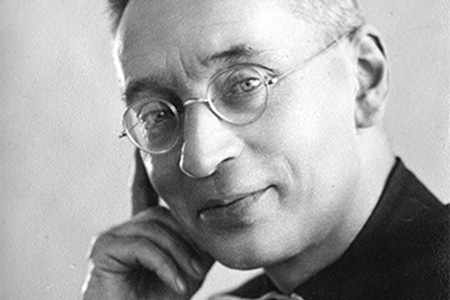 During a press conference organized by the Communications Office of the Carmelite Order for the canonization of Titus Brandsma, a Dutch journalist presented the prior general, Míceál O’Neill, a copy of a letter from Catholic Journalists to Pope Francis. The letter outlines why the newly canonized saint should be designated patron of journalists by the Church.
The four principle signers, from the Netherlands and Belgium, are joined by many others from around Europe and the United States of America.
Here is the copy of the letter from the journalists:
An Open Letter from Catholic Journalists to Pope Francis on the Occasion of the Canonization of Carmelite Titus Brandsma on May 15, 2022
Your Holiness,
In 2018 you asked us, journalists, loud and clear, “to promote a journalism of peace”, a “journalism that is truthful and opposed to falsehoods, rhetorical slogans, and sensational headlines. A journalism created by people for people, one that is at the service of all, (…) a journalism committed to pointing out alternatives to the escalation of shouting matches and verbal violence” (“The truth will set you free” (Jn. 8:32), Fake news and journalism for peace. Message of His Holiness Pope Francis for World Communications Day, 24 January 2018).
We wholeheartedly endorse your call to action and in it we recognize a mission statement for the whole of the journalistic enterprise: for old and new media, for editors of newspapers, magazines, radio and television stations, and internet platforms - and not only for journalists of Catholic origin, but for all journalists of good will.
On 15 May, in Rome, you will canonize a man who embodied these crucial journalistic values until his dying day: the Dutch Carmelite Father Titus Brandsma (1881 - 1942).
Titus Brandsma has meant a lot to the Catholic community in the Low Countries, but his journalistic work stands out among all his other activities. He was editor-in-chief of a newspaper, devoted himself to the modernization and professionalization of the Catholic daily press in the Netherlands, and strove for better working conditions and the establishment of a professional training for journalists.
Father Brandsma did his work in the context of the rise of fascism and Nazism in Europe. In word and deed he opposed the language of hatred and division that was becoming common at the time. In his view, what we now describe as ‘fake news’ was not to be tolerated in the Catholic press; he successfully argued for an episcopal ban on the printing of National Socialist propaganda in Catholic newspapers.
He paid with his life for his courageous actions: in early 1942 Father Titus was arrested by the occupying forces and consequently sent to the Dachau concentration camp. There, on July 26 of the same year, he was killed by an injection, on the Sunday that the Dutch bishops had their courageous protest against the deportations of Jews read out in all the churches.
We, Catholic journalists, recognize in Titus Brandsma a professional peer and fellow believer of considerable standing. Someone who shared the deeper mission that should drive journalism in modern times: a search for truth and veracity, the promotion of peace and dialogue between people.
We therefore see him as a friend and advocate for our entire profession, indeed a patron saint of journalism. We would therefore like to boldly ask you to make this patron saint’s office official.
The current patron saint of journalism is Francis de Sales. He is undoubtedly a holy man of faith and of great merit, but he was not a journalist in the modern sense of the word. Titus Brandsma was.
And as we said, he gave his life for it. In our view, this makes him particularly suitable for this patronage. According to UNESCO, in 2021, no less than 55 journalists died worldwide while carrying out their work. Many more had to deal with violence, threats, repression, censorship and persecution. The commitment to truth and humanity is extremely dangerous in these times of disinformation and polarization. This urgently requires a holy intercessor who has experienced this personally - and passed the ordeal with flying colors.
We thank you for your kindness in considering this request.
Journalists Ask Pope to Name Titus as Patron Saint
During a press conference organized by the Communications Office of the Carmelite Order for the canonization of Titus Brandsma, a Dutch journalist presented the prior general, Míceál O’Neill, a copy of a letter from Catholic Journalists to Pope Francis.
Titus Brandsma, Saint of Oss, by Fr. Buitendijk, O. Carm

Father Titus lived in Oss from 1909 to 1923. All those years he taught philosophy to the brothers of the Order. But he always kept his eye on the world around him.-- first on the City of Oss. Oss was a town with a growing industry.
Titus Brandsma, Saint of Oss, by Fr. Buitendijk, O. Carm

Father Titus lived in Oss from 1909 to 1923. All those years he taught philosophy to the brothers of the Order. But he always kept his eye on the world around him.-- first on the City of Oss. Oss was a town with a growing industry. There was a small upper class of very wealthy manufacturers. But most of the inhabitants were farmers who worked in the factories. For Titus, the serious question arose: how can God's mercy and love be seen in this society?
Today Titus is remembered in Oss, especially as a socially engaged Carmelite. He wanted to elevate the little people and offer them chances for the future. He took initiatives to improve the lot of the poor and involved the well-to-do citizens in this. Above all, Titus wanted a harmonious community in which people could be themselves and build a future. He was a builder of “community spirit.” He was a unifying force in the years of rising industry that brought bitter poverty. In this, he was guided by the Catholic values that he explained in a progressive way. In his progressive thinking and actions, he was a prophetic figure. The lasting fruits of his work are the public library and the Titus Brandsma Lyceum (school). Both institutions are celebrating their 100th anniversary.
In this way, Titus experienced a spirituality suited to the spirit of that time and place. As a religious, a Carmelite, he wanted to understand the times and not place himself outside their influence. In the everyday reality of the social environment, God wants to be sought and found. In this, there is an inspiration that transcends all time: God lives in every person and every person bears God's image that demands reverence and respect. Little people are precious in God's eyes. More than his contempoaries, Titus saw and experienced this. As a contemplative, Titus looked at reality right down to the essentials, including God.
During this period, Titus was deeply involved in the Catholic life of the Netherlands. He had unceasing dedication to all kinds of Catholic organisations. His speech as rector magnificus on the concept of God and his teaching of philosophy and mysticism spoke to many. The modernisation of the Catholic daily press and the advocacy of free and honest journalism ran through his entire life. His fundamental opposition to the ideology of National Socialism on a religious grounds was well known. But strongest of all was his desire to see the image of God in every human being. He was an encouraging pastor for fellow prisoners. He remained respectful to his torturers as people in whom the image of God had been seriously violated.
For me is Titus an appealing and exemplary saint for the universal Church. The traits of Titus' holiness find their origin in the period that Titus in Oss wanted to see God's image in the people for whom he devoted himself. We rightly pray for the intercession of Titus Brandsma as the Saint of Oss.
Father Tom Buitendijk, O. Carm.
Titus Brandsma Parish – Oss, The Netherlands
Happy coincidence or Providence?

Father Adriaan Staring, O. Carm., as postulator general of the Carmelite Order, was responsible for obtaining reliable and relevant documents to be used in the process of canonization of Titus Brandsma.
Happy coincidence or Providence?

Father Adriaan Staring, O. Carm., as postulator general of the Carmelite Order, was responsible for obtaining reliable and relevant documents to be used in the process of canonization of Titus Brandsma. These historically reliable documents were to be used to prove Fr. Titus’ martyrdom. Better than all testimonies, these documents offer us insight into the Nazi persecutor's and Titus Brandsma's own views on matters of faith and Titus Brandsma's acceptance of martyrdom. Fr. Staring was particularly struck by the 'happy coincidence or providence,' that many important documents survived the war and its aftermath. Here is a summary from his account of the miraculous journey of these documents. It concerns three different files.
1. The File of the Sicherheitspolizei
The file, Kirchliche Presse, contains documents outlining the activities of Titus Brandsma: the letters from Archbishop De Jong and his secretary Mr. Giese to Father Titus; the interrogation of Fr. Titus on January 21, 1942; the verdict of the “judge” of instruction of Hardegen and two reports on the matter. By the end of 1944, the Sicherheitsdienst had built an oven in Glanerbrug in which all documents from their archives in The Hague and other places were burned.
Carmelite Brocardus Meijer testified in the trial: “The deeds of his condemnation were confiscated by the partisans and sent to me and to the archbishop, who kept the originals, while copies were sent by me to the various newspapers.” But how did these documents reach Brocardus Meijer?
The Rev. Lambertus Smeets, rector of the Zenderen Grammar School, wrote to his provincial on June 19, 1945: “Mr Hilbrink in Zenderen, a member of the Dutch Internal Defense Forces, whose house the Krauts blew up, killing his father and brother, is in possession of the file of the S.S. concerning the accusations, etc., against Titus Brandsma. The Krauts left these papers behind when they left.”
Later, another official copy of the same file (however not a complete copy), was obtained from the office of the Sicherheitsdienst in Amsterdam. At the request of the Underground, this office was bombed and destroyed by the English on November 26, 1944, while the Underground themselves, acting as “firemen,” brought the documents out, saving them.
2. Documents about Fr. Titus’ Imprisonment
This file contains the letters of Titus Brandsma, his diary of the first days, his statement of his defense entitled “Why the Dutch People, Especially the Catholic Population, Resist the N.S.B. (the Dutch Nazi party), a meditation on the Stations of the Cross, a life of Saint Teresa, his lecture from Good Friday in Amersfoort, his poem written in Scheveningen, a report on the state of his health, some letters from Archbishop De Jong and from his cousin, the lawyer Brandsma, a doctor's certificate, condolences and witness statements about his imprisonment. These documents shed light on the feelings with which Father Titus accepted his imprisonment.
After the death of Father Titus, his cousin, Mr. Assuerus Brandsma, wrote to the Dachau concentration campe, requesting that Fr. Titus' personal belongings be returned. In fact, they were actually sent back, including the writings from his imprisonment. This happened just in time. A short time later, during a bombing of the S.S. barracks on the night of October 3-4, 1942, a firebomb fell on the prison camp's clothing warehouse. The possessions of 30,000 prisoners stored there were destroyed. The prior of Nijmegen, Father Verhallen, kept this file in his room together with the letters of Father Titus and the witness statements.
3. Saved by the Gestapo
On February 22, 1944 Nijmegen was bombed. The Carmelite house, where Titus had lived, was hit but did not burn down. On July 13, 1944, during a search of the house for something totally unrelated, the Nazi police discovered these documents of Father Titus in the prior’s room. This aroused their interest. Although Father Verhallen told them that these had been sent back tot he Carmelites by the Gestapo, they took everything with them.
On September 17, 1944 the battle for Arnhem started. The City of Nijmegen was deeply involved in this battle. The Germans retreated into Nijmegen and on September 18, the Carmelites were given 20 minutes to evacuate the monastery. It was then set on fire by the Germans and totally destroyed. But the documents of Titus Brandsma had already been confiscated by the police.
A Spirit So Pious, So Holy
A few days after May 5, 1945, the prior in Nijmegen, Fr. Verhallen, heard that a well-known lawyer, Mr. van Velzen, connected to the court of appeal in Den Bosch, was in possession of this file. Van Velzen, by request of the Diocese of Roermond, had worked to aid some of the clergymen who had been arrested. This is how he knew Professoor Nelis, the sucessor to the Nazi intergator, Hardegen. In the critical days of September 1944, van Velzen visited him in his villa at Zeist. During that meeting, Professor Nelis was called to the telephone. He returned a little later, pale and shocked. “We have to leave,” he said. “We now have strict instructions to burn everything.” He brought out a pile of files. “I can burn all this because it is all rubbish, but there is one that is something special. It expresses a spirit so pious, so holy, that I shy away from burning it. I gather from the file that they are trying to have him canonized. I don't know what to do with it, I can't keep it and I'm afraid to destroy it.” Mr. van Velzen offered to take it with him and hid it at his home under the carpet, where it remained until the south was liberated. He handed everything over to Fr. Verhallen.
Although these do not relate to the resistance and martyrdom of Titus Brandsma, they are of great value to our knowledge of who he was, his activities, and his commitment to Dutch mysticism. In the process of canonization, they comprise 136 volumes. They were located in Father Titus' study, which was sealed by the Siecherheitspolizei on January 19, 1942. After the house search on June 13, 1944, these writings were taken to safety. The seals of the room were broken and everything was taken to Boxmeer, where an industrialist, Mr. Hendriks, stored them in the refrigerators of his factory. For most of the winter of 1944-1945, Boxmeer lay on the war front like a “no man’s land:” under the Americans by day, under the Germans by night. The residents were evacuated, their property looted, but the writings of Titus Brandsma remained unharmed and were returned after the war.
All these documents are now in the Dutch Carmelite Institute. Through miraculous ways they have been preserved: happy coincidence or providence?
Testimony of the Carmelite Nuns on Titus Brandsma
Is for me a sign that monastic life and work can reach far beyond its walls and that mysticism and knowledge (science) do not contradict each other but can cross-fertilize each other. Both are for me the basis for acting sincerely according to my conscience, following the example of Titus Brandsma.
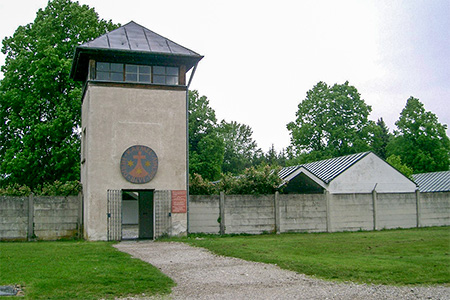
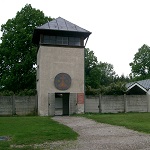
Titus Brandsma had been active far and wide as a Carmelite, scientist, writer and journalist in the Netherlands. I see in his work a lived mysticism until his death in Dachau. We Carmelites strive to live the rich tradition and spirituality of our religious saints. The union with God and the proclamation of peace and love was realized by Fr. Titus in his life. We too can proclaim the Kingdom of God, especially through our presence here at the concentration camp memorial. We want to be open to the needs in the world and the concerns of the people. Titus Brandsma encourages us to do so.
Titus Brandsma ended his last report on the responsibility of his resistance against National Socialism with the wish for peace: "God bless the Netherlands, God bless Germany. God grant that both peoples may soon again stand side by side in full peace and freedom, in the recognition of God and for His glory, for the salvation and welfare of both so closely related peoples." That's all it takes to see how relevant Titus Brandsma is to my praying and working in this place, as brother nations are once again at war with each other.
For me, in this time of crisis, Titus Brandsma has become a patron of independent and honest journalists in Russia. Despite persecution and death threats, he stood up for the freedom of expression of the press and gave his life for it. He is a sign of hope and a role model. We will call on him for guidance for all journalists who act according to their conscience despite repression.
His courage is a question to me whether I also follow my conscience.
I see Titus Brandsma as a role model. He encourages me to speak out my requests before God and to include in my prayers precisely those people whom I most desire God's closeness and help. To accept everything unpleasant in everyday life, to deal sincerely with myself and others, to live consciously in this place of Dachau, to remember the innocently maltreated. That is important to me.
What had a lasting influence on my encounter with Titus Brandsma was his beatification in Rome on November 3, 1985. On Nov. 5, we experienced a large group of pilgrims from Holland who, on their way back, prayed and celebrated the Eucharist in Dachau at the place of his suffering and death. Among the pilgrims was also his niece, with whom I was able to speak for a longer time. Suddenly Blessed Titus was one of us, it was felt very clearly. Friendships were formed between our brothers and sisters OCarm. Since then I have read to know him more.
The friendship with and through Fr. Titus, which unites us with our sisters and brothers worldwide, makes me happy and grateful.
For all of us, the annual meetings with the Dutch Carmel Family remain in vivid memory. Besides the meetings, it was standing together in front of Block 26 that became a place of remembrance of Titus, where he was so close to us. We heard the prayers and songs in his language, we were one in thanksgiving and in remembering him as sisters and brothers in his spirit. Whenever there is an occasion for us to gather in front of Block 26, Titus is there.
When I re-meditate the life of Fr.Titus Brandsma, it always gathers me in my daily prayer and work.
He has united the spirituality of the Carmelite parent order with the Teresian, the confessions of the different Christian churches in ecumenism and God with the world.He has pointed out that mysticism is a viable path for all people in all places in everyday life because "the presence of God is always present within. "He has been able to respond to the hatred of his tormentors with love because he said, "They, too, are children of the kind God, and who knows if something won't stick to them?" (Sources: Titus Brandsma, O. Carm, Martyrs at Dachau, Georg Geisbauer. Fiery Arrow, Encountering God in the Abyss).
The Discalced Carmelite Nuns of the Monastery of Helig Blut
Dachau, Germany
Testimony of the Carmelite Nuns on Titus Brandsma
Is for me a sign that monastic life and work can reach far beyond its walls and that mysticism and knowledge (science) do not contradict each other but can cross-fertilize each other.
Titus Brandsma and His Work With the Esperanto

Marija Belošević is the current president of the Internazionale Union of Cattolica Esperantists (IKUE) which counted Fr. Titus Brandsma of Oss, Netherlands, among its early members.
Titus Brandsma and His Work With the Esperanto
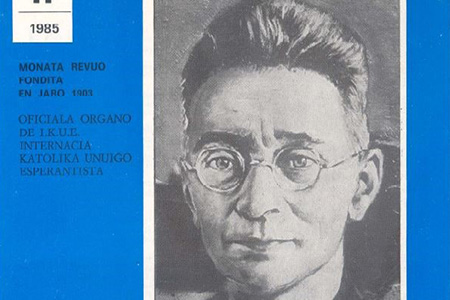 Marija Belošević is the current president of the Internazionale Union of Cattolica Esperantists (IKUE) which counted Fr. Titus Brandsma of Oss, Netherlands, among its early members. Aware of Fr. Titus’ upcoming canonization, Mrs. Belošević has been using digitized records and magazines from IKUE to research Fr. Titus’ connection to the language of Esperanto and to her Catholic organization which promotes it. Her research indicates that the Dutch professor was very involved with Esperanto earlier than previously thought.
Today’s very international city of Aia in the Netherlands hosted the Second Congress of the International Association of Catholic Esperantists on August 14-18, 1911. During that congress, a work group was formed to draw up an ecclesiastical (theological) dictionary in the Esperanto language. In the list of the 12 members of the work group is the name of Titus Brandsma.[1]
Naturally, the largest number of the members of this work group were professors and pastors in the Catholic Church. It is worth noting that the work group for the dictionary contains names of a number of experts in the Esperanto language. Most of these were active before the First Congress of the organization. That Congress was held in Paris in 1910 with some of the pioneers of the Esperanto movement attending.
It was already known that Fr. Titus celebrated a Mass in Esperanto in 1913. It was long thought that this liturgical celebration was his first activity in the Catholic Esperanto movement. However, this recent research by Mrs. Belošević proves that he started at least two years earlier, in the first half of 1911 or perhaps even before.
Studying old copies of the magazines Espero Katolika and Nederlanda katoliko, which are now digitized, Marija Belošević found a list of new members up to July 15, 1911 [Nederlanda Katoliko (n. 8/1911)]. In the section “Ordinary New Members” there is the listing for “Pro. Dr. Titus Brandsma, Klooster der Karmelieten, Oss.”
The name of the Carmelite saint is also found in the 1926 annual, the first of the group’s annual publications, as well as in those of 1928, and 1931/1932. His name is also listed in the annuals of the organization for 1937 and 1938.
The 1911 listing is the first known mention of Fr. Titus in connection to the Association of Catholic Esperantists. When one became a member of the Dutch Association one automatically became a member of the International Association of Catholic Esperantists.
The Internazionale Union of Cattolica Esperantists (Internacia Katolika Unuigo Esperantista in Esperanto) is a lay organization of the Catholic Church with an office in Rome. It strives to apply Christian ideals to everyday life and the spread the Gospel by means of Esperanto. The organization takes as its charge the command given in the Gospel of Mark: “Go out to the whole world; proclaim the Gospel to all creation.” (Mk 16:15)
There is a similar organization for Protestant Christians, Kristana Esperantista Ligo Internacia (KELI). The language Esperanto has many ties with the Christian Churches. The first book translated into Esperanto was the Old Testament. The magazine Espero Katolika (Catholic Hope) first appeared in 1903.
The Catholic Church continues to be closely networked with the movement as well. Pope John Paul II used Esperanto as one of the languages in his annual Urbi et Orbi blessing. Vatican Radio continues broadcasting programs in Esperanto regularly. Catholic or Ecumenical International Congresses are held almost every year. Because it is an officially recognized liturgical language, Catholic religious services continue to be held in Esperanto.
The first issue in 2018 of the Carmelite journal The Sword, Fr. Fernando Millán Romeral, O. Carm., the co-vice postulator for Fr. Titus Brandsma’s cause for canonization, published an article on Blessed Titus and the Esperanto language. The article explores the origins of the language as well as Fr. Titus’ promotion of its use and its value to him.
In recognition of the canonization of its famous member, the IKUE is preparing a prayer card with the official prayer for the canonization in Esperanto.
[1] Questa informazione l’ho trovata nella rivista "Espero Katolika" n. 78/1911.
Sankta Titus Brandsma Carmelite Preĝo
Dio de paco kaj justeco,
malfermu niajn korojn al amo
kaj al la ĝojo de la Evangelio
eĉ meze de sennombraj formoj de perforto
kiuj subpremas la dignon de niaj fratoj kaj fratinoj,
plenigu nin per Via graco,
por ke, samkiel sankta Titus Brandsma,
tenere, povu ni vidi preter la hororoj de malhomeco
kaj kontempli vian gloron
kiu brilas en la martiroj de ĉiu epoko,
kaj tiel iĝi viaj aŭtentaj atestantoj en la nuna mondo.
Amen
(traduzione: Marija Belošević)
Download the Prayer in Esperanto here


