















O.Carm
Available in Spanish the book 'The Price of Truth' on St. Titus

The Price of Truth: Titus Brandsma, Carmelite (in Spanish)
by Miguel Maria Arribas, O. Carm.
The biography of the Church's most recent martyr--a dangerous friar according to the Nazis--Fr. Arribas succeeds in capturing the heart and soul of St. Titus Brandsma's lessons for us today. We all know the life of Titus, but in this book Fr. Arribas explores the documentation behind the canonization process to show why Titus is so important for today.
A simple and cordial Carmelite, a multi-faceted priest who was at times a mystic, a passionate journalist, a university rector and, throughout his life, a driven witness for Christ to the point of giving his own life for the truth.
The author, now deceased, traveled to the Netherlands and Germany, to the places of birth, life and death of St. Titus, to better understand this "martyr of freedom of expression".
Edizioni Publishes 'Meditations' of John of St. Samson

A book of 30 meditations by John of St. Samson inviting us to listen in on his prayers of aspiration as the Church makes its way through the liturgical year and through the various Mysteries of Christ and His Church. John of St. Samson was a French Carmelite and mystic. He is known as the soul of the Touraine Reform of the Carmelite Order, which stressed prayer, silence, and solitude.
John was blind from the age of three after contracting smallpox and receiving poor medical treatment for the disease. He insisted very strongly on the mystical devotion of the Carmelites. After a series of healings word spread and the local bishop asked his theologian his opinion of the healings. The theologian replied, "If people had the faith of Br. John, and lived as authentically as he, the gift of healing the sick would be far more common."
Donatien of St. Nicholas, a disciple and editor of his works "it is certain that this illuminated blind brother has been chosen and given to us by God to be the teacher and director of the spiritual life of our Reform." Donatien later wrote "his face was frequently beheld to be divinely radiant, resplendent with as it were some luminous ray, as I myself and other very trustworthy brothers have witnessed." John of St. Samson has been referred to as the "French John of the Cross" by students of Christian mysticism.
The work is expertly translated from the French by Carmelite nun Sr. Veronica of the Immaculate Heart of Mary of the Wahpeton cloistered Carmel. In his preface to the book, Fr. Charlò Camilleri writes "Notwithstanding the fact that blindness impeded him from using visual imagery to clarify his ideas, and that the texts are generally full of crowded ideas, digressions, and loosely connected concepts, his doctrine is sound and inspires the reader to live radically the call to divine transformation."
Centenary of Clavis Ecclesiae by Fr. Xiberta Celebrated
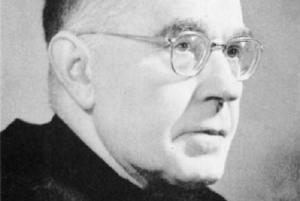
On November 22, at 3 p.m., the Pontifical Gregorian University will hold an academic event to commemorate the centenary of the publication of the Clavis Ecclesiae of Father Bartolomé Xiberta.
The event is organized jointly by the Order of Carmel and the Gregorian University. Mark Andrew Lewis S.J., and the Prior General, Fr. Míċeál O'Neill, O. Carm. The speakers, Josep M. Manresa Lamarca, Valfredo Maria Rossi, Joseph Carola S.J., and Fernando Millán Romeral O. Carm, will present the figure of Father Xiberta and various aspects of his thesis. The thesis will be read in the light of the preceding ecclesiology and the patristic elements present in it. The process of reception of Fr. Xiberta's text up to Vatican II will also be presented.
Those interested in participating in person are asked to register through the website: www.unigre.it. The deadline is November 14, 2022. Those who cannot attend in person will be able to follow the event via streaming at bit.ly/gregonline. The entire event will be in Italian.
This initiative is part of the activities proposed by the Order for the commemoration of this event. The celebration of this event has been made possible thanks to the generous and assiduous support of the Catalan Province of the Most Holy Redeemer.
Conferences on Carmelite Spirituality Begin
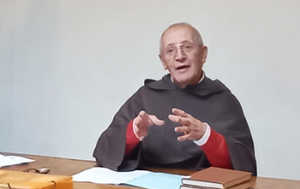
On September 15, the Carmelite Centre d'études d'histoire de la spiritualité (CEHS) in Nantes started the program of Conferences on Carmelite Spirituality for the year 2022-2023, with a seminar conducted by Frère Gianfranco Tuveri on Saint Mary Magdalene de Pazzi.
The conferences entitled Sainte Marie Madeleine de Pazzi et set Oeuvres launched also the latest publication by Frère Gianfranco, of The Colloquies of the Florentine mystic. The volume, entitled Entretiens was published by the prestigious Parisian Publishing House Honoré Champion. This volume is the last one of a larger project by Frère Gianfranco: the translation of the Complete Works of St Mary Magdalene de Pazzi in French, completed with critical introductions and notes. The whole project took twenty years to complete, with the first edition of Les Quarante Jours published by Editions Jérôme Million in 2002.
The program of the conferences CEHS, Parcours "La Source du Carmel" Découvrir la Spiritualité Carmélitaine includes seminars of Blessed Françoise d'Amboise, the Rule of Carmel, The Prophet Elijah, John of Saint Samson and Titus Brandsma.
40th Anniversary of the Carmelite Nuns in Santo Domingo

On October 15, the feast day of St. Teresa of Jesus, the Carmelite nuns of the Monastery of St. Teresa in Santo Domingo celebrated the 40th anniversary of their foundation. With great joy, the Carmelite community of the Mount Carmel House of Formation participated in the Holy Eucharist which was presided by Bishop Faustino Burgos Brisman, CM, auxiliary bishop of the Archdiocese of Santo Domingo.
In his homily the bishop emphasized the life of St. Teresa of Jesus, her service to the Church, her teachings and her writings as the first doctor of the Church. The spiritual depth of her doctrine makes us taste the living source that is Christ. Her encounter with the humanity of Jesus changed her life, showing him to the world as a reference not only for the consecrated life, but for every Christian.
The bishop then gave thanks to God for the 40th anniversary. The Carmelite nuns of the capital of St. Dominic have become throughout these years a channel of intercession for all of us. In the afternoon the nuns celebrated together, as a community, with Fr. Ignatius, at St. Teresa of Jesus Parish in Santo Domingo, the patroness day.
History of the Foundation
Bishop Octavio Antonio Beras Rojas had a great love for St. Teresa of Jesus, which gave him the desire to found a monastery of Carmelite nuns in the Archdiocese of Santo Domingo. This dream was shared by his successor, Msgr. Nicolás de Jesús and Cardinal López Rodríguez, who, with great interest and enthusiasm, also desired a foundation of contemplative Carmelite Nuns. He asked the prior general at the time, Falco Thuis to initiate the foundation. The prior general authorized the foundation and the community of Carmelite nuns began on October 15, 1982. This was the IV Centenary of the death of St. Teresa. For this reason, Cardinal López Rodríguez suggested that this saint be the titular of this monastery, and Fr. Falco agreed to the request.
The community was formed by six sisters coming from three monasteries: the monastery of Nuestra Señora del Carmen de Santiago de los Caballeros in the Dominican Republic, the monastery of Villalba del Alcor in Huelva, Spain, and the monastery of Utrera in Seville, Spain.
The community moved into its own house in Villa Mella for two years. From there they moved to Colegio Nuestra Señora de la Altagracia, for three years. By that time, the new monastery was being built in Engombe, where by the immense grace of God and the blessing of Our Lady of Mount Carmel, the Carmelite nuns currently reside.
147/2022: Causa Nostrae Laetitiae

PROFESSIO TEMPORANEA
02-07-22 Joseph Caleb Maingi (Ken) Nkoroi, Kenya
02-07-22 Michael Reagan Onyango Agutu (Ken) Nkoroi, Kenya
02-07-22 Thomas Mwanzia Muange (Ken) Nkoroi, Kenya
08-09-22 Mary Veronica Katei of the Holy Spirit (MAC)
08-09-22 Mary Virginia Ndungwa of the Sacred Heart of Jesus (MAC)
01-10-22 Mercedes Mediatrix of Jesus Divine Master Justo (BUR) Burgos, Philippines
01-10-22 Teresita of Good Shepherd Nguyen Thanh Hao (BUR) Burgos, Philippines
01-10-22 Fatima Petra of the Cross Nguyen Thi Hien (BUR) Burgos, Philippines
PROFESSIO SOLEMNIS
27-08-22 Dominik Norbert Smeja (BM) Kostelní Vydrí, Czech Republic
24-09-22 Fernando Luque Herrera (ACV) Madrid, España
ORDINATIO SACERDOTALIS
01-09-22 Emmanuel Maria Shikoli Ambeyi (Ken) Nkoroi, Kenya
22-09-22 F.X. Febri Putra Dewa (Indo)
22-09-22 Julian Antonius Sihotang (Indo)
22-09-22 Thomas Onggo Sumaryanto (Indo)
Communications – Evangelization
Communications Office of the Carmelite Order
Shortly after the General Chapter in September 2019, discussions took place to place the various pieces of the Order’s communication program under the Communications Office of the Carmelite Order with a single director and staff. This new entity was charged with creating a more coordinated effort in the Order’s internal and external communications. The two main components:
Edizioni Carmelitane
publishing house of the Carmelite Order
Located in Rome, Italy, Edizioni Carmelitane provides the public with a variety of books, magazines, and audio/videos on the history and spirituality of Carmel, sharing the riches of the Carmelite tradition and spirituality to people around the world. Publications are in a variety of languages but the majority are in English, Italian, Spanish, French, and Portuguese.
- Edizioni Carmelitane webstore: https://edizionicarmelitane.org/
- Books are also available at some major Carmelite sites around the world
- Or contact us for more information: Questo indirizzo email è protetto dagli spambots. È necessario abilitare JavaScript per vederlo.
- Facebook: @edizionicarmelitane
Social Media
The social media office of the Carmelite Order provides a number of services—both internal and external to the Order
- Website of the Carmelite Order: ocarm.org
- To subscribe to CITOC eNews (periodic updates of news in the Order)
- Twitter: @ocarm_org
- Facebook: @ocarm.org
- Online Lectio Divina (to see the current month) | mailed each month: to sign up
- Online Celebrating at Home (mailed weekly: to sign up)
- To Make a Request for Prayers
Communications Offices of the Carmelite Order
The Communications Offices of the Carmelite Order is formed by members of the Order and staff from around the world:
Centro Internazionale S. Alberto (CISA)
The community of Centro Internazionale S. Alberto (CISA) is formed by members of the Order from around the world and is directly under the prior general. The majority of the Carmelites in this community are involved in academic work, either as teachers, students or researchers. There are two major initiatives in communications-evangelization:
Stella Maris Journal
An online publication of the community of CISA. The Stella Maris Journal is an “open space” for the presentation and discussion of various topics.
- Website of Stella Maris Journal
Scuola Carmelitana
A monthly opportunity for the larger community of those interested in res carmelitana to come together and reflect on various themes. Presentations are in Italian. The website contains some past courses.
- Website of Scuola Carmelitana
Carmelite Media
Communications Office of the PCM Province (America).
- Homepage: carmelnet.org
- Carmelite Media Publications Webstore
- Facebook: @CarmeliteMedia
- YouTube: YouTube.com/c/CarmelitesPCM
- Twitter: @carmelites
Elective Chapter of the Monastery in Vetralla

The elective chapter of the Monte Carmelo Monastery in Vetralla, Italy, took place on October 15, 2022.
The monastery was founded in 1669 by Servant of God Benedetto Baldi with Carmelite nuns from Rome, commonly called Le Barberine. The original monastery was located in a medieval castle, but this was completely destroyed during World War II. Mother Maria Angelica di Gesù secured a new location with the help of Cardinal Domenico Tardini, Vatican secretary of state under Pope John XXIII. The present monastery is the modified villa of the sculptor Canonica.
The community often benefited from the spiritual assistance of St. Paul of the Cross, founder of the Passionists. Pope John XXIII visited the tomb of Cardinal Tardini in the monastery chapel on the first anniversary of the cardinal's death.
The monastery of St. Joseph of San Giovanni la Punta is a daughter foundation of the Monastery of Mount Carmel in Vetralla.
The results of the elective chapter were as follows:
Prioress | Priora | Priora:
Sr Maria Rosalia Mangiarotti, O. Carm.
1st Councilor | 1ª Consejera | 1ª Consigliera:
Sr Marianna Caprio, O. Carm.
2nd Councilor | 2ª Consejera | 2ª Consigliera:
Sr Maria Sabina Berneschi, O. Carm.
3rd Councilor | 3ª Consejera | 3ª Consigliera:
Sr Maria Rita Gugliara
4th Councilor | 4ª Consejera | 4ª Consigliera:
Sr Maria Celina Atzei
Director of Novices | Maestra de Novicias | Maestra delle Novizie
Sr Maria Sabina Berneschi, O. Carm.
Treasurer | Ecónoma | Economa:
Sr Maria Benedetta Succu, O. Carm.
Sacristan | Sacristán | Sacrestana:
Sr Marianna Caprio, O. Carm.
Celebrating At Home - 30th Sunday in Ordinary Time
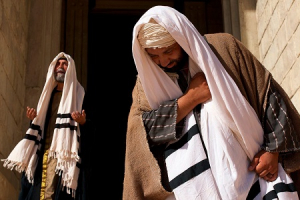
We’ve all met them!
(Luke 18:9-14)
We’ve all met them: people who only seem to be able to bolster their self-image by putting everyone else down. We meet such a character in the Pharisee in the Gospel for this Sunday.
Like the Pharisee in this week’s Gospel, we can sometimes see religion as a set of personal rituals, actions and prayers that cause us to think we have been faithful to God’s calling because we have done this or that.
Spirituality, however, is about practising our ‘faith’ with a profound sense of God’s presence, God’s love for us, and ours for one another. We live work and pray out of our relationship with God, deeply aware of God’s gift of abiding love and mercy that surrounds us.
The background for the Gospel is set in the First Reading from Ecclesiasticus (35:12-14, 16-19) – God’s judgement is not fooled by outward appearances of wealth, or power, or religious shows of piety. God cannot be fooled into judging against the injured, the poor, the widow or orphan.
It is the person ‘who with his whole heart serves God’ whose prayers are accepted.
The parable in this Gospel, we are told, is addressed to ‘people who prided themselves on being virtuous and despised everyone else’.
The Pharisee (people well respected due to their personal piety) prays to God, reminding God (and himself) what a good person he is and all the religious things he has done. He has thus fulfilled the duties of a ‘religious’ and ‘righteous’ person – unlike, he says, the tax collector.
However, the tax collector (considered a sinner in Jesus’ time), doesn’t see himself worthy to even lift his eyes to God and acknowledges that he has sinned and considers himself unworthy to be in the presence of God. But, as Jesus says, he leaves the temple ‘at rights with God’. His relationship with God is from the heart. Overcome with a deep awareness of God’s love for him, and his own unworthiness of it, he does not dare to even lift up his eyes. Whereas the Pharisee, through his lack of humility and apparent self-righteousness, leaves assuming that he is at rights with God.
Our prayer and worship should never be empty words or merely symbolic actions. They must truly come from our hearts and so lead us not only into a deeper relationship with God but also into the willing service of all.
- pdf Celebrating At Home - 30th Sunday in Ordinary Time [PDF](3.47 MB)
- default Celebrating At Home - 30th Sunday in Ordinary Time [ePub](4.49 MB)
- pdf Celebrando en Familia - 30 Domingo del Tiempo Ordinario(632 KB)
- pdf Celebrando in Casa - XXX Domenica del Tempo Ordinario(631 KB)
- pdf Celebrando em Família - 30 Domingo do Tempo Comum(633 KB)
General Curia of the Order


