













O.Carm
Carmelite Nuns in Puerto Rico Celebrate Chapter

The Carmelite monastery of San José in Trujillo Alto, Puerto Rico, celebrated its triennial elective chapter on June 30, 2023.
In 1642, the noble lady, Anna de Lanzós, donated her palace for a monastery in San Juan. King Philip IV issued royal permission in 1646. Efforts to import Carmelite nuns from Seville were blocked because of the dangers of sea travel. So three Dominican nuns came from Queen of Angels monastery in San Domingo came to initiate Carmelite life according to the Carmelite Rule (1651) and the monastery was canonically erected. Lady Anna, who donated her house to be the monastery, and her sister entered the monastery. After the Dominicans returned to their monastery, Anna took over as prioress. The monastery was later transferred to the cities of San Germán (1903) and Santurce (1910) and currently is in Trujillo Alto.
The results of the elective chapter were as follows:
Prioress | Priora | Priora:
Madre Carmen Noemí Marrero Marrero, O. Carm.
1st Councilor | 1ª Consejera | 1ª Consigliera:
Sor Linda María Pérez González, O. Carm.
2nd Councilor | 2ª Consejera | 2ª Consigliera:
Sor Lutgarda María Reyes Maldonado, O. Carm.
Director of Novices | Maestra de Novicias | Maestra delle Novizie:
Sor Linda María Pérez González, O. Carm.
Activities of the Prior General for July 2023

July 2 - 6 Celebrations and conference on Edith Stein, at The Friars, Aylesford.
July 10 - 18 Canonical visitation of communities in Cameroon.
July 19 - 27 Canonical visitation of communities in Burkina Faso.
Celebrating At Home - 13th Sunday in Ordinary Time

True discipleship
(Matthew 10:37-42)
Today’s Gospel is the final in this section of Matthew’s Gospel about the spread of the Kingdom and the role of the disciples.
Matthew often uses events as a beginning point for Jesus’ sermons. The section we have been listening to began with the call of Matthew and was followed by the instructions given to the disciples before setting out on mission. We heard part of that last Sunday.
So far in this sermon we have heard Jesus teach that the truly virtuous are those who exercise mercy; disciples are to proclaim the Kingdom of God with works of compassion and mercy; they are not to let fear compromise the message, but are to trust always in God.
Today’s Gospel passage highlights both the cost and rewards of true discipleship. The disciples’ relationship with Jesus must be the centre of their lives and the context for all other relationships.
Hospitality and welcome are concrete expressions of discipleship because the disciple is one who witnesses to the compassion and mercy of God with open hearts and concrete good actions.
Even though the first paragraph of today’s Gospel sounds like an exclusive choice must be made between Jesus and family, the idea behind the text is more that: in our relationship with Jesus, all other relationships fall into their proper context.
Without being in right relationship with Jesus we can’t learn how to be in right relationship with others. It is our relationship with Jesus which brings depth and richness to all our other relationships. So, for example, our family relationships become more thanjust fulfilling a social custom. They become true relationships filled with love, mercy, forgiveness and respect.
The Pharisees and Scribes seldom made good disciples because they thought that religion was about doing religious things. They went to the synagogue, kept the Law, fasted, and so on, but their hearts were never changed by their religious observance. They were self-righteous, despised the poor and the ‘sinners’, and acted without justice or mercy.
The truth about our conversion to Jesus (our becoming Jesus) is not so much seen in easily identifiably ‘religious’ things but in concrete good actions and right relationships.
Our religious observance is meant to support and nourish our relationship with Jesus. It is not a substitute for it. That relationship has the power to change and transform us so that we can bear witness to Christ through lives of mercy, compassion, justice and integrity.
- pdf Celebrating At Home - 13th Sunday in Ordinary Time [PDF](3.12 MB)
- default Celebrating At Home - 13th Sunday in Ordinary Time [ePub](4.27 MB)
- pdf Celebrando en Familia - 13 Domingo del Tiempo Ordinario(460 KB)
- pdf Celebrando in Casa - 13 Domenica del Tempo Ordinario(461 KB)
- pdf Celebrando em familia - 13 Domingo do Tempo Comum(462 KB)
Lectio Divina July 2023

Opening Prayer
Father,guide and protector of your people,grant us an unfailing respect for your name, and keep us always in your love.We ask this through our Lord Jesus Christ, your Son, who lives and reigns with you and the Holy Spirit, one God, for ever and ever. Amen.- pdf Lectio Divina July 2023 [PDF] Download here(981 KB)
- default Lectio Divina July 2023 [ePub] Download here(258 KB)
- default Lectio Divina July 2023 [Mobi] Download here(1.28 MB)
Cover image: Blessed Virgin Mary of Mount Carmel, Terenure College, Dublin, Ireland. Photo: William J. Harry, O. Carm.
The PCM Province Celebrates Its Triennial Chapter

The Province of the Most Pure Heart of Mary held its triennial provincial chapter June 20-23, 2023. The gathering was held in Darien, Illinois at the Carmelite Spiritual Center. It was an open chapter with members from Canada, the United States, Mexico, El Salvador, Honduras, and the Provincial Commissariat of Perú participating.
The Prior General, Míceál O'Neill, and the General Councilor for America, Luis Maza, attended.
Besides the reports by the prior general and the prior provincial, sessions were held on synodality and the papal encyclical Laudato Si’. A one woman play on the life of St. Thérèse was presented one evening to celebrate the 150th anniversary of the Carmelite’s birth and the 100th anniversary of her beatification.
Almost 160 years ago, two Carmelites from the monastery in Straubing (Germany) journeyed to Louisville, Kentucky, to work among the German immigrants. Unable to secure a parish, they moved to St. Joseph’s parish in what is now Sellersburg, Indiana and later to Leavenworth, Kansas. The Vicar General of the Order, Angelus Savini, appointed Cyril Knoll as the General Commissary and houses were established in Scipio, Kansas (1865) and then in Englewood, New Jersey (1869) by a Dutch Carmelite who had previously lived in Merthyr Tydvil (Wales). The Carmelites also worked among the freed Black slaves in Maryland. In 1870 the Carmelites established a base at Paducah serving a wide area of Western Kentucky, a part of the Jackson Purchase. They also accepted a parish in Louisville, where they had originally immigrated to from Germany.
The monastery of Niagara Falls (Canada) was founded in 1875 in a house overlooking the famous waterfalls. In 1881 all the houses of North America were united into one General Commissariat.
The Province of the Most Pure Heart of Mary was established in 1890 with Pius Mayer serving as the first prior provincial. He would later serve as prior general of the Order.
From 1929 to 1949 the province had a house in Palestine; and then in 1949 foundations were made in Chile (now closed) and Perú. In 1995 a foundation was made in Torreón, Mexico. In 2014, the foundation in El Salvador was officially incorporated into the province. Today there are foundations in Canada, the United States, Mexico, El Salvador, Honduras, and a commissariat in Perú.
The following members were elected to leadership:
Provincial | Provincial | Provinciale
Carl Markelz, O. Carm.
Vice Provincial | Vice Provincial | Vice Provinciale
David McEvoy, O. Carm.
1st Councilor | 1er Consejero | 1o Consigliere
Rolf Nepi Willemsen, O. Carm.
2nd Councilor | 2do Consejero | 2o Consigliere
Luis Jesús Paz Acosta, O. Carm.
3rd Councilor | 3er Consejero | 3o Consigliere
Jorge Monterroso Mérida, O. Carm.
4th Councilor | 4to Consejero | 4o Consigliere
Samuel Citero, O. Carm.
Celebrating At Home - 12th Sunday in Ordinary Time

Be the living Gospel
(Matthew 10:26-33)
The first reading from the Old Testament book of the prophet Jeremiah reflects Jeremiah’s experience of rejection - no one wants to hear the message God has called him to give. In fact, they want to kill him.
Jeremiah sounds desperate and afraid. But then the reading turns into a prayer of confidence and trust in God’s companionship and spiritual protection - God and Jeremiah will win out.
Preaching in the name of God is a risky and frightening business, as Jesus knows. So he urges the disciples not to be afraid of small beginnings, of those who can kill only the body, or that God would abandon them. He reminds them that God is always mindful of them and accompanies them on their mission. He urges them to be brave and bold in proclaiming the truth about God and in confessing their belief in Jesus before others.
Matthew’s audience, like Jesus, Jeremiah and the disciples, knew all about persecution and rejection.
Their question is also ours: if we allow fear to silence us how will the Good News of Jesus Christ ever be heard in the world? If we don’t speak, who will? If we don’t act, who will?
It is not really a matter of talking at people and quoting at length from the Bible. As St Francis of Assisi said, ‘Preach the Gospel at all times. When necessary use words’.
- pdf Celebrating At Home - 12th Sunday in Ordinary Time [PDF](3.16 MB)
- default Celebrating At Home - 12th Sunday in Ordinary Time [ePub](4.86 MB)
- pdf Celebrando en Familia - 12 Domingo del Tiempo Ordinario(484 KB)
- pdf Celebrando in Casa - 12 Domenica del Tempo Ordinario(591 KB)
- pdf Celebrando em familia - 12 Domingo do Tempo Comum(591 KB)
JPIC Webinar on "Common Good, Common Home"

On July 1, 2023, (2 pm Central Europe) the Carmelite JPIC Webinar will take place with the theme "Common Good, Common Home. Prophetic Advocacy in the Church and the Carmel".
The webinar is organized by Fr. Eduardo Agosta Scarel, O. Carm, who is the Advocacy Senior Advisor for the Laudato Si’ Movement (Vatican City) and a Climate Researcher for the National Research and Technique Council (CONICET, Argentina).
Eduardo is an expert in climate variability with more than 20 years of experience in climate research and its impacts on different regions of the planet.
The General Commission for Justice, Peace and Integrity of Creation (JPIC) of the Carmelite Order serves under the direction of the responsible and General Councillor for Africa, Fr. Conrad Mutizamhepo, O.Carm. and all its members, with the international community through the Carmelite NGO at the United Nations and with the other NGOs within the Carmelite Family towards the promotion of the Sustainable Development Goals in Carmelite ministries worldwide especially in the areas of education, religious freedom and human rights, among other aspects contained in the Global Plan of the General Council 2019-2025.
"Common Good, Common Home. Prophetic advocacy in the Church and the Carmel". First theme on Justice, Peace, and Integrity of Creation (JPIC) in preparation for the 2024 JPIC Carmelite Family Congress.1 July 2023, 2 pm CET
9th General Chapter of the Carmelite Sisters of Our Lady

The Carmelite Sisters of Our Lady gathered for their Ninth General Chapter to discern the will of God for the Congregation for the next four years. The momentous celebration took place at St. Joseph Seminary College in Agan-an, Sibulan, Negros Oriental, Philippines on April 11-19, 2023.
The theme of the Chapter, “You are the Salt of the Earth and Light of the World” taken from Matthew 5:13-14 underscores the congregations unique calling to be agents of change in a world that hungers for love and light. As a Congregation, they seek to embody the love of Christ in a special way and are committed to be the light in the world.
At the General Chapter of Elections, the following were elected for the next quadrennium:
Superior General –
Sr. Baybeth Marie K. Andaya, Carm. O. L.
1st General Councilor and General Assistant –
Sr. Jocelinda Agnes C. Cacas, Carm. O. L.
2nd General Councilor –
Sr. Leonila Augustine N. Kilinguen, Carm. O. L.
3rd General Councilor and General Treasurer –
Sr. Liezl Soreth B. Jaralve, Carm. O. L.
4th General Councilor and General Secretary –
Sr. Elena Therese T. Soldivillo, Carm. O. L.
Celebrating At Home - 11th Sunday In Ordinary Time

Growing disciples
(Matthew 9:36-10:8)
To these twelve Jesus entrusts the mission of proclaiming that the kingdom of God is close at hand.
This is not an ‘end of the world’ prediction. We could better translate it as: the kingdom of God is very close to you. To a people who had constantly been told that God despised them, that they were sinners and very far from the kingdom of God, this was good news indeed.
Jesus gives the disciples the authority to accompany the proclamation of the Good News with the healing of ‘all kinds of diseases and sickness’ to break the idea that illness (in whatever form) was a curse sent by God or punishment for sinfulness. Instead, the disciples are to be a sign of God’s kindness which brings health and wholeness. The proclamation of the Good News is always to be done generously and without counting the cost.
Through the words of the Gospel may we hear again our own call to be emissaries of God’s love and bearers of Good News. May we allow the kindness and compassion of God to touch one another through us.
- pdf Celebrating At Home - 11th Sunday In Ordinary Time [PDF](3.07 MB)
- default Celebrating At Home - 11th Sunday In Ordinary Time [ePub](4.49 MB)
- pdf Celebrando en Familia - XI Domingo del Tiempo ordinario(472 KB)
- pdf Celebrando in Casa - XI Domenica del Tempo Ordinario(470 KB)
- pdf Celebrando em familia - 11 Domingo do Tempo Comum(473 KB)
Neapolitan Province Chapter Held
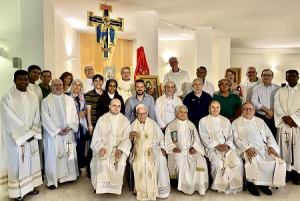
During the Provincial Chapter of the Neapolitan Province, which is being held from June 12 to 16, 2023 in Bari at Oasi Francescana De Lilla - St. Francis of Assisi Spirituality House, the election of the New Provincial Council was held, which saw the reappointment, as Prior Provincial, of Fr. Cosimo Pagliara.
The Prior General, Míceál O'Neill, and the General Councilor for Europe, Richard Byrne participated.
For the first time the election was held in the presence of a representation of the Third Order, the various lay groups and the youth belonging to our Carmelite Family, who have been active members of the Chapter in all its phases.
The following members were elected to leadership:
+ + +
Provincial | Provincial | Provinciale
Cosimo Pagliara, O. Carm.
1st Councilor | 1er Consejero | 1o Consigliere
Nicola Barbarello, O. Carm.
2nd Councilor | 2do Consejero | 2o Consigliere
Aureliano Pacciolla, O. Carm.
3rd Councilor | 3er Consejero | 3o Consigliere
Angelo De Florio, O. Carm.
4th Councilor | 4to Consejero | 4o Consigliere
Milosz Mazewski, O. Carm.


