











O.Carm
Lectio Divina January 2024

Opening Prayer
Lord Jesus, send Your Spirit to help us read the Scriptures the same way that You read them to the disciples on the way to Emmaus. In the light of the Word, written in the Bible, You helped them to discover the presence of God in the disturbing events of Your sentence and death. Thus, the cross that seemed to be the end of all hope became for them the source of life and of resurrection.
Create in us silence so that we may listen to Your voice in Creation and in the scriptures, in events and in people, and above all in the poor and suffering. May Your word guide us so that we too, like the two disciples from Emmaus, may experience the force of Your resurrection and witness to others that You are alive in our midst as a source of fraternity, justice and peace. We ask this of You, Jesus, son of Mary, who revealed to us the Father and sent us Your Spirit. Amen.
- pdf Lectio Divina January 2024 [Pdf] (1.01 MB)
- default Lectio Divina January 2024 [ePub] (215 KB)
-
default
Lectio Divina January 2024 [Mobi]
(880 KB)
"Lectio divina," a Latin term, means "divine reading" and describes a way of reading the Scriptures whereby we gradually let go of our own agenda and open ourselves to what God wants to say to us. In the 12th century, a Carthusian monk called Guigo, described the stages which he saw as essential to the practice of Lectio divina. There are various ways of practicing Lectio divina either individually or in groups but Guigo's description remains fundamental.
Celebrating At Home - Christmas - Nativity of the Lord

God is with us!
(Matthew 1:18-25)
We began Advent with the cry, ‘Come, Lord Jesus’.
Now we end it with the joyful shout, ‘God is with us!’ Reflecting on the historical birth of Jesus, the Church proclaims the truth that God is, and has always been, with his people. And if God is with us, then God is for us. God is on our side.
God has no desire to live in houses made of wood, stone or gold. God’s deepest desire is to live in human flesh. Just as God did that in the human flesh of Jesus Christ a long time ago, God continues to do so now in us.
Like Mary, we accept God’s invitation, allowing Jesus to become flesh in us, too; to be seen and experienced in good thoughts, good words and good actions, in deeds of loving kindness which bring life, not death, to God’s people.
- pdf Celebrating At Home - Christmas - Nativity of the Lord [PDF] (2.38 MB)
- default Celebrating At Home - Christmas - Nativity of the Lord [ePub] (6.20 MB)
- pdf Celebrando en Familia - Navidad - La Natividad del Señor (711 KB)
- pdf Celebrando in Casa - Natale - Natività del Signore (750 KB)
- pdf Celebrando em familia - Natal - Natividade do Senhor (761 KB)
Celebrating At Home - 4th Sunday of Advent

Receive your God!
(Luke 1:26-38)
The great Christmas feast is almost here. As always in Advent, what is promised in the first reading is brought to fulfilment in the Gospel reading. We began Advent with the cry, ‘Come, Lord Jesus’. We will end it with the joyful shout, ‘God is with us!’ In the first reading King David wants to build a house (temple) for God, but God says that, instead, God will build David and his descendants into a great house.
God is not about building temples to himself and it’s not dwelling-places made of wood or stone that God wants. God is about building a dwelling-place in human flesh. God is about building a people among whom and in whom he can live.
In the Gospel, Mary accepts God’s invitation to make herself into a dwelling place for God by receiving Christ and God makes his dwelling-place in her human flesh. Through her God has come to live permanently in humanity.
That is what we, too, are about – making ourselves into a living dwelling place for Christ. The great gift of Jesus to the world is not meant to be frozen in one moment of time. Through us, that Gift is made present in every moment of history so that through us Christ is able to continue to touch, to hold and to heal the world.
- pdf Celebrating At Home - 4th Sunday of Advent [PDF] (1019 KB)
- default Celebrating At Home - 4th Sunday of Advent [ePub] (3.09 MB)
- pdf Celebrando en Familia - Cuarto Domingo de Adviento (727 KB)
- pdf Celebrando in Casa - Quarta Domenica di Avvento (739 KB)
- pdf Celebrando em familia - Quarto Domingo Do Advento (728 KB)
Experts on John of Saint-Samson Gather in France

Experts Gather in France to Continue Building a Critical Edition of the Works of John of Saint-Samson
On December 15, 2023, the second Atelier Jean de Saint-Samson took place at the University of Rennes 2. Charló Camilleri, O. Carm., project editor for the Order’s publication project of the Complete Works of Jean de Saint-Samson, together with Prof. François Trémolières, Martin de la Croix, O. Carm., Prof. Audrey Duru, Dr Clément Duyck and Prof Guillaume Peureux met to discuss and work on the poems, sonnets and canticles of Jean de Saint-Samson.
Hailing from the Université Picardie Jules Verne, the Université catholique de Louvain, the Université Paris-Nanterre, the Université de Rennes 2 and the Università ta' Malta, with their expertise in mysticism, spiritual theology, French literature and poetry of the 17th century, these scholars are working on volume 9 of the Œuvres complètes of Jean de Saint-Samson. Martin de la Croix, O. Carm., is authoring this upcoming volume. Simultaneously Drs Giovanna Brizi, postulator general of the Carmelite Order, is working on volume 11 in the series, containing historical and hagiographical documents related to the cause of John of Saint-Samson.
The next Atelier is planned for May 2024 at the Centre d'Études d'Histoire de la spiritualité (CEHS) in Nantes, France.
The Interfaith Statement for COP28
Global Faith Leaders Summit
The Abu Dhabi Interfaith Statement for COP28
Introduction
In the spirit of unity, shared responsibility, and Human Fraternity, and at this pivotal moment of the global climate crisis that demands transformative action to keep 1.5 degrees within reach and serve affected and vulnerable communities, we, representatives of diverse faith and Indigenous traditions, through dialogue with scientists, religious scholars, academics, women’s organizations, youth, civil society, business leaders, and environmental policymakers, convened in Abu Dhabi in the lead-up to COP28 to express our shared concern for the escalating climate impacts that imperil our cherished planet, as well as our common commitment to jointly address this global crisis, building upon our previous efforts, including the interfaith appeal for COP26.
Our faith instills in us a sacred duty to cherish not only our human family but also the fragile ecosystem that cradles us.
Preamble
- We recognize the sorrow that many experience at this time and will respond effectively.
- We welcome the contributions of science, traditional, religious, and Indigenous knowledge.
- We advocate for Human Rights in a clean, healthy, and sustainable environment, a declaration adopted by the General Assembly in 2022. This recognizes the intrinsic rights of ecosystems, encompassing water, oceans, and seas, to exist, thrive, and rejuvenate.
- We welcome all into the embrace of Social Inclusion, building bridges that transcend differences and nurture unity.
- We highlight the experience of faith groups in strengthening the resilience of local communities and Indigenous Peoples to climate shocks, working on adaptation that is trusted by local communities and Indigenous Peoples.
- We welcome actions by faith actors across different backgrounds since COP26 to redirect their investments into nature-positive ones aligning with the goals of a transition to a new inclusive and just development paradigm.
- We acknowledge Faith-Compliant Finance for Sustainable Development, harnessing resources for the well-being of all sentient beings today and in the future.
- We recognize the connections between climate change, migration, and conflict and the potential role for people of faith as 'environmental peacebuilders,' striving to forge pathways of compassion and mediation amid conflicts.
- We acknowledge the urgent need for a narrative of development and actions that align with values that foster well-being and sustainable development, a framework rooted in hope and courage.
- We acknowledge our profound interconnectedness with one another and with the intricate web of life that envelops us. Recognizing our limits, we humbly pledge to address these multifaceted crises through the prism of values, ethics, and spirituality.
- We stand united in acknowledging the profound convergence of wisdom across the world's diverse faith, religious, cultural, and Indigenous traditions, each echoing with the resonant chords of our collective vision and mission.
- We embrace the mantle of Love, Stewardship, and Care for Creation, recognizing our willingness and responsibility to safeguard the Earth.
- We recognize the Sacredness and Sanctity of Life and Nature, honoring the inherent value of all living beings and the landscapes they inhabit on Mother Earth.
- We stand firm for Environmental Equity and Justice, advocating for fairness and equality as cornerstones of a thriving world.
Call to Action
Transcending nations and traditions, we declare our steadfast commitment and call upon Heads of States, Governments, non-state actors, and decision-makers to act on the following principles:
- Call for urgent responses by fast-tracking Energy Transitions, ensuring fairness and equity and what’s morally right.
- Regard Mother Earth as a source of life that must be protected.
- Ask governments to overcome the linear growth paradigm and move to a circular model that allows us to live a balanced and dignified life in harmony with nature.
- Urge businesses and policymakers to adopt a rapid, just transition away from fossil fuels, embracing clean energy sources that nurture the Earth and safeguard its inhabitants unconditionally.
- Call on governments to promote sustainable agriculture and resilient food systems that respect local cultures and ecosystems while ensuring food security for all.
- Call on governments to enhance services to address the burden of climate change on human health, especially in the most vulnerable and fragile communities
- Urge governments, especially those endowed with greater resources, to lead in curbing emissions and supporting climate mitigation and adaptation efforts in less privileged nations.
- Beseech financial institutions, IFIs, private sector, companies, and governments to adopt responsible investments and business practices aligned with climate, environmental and social standards.
- Call on governments and stakeholders to recognize the inseparable link between the human-made crisis affecting the climate and biodiversity and adopt comprehensive actions that harmonize the restoration of both systems.
- Call on governments to establish accountability mechanisms for the fulfillment of global and national commitments to inclusive climate action.
- Call on policymakers to ensure inclusivity in Climate Transition: As we collaborate for a sustainable future, no one must be left behind. The needs of all people, especially children, vulnerable communities facing disaster and conflict, young people, women, and Indigenous Peoples, as well as animals and nature, must be at the center of our endeavors.
- Implore governments to commit to the operationalization of new financial mechanisms that address loss and damage, especially in the most vulnerable regions, and ensure that this fund is interdisciplinary, effective, and inclusive and directly reaches the most vulnerable or the affected communities.
- Encourage an inclusive dialogue, during and beyond COPs, with faith leaders, vulnerable groups, youth, women’s organizations, and the scientific community to forge alliances that strengthen sustainable development.
Our Commitment
We, as representatives of our respective faith, Indigenous, and wisdom traditions, acknowledge our collective duty to:
- Honor the threads of Interconnectedness and Interdependence that weave us into the intricate fabric of life, reminding us of our shared destiny.
- Herald the dance of Balance and Harmony, seeking equilibrium within us and with the natural world that cradles us.
- Encourage a paradigm shift in our relationship with Earth and all its inhabitants, fostering a profound sense of reverence and responsibility.
- Champion the development of a faith-based ecological narrative, continuous learning, and the integration of ecological teachings and values within educational, religious, and cultural institutions, nurturing a holistic understanding of our interconnectedness.
- Actively participate in public discourse on environmental matters, guiding our congregations and institutions to foster resilient and just communities.
- Lead the pursuit and reimagining of sustainable lower carbon lifestyles and social progress rooted in harmony with the Earth and respect for its resources.
- Embrace Frugality, Resource Efficiency, and spiritual and wisdom-oriented Lifestyles, forging pathways of minimal waste and mindful living which fosters giving back to Mother Earth what we take from it.
- Change our consumption patterns, ensuring that we are mindful that our purchases and services reflect our ethical commitment to accelerate the energy transition and achieve net zero by 2050, as called for in the Paris Agreement.
- Align financial investments with ethical standards, embracing responsible and inclusive financing that supports a thriving planet and its inhabitants.
- Commit ourselves to be attentive, intelligent, and responsible, knowing that we must be the first to strive for development and justice.
- Support the Faith Pavilion at COP28, the first of its kind, and continue to convene in future COPs to commission a message of hope and action at COPs.
- Work together with communities, governments, individuals, families, corporations, and the whole of society to deliver on our commitments and inspire others to do so.
- Pledge ourselves to Justice, cause no Harm, and Peace with all Sentient Beings, including Nature, fostering a harmonious coexistence that enriches both humanity and the planet.
- Raise our voices for Biodiversity and Wildlife Conservation.
- Extend our hands in Doing Good, Charity, and Returning to Nature, nurturing the cycle of benevolence and transformation that sustains all existence.
- Champion Equality, dismantling human-made barriers to ensure inclusivity, equal participation, and empowerment for all.
- Uphold the Rights of Indigenous Peoples, defending the ancestral wisdom that is entwined with the Earth's well-being.
- Multifaceted global challenges can only be tackled if we work together, people of all faith communities, supporting an effective multilateralism to tackle the triple planetary crisis.
Hope for Current and Future Generations
As people of hope and faith, we unite in Divine Wisdom bestowed on us, guided by an unwavering commitment to a sustainable future for all. Attention to the suffering of many and the engagement among faith leaders in climate action will allow us to achieve these commitments and results for the good of all.
As we stand at the precipice of history, considering the gravity of the challenges we collectively face, we remain mindful of the legacy we will leave for generations to come. We ardently implore all decision-makers assembled at COP28 to seize this decisive moment and to act with urgency, weaving a tapestry of shared action and profound responsibility. The urgency of the hour demands that we act swiftly, collaboratively, and resolutely to heal our wounded world and preserve the splendor of our common home. In the process, we need to bring back hope for future generations. Together, we extend our open arms to all people, inviting them to embark on this journey toward a future of resilience, harmony, and flourishing for all life on Earth.
Cooperative Learning in Formation Studied

On November 27, 2023, the Asia-Australia-Oceania Formation Commission organized an on-line webinar on Cooperative Learning in Carmelite Formation. This was one of many on-line events coordinated by the Commission. The Formation Commission has already conducted on-line student and formator gatherings, the Titus Brandsma webinar series and an on-line gathering of vocation promoters from the geographic area.
The presentation on “Cooperative Learning” was given by Dr. Anita Lie, a professor from the Widya Mandala Catholic University in Surabhaya, Indonesia. Using “cooperative learning,” a teaching method as well as guidelines from the RIVC, our Carmelite formation manual, Dr. Lie encouraged the formators to form the students through collaboration and to reflect on their formative experiences in cooperative groups. According to Dr. Lie, one of the goals of formation is to free the formandi, not only from the state of not knowing but also from dependence on the formator. Ultimately this moves into a spirit of interdependence in the community. Using ‘mentimeter’ the interactive presentation software, Dr. Lie showed what formators can do to introduce the cooperative learning techniques in Carmelite formation.
All the formators from Asia-Australia-Oceania, 60 in total, along with the priors of the formation houses participated in this interactive session. The presentation was was well- appreciated. The group recommended that cooperative learning be one of the tools for our formation program.
The Formation Commission is now organizing a week-long gathering of students and formators in Vietnam from July 21-27, 2024.
Celebrating At Home - 3rd Sunday of Advent

Rejoice! The Lord is near
(John 1:6-8, 19-28)
Today is Gaudete Sunday. The name comes from the first word of the Entrance Antiphon in Latin, which means, ‘Rejoice’. The full text of the antiphon is: Rejoice in the Lord always, again I say, rejoice! Indeed, the Lord is near.
That is what we are rejoicing in: God’s nearness to us.
We recognise that nearness in the presence of Jesus, born so long ago, and his continuing presence through the Holy Spirit in our lives now. We rejoice that God has always been with us, whether we realised it or not.
God has never left us.
Advent is very much about a fresh discovery of God’s presence and grace in our lives, in our own moment of history.
This is what we are celebrating on Christmas Day, too. Christ is God’s great present to the human family.
Christmas celebrates not only the birth of Jesus in one moment of human history, but his continual birth in us so that he may be present in every moment of human history.
As we wait for the final coming of Jesus we, like John the Baptist, are called to be witnesses to the Light.
We do that best by taking up the mission of the prophet in the first reading, just as Jesus did. The Lord has anointed us to bring Good News to the poor, to bind up hearts that are broken, to proclaim liberty to captives, freedom to those in prison and a year of favour from the Lord. God trusts us to do that. We have been commissioned by the Church through our Baptism to do that.
Our faith in (that is, living relationship with) Christ is meant to be lived openly, generously and graciously, at the service of our brothers and sisters in the world by being the living presence of Jesus in our day and age.
- pdf Celebrating At Home - 3rd Sunday of Advent [PDF] (1.05 MB)
- default Celebrating At Home - 3rd Sunday of Advent [ePub] (3.25 MB)
- pdf Celebrando en Familia - Tercer Domingo de Adviento (486 KB)
- pdf Celebrando in Casa - Terza Domenica di Avvento (499 KB)
- pdf Celebrando em familia - Terceiro Domingo Do Advento (487 KB)
International Lay Commission Plans Congress in 2024
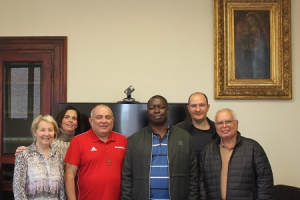
International Lay Carmelite Commission Plans Congress During Meeting in Rome
The first in-person meeting and the seventh ever meeting of the International Secretariat for the Laity took place in Rome from November 27 to December 1. Participating in this meeting were: Amos Ochieng, T. O. Carm (Commissariat of Kenya), Maria Monica Enhudjiana, T. O. Carm., (Province of Indonesia), Paulo Daher, T. O. Carm., (Province of Rio de Janeiro), Rosario Mª Vera Martin T. O. Carm., (Province of Betica), Aideen Ryan, T. O. Carm., (Province of Ireland), Luis Maza Subero, O. Carm., (General Delegate for the Laity) and Tobias Kraus, O. Carm., (Province of Germany), who acted as translator. Michele Bonanno, T. O. Carm., (Province of Italy) was excused.
During these days they have been working on the organization of the next International Congress of the Laity to be held next year from September 15 to 21, 2024, in Sassone, (near Rome). This Congress will have a previous phase in which all the laity or those accompanying the laity can participate, which will consist in reflecting on the material and completing the following questionnaire: https://elink.do/congresocarm2024
With the collected contributions, an Instrumentum Laboris will be elaborated, which will set the guidelines for the Congress.
Among other items on the agenda, the Secretariat discussed the organization of an International Congress of Third Order leaders to be held from February 26 to March 2, 2025, in Fatima, Casa San Nuno de Santa Maria and also had the opportunity to share with Míċeál O'Neill, prior general who wanted to encourage the members of the Secretariat, with William J. Harry, O .Carm, director of communication of the Order, who discussed the web of the Order and the publications of Edizioni Carmelitane, and Michael Farrugia, Procurator General, who helped to clarify and correctly interpret various juridical aspects of the Third Orders.
St. John of the Cross, Doctor of the Church

December 14th | Feast
With all that the Eucharist means to a Catholic Christian, does John of the Cross have a Eucharistic spirituality? His devotion to the Blessed Sacrament or the Mass is not immediately evident. But, if in fact the Eucharist holds central importance for him, why is this obscure in his writings?
For more on John of the Cross and His Eucharistic Spirituality
Celebrating At Home - 2nd Sunday of Advent

Prepare a way!
(Mark 1:1-8)
Repentance and forgiveness console God’s people and prepare the way for the Lord to enter our hearts.
The magnificent first reading from the prophet Isaiah today looks forward to the appearance of God.
Great preparations take place for his arrival - hills are lowered, valleys filled in, a straight highway is made in the desert. The joyful message of God’s approach is proclaimed from the mountain tops and shouted in the streets.
How will this God show himself to his people? Not as a warrior-king with a frightening display of military power or with thunderbolts in his hands, but as a shepherd-king: feeding his flock, gathering the lambs in his arms, holding them against his breast and leading the mother ewes to rest. God’s coming liberates and frees his people through tenderness and forgiveness.
The Gospel presents John the Baptist as one who comes preparing the way for the Lord by proclaiming ‘a baptism of repentance for the forgiveness of sins’. According to Mark, all Judea and the whole of Jerusalem come to John for baptism and to hear the proclamation of forgiveness – a moment of real conversion. John says that another will come, more powerful than himself, who will baptise, not with water, but with the Holy Spirit.
Our Advent readings help us realise God’s profound love for us and his presence within us through the Holy Spirit. Knowing that God will always treat us with love and tender care helps us to turn again towards him and to trust in the depth of his mercy.
Our Advent journey is showing us how to prepare our hearts for a fresh discovery of God’s presence in our lives; how to recognise the hidden presence of Jesus among and around us; how to turn around and face towards God with faith, hope and love; and how to be the living presence of Jesus in our moment of history.
The candles of the Advent Wreath remind us of the growing light and warmth of God’s love made visible in Christ.
- pdf Celebrating At Home - 2nd Sunday of Advent [PDF] (1.14 MB)
- default Celebrating At Home - 2nd Sunday of Advent [ePub] (3.40 MB)
- pdf Celebrando en Familia - Segundo Domingo de Adviento (479 KB)
- pdf Celebrando in Casa - Seconda Domenica di Avvento (483 KB)
- pdf Celebrando em familia - Segundo Domingo do Advento (480 KB)


