













O.Carm
St. Nuno Alvares as a Carmelite

6 November Memorial
St. Nuno Alvares was always a religious man. As a soldier and knight of the noble class, he carried the sacred images of the crucified Christ, the Virgin Mary, and of the two patron saints of the knight, St. George and St. James.
Having fulfilled his obligations as parent, re-established the peace with Castile, and concluded the African expeditions which he took part in as supreme head of the Portuguese army, the Constable began his work on a promise he had made to the Virgin: the building of a votive church. He chose the highest spot in Lisbon and placed the first stone in 1389. The construction lasted for 30 years. When completed, it was most sumptuous with beautiful gothic architecture and rich decoration. Nuno wanted a Marian order to take possession of the church and chose the Carmelites.
The Constable was very familiar with the Order. A former military companion, Juan Gonçalves, had professed in the monastery of Moura; also he had a great friendship with Alfonso de Alfama, Vicar General in Portugal.
In 1423, the Carmelites celebrated their first Provincial Chapter in Portugal, an occasion for Nuno to publicly request admission into the Order as a layman. He took the name Fray Nuno de Santa Maria and renounced his titles and declined to enter the clerical state despite his family lineage, wisdom, and cultural preparation. For Nuno, to serve the servants of God, to be the lowest in the community, was an evangelical option that he fully embraced. He refused to maintain any honors in the cloister.
The king, down to the lowest of his vassals, were shocked by the news that the Grand Constable intended to become a lay brother in a religious order. Nuno had no doubts however and chose the Feast of the Assumption of Our Lady as the date to be invested in the habit.
Numerous stories are told about Nuno’s life with the Carmelites. When he met his old friend and former vassal, Fr. Juan Gonçalves, then prior of the house in Lisbon, Nuno would kiss the prior’s hand and ask permission to go out with the classical formulation “Benedicite Pater” to which the prior would respond “At your orders, my Constable. God bless you.” Both took a humble stance toward the other.
He lived the rest of his life in such humility until he died in April of 1431 (Some sources give his death date as November 1, 1431). His fame for holiness rapidly spread throughout the whole country; for the Portuguese he was always the Holy Constable.
Celebrating At Home - 31st Sunday in Ordinary Time

Sincere & Grounded Faith
(Matthew 23:1-12)
The warnings against the leaders conclude this week. This is the final part of this series of readings in which Jesus strongly criticises various groups of leaders who have failed to grasp what religion and faith in God are really about.
The problem centres around the belief that religious practice is all that is necessary to be justified in God’s eyes. According to Jesus, however, it is really about conversion, the continual process of turning oneself towards God. Bit by bit as our hearts are changed by the Holy Spirit we come to see with God’s eyes and feel with God’s heart. That is why Jesus insists that it is what is within one’s heart that is important, not how many religious laws one fulfils.
The Scribes and Pharisees have a ‘one-dimensional’, narrow view of religion and faith. Jesus’ view embraces the whole person in the journey of faith. As St Paul puts it in the Letter to the Romans: faith is a journey of being remade in the image and likeness of Christ. It changes and transforms every part of us.
No true believer can live as though faith and life are separate. Often contemporary civil leaders wish that the Church would confine its comments only to ‘religious’ things. For us, all the dimensions of life are part of our religious framework – social, political, economic, physical, psychological, mental and spiritual.
All these are viewed from the perspective of our faith. As Pope John Paul II said, “The light of the Gospel must be brought to bear on every aspect of human life.” Our moral sense of what is right and wrong develops as we reflect on the issues of human life inthe light of the Gospel.
Ours is never an attitude of “all’s fair in love and war”. No matter what the issue, or what sphere of human endeavour in which we are involved, our words and actions must always be true to the values of our Christian life.
With Christ as our only teacher we learn the ways of wisdom and love. We learn how to live, not by the values of the world, but by the values of the Spirit.
- pdf Celebrating At Home - 31th Sunday in Ordinary Time [PDF] (2.87 MB)
- default Celebrating At Home - 31th Sunday in Ordinary Time [ePub] (2.59 MB)
- pdf Celebrando en Familia - 31 Domingo del Tiempo Ordinario (659 KB)
- pdf Celebrando in Casa - 31 Domenica del Tempo Ordinario (660 KB)
- pdf Celebrando em familia - 31 Domingo do Tempo Comum (661 KB)
Meeting of the General Economic Commission

Prior General’s Schedule for November

November 1-7: Canonical Visitation in Mozambique
November 8-20: Canonical Visitation in Zimbabwe
November 22-24: USG Assembly
November 25: USG Executive Meeting
November 28- December 1: Visit the two Carmelite Communities in Ukraine.
Bl. Frances d’Amboise, Religious

5 November Optional Memorial
On November 5, we celebrate the memory of Frances D’Amboise, once duchess of Brittany, who died as a Carmelite nun in Nantes, France. Her meeting with the prior general, John Soreth, and her subsequent efforts on behalf of the Carmelites had a transforming effect on Carmel in France. The Carmelite historian, Joachim Smet, calls it “one of those warm and human friendships between saints.” In fact, the establishment of enclosed Carmelite monasteries in France is generally attributed to her. She and her husband had already founded a monastery of Poor Clares in Nantes which she intended to join after the death of her husband. However, her health failed her. She considered devoting herself to the care of the poor in a hospital.
Frances received the Carmelite habit on March 25, 1468 from Bl. John Soreth. She insisted on being treated the same as any novice. Later, as prioress, Frances taught, “We are all sisters wearing the same habit and making the same profession. The Rule is not longer for one than for another.”
During the French Revolution the memory of Bl. Frances D’Amboise were dispersed, and her body was desecrated. Unfortunately, most of the instructions and exhortations she gave her nuns for their formation, like the one above, have been lost. The few fragments that remain reveal her to be a strong, loving, generous woman who was truly in love with God. She is depicted wearing an ermine cape* instead of the white wool cape of Carmel to recall her rank as duchess— iconography she herself would not have allowed.
* Portrait of Blessed Françoise d'Amboise - wearing the habit of a Carmelite nun and the crown and ermine cape signifying her rank as Duchess of Brittany.
Nuns in Dominican Republic Celebrate Elective Chapter

Carmelite Nuns in La Vega, Dominican Republic, Celebrate Elective Chapter
The nuns of the community of the Maria Ecclesiae Mater (Mary Mother of the Church) Carmelite Monastery held their triennial elective Chapter on Thursday, October 26, 2023.
The monastery was founded on November 21, 1976, by Carmelite nuns from Santiago de los Caballeros (Dominican Republic) , Ravenna (Italy), and Trujillo Alto (Puerto Rico). After seven years at their original foundation, the nuns moved to a new monastery on November 20, 1983.
The results of the elective chapter were as follows:
Prioress | Priora | Priora:
Hna. María del Carmen Ferreira, O. Carm.
1st Councilor | 1ª Consejera | 1ª Consigliera:
Hma. Ana María Arroyo, O. Carm.
2nd Councilor | 2ª Consejera | 2ª Consigliera:
Hma. María Lillian Ferreira, O. Carm.
3rd Councilor | 3ª Consejera | 3ª Consigliera:
Hma. María Jacinta Paniagua, O. Carm.
4th Councilor | 4ª Consejera | 4ª Consigliera:
Hma. María Antonia Isidor de Leon, O. Carm.
Treasurer | Ecónoma | Economa
Hma. Ana María Arroyo, O. Carm.
Formator | Formadora | Formatrice
Hma. María Lillian Ferreira, O. Carm.
Celebrating At Home - 30th Sunday in Ordinary Time

Loving God & Each Other
(Matthew 22:34-40)
Another attempt to trap Jesus is contained in the Gospel this Sunday. Opinions and arguments about which was the greatest commandment were common among the Pharisees and questions about it were frequently asked of rabbis. Clearly, those who asked this question of Jesus were trying to disconcert or ‘wrong foot’ Jesus in an attempt to discredit him with his reply.
Once again, Jesus does not cleverly sidestep the question; he goes right to the heart of the matter.
Love of God and love of neighbour are brought together in one ‘great commandment’. In refusing to be drawn into an ‘either/or’ response Jesus, as he did last week, brings two separate things into right relationship. Love of God and love of neighbour belong together. That’s why the first reading today from Exodus warns against mistreating strangers, widows and orphans and talks about the proper conduct of loans and pledges. The warning comes from God’s lips. It’s not just a nice piece of social philosophy; it is the demand of living our faith.
It means that true faith, as Jesus teaches it, is about being in loving relationship with God and other human beings. Religious rituals are meant to be ways of reflecting on, savouring, remembering, celebrating and expressing that love. Sometimes they just end up as ‘empty’ rituals, when love has been replaced by fear, or when love is absent.
The Kingdom of God is not some far off place, but the moments when God’s life breaks into the human story. Those moments bring love, wisdom, grace, compassion, generosity, forgiveness and peace.
Those practiced in the things of God recognise God’s presence most of all in loving relationships. If our rituals grow out of and express our sincere love for God and neighbour then they have value. We are always at risk of putting ritual above the practise of love.
- pdf Celebrating At Home - 30th Sunday in Ordinary Time [PDF] (3.08 MB)
- default Celebrating At Home - 30th Sunday in Ordinary Time [ePub] (2.37 MB)
- pdf Celebrando en Familia - 30 Domingo del Tiempo Ordinario (790 KB)
- pdf Celebrando in Casa - 30 Domenica del Tempo Ordinario (783 KB)
- pdf Celebrando em familia - 30 Domingo do Tempo Comum (783 KB)
Lectio Divina November 2023

Opening Prayer
Lord, the meaning of our life is to seek your Word, which came to us in the person of Christ. Make me capable of welcoming what is new in the Gospel of the Beatitudes, so that I may change my life. I would know nothing about you were it not for the light of the words spoken by your Son Jesus, who came to tell us of your marvels. When I am weak, if I go to Him, the Word of God, then I become strong. When I act foolishly, the wisdom of His Gospel restores me to relish God and the kindness of His love. He guides me to the paths of life. When some deformity appears in me, I reflect on His Word and the image of my personality becomes beautiful. When solitude tries to make me dry, my spiritual marriage to Him makes my life fruitful. When I discover some sadness or unhappiness in myself, the thought of Him, my only good, opens the way to joy. Therese of the Child Jesus has a saying that sums up the desire for holiness as an intense search for God and a listening to others: "If you are nothing, remember that Jesus is all. You must therefore lose your little nothing into His infinite all and think of nothing else but this uniquely lovable all…" (Letters, 87, to Marie Guérin).- pdf Lectio Divina November 2023 [Pdf] Download here (721 KB)
- default Lectio Divina November 2023 [ePub] Download here (162 KB)
-
default
Lectio Divina November 2023 [Mobi] Download here
(671 KB)
"Lectio divina," a Latin term, means "divine reading" and describes a way of reading the Scriptures whereby we gradually let go of our own agenda and open ourselves to what God wants to say to us. In the 12th century, a Carthusian monk called Guigo, described the stages which he saw as essential to the practice of Lectio divina. There are various ways of practicing Lectio divina either individually or in groups but Guigo's description remains fundamental.
Cover image: St. Nuno Alvares Pereira, Carmelite
Carmelite Nuns in Portugal Celebrate Elective Chapter
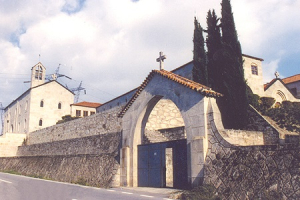
The nuns of the community of the Holy Family (Carmelo da Sagrada Família) Carmelite Monastery held their triennial elective Chapter on October 18, 2023. The Chapter was presided over by the bishop of the Diocese of Bragança-Miranda, Bishop Nuno Manuel dos Santos Almeida. The Carmelite General Commissary of Portugal, Agostinho Marques Castro, was also present.
Sérgioni Ancelmo da Silva, of the Province of Pernambuco, is the assistant at the monastery while he studies at the Universidad Católica Portuguesa.
The monastery was founded in 1947 by the Carmelite nuns from St. Ann's in Seville, Spain, headed by Sr. Maria of Fatima and of the Holy Face together with Sr. Maria Pilar. Moncorvo is the first enclosed monastery in Portugal after the laws of the 19th century.
The results of the elective chapter were as follows:
Prioress | Priora | Priora:
Irmã Maria Imaculada Conceição Nevado, O. Carm.
1st Councilor | 1ª Consejera | 1ª Consigliera:
Irmã Maria da Sagrada Familia Costa, O. Carm.
2nd Councilor | 2ª Consejera | 2ª Consigliera:
Irmã Maria Martina de Jesus Crucificado Dume, O. Carm.
3rd Councilor | 3ª Consejera | 3ª Consigliera:
Irmã Maria de Cristo Rei Valdigem, O. Carm.
4th Councilor | 4ª Consejera | 4ª Consigliera:
Irmã Maria da Natividade da SS. Virgem Gomes, O. Carm.
Treasurer | Ecónoma | Economa
Irmã Maria Martina de Jesus Crucificado Dume, O. Carm.
Formator | Formadora | Formatrice
Irmã Maria da Cruz Gloriosa Cunha, O. Carm.
Sacristan | Sacristana | Sacrestana
Irmã Maria da Natividade da SS. Virgem Gomes, O. Carm.
Pope Francis' Releases Laudate Deum

Pope Francis' Releases Laudate Deum "to All People of Good Will on the Climate Crisis"
Eight years after Pope Francis released his Encyclical Laudato Si' he has followed up with an Apostolic Exhortation Laudate Deum (Praise God) because he has realized that enough has not been done. In his letter he says the climate crisis is a global social issue and is intimately related to the dignity of human life. He calls climate change "one of the principal challenges facing society and the global community."
He continues by saying "It is no longer possible to doubt the human ... origin of climate change and then explains why. He then outlines the damages and risks for all creation, including humans.
The pope later highlights what he believes to be "the weakness of international politics" and the progress and failures of the various initiatives that have taken place around the world to address the situation. He conclused the exhortation with a number of points about the spiritual motivations for the fight against climate change.
Laudato Deum Text in English
(courtesy of the Province of Australia)


