













O.Carm
Conference on St. Titus Brandsma Held in Nijmegen

From October 3 to 6, the first congress of the newly established Titus Brandsma Circle was held at Radboud University. Approximately 70 people from 17 countries took part. The program of the congress can be seen here [https://www.ru.nl/
The Congress is part of the major project to publish the Collected Works of Titus Brandsma in seven volumes that Dr Elisabeth Hense, Associate Professor for Spirituality at Radboud University, is leading in collaboration with Joseph Chalmers S.T.L.
The project is funded by Radboud University and the British and Irish Provinces of the Carmelites as well as the General Council of the Carmelites in Rome.
Dr Elisabeth Hense organized the Congress in collaboration with Prof. Michael Plattig and Dr Edeltraud Klueting, both members of the German Carmelite Institute. The proceedings of the Congress will be published in the series of the German Carmelite Institute at Aschendorff.
The conference included talks by experts on the various facets of Brandsma’s life as well as a broader look at Dutch mysticism, Eastern mysticism, National Socialism, Carmelite Spirituality, and the Carmelite Rule.
The days also included a tour of the Carmelite monastery in Boxmeer where Brandsma made his novitiate. Today it houses the Dutch Provincial Archives and the Dutch Carmelite Institute. There was also a walk around the extensive Radboud University campus and “in the footsteps” of Titus Brandsma around the city of Nijmegen.
One night the composer Willibrord Huisman, Hendrik Jan Bosman, and a local choir performed works honoring the life and spirituality of Brandsma at the Titus Brandsma Memorial in Nijmegen.
The opening session was held in the theater in the Elinor Ostrom Building on the campus. There was an opening address by the Dean of the Faculty of Philosophy, Theology and Religious Studies, followed by presentations on “The Meaning of Titus Brandsma for the Dutch Church” by Bishop Gerard de Korte, bishop fo Den Bosch; “The Meaning of Titus Brandsma for the Carmelite Order” by the prior general of the Order, Míceál O’Neill; and “The Meaning of Titus Brandsma for the Dutch Carmelite Province” by Huub Welzen, the prior provincial of the Dutch Province. Between presentations, music was provided by composer Chris Fictoor and a clarinettist and 4 choral signers.
The evening concluded with a social hour in the campus bar/cafeteria.
Each day began with morning prayer in the University Chaplaincy. On the final day the members celebrated a Eucharist together led by the prior general. A festive meal followed at a local restaurant.
St. Teresa of Jesus, Virgin and Doctor of the Church

15 October Feast
Known to her family as Teresa de Cepeda y Ahumada, she became the reformer of Carmel, mother of the Discalced Carmelite nuns and friars, "spiritual mother" (as is engraved under her statue in the Vatican Basilica), patron of Catholic writers (from 1965) and Doctor of the Church (1970), the first woman with Saint Catherine of Siena to ever receive this last title.
Saint Teresa is among the most important figures of all time for Catholic spirituality. Her works - especially the four best known (The Life, The Way of Perfection, The Mansions and The Foundations) - together with her more historical works, contain a doctrine which encompasses the whole of the spiritual life, from the first steps right up to intimacy with God at the centre of the Interior Castle. Her Letters show her occupied with a great variety of everyday problems.
Read more about the life of St Teresa
To learn more about the life of St. Teresa and her work and legacy, we suggest reading the books both published by Edizioni Carmelitane:
- The Heirs of St. Teresa of Avila
- "I Consider the Labor Well Spent" A Mini-Course on the Interior Castle
Two Members of CISA Received Doctorates
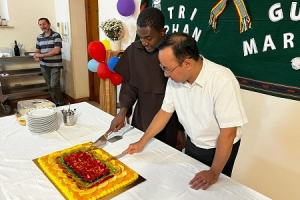
Two members of the CISA Community in Rome recently received doctorates from the Pontifical Gregorian University. Djomandji Zofiet Guy Martial, O. Carm., from Cameroun in the German Province, defended his thesis on Le retour à l’imagine et à la resemblance de Dieu dans les Exercices de dix jours chez Jean de Saint-Samson.
The second doctorate was awarded to Joseph Tri Phan, a member of the North American Province of St. Elias. His thesis was titled Toward a Fully Co-responsible Sharing in Evangelization and Ministry Specific to Carmel: The Impact of the Carmelite Reception of Vatican II's Ecclesiology and Theology of the Laity on the Secular Order of Carmelites in Asia.
Both men will now return to their respective countries to minister. We pray that their ministries may bear much fruit.
New Circle Promotes Research into Brandsma's Life

A new group is forming to promote continuing research into the life of Carmelite Saint Titus Brandsma. The group was formally introduced at the end of the conference on Titus Brandsma held at Radboud University in Nijmegen October 3-6, 2023.
The Circle is inviting all scholars interested in research on Titus Brandsma from around the world to join. Members will receive information about research being conducted and invitations to its congresses.
Fernando Millán Romeral, O. Carm., from Comillas University in Madrid, has been appointed the first president. Christian Körner, O. Carm., general bursar of the Carmelite Order, will serve as treasurer. Elisabeth Hense, T.O. Carm. will be the secretary.
The membership fee is €50.00 or US$50.00 for Europe and North America. The fee for members in Asia, Africa, and South America is €40.00. There is a €10 or US$10 discount for members of the Order. Deadline for joining is November 11, 2023.
For further information, contact This email address is being protected from spambots. You need JavaScript enabled to view it..
Celebrating At Home - 28th Sunday in Ordinary Time

Invitations Refused & Accepted
(Matthew 22:1-14)
The third of the parables addressed to the chief priests and the elders is our Gospel today. Told in the context of a wedding feast given by a great King it’s a parable in three parts.
The first part is about God’s gracious invitation and its indifferent and sometimes violent refusal by those invited first (the religious and lay leaders).
Second part: God’s invitation having been rejected by the first to whom it was offered, is now offered to others - good and bad alike (the sinners).
Third part: the story of the guest without a wedding garment (one who accepts the invitation but does not change - a little like the son in the first parable who said, “Yes”, but didn’t go to the vineyard).
The wedding garment is a symbol of a converted life full of good deeds.
The sense of the last line of the Gospel: “Many are called but few are chosen”, is that all are called to salvation, but it is only had by those who accept the invitation and who change and yield good deeds.
There is no room for complacency.
All three Gospel parables of the last three Sundays are about conversion. Conversion is not just turning away from sin but a radical reorienting of one’s life (turning) towards God. Repentance is not so much being sorry for past sins as a total change of direction. Conversion is impossible for the self-righteous because they don’t believe they need it. Hardness of heart and the refusal to listen are two great biblical sins.
In the three parables, St Matthew is urging his community to seek after true righteousness which comes from conversion and repentance, which flows from allowing the vision of God to fill their eyes and hearts. The kingdom has been entrusted to them, they are to produce its fruit of good deeds through a life of continual turning towards God.
Hard hearts, blocked ears, blind eyes, refusing to change are the path to death.
We are those who choose Life.
- pdf Celebrating At Home - 28th Sunday in Ordinary Time [PDF] (2.85 MB)
- default Celebrating At Home - 28th Sunday in Ordinary Time [ePub] (2.98 MB)
- pdf Celebrando en Familia - 28 Domingo del Tiempo Ordinario (573 KB)
- pdf Celebrando in Casa - 28 Domenica del Tempo Ordinario (572 KB)
- pdf Celebrando em familia - 28 Domingo do Tempo Comum (573 KB)
Celebrating At Home - 27th Sunday in Ordinary Time

Stewards of God’s gift
(Matthew 21:33-43)
In last Sunday’s parable, Jesus addressed the Jerusalem priests and elders with a message that “action speaks louder than words”.
This Sunday, Jesus continues his address to them, building upon that message by using another parable.
This week’s parable asks us how we have used the gifts that God has entrusted to us. It is essentially a parable about stewardship.
God has entrusted the kingdom to us, individually and collectively. We are expected to cultivate and manage this Kingdom life in such a way that it bears good fruit, fruit that we can present to God, the ‘owner of the vineyard’.
There is nothing in the parable to indicate that there was any actual produce for the landowner to collect. It may very well be that the tenants had simply neglected the wonderful vineyard altogether and allowed it to fall into ruin.
Each of us has been given, not only the gift of life, but the wealth provided by God’s grace – the very kingdom of God. Indeed, we have been privileged. However, with this privilege comes responsibility and we are ultimately responsible to God for the way we use or neglect the Kingdom within. We have to become a people who produce the fruit of the kingdom: love, mercy, justice, forgiveness, tolerance, hope, joy, deeds of loving kindness.
What will we do with the Kingdom that has been entrusted to us?
Let us pray that we may leave all the various ‘vineyards’ of our worlds in a better condition than how we were given them. Let us develop and sustain our awareness, seek out opportunities to contribute and then make judicious use of the gifts and grace that God has given us by letting God’s grace be seen at work in us; and, through us, at work in the world.
We are stewards of the Kingdom and of God’s grace. Let’s not waste such a great gift.
- pdf Celebrating At Home - 27th Sunday in Ordinary Time [PDF] (2.85 MB)
- default Celebrating At Home - 27th Sunday in Ordinary Time [ePub] (2.28 MB)
- pdf Celebrando en Familia - 27 Domingo del Tiempo Ordinario (560 KB)
- pdf Celebrando in Casa - 27 Domenica del Tempo Ordinario (404 KB)
- pdf Celebrando em familia - 27 Domingo do Tempo Comum (561 KB)
Vitam Coelo Reddiderunt

|
14-09-23 |
|
|
|
|
|
22-09-23 |
|
|
|
|
|
22-09-23 |
|
|
|
|
Carmelite Nuns in Batu Celebrate Elective Chapter

The nuns of the community of the Flos Carmeli Carmelite Monastery held their triennial elective Chapter on September 24, 2023.
The Indonesian nuns from the St. Mary Magdalene monastery in Boxmeer, Netherlands, and three nuns from Holy Trinity monastery in Schlüsselau, Germany, founded the Carmelite monastery in Batu in 1962. The bishop of Malang at the time was Everard Ioannis (Avertani) Albers, O. Carm.
It was the first cloistered monastery in Indonesia. In 1993, the Batu community founded a Carmelite monastery in Palangka Raya, Indonesia.
The monastery's webpage is: www.floscarmelibatu.org
The results of the elective chapter were as follows:
Prioress | Priora | Priora:
Sr. Maria Brigitta Gitasianiningsih Purnama O. Carm.
1st Councilor | 1ª Consejera | 1ª Consigliera:
Sr. Maria Laura Inacentia Sulistiowati Widjajakusuma, O. Carm.
2nd Councilor | 2ª Consejera | 2ª Consigliera:
Sr. Maria Elisabeth Widhi Habsari Soetadi, O. Carm.
3rd Councilor | 3ª Consejera | 3ª Consigliera:
Sr. Maria Gerarda Suwarti Jokasemo, O. Carm.
4th Councilor | 4ª Consejera | 4ª Consigliera:
Sr. Maria Angelina Wiwik Andriani Koesman, O. Carm.
Treasurer | Ecónoma | Economa
Sr. Maria Elisabeth Widhi Habsari Soetadi, O. Carm.
Formator | Formadora | Formatrice
Sr. Maria Laura Inacentia Sulistiowati Widjajakusuma, O. Carm.
Sacristan | Sacristana | Sacrestana
Sr. Maria Angelina Wiwik Andriani Koesmam, O. Carm.
Schedule of the Prior General for October

Oct. 1
Celebration of 70th anniversary of the Carmelite Third Order in Caivano, Italy.
Oct. 2
General Council, plenary meeting.
Oct. 3 – 7
Titus Brandsma Congress, Nijmegen, Netherlands.
Oct 09 – 13
General Council in Rome
Oct 13
Preparatory session for the General Chapter of the Carmelite Missionary Sisters of St Therese of the Child Jesus. Santa Marinella, Italy.
Oct 16 – 30
Canonical visitation of the Province of St. Elias, Rio de Janeiro.
Oct 31
Begin the canonical visitation of the communities in Mozambique.
Feast of Saint Thérèse of Lisieux

1 October Feast
The year 2023 is the 150th anniversary of the birth of Marie-Francoise Thérèse Martin on January 2 in Alençon in the Normandy region in northwest France. In 1888 she became a cloistered Discalced Carmelite nun in the town of Lisieux where her family had moved following her mother’s death. Following her death on September 30, 1897, of tuberculosis at the age of 24, she became known around the world as St. Thérèse of the Child Jesus and the Holy Face through the publication of her autobiography now known as Story of a Soul.
This year also marks the 100th anniversary of St. Térèse’s beatification. Pope Pius XI performed the ceremony on April 29, 1923. Two years later he would canonize her. Two years after that, in 1927, he declared her patroness of the missions along with the Jesuit Francis Xavier. The pope referred to Thérèse as “the star of his pontificate.” During his homily at the canonization, the pope said, “If everyone follows this path of spiritual childhood, everyone will see how easily reformation of human society can be achieved, which we have proposed since the beginning of our pontificate. On the wall of the niche in the crypt of St. Peter’s Basilica where Pius XI is buried, there is a mosaic of the saint.
Thérèse’s simple yet powerful spirituality has captured the imagination of Catholics and non-Catholics alike for the last century. Her sense of commitment led her to a profound experience of the love of God and of neighbor. She never had an easy life, but she did live with a great sense of peace and joy.
To learn more about St. Therese
St. Thérèse, Her Family and Her Spirituality
Proclamation of St. Therese of Lisieux as Doctor of the Church
150th Anniversary of the Birth of Thérèse of Lisieux Celebrated in Association with UNESCO
Edizioni Carmelitane recently published a book in a year of anniversaries associated with Saint Thérèse of Lisieux: the 150th anniversary of her birth in 1873 and the 100th anniversary of her beatification by Pope Pius Xi in 1923.
To learn more visit
Singing the Mercies of the Lord Writings on Saint Thérèse of Lisieux


