
















O.Carm
Celebrating At Home - 26th Sunday in Ordinary Time

Disobedient obedience
(Matthew 21:28-32)
Over the next three Sundays we will listen to three parables where Jesus, having cleansed the temple, addresses the Jerusalem priests and elders. These “parables of judgement” voice God’s judgement against Israel – especially her leaders – for their rejection of Jesus.
The message, however, is also for us.
In this Sunday’s parable, the message could not be simpler: action speaks louder than words.
The tax collectors and prostitutes acted like the first son. Initially they said no to God, but hearing John the Baptist’s preaching they converted and did what pleased God.
The chief priests and elders are like the second son. They, too, heard John’s preaching and saw the responses of the tax collectors and prostitutes but didn’t change. They pretended acceptance of God but refused to accept John’s message. It is the tax collectors and the prostitutes, therefore, who will enter the Kingdom of God before the chief priests and elders.
It is easy to say that we are going to do something to please someone. But the real honour comes in doing.
If we really want to honour our God, we must find ways to do the will of God. Sometimes it won’t be easy, sometimes it will put us out.
We are not called to ‘police’ God’s mercy – to decide who is deserving of it and who is not. If we have truly heard the Word of God we will be more concerned about extending the reign of God’s mercy and love to everyone, especially to those most despised in the world.
- pdf Celebrating At Home - 26th Sunday in Ordinary Time [PDF] (2.89 MB)
- default Celebrating At Home - 26th Sunday in Ordinary Time [ePub] (2.27 MB)
- pdf Celebrando en Familia - 26 Domingo del Tiempo Ordinario (463 KB)
- pdf Celebrando in Casa - 26 Domenica del Tempo Ordinario (464 KB)
- pdf Celebrando em familia - 26 Domingo do Tempo Comum (565 KB)
Prior General on Indonesia’s 100 Years Celebration
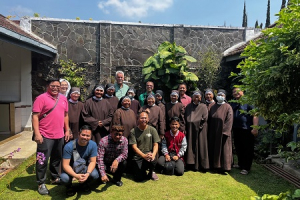
This year is the first centenary of Carmelite Presence in Indonesia. It all began in 1923 when three friars from the Dutch Province arrived in Eastern Java, in the city of Malang. From very small beginnings, the Carmelilte presence in Indonesia has now grown to include some four hundred friars, two monasteries of nuns, three affiliated congregations and a very strong Carmelite Third Order.
Very joyful celebrations were held in Jakarta, August 11, 12 and 13, in Malang and in Maumere, August 15. Further celebrations are due to be held in Medan later this month. The Indonesian form of celebrations includes a solemn celebration of the Eucharist, a meal to which the masses are invited and a presentation of song and dance in the native culture, all very colourful, and overflowing with exuberance and welcome.
The achievements of the Carmelites in Indonesia are very clear to be seen. Not only are the numbers of vocations both of men and women very abundant and significant, but the sense of identity as Carmelites and the quality of formation over the years is and has been very encouraging. It augurs very well for the future in a country that respects religion and religious difference and promotes an education that is steeped in tradition but also very focused on the demands of the modern world. In the fields of pastoral ministry, education and spiritual accompaniment, Carmelites in Indonesia make a very important contribution. By the same token, we may say that in the future Indonesian Carmelites will find themselves making a major contribution to the international life of the Carmelite order and family, something that has already begun in many parts of the world. As a country that recognises very clearly the value of prayer, our prayer is one of gratitude for what has been done and of great hope for what is to come in the future as people respond to the call to be Carmelites and offer their very generous service to the Church and to the society in Indonesia and beyond.
Lectio Divina October 2023

Opening Prayer
Lord Jesus, send your Spirit to help us to read the Scriptures with the same mind that you read them to the disciples on the way to Emmaus. In the light of the Word, written in the Bible, you helped them to discover the presence of God in the disturbing events of your sentence and death. Thus, the cross that seemed to be the end of all hope became for them the source of life and of resurrection.
Create in us silence so that we may listen to your voice in Creation and in the Scriptures, in events and in people, above all in the poor and suffering. May your word guide us so that we too, like the two disciples from Emmaus, may experience the force of your resurrection and witness to others that you are alive in our midst as source of fraternity, justice, and peace. We ask this of you, Jesus, son of Mary, who revealed to us the Father and sent us your Spirit. Amen.
- pdf Lectio Divina October 2023 [Pdf] Download here (867 KB)
- default Lectio Divina October 2023 [ePub] Download here (218 KB)
-
default
Lectio Divina October 2023 [Mobi] Download here
(892 KB)
"Lectio divina," a Latin term, means "divine reading" and describes a way of reading the Scriptures whereby we gradually let go of our own agenda and open ourselves to what God wants to say to us. In the 12th century, a Carthusian monk called Guigo, described the stages which he saw as essential to the practice of Lectio divina. There are various ways of practicing Lectio divina either individually or in groups but Guigo's description remains fundamental.
Cover image: St. Teresa of Jesus, Virgin and Doctor of the Church.
The Carmelites of Paraná celebrate Electoral Chapter
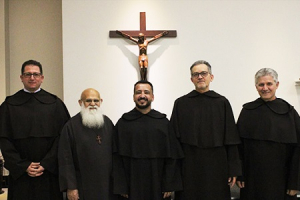
The Carmelites of the General Commissariat of Paraná celebrated their triennial elective chapter from September 18-22, 2023. The gathering, held in Maringá, had as its theme "We Walk Together Towards God" from the Rule and Constitutions. The motto for the meetings was from Luke's Gospel: "Stay with us, Lord, it is late and night is coming." Míċéal O'Neill, the prior general, accompanied by José Luis Maza Subero, the Councillor for the Americas, participated.
In 1951, the Province of Upper Germany began missionary work in the city of Paranava, in the State of Paraná, Brazil. Within a few years fifteen missionaries went to the new foundation. They promoted local vocations and two years later, they started a second foundation in the city of Graciosa, where a small seminary house was built. In 1965, the Paranese mission was set up as a provincial commissariat of the Upper German Province.
In 1967, the Carmelites assumed the pastoral care of the parish of Saint Joseph in Cidade Gaúcha and the parish of the Immaculate Conception of the Blessed Virgin in the city of Fanny-Curitiba; in this second parish they also erected a novitiate and a minor seminary. In 1968, after the division of the Cidade Gaúcha parish, the Carmelites took over a new parish in the city of Tapira. The following year, in the city of Paranava, the brothers set up a seminary of St. John of the Cross and a middle school. In 1984, the parish of Good Jesus in the city of Dourados, in the State of Mato Grosso do Sul, was taken over by the Order. In 1994, the Carmelites left the parishes in the city of Gaúcha and in Tapira in order to start a new mission in the northern region. They assumed the pastoral care of the parish of Our Lady of Aparecida in the city of Rolim de Moura, in the State of Rondônia in the Amazon region. In 1996, a house of formation was founded in Barrio Novo, in the city of Curitiba. At the beginning of the third millennium, convents were established in Manaus and Navigentes (2009) and in Florianopolis (2011). On October 20, 2012, the prior general, with the approval of his General Council, canonically erected the General Commissariat of Paraná.
The following members were elected to leadership at the Chapter:
Provincial | Provincial | Provinciale
Flávio Barbosa dos Santos, O. Carm.
1st Councilor | 1er Consejero | 1o Consigliere
Edmilson Borges de Carvalho, O. Carm.
2nd Councilor | 2do Consejero | 2o Consigliere
Francisco Manoel de Oliveira, O. Carm.
3rd Councilor | 3er Consejero | 3o Consigliere
Vagner Sanagiotto, O. Carm.
4th Councilor | 4to Consejero | 4o Consigliere
João Bernardes Alves, O. Carm.
Celebrating At Home - 25th Sunday in Ordinary Time

God’s Outrageous Generosity
(Matthew 20:1-16)
For many, the parable which Jesus tells in the Gospel today seems profoundly unjust. Why should those who have done little work get the same pay as those who worked all day?
Maybe the answer lies in the first reading for today: My ways are not your ways; my thoughts not your thoughts. So often in the scriptures, God seems to have a totally different way of approaching things to most of us.
The parable presents God as a landowner going out at five different times during the day to hire workers for his vineyard.
With the 6am workers he makes an agreement for one denarius for the day’s work - the usual daily wage for a labourer. The workers who come later are promised a ‘fair wage’. But when payment time comes, they get a full day’s pay even though some have worked only one hour!
Usually, the youngest and fittest would be hired first and older and weaker workers left till last. But God doesn’t seem too worried about what condition the workers are in or what time of day it is.
The last comers must have been delighted to have received their unexpected full day’s pay. For them, it was really a gift rather than a wage for time worked. The ‘early birds’ fell victim to ‘rising expectations’, thinking that they would get more.
In giving both early birds and late comers the same ‘wage’ the landowner has made them equals – all are equal beneficiaries of God’s gracious invitation to the Kingdom. And there is a place for everyone in that Kingdom, including those often left behind in the world – the poor, sick, old, disabled, etc.
Life in the Kingdom is not a reward for long hours of work. It is a gift – it cannot be earned, but is had by responding to God’s choice of us, no matter what condition we are in, whether we are an early bird or a late comer.
God’s kind of thinking and acting is often very different to human thinking and acting.
The parable can also be interpreted as a practical expression of how to love our neighbour – with generosity and compassion, without considering if they deserve our kindness or not – for the disciple of Jesus must think and act like God.
This parable fits right into the biblical idea of justice which is heavily biased in favour of the ‘have nots’ – the widows, orphans, poor, blind, lame, sinners, etc. No one is left out of the gaze of God’s care.
God’s outrageous and extravagant graciousness and generosity is so different to the often petty and exacting way in which we treat each other. God’s sense of fairness and justice is so much broader and richer than ours. That is what life in the Kingdom of God is supposed to be.
Like last Sunday, it is our awareness of God’s extraordinary kindness, patience and mercy which help us to act in the same way - to see with God’s eyes, to feel with God’s heart and to act with God’s intention.
- pdf Celebrating At Home - 25th Sunday in Ordinary Time [PDF] (2.84 MB)
- default Celebrating At Home - 25th Sunday in Ordinary Time [ePub] (2.23 MB)
- pdf Celebrando en Familia - 25 Domingo del Tiempo Ordinario (452 KB)
- pdf Celebrando in Casa - 25 Domenica del Tempo Ordinario (561 KB)
- pdf Celebrando em familia - 25 Domingo do Tempo Comum (560 KB)
Carmelite Nuns in Huesca Celebrate Elective Chapter

The Carmelite nuns of the monastery of Our Lady of the Assumption held their triennial elective Chapter on September 1, 2023.
The monastery was founded in 1656 by a Sr. Beatrice the Sheperd who brought nuns from the monastery of St. Michael, also in the town of Huesca. The monastery belongs to the Mater Unitatis Federation.
The results of the elective chapter were as follows:
Prioress | Priora | Priora:
Hna. Mª Jacinta Nthenya Wambua, O. Carm.
1st Councilor | 1ª Consejera | 1ª Consigliera:
Hna. Mª Anastacia Kavuu Kiswili, O. Carm.
2nd Councilor | 2ª Consejera | 2ª Consigliera:
Hna. Mª Inés Nthenya Nzyuko, O. Carm.
3rd Councilor | 3ª Consejera | 3ª Consigliera:
Hna. Mª Carmen Ibarra, O. Carm.
4th Councilor | 4ª Consejera | 4ª Consigliera:
Hna. Benedictar Mutiwa Nzuve, O. Carm.
Treasurer | Ecónoma | Economa
Hna. Inés Nthenya Nzyuko, O. Carm.
Formator | Formadora | Formatrice
Hna. Mª Anastacia Kavuu Kiswili, O. Carm.
Sacristan | Sacristana | Sacrestana
Hna. Mª Regina Mumbua Musyoka, O. Carm.
Activities of the Prior General for September 2023

01 - 07: Continuation of the Canonical Visitation in the Indonesian Province
05: Address via zoom to the meeting of the nuns of the Italian Federation, held in Sassone, on the theme of formation
08: Address via zoom to the gathering of members of the Northern European Region, held in Dublin on the theme of vocations in Europe
08-09: Mid-Chapter of the Indonesian Province, held in Malang
11 - 16: Rome time.
18 - 22: Chapter of the General Commissariat of Parana, held in Maringa.
26: Online course for new provincials offered by the General Council.
27-30: Rome time.
Relics of Titus Move the Philippine Church

Since July 2022, the Carmelites in the Philippines have sponsored a yearlong pilgrimage of the relics of St. Titus Brandsma. The pilgrimage was the result of a decision of the previous provincial council to promote the life of the Carmelite saint to the people of the nation. The relics made more than 90 stops during the year. Although the designated year finished, dioceses are still contacting the province to ask for the relics to visit them.
Each Carmelite community has received a relic of St Titus from the postulator general’s office in Rome, allowing each to foster their own program of evangelization of St. Titus. The traveling relic is in a reliquary which in turn is inside an urn. The pilgrimage is self-sustaining. The cost of transportation as well as the cost for accommodations for those accompanying the relics
“The relics went from one parish to another, from one monastery to another, from one diocese to another, from one island to another,” said Fr. Esmeraldo Reforeal, O. Carm., the national coordinator of the tour. “We traveled by car, boat and plane.” Some remote chapels were included in the tour, enabling people without access to transportation to benefit from the relic visit.
The presence of the relic provided the faithful with far more opportunities to experience the faith than just praying before the relic. The program at each stop included a catechism, lectio divina on the life of St. Titus, a Mass of Welcome, the opportunity for confessions, a farewell Mass. Some stops made requests for a specific service and these were honored if possible. The relics were accompanied by a Carmelite and others to provide security for the relics as well as the religious services.
The final stop for the year was in the annual meeting of the Catholic Bishops Conference of the Philippines (CBCP). The bishops welcomed the idea of presenting Titus as a “truth-seeker” "truth-defender" and a “promoter of the truth.” The relic was also present at the annual meeting of the Conference of Major Superiors in the Philippines. The Carmelites were given time to present the story of St. Titus and spend time in prayer with the relics.
Feedback from the year long experience indicated that people were impressed and inspired by the life of St. Titus. This was also true among the students who were able to participate.
Causa Nostrae Laetitiae
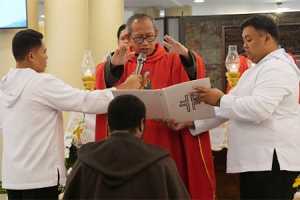
INITIUM NOVITIATUS
12-08-23 Teodorus Tonda (Indo-Est) Flores, Indonesia
12-08-23 Jilbertus F. Samo Langoarang (Indo-Est) Flores, Indonesia
12-08-23 Samuel Yulson Nitti (Indo-Est) Flores, Indonesia
12-08-23 Aloysius Sipa (Indo-Est) Flores, Indonesia
12-08-23 Gregorius Mahur (Indo-Est) Flores, Indonesia
12-08-23 Emanuel Roberto Carlos Ngaku (Indo-Est) Flores, Indonesia
12-08-23 Januarius Asa (Indo-Est) Flores, Indonesia
12-08-23 Andreas Konsili Ndoa (Indo-Est) Flores, Indonesia
12-08-23 Ignasius Alvedo Hasan (Indo-Est) Flores, Indonesia
12-08-23 Yohanes De Nggedu (Indo-Est) Flores, Indonesia
12-08-23 Agustinus Risno (Indo-Est) Flores, Indonesia
12-08-23 Yakobus Christianus Gado Tonda Bei (Indo-Est) Flores, Indonesia
12-08-23 Yohanes Paolus Kenedi (Indo-Est) Flores, Indonesia
12-08-23 Yoseph Yulius Wetu (Indo-Est) Flores, Indonesia
12-08-23 Yakobus Helianto Raymondo Djo (Indo-Est) Flores, Indonesia
12-08-23 Yohanes Samson Dapa Woda (Indo-Est) Flores, Indonesia
27-08-23 Abraham Anggelo Dulcis (Indo) Batu-Malang, Indonesia
27-08-23 Agustinus Bintang Kejora Teweng (Indo) Batu-Malang, Indonesia
27-08-23 Agustinus Herjuno Handhika Pradinta (Indo) Batu-Malang, Indonesia
27-08-23 Albert Sugendri Situmorang (Indo) Batu-Malang, Indonesia
27-08-23 Antonio Viko Ledang (Indo) Batu-Malang, Indonesia
27-08-23 Daniel Syahputra Giawa (Indo) Batu-Malang, Indonesia
27-08-23 Gomal Silalahi (Indo) Batu-Malang, Indonesia
27-08-23 John Horas Gregorius Rumapea (Indo) Batu-Malang, Indonesia
27-08-23 Michael Bagasmayo Kariadi (Indo) Batu-Malang, Indonesia
27-08-23 Rikialdus Albertus Longa (Indo) Batu-Malang, Indonesia
27-08-23 Rustam Hary Siholang (Indo) Batu-Malang, Indonesia
27-08-23 Supri Hadi Prima Marpaung (Indo) Batu-Malang, Indonesia
27-08-23 Vincentius Reyant Ekarista (Indo) Batu-Malang, Indonesia
27-08-23 Yohanes Paulus Noendi (Indo) Batu-Malang, Indonesia
PROFESSIO TEMPORANEA
16-08-23 Vinicius Alexandre Belger da Luz (Par) Florianópolis, Brazil
02-09-23 Maria Stefania di Gesù Misericordioso (CAR) Carpineto Romano, Italia
ORDINATIO DIACONALIS
02-09-23 Silvestre Alves (Aust-TL) Hera, Timor-Leste
ORDINATIO SACERDOTALIS
05-08-23 José Roberto Santos (Pern) Pacatuba, Brasil
19-08-23 José Edson da Silva (Pern) Primavera, Brasil
02-09-23 Amandio Soares Salsinha (Aust-TL) Hera, Timor-Leste
02-09-23 Narcizio Da Costa Vilanova (Aust-TL) Hera, Timor-Leste
07-09-23 Cornelius Danny Septian Pamungkas (Indo) Malang, Indonesia
07-09-23 Albertus Hamonangan Situmorang (Indo) Malang, Indonesia
07-09-23 Ignasius Anang Setia Darmanto (Indo) Malang, Indonesia
St. Albert of Jerusalem, Bishop and Lawgiver

17 September Feast
Saint Albert was born towards the middle of the 12th century in Castel Gualtieri in Emilia, Italy. He entered the Canons Regular of the Holy Cross at Mortara, Pavia, and became prior there in 1180. In 1184, he was named bishop of Bobbio, and the following year he was transferred to Vercelli which he governed for twenty years.
Edizioni Carmelitane, the editorial house of the General Curia of Carmelite Order, has recently published Albert and His Rule, a book written by biblical scholar and Carmelite Michael Mulhall.
The Carmelites are one of a small handful of religious communities that can trace their origins back into the Middle Ages. The Rule that Carmelites continue to follow started with Albert, the patriarch of Jerusalem from 1206 to 1214. Some thirty-three years after Albert's death, Pope Innocent IV granted full recogntion of these Carmelites and to the Rule first written for them by Albert.
Albert's spirit still imbues the Rule. Over the years following his death three popes addressed themselves to these Carmelite hermits. Pope Honorius III acknowledged the fact that they had received their way of life from Albert, and consequently they need not fear a later prohibition against following their own unique Rule. Pope Gregory IX, who had befriended both St. Francis and St. Dominic, put the hermits under his personal protection. Lastly, Pope Innocent IV authorized two Dominicans to help bring all their changes together into one text. It is this text that we read today as the Carmelite Rule.
The book Albert and His Rule attempts to retrieve the mindset that first enlivened and held together the vision that Albert fashioned for them. lt is this originai spirit that Albert and His Rule attempts to retrieve.
Visit the New Official Website of Edizioni Carmelitane


