












O.Carm
An Ecumenical Dialogue On St. Thérèse of Lisieux
Sponsored by the Center for Carmelite Studies
***Virtual Event***
AN ECUMENICAL DIALOGUE
ON ST THÉRÈSE OF LISIEUX
ANDERS CARDINAL ARBORELIUS, OCD & LUTHERAN BISHOP KARIN JOHANNESSON
SUNDAY, AUGUST 27, 2023
3:00 PM Eastern
Click on Link Here for YouTube Live Attendance
St. Mary of Jesus Crucified (OCD), Virgin

25 August Optional Memorial
Mariam Baouardy was born at Abellin in Galilee on 5th January 1846 to very poor parents who were good living and devoted Greek-rite Catholics. She was left an orphan after the death of her parents at only three years of age when, together with her brother Paul, she was entrusted to the care of an uncle,who had moved to Alexandria in Egypt a few years earlier. She never received any formal education and remained unable to read. At thirteen years of age, wanting to give herself only to God, she firmly refused the marriage which her uncle, according to the Eastern custom, had arranged for her. The next few years, she worked as a domestic in Alexandria, Jerusalem, Beirut and Marseilles.
Lectio Divina September 2023

Opening Prayer
Father of everlasting goodness, our origin and guide,be close to us and hear the prayers of all who praise you. Forgive our sins and restore us to life. Keep us safe in your love.We ask this through our Lord Jesus Christ, your Son, who lives and reigns with you andthe Holy Spirit, one God, for ever and ever. Amen.
- pdf Lectio Divina September 2023 [PDF] Download here (2.02 MB)
- default Lectio Divina September 2023 [ePub] Download here (185 KB)
- default Lectio Divina September 2023 [Mobi] Download here (901 KB)
"Lectio divina," a Latin term, means "divine reading" and describes a way of reading the Scriptures whereby we gradually let go of our own agenda and open ourselves to what God wants to say to us. In the 12th century, a Carthusian monk called Guigo, described the stages which he saw as essential to the practice of Lectio divina. There are various ways of practicing Lectio divina either individually or in groups but Guigo's description remains fundamental.
Cover image: This icon at the National Shrine of Saint Jude at Faversham depicts St. Albert’s giving of the Rule to Saint Brocard.
From the one Well of Elijah (top left) two streams flow, representing the two major branches of the Carmelite Family.
Celebrating At Home - 21th Sunday in Ordinary Time

Who Do You Say I Am?
(Matthew 16:13-20)
At this point in St Matthew’s Gospel, Jesus and his chosen ones have travelled and lived together for some time. He now invites them to explore what they understand about his identity. Even in his question there is explicit hint: Who do people say the Son of Man is?
The disciples tell Jesus what they have heard from others: John the Baptist, Elijah, Jeremiah or one of the prophets.
Jesus then asks the disciples, “But, who do you say I am?” It is Peter who adds to the title ‘Son of Man’ by recognising Jesus as ‘the Christ, the Son of the living God’.
Jesus names Peter as a happy man. This same Peter whose faith faltered when he was buffeted by the wind and waves in the Gospel two weeks ago has now shown his openness to God and recognises Jesus for who he is. But this is not the end of Peter’s story.
There are ups and downs in his response, as we will see next Sunday when this ‘rock’ of faith becomes a ‘stumbling block’ to God’s purpose.
In spite of that, Jesus names Peter as the ‘rock’ on which he will build the church. Peter has a new name and a new vocation. This church will have to battle hostile forces which seek to enslave people in sin. It will be a safe haven of freedom by being the living presence of God.
Peter’s job is to use the ‘keys of the kingdom’ to unlock and release the reign of God’s grace into the world. In this work, decisions have to be made for the whole community of the church. Here, Matthew’s words about ‘binding’ and ‘loosening’ have nothing to do with the forgiveness of sins. They are a kind of pledge that the sincere and honest decisions of faithful people have divine backing. It does not mean that these decisions are the best or most perfect ones.
Discernment and decision-making are part of the job of being disciples finding together the way of the Lord; of being the living presence of God in the world.
Finally, Jesus binds the disciples to silence about his true identity lest his Messiaship get confused with the people’s expectation of a messiah who will free them from Roman occupation.
Like last Sunday, Peter is a lot like us. We really want to believe, to become the presence of God, but we don’t always seem to be able to do it. We have great moments of faith and moments in which we are deeply in tune with the heart of God. Most of us also have moments when we fall back into narrow and harsh ways that cannot hold the power of God’s love. But the Gospel reassures us that, in spite of our weakness and the many ways in which we may be found wanting, God is still close to us and faith is a journey, not a destination.
In my thoughts, words and actions, who do I say Jesus is?
- pdf Celebrating At Home - 21th Sunday in Ordinary Time [PDF] (2.83 MB)
- default Celebrating At Home - 21th Sunday in Ordinary Time [ePub] (2.73 MB)
- pdf Celebrando en Familia - 21 Domingo del Tiempo Ordinario (436 KB)
- pdf Celebrando in Casa - 21 Domenica del Tempo Ordinario (541 KB)
- pdf Celebrando em familia - 21 Domingo do Tempo Comum (279 KB)
Causa Nostrae Laetitiae
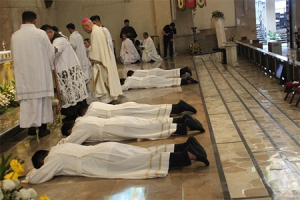
INITIUM NOVITIATUS
13-08-23 John Baptist Minh-Duc Nguyen (SEL-V)
13-08-23 Paul Toan Ho (SEL-V)
13-08-23 Peter Vu Nguyen (SEL-V)
PROFESSIO TEMPORANEA
16-07-23 Trisantus Sihombing (Indo) Malang, Indonesia
16-07-23 Kiki Forfius Situmorang (Indo) Malang, Indonesia
16-07-23 Gian Suharjo Situmorang (Indo) Malang, Indonesia
16-07-23 Reinhard Mayliano Forthe Gama (Indo) Malang, Indonesia
16-07-23 Yohanes Dian Anugrah Simanjorang (Indo) Malang, Indonesia
20-07-23 Simplisius Seke Kawa (Indo-Est) Wairklau, Indonesia
20-07-23 Fridolin De’e (Indo-Est) Wairklau, Indonesia
20-07-23 Yohanes Delasale Bao (Indo-Est) Wairklau, Indonesia
20-07-23 Antonius Du’a (Indo-Est) Wairklau, Indonesia
20-07-23 Marseliano Hernan Bagio (Indo-Est) Wairklau, Indonesia
20-07-23 Hubertus Benge Ratu (Indo-Est) Wairklau, Indonesia
20-07-23 Roman Rofinus Nganja (Indo-Est) Wairklau, Indonesia
20-07-23 Carlos Demitrio Staren Djaman (Indo-Est) Wairklau, Indonesia
20-07-23 Markus Apriyaldi Purnama (Indo-Est) Wairklau, Indonesia
20-07-23 Marianus Soni Jaya Mahe (Indo-Est) Wairklau, Indonesia
20-07-23 Berno Andrianus (Indo-Est) Wairklau, Indonesia
20-07-23 Epi Pianus Gregorius Gadja Wora (Indo-Est) Wairklau, Indonesia
20-07-23 Stanis Rikardus Aprinus (Indo-Est) Wairklau, Indonesia
20-07-23 Bonaventura Marciano Thomas Ire (Indo-Est) Wairklau, Indonesia
20-07-23 Hendrikus Thomans Temongmere (Indo-Est) Wairklau, Indonesia
27-07-23 Albert Magbag (Phil) Quezon City, Philippines
27-07-23 Alfred Perlas (Phil) Quezon City, Philippines
27-07-23 Rodgen Apor (Phil) Quezon City, Philippines
14-08-23 Luke Huynh Gia Kieu (SEL-Viet) Ho Chi Minh City, Vietnam
14-08-23 Anthony Bau Xuan Tran (SEL-Viet) Ho Chi Minh City, Vietnam
14-08-23 Joseph Dinh Binh Phan (SEL-Viet) Ho Chi Minh City, Vietnam
14-08-23 Yosef M. Hong-Khanh Nguyen (SEL-Viet) Ho Chi Minh City, Vietnam
14-08-23 Michael Ni Hoang Nguyen (SEL-Viet) Ho Chi Minh City, Vietnam
PROFESSIO SOLEMNIS
16-07-23 Alfonsus Christ Setiawan (Indo) Malang, Indonesia
16-07-23 Claudius Willy Ribert Situmorang (Indo) Malang, Indonesia
20-07-23 Yohanes Seran (Indo-Est) Wairklau, Indonesia
20-07-23 Alexander Raymond Dhena (Indo-Est) Wairklau, Indonesia
20-07-23 Heronimus Muga Wio (Indo-Est) Wairklau, Indonesia
20-07-23 Andrianus Bado Rema (Indo-Est) Wairklau, Indonesia
20-07-23 Arnoldus Reban (Indo-Est) Wairklau, Indonesia
20-07-23 Bonefasius Afandi (Indo-Est) Wairklau, Indonesia
20-07-23 Georgius Ture (Indo-Est) Wairklau, Indonesia
20-07-23 Wilibrodus Ironius Sebho (Indo-Est) Wairklau, Indonesia
27-07-23 David Oala (Phil) Quezon City, Philippines
18-08-23 Ryan-Joseph Resurrección (PCM) Washington, DC
18-08-23 Roberto Carlos Reyes Castillo (PCM) Washington, DC
ORDINATIO DIACONALIS
27-07-23 Rio Mar Sindac (Phil) Quezon City, Philippines
27-07-23 Oscar Robles, Jr. (Phil) Quezon City, Philippines
27-07-23 Vincent Sumanting (Phil) Quezon City, Philippines
27-07-23 Kim Paul Escobal (Phil) Quezon City, Philippines
27-07-23 Marjune Caloring (Phil) Quezon City, Philippines
12-08-23 Keven Mutsvairo (Hib-Zim) Harare, Zimbabwe
12-08-23 Gift Chinyadza (Hib-Zim) Harare, Zimbabwe
ORDINATIO SACERDOTALIS
15-07-23 Samual Ndjate Kiongo (Ita-Congo) Kinshasa, RDCongo
12-08-23 Shelton Sylvester Zimondi (Hib-Zim) Harare, Zimbabwe
12-08-23 Underson Musina (Hib-Zim) Harare, Zimbabwe
12-08-23 Marvellous Tawanda Murungu (Hib-Zim) Harare, Zimbabwe
Celebrations for the 100th anniversary in Indonesia Continue

Indonesian 100th Anniversary Celebrations Move from Jakarta to Malang
The celebrations for the 100 years of the Indonesian Province of the Carmelite Order continued in Jakarta on August 12-13. In addition to celebrating with the various Carmelite, parish, and school communities, this week has provided an opportunity for the Carmelites from other parts of the world to see the various ministries and houses of the Indonesian Province.
On Saturday, August 12, the community gathered with the community of the Mary Magdalene of Pazzi priory for lunch. This happened to coincide with the birthday of Huub Welzen, the prior provincial of the Netherlands. So in addition to the meal, the tradition birthday songs were sung, gifts were provided, and cake was shared.
Later in the afternoon, there was a Eucharistic celebration with the people of Mary Flower of Carmel parish. Benny Phang, a member of the Indonesian Province and vice-general of the Order was the main celebrant and preached. Following communion, FX Hariwan Adji, the prior provincial of the Indonesian Province spoke and then introduced all the Carmelites from other provinces who were in attendance. The prior provincial of the Dutch Province, Huub Welzen, also spoke as did Míceál O’Neill, the prior general of the Order. A reception followed the Mass with food, music, dancing and raffles.
On Sunday morning, the parish community of Mary Mother of Carmel parish joined with the Carmelites to celebrate. The prior provincial was the main celebrant. A meal followed this Mass for the Carmelites and some invited guests.
In the evening, the Carmelites joined the Little Way Community, to celebrate the 7th anniversary of the organization. The couples provide support to the province, particularly in the area of formation. Approximately 100 people attended the dinner.
On Monday the festivities transferred to Malang which is where the Carmelites originally established themselves in 1923. The Order took over administration of Malang’s Sacred Heart Parish from the Jesuits to begin their ministry in Indonesia. Flights were delayed due to the air force practicing at and around the airport for the up-coming Independence Day celebrations. So the planned visit to the novitiate in Batu had to be cancelled. The prior general and Robert Puthussery, the general council for Asia, Australia and Oceania, will visit the community later as will some of the Carmelites who are remaining a few extra days in the Malag area.
The Carmelites travelled on Tuesday morning to the Titus Brandsma Formation House. This community is made up of the professed who attend theology and philosophy classes at the university, STF Widya Sasana next door. Members took a tour of a classroom and office building completed in recent years. Then the group moved to the blessing of the new provincial library building. This multi-story structure with have a reading/study area which can be easily adapted for a meeting or conference with the students. The next floors will contain the library books. The roof will provide space (and secure safety measures) for the Carmelite students to play football or other sport since the library building eliminated their sports’ field.
That evening, the celebration of the Eucharist took place outdoors at Sr. Albert’s Carmelite High School. The main celebrant was Bishop Henricus Pidyarto Gunawan, O. Carm. He was joined by many Carmelites and religious priests, sisters, and approximately 1000 lay people. The Mass was followed by a lively show of dance and singing with many of the religious communities present as well as student groups from the school performing.
On Wednesday morning the Carmelites traveled to House of Mercy, Dau, a hospice established by the province to welcome elderly who have no family to take care of them. The house is open to people of all faiths. A local foundation of Carmelite sisters minister there full time. Carmelite students from Batu also provide assistance to the people as part of their outreach into the community.
On Wednesday evening Bishop Pidyarto dedicated the new chapel, community house, and museum at Karmel Parantijati, a columbarium established by the Carmelites. In addition to the columbarium, the space provided individuals or families area to walk around and pray while reflecting on scenes from the scriptures. Also on the property is a museum celebrating the story of the Carmelites as well as their ministries in Indonesia. The museum displays many objects from the members of the province that would have been part of their daily lives as well. Art pieces and some of the other collections celebrate the Indonesian culture.
The final days of celebration included a trip to Karmel Syanti Argo, a retreat house with accommodations for about 30 people. The staff includes two Carmelite sisters and 1 priest. The house sits on the side of a mountain, providing spectacular views. We shared a noon meal with the community there while enjoying the cooler air and incredible panorama.
Since August 17th is Indonesian Independence Day, another Mass was held at St. Albert Carmelite High School followed by a reception. This was followed by a dinner.
The celebrations move to Flores in the coming week.
Monastery on Mount Carmel Scene of Protests
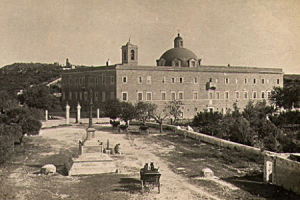
For the last several months, members of an ultra-orthodox Jewish sect known as Berslav Hasidim have been creating difficulties at the Discalced Carmelite monastery of Stella Maris on Mount Carmel. The sect teaches that the grave of Elisha is in the ancient monastery. Others deny that claim and see the disruptions as an attempt by the radical group to take over the site dear to the Carmelites worldwide.
Israeli President Isaac Herzog denounced the increasing violence against Christians in Israel during his visit on August 9 to the Stella Maris Carmelite Monastery in Haifa.
Herzog was accompanied by Israel Police Inspector General Yaakov Shabtai. One of the complaints has been that the police are slow to respond when Christians are the victims. The response is often not adequate. President Herzog emphasized Israel’s commitment to the full protection of freedom of religion and worship. He met with patriarchs and church leaders including Cardinal-designate Pierbattista Pizzaballa, the Latin patriarch of Jerusalem, and Discalced Carmelite Jean Joseph Bergara, the monastery superior of Stella Maris.
The president called for greater understanding of the histories of the religious communities in the Holy Land, noting that it was the birthplace of the three monotheistic religions.
At first a few visitors would enter the church. Then dozens “burst” into the church according to news accounts. They began holding prayers “in a provocative manner,” according to a Palestinian Christian from the city of Haifa.
Palestinian Christians now volunteer to be present at the church 24 hours a day in order to quell any problems. It is reported that a metal fence will be erected to keep out protesters.
Similar protests have taken place by Israeli extremists at St. Elijah Cathedral of the Melkite Greek Catholic church in Haifa. Multiple attacks have also occurred against Christian sites in Jerusalem, the most recent being against the Church of the Tomb of Mary in occupied East Jerusalem. A Christian cemetery near Jaffa Gate outside the Old City of Jerusalem was vandalized in January. A statue of representing Jesus was valdalized at a Catholic church near the Lion’s Gate.
Following the attack on the Church of the Tomb of Mary in March, the Patriarchate of Jerusalem finally appealed for "international protection" of holy sites citing "terrorist attacks, by radical Israeli groups, targeting churches, cemeteries, and Christian properties."
Palestinian Christians account for some 2 per cent of Israel's population. The Israel Central Bureau of Statistics estimated their number on the eve of Christmas 2022 at approximately 182,000.
Another 51,000 live in the occupied West Bank, according to unofficial figures.
Brandsma Present at Esperanto World Congress

According to an article by Beatrice D’Ascenzi, published by Vatican News, over 1,300 Esperantists from 69 nations met in Turin, Italy for the 108th World Esperanto Congress. Over the seven days, scholars and enthusiasts focused their discussions on the theme Immigration and the Confluence of Human Values, the Inclusive Experience of Turin.
Two books were offered to participants during the conference: Pope Francis’ I Am I, Do Not Be Afraid. The second was Carmelite Fernando Millán’s Truth in Love: The Life of St. Titus Brandsma, Carmelite. Fr. Fernando was prior general of the Carmelite Order from 2007-2019 and is considered one of the top experts on the life of St. Titus. He was vice postulator for the cause of St. Titus as well.
The saint from the Netherlands was a major promoter of the Esperanto language. He is now considered the patron saint of the Catholic Esperantists. He participated in several of the international congresses and was a member of the Commission for the Ecclesiastical Dictionary of Esperanto. The language facilitated Brandsma’s desire to build community among all the people.
The language, developed by Polish linguist Ludwik Lejzer Zamenhof in the second half of the 19th century, is estimated to have a worldwide following in at least 120 countries. It is considered the language of peace as it stresses equality and communion among people brought together by the language. Esperanto was created in order to establish a dialogue between various populations, trying to overcome hostilities and conflicts. Esperanto’s creator, felt that many misunderstandings were the result of linguistic difficulties. Zamenhor wished to solve this by creating a universal idiom, belonging to humanity and not to a single people. This would not only impact inter-personal relationships but political and culture connections.
According to the enthusiasts the artificial language of Esperanto is experiencing a rebirth 150 years after its development. Esperanto associations and the number of enthusiasts on the Internet continues to grow. According to experts, the digital age of communications has been a major plus for the growth in the number of people speaking the language. The simplicity of the language allows people to achieve a satisfactory proficiency in less time than any of the ethnic languages.
With this in mind, the recent world congress in Piedmont was the central event of the year for scholars and enthusiasts, who over the seven days of the event were able to reflect together on an extremely timely topic, "Immigration and the confluence of human values, the inclusive experience of Turin." Inclusive like the practice of Esperanto, which has in its DNA the will to establish a dialogue between different populations, trying to overcome hostilities and conflicts - fueled, according to the creator, also by linguistic misunderstandings - through the use of a universal idiom, belonging to humanity and not to a single people.
In fact, since its inception, Esperanto functioned through with wars and conflicts that have severely tested its scholars, who are culturally inclined to dialogue. However, these are often victims of discrimination and persecution in these situations because of their ability to receive information outside the official channels.
According to the experts, the social changes that followed the conflicts of the last century gradually consigned the national idioms of smaller countries with fewer resources into oblivion. This inevitably forced the inhabitants of these states to have to use the languages of the dominant countries, a practice strongly by Esperantists. Esperanto represents a supranational and neutral idiom, allowing all groups to connect and exchange information without discrimination, but rather protecting idioms considered "minor," otherwise doomed to extinction by the languages of stronger nations.
The flag of Esperanto, the verda stelo, sums up the Esperanto philosophy. The verda stelo is formed by a green background with a white box in the upper left corner with a centered, green 5-pointed star, representing the five inhabited continents. The green color also indicates hope for a better future, while white represents neutrality and peace.
Catholic Esperantists have always maintained a deep-rooted connection with Catholicism. In fact, a separate program for the Catholic Esperantists was offered during the Turin congress, led by President Marija Belošević. The connection, that began as early as the early 1900s and was consolidated after World War II, when Pius XII at a general audience in 1950 welcomed the Esperantists who had come to meet him in their own language. In 1966, two years after Paul VI publicly recognized the importance of the Catholic Esperanto movement and the usefulness of the language, Esperanto was officially recognized as a language in which it is possible to celebrate Mass and pray. Since that time, on the occasion of the Urbi et Orbi blessing on Christmas and Easter Sunday, the pope has occasionally offered greetings in Esperanto. Some of Vatican Radio’s programs are broadcast in the language as well.
Celebrating At Home - 20th Sunday in Ordinary Time

A Kingdom for all
(Matthew 15:21-28)
Today’s Gospel marks a turning point in the ministry of Jesus. He sees himself as sent ‘only to the lost sheep of the house of Israel’. That is, to those who were deemed sinners because they could not keep the Law of Moses, and were considered beyond the care and concern of God by religious authorities.
The story centres around a confrontation between Jesus and a pagan (Canaanite) woman.
Firstly, Jesus ignores her altogether. Then, because the woman is making such a racket, the disciples ask him to give her what she wants. Jesus refuses. The woman approaches him directly and asks for help. He refuses again, quoting an ancient popular racial slur against the Canaanites. His words are harsh and demeaning, but the woman persists, defeating Jesus with her quick thinking and twisting his own imagery in her favour.
He recognizes her faith and grants her wish.
St Matthew uses this story about Jesus and the woman to answer the question about who belongs in the Kingdom of God – who are the insiders and who are the outsiders?
In terms of the story, not only Israelites, but all who come with faith, are part of the Kingdom. The first reading from the Prophet Isaiah makes the same point: God’s house is a house for all the peoples.
Matthew’s early Christian community is struggling with accepting some non-Jews wanting to join them.
Just as Jesus (the ultimate insider) moves past his own prejudices, so the members of the Kingdom and the Church must move past theirs’ so that God’s house of prayer will be a place of justice and integrity for all the peoples; a house from which God’s salvation and healing flows.
- pdf Celebrating At Home - 20th Sunday in Ordinary Time [PDF] (2.92 MB)
- default Celebrating At Home - 20th Sunday in Ordinary Time [ePub] (2.17 MB)
- pdf Celebrando en Familia - 20 Domingo del Tiempo Ordinario (437 KB)
- pdf Celebrando in Casa - 20 Domenica del Tempo Ordinario (438 KB)
- pdf Celebrando em familia - 20 Domingo do Tempo Comum (438 KB)
Pope Receives Letter From Fray Pablo
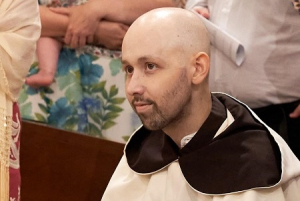
Pope Francis received a letter from 21-year-old Carmelite Pablo de la Cruz Alonso Hidalgo, who died on July 15 from cancer just two weeks after his profession “in articulo mortis.” Pablo wrote to the pope, expressing the hope of joining the pontiff and all the young people at the World Youth Day in Portugal. Knowing he would not be able to be physically present, Pablo asks to “to give you a hand from Heaven….”
Eva Fernández, the Vatican correspondent for COPE, the radio station of the Spanish Bishops’ Conference, delivered the letter to the pope, along with a holy card designed by the Carmelite for his wake. During the flight to Lisbon from Rome, the pope acknowledged being aware of Pablo’s story.
CITOC received a copy of the letter in Spanish and translations in English and Italian which we provide below.
Heaven exists!
Br Pablo Maria de la Cruz’s letter to Pope Francis
Salamanca, July 12, 2023
Dear Pope Francis,
I am Fray Pablo Maria of the Cross Alonso Hidalgo, a Carmelite Friar. I am 21 years old. On June 25, 2023 I received the grace of being admitted for religious profession “in articulo mortis,” taking the vows of poverty, obedience, and chastity within the Carmelite Order, in the priory of San Andrés in Salamanca, a place where St John of the Cross once lived. At this point I can only thank God for this undeserved and great gift rendered to me by the Church our mother, through the Carmelite Order. Its life programme could not be more fascinating: “to live in allegiance to Jesus Christ.”
For the past six years, I have been struggling with Ewing Sarcoma. I know that everything makes sense within God’s plan. Through ups and downs, better days and worse, through much purification by means of this sickness, today I can contemplate my life and confess that I have been and am happy. I have discovered that the center of my life is not my illness but Christ. As I said to my friends, my family, and my Carmelite brothers: “Through suffering by means of this sickness I have encountered God, and by means of death through this illness, I will go to Him. And for this I thank him.”
Currently I am in the Palliative Care Unit at the University Clinical Hospital of Salamanca, and I feel that the Father, in his infinite mercy, will very soon call me to be with him. At this final stage of my life the doctors have given me a piece of great news: that I can return to the priory, and there surrender my life to Jesus, dying in “El Carmen de Abajo,1 where I have received so many graces at the feet of the Virgin of Carmel. The mystery of the Cross has reigned over my life, but I can shout out loud along with St Titus Brandsma, to whom I entrusted myself a few months ago: “The Cross is my joy, not my sorrow.” Nevertheless, throughout my sickness, I have not been alone. Jesus in the Eucharist has accompanied me day by day, and He has been the best palliative and the best medicine for my pain. I have already arranged for it to be announced at my funeral, that: “Whoever wants to speak to me, it is very easy to do so; let him approach the Eucharist, and there he will always find me available. If you and I, brother, feel the same fire of love for Jesus in the Eucharist, then we are ONE!”
I would have loved to join you at the World Youth Day in Lisbon, together with so many youths who travel there from all over the world. I know from experience that no one can extinguish the interior fire that a young person who is in love with Jesus, can have. I pray the Lord that this fire of love of God will burn in Lisbon. How I would like for young people to get to know Jesus, my Beloved! How much he has given me! How much he has consoled me! How happy he has made me! Physically I am without any strength, but the communion of saints will allow me to join you in another, more profound and by no less distant way. Indeed, I don’t know if, when you receive this letter, I would be able to accompany you with my prayers, or if God in his infinite mercy, would have already called me to himself. In that case, I hope you will allow me to give you a hand–that would be much better!–from Heaven, making a feast with much noise, as you yourself would put it.
I have asked the Lord insistently, that I may be small and poor, and as such, I would be close to the smallest and especially to the sickest persons and their families. The Cross has given me a special faculty of sensing what they go through, and the courage to approach them and touch their wounds. I wish that my offering will also touch the sick persons’ families. For this reason, I unite the weakness of my fragile life–a life however, which I know is precious in the eyes of Jesus–and my intentions to yours, on the strength of the World Youth Day. In the first place, I ask the Lord for the conversion of young people, that they may encounter the love of God through Jesus in the Eucharist. In second place I offer my life for the Church, our mother, and I ask for the help of the Virgin Mary so that all the movements, itineries, ecclesial groups, religious congregations and orders may be one, in a way that no division will scar the face of the Church, and that the beauty of the Body of Christ will shine in our world and within the Church itself. In the third place, I unite myself to the passion of the Lord so that the offering of my poor life, if it is the Lord’s will, will help us do away with the fear of death. Heaven exists!
In Carmel, the Garden of God, antechamber of Heaven, grows Mary, God’s sunflower, whom I love to call and imagine as the Virgin of Spring. I ask her to transform the deserts of suffering into gardens of consolation. And in her hands, I entrust the evangelization of young people.
In my prayer, I entrust to the Lord the Order of Carmel, the Diocese of Salamanca, and the entire Church.
May Jesus and Mary accompany you in your old age and in your proclamation of the Gospel.
I pray for you. Pray for me
.
Fray Pablo Maria of the Cross,
Carmelite
- As the Carmelite priory of San Andrés is known locally (note of the translator).


