













O.Carm
St. Angelus, Priest and Martyr

May 5 - Memorial
Angelus is thought to have been one of the first Carmelites to return to Sicily from Mount Carmel and, according to a long-standing tradition, he was murdered in Licata during the first half of the 13th century.
The cult of Saint Angelus spread throughout the Order and among ordinary lay people. Angelus and St Albert of Trapani are considered the "fathers" of the Order because they were the first two saints to have devotion in the Order.
Read more ...
Celebrating At Home - Fifth Sunday of Easter

Jesus, our Way, Truth and Life
(Jn 14:1-12)
In the opening words of the Gospel Jesus calls the disciples to trust him and to trust God. He does so in the context of announcing his departure to them.
Understandably, the disciples are afraid and uncertain which the questions of Thomas and Philip show.
Jesus calls them to trust him as the way to the God, the living truth about the God and the very life of God.
In a sense, Jesus is our map, our road and the destination of our journey. But arriving at the destination is not something which only happens in heaven. We are meant to start arriving now through the gift of the Spirit.
It is the spirit of Jesus who holds us in communion with God, who reveals to us the truth about God and who is the very life of God within each of us. Jesus is the reign of God in person and that is what we are called to be, too.
We want to live true to the vocation God has given us, aware of the Spirit which has been placed into our hearts, allowing that Spirit to change us into true believers so that the face of God might be seen within our own.
- pdf Celebrating At Home - Fifth Sunday of Easter [PDF] (5.93 MB)
- default Celebrating At Home - Fifth Sunday of Easter [ePub] (4.69 MB)
- pdf Celebrando en Familia - Quinto Domingo de Pascua (431 KB)
- pdf Celebrando in Casa - Quinta Domenica di Pasqua (423 KB)
- pdf Celebrando em familia - Quinto Domingo da Páscoa (415 KB)
Bl. Angel Prat Hostench & Companions

May 4 - Optional Memorial (Obligatory Memorial in Provinces of Spain)
In 1936 seventeen Spanish members of various Carmelite communities gave their lives in defence of and in witness to their Christian faith and consecration to Jesus Christ.
On 28 July at the railway station in Tarrega, twelve religious belonging to the Tarrega community were arrested. They were moved to Clots dels Aubens di Cervera and were shot at dawn on 29 July while they called on Jesus’ name and that of the Mother of Carmel.
Read more ...
Portugal's General Commissariat Chapter Held

The Chapter of the General Commissariat of Portugal was held from April 26-28, 2023 in Hotel Casa São Nuno in Fatima. Both the Prior General Míċeál O'Neill and the General Councilor for Europe, Richard Byrne, participated.
In 1251 Carmelites, coming from Mount Carmel, made a foundation in the town of Moura. In 1397 St. Nuno Álves Pereira, a hero as commander of the Portuguese in their war for independence from Castille in 1383-1385, entrusted the magnificent monastery and church in Lisbon which he had built in honor of the Blessed Virgin, to the Carmelites. He himself then entered the Order.
In 1423 the Province of Lusitania was established in the Order. During the 15th century, the province was completely reorganized with the foundation of several houses, among them the house of studies in Coimbra (1536). In 1580, the first Carmelites established Carmel in Brazil.
The province continued to grow in the 17th and 18th centuries, until the earthquake of 1755, which was devastating. The province was suppressed in 1834 along with other religious orders in Portugal. The work to reestablish Carmel in Lusitania was initiated in 1930 by the Province of Baetica. Beginning in 1949, the daughter province of Rio de Janeiro joined in the efforts, replacing the Baetica Province in 1954. A provincial commissariat was created shortly thereafter. On December 8, 1992, the General Commissariat of the Lusitania was created.
The following members were elected to leadership:
. . .
Provincial | Provincial | Provinciale
Fr. Agostinho Marques Castro, O. Carm.
1st Councilor | 1er Consejero | 1o Consigliere
Fr. Ricardo dos Reis Rainho, O. Carm.
2nd Councilor | 2do Consejero | 2o Consigliere
Fr. Pedro Bravo Pereira da Silva, O. Carm.
3rd Councilor | 3er Consejero | 3o Consigliere
Fr. Manuel Ribeiro de Freitas, O. Carm.
4th Councilor | 4to Consejero | 4o Consigliere
Fr. João Manuel Oliveira Costa, O. Carm.
Lectio Divina May 2023

Lord our God, Father of all,
you sent your Son Jesus Christ among us to reveal to us that you care about people
and that your love extends to all,
without any distinction of race or culture. Give us a great respect for all people, whatever way they come,
and let your Church embrace all cultures, that Jesus may truly be
the Lord and Shepherd of all, now and forever.
Carmelite Nuns' Federation Elects New Leadership

The Electoral Assembly of the Federation of St. Mary Magdalene de'Pazzi, a federation of the Carmelite monasteries of nuns in Italy, was held April 17-20.
The Federation was created, after years of cooperaton between the monasteries, on July 16, 2010.
The results of the elective chapter were as follows:
. . .
Federation President | Presidente de la Federación | Presidente della Federazione:
Sr Maria Valentina Rossin, O. Carm. (Carpineto)
1st Councilor | 1ª Consejera | 1ª Consigliera:
Sr Maria Martina Simeone, O. Carm. (Sutri)
2nd Councilor | 2ª Consejera | 2ª Consigliera:
Sr Maria Rosalia Mangiarotti, O. Carm. (Vetralla)
3rd Councilor | 3ª Consejera | 3ª Consigliera:
Sr Marilla Pia Fiumana, O. Carm. (Sogliano)
4th Councilor | 4ª Consejera | 4ª Consigliera:
Sr Maria Archangela Parisi, O. Carm. (Fisciano)
Presentation of book on the Carmel of Andalusia

On April 20, the latest volume of the prestigious TPM (Texts for a Millennium) collection, entitled "Flowers of the Carmel of Andalusia", was presented at the Carmelite Monastery of Seville. It is the work of Fernando de la Corte (1685-1759), a Carmelite from Granada, in which he recounts the founding of some of the most important monasteries of the contemplative Carmel in Andalusia: Seville (Santa Ana), Seville (Belen), Villalba del Alcor, Cañete la Real and Utrera. De la Corte also presents the lives of a series of venerable figures of the Andalusian female Carmel. It is, in short, a very valuable work to know the evolution of the Carmel in this part of Spain in the post-Tridentine period. The book also includes an extensive introductory study by historian Pedro Godoy Domínguez, in which he frames the founding of these convents in their historical context.
The book was presented by Doña Rosario Vera, Prioress of the Third Order of Carmel of Seville, and Father Fernando Millán Romeral, O.Carm. and the editor of the book, Pedro Godoy Domínguez, intervened. Both highlighted the contribution of this work to the Carmelite historiography and the need to make known these texts that form the living history of the Carmel of a certain historical period.
Chapter of the Province of Great Britain Held

The Provincial Chapter of the Province of Great Britain was held April 17-21, 2023, in Aylesford, Kent (England).
Carmelites arrived in England about the year 1241 and quickly established a province. Records indicate a certain “W. provincial in England," in the years 1256-1257. At the time when the province was most flourishing, there were about a thousand brothers and about 37 houses. The first division of the province into two, namely, England and Ireland-Scotland, was recorded already in 1291 or 1294; which division, apparently, lasted until the year 1300. The autonomous province of Ireland was established in 1305. The establishment of the province of Scotland, established in 1321, was finally carried out in 1324.
In the course of time the Province of England was greatly reduced and it finally ceased with the suppression of Henry VIII (c. 1538). Some failed attempts were made to restore houses until c. 1926, when the brothers of the Province of Ireland opened the houses of Faversham and Sittingbourne in southeastern England.
Other houses were later added. Among these was ancient monastery in Aylesford which had been founded by 1242 but lost in Henry VIII suppression. On January 1, 1952, the general commissariat was established; and on September 12, 1969, the province of England and Wales was established under the title of the Assumption of the Blessed Virgin Mary. The name of the province was changed to 'Great Britain' in May 1999.
The following members were elected to leadership:
. . .
Provincial | Provincial | Provinciale
Fr. Brendan Grady, O. Carm.
1st Councilor | 1er Consejero | 1o Consigliere
Fr. Kevin Melody, O. Carm.
2nd Councilor | 2do Consejero | 2o Consigliere
Fr. Gerard Walsh, O. Carm.
3rd Councilor | 3er Consejero | 3o Consigliere
Fr. Michael Cox, O. Carm.
4th Councilor | 4to Consejero | 4o Consigliere
Br. Paul de Groot, O. Carm.
Pope Francis on Cloistered religious
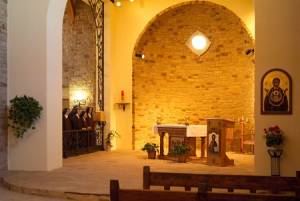
At his weekly General Audience on April 26, 2023, Pope Francis spoke of monks and nuns in the context of his catechesis on apostolic zeal. He referred to the monks and nuns as the “beating heart” of the Church’s mission.
As part of his reflection, the pope spoke of the medieval Armenian monk, Gregory of Narek, as the example par excellence of the universal, all-embracing love which Christian are called to.
Asking what contribution men and women living in an enclosed monastery make towards the announcing of the Gospel, the pope rhetorically proposed a more effective way to contribute. His tongue in cheek proposal is one often heard in society and in the Church. “Wouldn’t it be better, if they dedicated their energies to mission?” he suggested.
He then went on to explain what he sees as their already most valuable contribution.
“Monks and nuns,” he said, “are the “beating heart of the Church’s proclamation— their prayer is oxygen for all the members of the Body of Christ, the invisible force that sustains the mission.”
He then pointed out that the patron saint of mission is the Discalced Carmelite nun, Thérèse of Lisieux. In 2023 the Church is celebrating the 150th anniversary of St. Thérèse’s birth and the 100th anniversary of her beatification.
Using St. Gregory as a specific example, Pope Francis spoke of his “universal solidarity” – his identification with all people and his decision to dedicate his life to praying for them. The pope then said that this universal solidarity is a feature of the lives of all monks and nuns. The monks and nuns, in imitation of Christ, "take on the world's problems, the difficulties, the illnesses, many things, and pray for others." Cloistered religious, he said, are always busy - with work, and with prayer.
Pope Francis concluded by encouraging people to visit monasteries whenever possible. "It'll do you good!"
The enclosed Carmelite nuns have a long history, being officially recognized by the Church with the papal bull Cum nulla issue by Pope Nicolaus V in 1452. According to the 2019 Status Ordinis, there are 757 nuns in the Order, living in 83 monasteries.
Celebrating At Home - Fourth Sunday of Easter

The Good Shepherd calls his own by name,
and they recognise his voice
(John 10:1-10)
The Fourth Sunday of Easter is often called “Good Shepherd Sunday” because no matter what reading cycle we are in, the Gospel always focusses on the image of Jesus as the Good Shepherd.
This year, the Gospel reading talks about Jesus as the ‘gate of the sheepfold’, that is, Jesus is the one through whom we truly enter into the fold of God. The reading implies that those who get into the sheepfold some other way bring only disaster and destruction. Those who enter the fold through Christ, the Good Shepherd, will be safe, will be led to good pasture and have life in all its fullness.
Jesus acts towards us like a good shepherd: feeding, nurturing, defending and even laying down his life for us. Our Good Shepherd is deeply concerned about us, the flock and there is a deep sense of warmth and intimacy in the realisation that Jesus knows each one of us by name. Like a good shepherd Jesus is the source of life, nourishment, and safety for the sheep.
Any reflection about Jesus as the Good Shepherd also serves as a reminder that shepherding each other in Jesus’ name is part of the vocation of every disciple.
We are very used to thinking about Jesus as the Good Shepherd, but we also need to think about being/ becoming good shepherds to each other.
One of the very encouraging things about the pandemic was the number of people who became good shepherds to others, providing safety and security to vulnerable people, supporting health workers, providing meals and companionship. Yes, there were the ‘thieves and brigands’ too who preyed on others by hiking prices, selling goods which were never delivered and various other online scams.
But, like Jesus, we are called to bring life in all its fullness to one another.
- pdf Celebrating At Home - Fourth Sunday of Easter [PDF] (5.38 MB)
- default Celebrating At Home - Fourth Sunday of Easter [ePub] (2.63 MB)
- pdf Celebrando en Familia - Cuarto Domingo de Pascua (327 KB)
- pdf Celebrando in Casa - Quarta Domenica di Pasqua (344 KB)
- pdf Celebrando em familia - Quarto Domingo da Páscoa (324 KB)


