













O.Carm
General Congregation Held September 5-16

The General Congregation of the Order will take place from Monday, September 5th until Friday, September 16. This year the meeting will be held at Villa Aurelia, near the Vatican in Rome. The theme of the gathering is Gift and Mission: The Radical Witness of Consecrated Carmelites in the World of Today. “By This Everyone will Know that Your are My Disciples” (Jn 13: 35).
a) assisting the prior general and his council in their task of governing and animating the Order;b) fostering communication and contact between the General Curia and the various areas of the Order;c) ensuring the implementation of the decisions and decrees of the previous General Chapter; to assess the effectiveness of the directions proposed; to make decisions and issue decrees, which shall be valid only until the following Chapter;d) assisting in the preparation of the next General Chapter, and to advise the prior general concerning the venue of the Chapter;e) to discuss the financial matters of the Order.
Memorial of St. Teresa Margaret Redi (OCD), Virgin
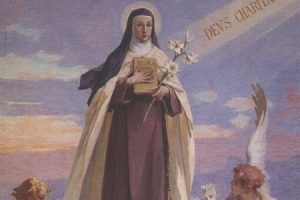
1 September Optional Memorial
Saint Teresa Margaret Redi was born in Arezzo on 1st September 1747 into the noble family of Redi. In 1764, she entered the monastery of the Discalced Carmelites in Florence, changing her baptismal name of Anna Maria to that of Teresa Margaret of the Sacred Heart of Jesus.
Celebrating At Home - 23rd Sunday in Ordinary Time

Real reality
(Luke 14:25-33)
There is very little that is real in so-called ‘reality TV’.
We know that, in fact, situations and circumstances are highly contrived and rather artificial. People are deliberately set up to fail, tensions are fuelled and contestants often exploited emotionally and physically.
Today’s Gospel contains a rather heavy dose of real reality about what is required in order to be a disciple of Jesus.
The words of Jesus have to be read against the background of the Kingdom life God is inviting us into and the central message of Jesus that we need to place God in the centre of our hearts.
The language about hating family members and even our own lives comes from a Semitic idiom which expresses preference. If you prefer one person or thing over another you are said to ‘love’ the first and ‘hate’ the second. The Gospel is not calling us to hate either our relatives or ourselves.
When we let the presence of God flood our hearts and minds all other aspects of our lives, including our relationships, find their proper place. Relationships become more genuine and less exploitive; possessions have less hold over us and we begin to share them more generously, our need for power and status fades.
To do this, however, is no easy thing. It requires many daily decisions, choosing to see with God’s eyes, to feel with God’s heart and to act according to God’s vision for human life: to choose love over hate, generosity over hoarding, to let go of power and status and be of real service to our sisters and brothers. That is what ‘carrying the cross’ is all about.
Jesus warns that this is a difficult and demanding way, and that a disciple needs to be clear-eyed and ready to take up the task.
- pdf Celebrating At Home - 23rd Sunday in Ordinary Time [PDF] (5.82 MB)
-
default
Celebrating At Home - 23rd Sunday in Ordinary Time [ePub]
(4.90 MB)
- pdf Celebrando en Familia - 23 Domingo del Tiempo Ordinario (539 KB)
- pdf Celebrando in Casa - XXIII Domenica del Tempo Ordinario (538 KB)
- pdf Celebrando em Família - 23 Domingo do Tempo Comum (540 KB)
Corpus Christi Carmelites Elects New Leadership
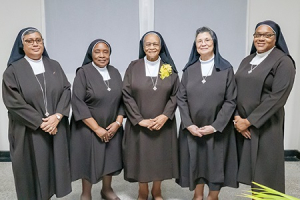
The XVII General Chapter of the Congregation of the Corpus Christi Carmelites was held August 15-26, 2022, at the Generalate/Novitiate in Tunapuna, Trinidad.
Pictured above (left to right) are Sr. Marcella Ali, Sr. Geraldine George, Sr. Katrina Charles, Sr. Clare Marie Nero, Sr. Joanne Browne.
The following sisters were elected to the new Leadership Team:
General Superior | Superiora General | Superiora Generale:
Sr. Katrina Charles, O. Carm.
1st Councilor | 1ª Consejera | 1ª Consigliera
Sr. Joanne Brownie, O. Carm.
2nd Councilor | 2ª Consejera | 2ª Consigliera:
Sr. Clare Marie Nero, O. Carm.
3rd Councilor | 3ª Consejera | 3ª Consigliera:
Sr. Geraldine George, O. Carm.
4th Councilor | 4ª Consejera | 4ª Consigliera:
Sr. Marcella Ali, O. Carm.
Leadership of Institutum Carmelitanum Appointed

The prior general and his council made the appointments for the leadership of the Institutum Carmelitanum until the next General Chapter. Renewed for a new term as president of the Institute is Giovanni Grosso of the Italian Province. He will be assisted by Kuba Walczak (Poland) as secretary and Mario Alfarano (Neapolitan) as librarian of both the Carmelite library and the CISA house library.
Also appointed were the members of the scientific board of the Institutum. Members until 2025 are Simon Nolan (Ireland), Rico Ponce (Philippines), Edimar Fernando Moreira (Paraná), Edison Tinambunan (Indonesia) and Dr. Elizabeth Hense of Radboud University. Dr. Hense is an editor of the multi-volume series of the collected words of Titus Brandsma in English.
The Institutum Carmelitanum is the scientific research and educational arm of the General Curia of the Carmelite Order. It was instituted in November 1951 by then prior general Kilian Lynch. The Institutum focused on Carmelite themes in the fields of Mariology, the spiritual life, history and bibliography. In 1954 the Institutum's official journal, Carmelus, was initiated. Other activities of the Institutum include collaboration with articles for dictionaries and encyclopedias, as well as scientific magazines, contact with other research institutes, and the organization of congresses and conventions. Within the Carmelite Family, the Institute is a resource for commissions, formation courses, and conventions.
Memorial of Bl. Jacques Retouret, Priest and Martyr
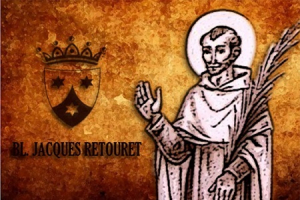
August 26
Like the majority of his fellow clergy, Jacques refused to accept the civil law, unilaterally introduced by the state, which decreed, among other things, the election of bishops and parish priests by the people, only afterwards to be approved by the hierarchy and the pope. In addition to this refusal, Jacques was accused of siding with a group of political emigres who had invaded the country against the revolutionaries. He was arrested and condemned, together with many other priests and religious, and sentenced to exile in French Guinea in South America. Taken to Rochefort, he was held there in a prison ship.
Read more
Lectio Divina September 2022

- Lectio Divina September 2022 [PDF] Download pdf here (905 KB)
- Lectio Divina September 2022 [ePub] Download default here (218 KB)
- Lectio Divina September 2022 [Mobi] Download default here (769 KB)
General Council Appoints New Leadership in Kenya

Following consultations, the General Council appointed three members of the General Delegation in Kenya to leadership positions. They are:
Delegate General: Patrick Musyimi Kitaka
Delegation Councilors: Eugine Ekeya
Peter Wafula
Fr. Patrick has been serving as the joint novitiate director in Zimbabwe. In his new role he will be supporting the formation program for Kenya, Tanzania, Mozambique, and Zimbabwe, according to the prior general, Míceál O’Neill. Fr. Eugine is the assistant pastor of the Carmelite parish in Nkoroi. Fr. Peter has been involved with the formation program.
The Delegation of Kenya was established on July 16, 2010. It was originally formed as a mission under the former Upper German Province with responsibility for its administration and staffing given to the Indian Provincial Commissariat. Formation of the first candidates was entrusted to the Provinces of Catalonia and Argo-Valentine in Spain. In June of 2005, the first house, Bustani ya Karmeli in Ngong was opened. Some nine men are now professed members of the Delegation.
St. Mary of Jesus Crucified, OCD, Virgin

Optional Memorial - August 25
Mariam Baouardy was born at Abellin in Galilee on January 5, 1846 to very poor parents who were good living and devoted Greek-rite Catholics. She was left an orphan after the death of her parents at only three years of age. On June 14, 1867, she entered the Carmel in Pau.
On August 21, 1870, while still a novice, she left for India to join a new Carmel to be founded at Mangalore. On 21st November 1871, she made her religious profession there. One year later, she was recalled to Pau, from where she left as part of a new foundation, the first Carmel in Palestine.
She died on 26th August 1878 at Bethlehem from a cancer which she had contracted after a fracture caused by a fall.
Celebrating At Home - 22nd Sunday in Ordinary Time

Invitation to dinner
(Luke 14:1, 7-14)
It’s no accident that the Gospels contain many instances of shared meals, weddings feasts and miraculous feeding. In the Scriptures, meals always have something to do with the great meal – the eternal wedding feast.
We celebrate the sacred meal of the Eucharist anticipating the eternal feast of continual communion with God.
In this Gospel episode, Jesus has been invited to a meal at the home of a leading Pharisee. Luke tells us that they watched Jesus closely. No doubt, they are trying to make up their minds about him and his teaching.
Jesus, too, is watching closely and observes how those at the meal readily chose the places of honour for themselves. The fact that Luke calls the words of Jesus a ‘parable’ alerts us to the fact that this is more than just good advice about how to avoid embarrassment at a dinner party in the ancient world.
It turns out that the parable is about the feast in the Kingdom of God. In the Kingdom the usual conventions of this world are completely reversed, such that those who exalt themselves will be humbled and those who humble themselves will be exalted; the last will be first, and the first last.
It is not wealth, power and social status that gains us a high place at the eternal feast, but the good treatment (humble service) of the most disadvantaged. Being hospitable to the poor and disadvantaged now gains a person the only welcome that truly matters: the welcome into the everlasting hospitality of God.
The true disciple acts towards others with the same largeness of heart as God. Humility enables us to be open to God’s heart, and gentleness is the way of imitating his love.
- pdf Celebrating At Home - 22nd Sunday in Ordinary Time [PDF] (3.14 MB)
- default Celebrating At Home - 22nd Sunday in Ordinary Time [ePub] (4.39 MB)
- pdf Celebrando en Familia - 22 Domingo del Tiempo Ordinario (574 KB)
- pdf Celebrando in Casa - XXII Domenica del Tempo Ordinario (574 KB)
- pdf Celebrando em Família - 22 Domingo do Tempo Comum (576 KB)


