











O.Carm
Feast of St. Thérèse of the Child Jesus and the Holy Face

St. Thérèse of the Child Jesus and the Holy Face, Virgin and Doctor of the Church
October 1 | Feast
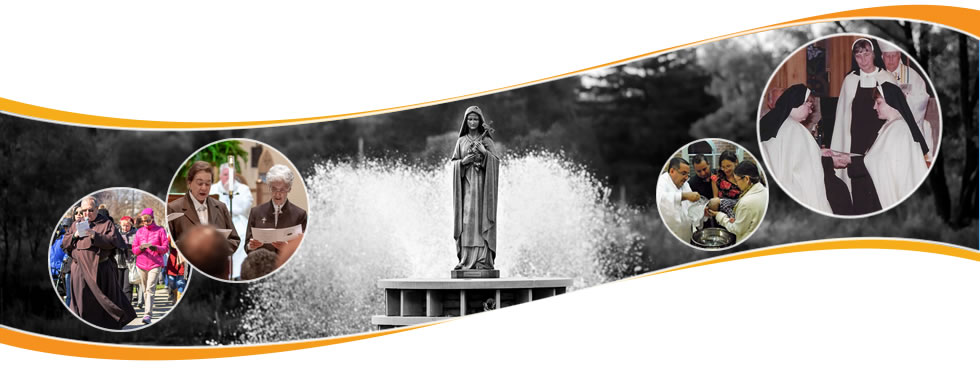
Saint Thérèse was born at Alençon in France on 2nd January 1873. Her parents were Louis Martin and Zélie Guérin. Following her death on September 30, 1897, of tuberculosis at the age of 24, she became known around the world as St. Thérèse of the Child Jesus and the Holy Face through the publication of her autobiography now known as Story of a Soul.
In 2025, the Church celebrates the 100th anniversary of St. Thérèse's canonization. During his homily at the canonization, the Pope Pius, “If everyone follows this path of spiritual childhood, everyone will see how easily reformation of human society can be achieved, which we have proposed since the beginning of our pontificate. On the wall of the niche in the crypt of St. Peter’s Basilica where Pius XI is buried, there is a mosaic of the saint.
Thérèse’s simple yet powerful spirituality has captured the imagination of Catholics and non-Catholics alike for the last century. Her sense of commitment led her to a profound experience of the love of God and of neighbor. She never had an easy life, but she did live with a great sense of peace and joy.
Read more about the life of St Therese
St. Thérèse, Her Family and Her Spirituality
Proclamation of St. Therese of Lisieux as Doctor of the Church
Edizioni Carmelitane published a book to celebrate the 150th anniversary of her birth in 1873 and the 100th anniversary of her beatification as well as the 100th anniversary of her canonization in 2025. More information is available here:
Singing the Mercies of the Lord Writings on Saint Thérèse of Lisieux
Also available as an ebook
Carmelite Nuns on Isla de Margarita Hold Elections

Carmelite Monastery of the Annunciation on the Isla de Margarita-Venezuela Celebrates Elective Chapter
The Carmelite nuns of the monastery of the Annunciation in Porlamar on the Isla de Margarita-Venezuela held their triennial chapter on September 25, 2025.
The monastery was founded on January 7, 1983, by six nuns, four of whom came from the monastery in Barcelona, one from the monastery in Tarrega, and one from the monastery in Vilafranca del Penedés. The canonical erection was entrusted to the Bishop of Margarita.
The monastery is part of the Nuestra Señora del Carmen Federation.
Those elected to leadership are:
Prioress | Priora | Priora:
Suor Rosa Coromoto Pérez
1st Councilor | 1ª Consejera | 1ª Consigliera:
Suor Mariela del Carmen León
2nd Councilor | 2ª Consejera | 2ª Consigliera:
Suor Norma del Carmen Sánchez
Treasurer | Ecónoma | Economa
Suor Mariela del Carmen León
Formator | Formadora | Formatrice
Suor Ludys de Cristo Rey
Sacristan | Sacristana | Sacrestana:
Suor Norma del Carmen Sánchez
Carmelite Nuns Held Elective Chapter in Cabanatuan

Carmelite Monastery Our Lady of Nazareth in Cabanatuan Celebrates Elective Chapter
The Carmelite nuns of the Our Lady of Nazareth Monastery in Cabanatuan, Philippines, recently held their triennial chapter.
The monastery was founded on April 8, 1983, by seven nuns from the monastery of the Holy Family in Guiguinto, Philippines. It is part of the Stella Maris Federation.
Those elected to leadership are:
Prioress | Priora | Priora:
Sr. Ma. Dorotea Santiago
1st Councilor | 1ª Consejera | 1ª Consigliera:
Sr. Ma. Dolores Asuncion
2nd Councilor | 2ª Consejera | 2ª Consigliera:
Sr. Ma. Teresa Canillo
3rd Councilor | 3ª Consejera | 3ª Consigliera:
Sr. Ma. Regina Gutierrez
4th Councilor | 4ª Consejera | 4ª Consigliera:
Sr. Ma. Raquel Ylagan
Treasurer | Ecónoma | Economa
Sr. Ma. Dolores Asuncion
Formator | Formadora | Formatrice
Sr. Ma. Teresa Canillo
Sacristan | Sacristana | Sacrestana:
Sr. Ma. Raquel Ylagan
A Carmelite Named Prefect of Bishops' Dicastery
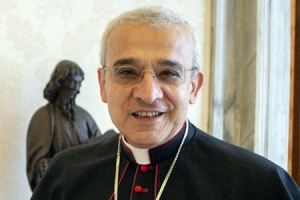
Carmelite Archbishop Filippo Iannone Appointed Prefect of the Dicastery for Bishops by Pope Leo XIV
On Friday, September 26, Pope Leo XIV appointed Archbishop Filippo Iannone as Prefect of the Dicastery for Bishops. He was previously Prefect of the Dicastery for Legistlative Texts. His new role includes the presidency of the Pontifical Commission for Latin America (CAL). He begins his new position on October 15, 2025.
The news of Mons. Iannone's appointment arrived at the General Chapter at the conclusion of the Closing Mass in the Cathedral of Our Lady of Mount Carmel. The prior general, Desiderio García Martínez, made the announcement to the congregation following the signing of the Acts of the Chapter. Later, Fr. Desiderio said, "We were very happy when we received the news that Mons. Filippo Iannone has been appointed by the pope as Prefect of the Dicastery for Bishops and President of the Pontifical Commission for Latin America. We send him our warmest congratulations on behalf of the Carmelite Order. Pope Leo XIV, due to Archbishop Iannone's dedication to the Church, has deemed him worthy of this great responsibility. May the Holy Spirit enlighten him in his new work in the service of the Church."
Archbishop Iannone is a native of Naples, Italy and member of the General Commissariat of La Bruna. He is a jurist and canon lawyer with extensive experience in courts, pontifical universities, and the archdiocese of Naples where he was an auxilary bishop. He has help various positions in Rome, including as member of the Supreme Tribunal of the Apostolic Signatura; a consultant to the then Congregation for Institutes of Consecrated Life; a member of the Council for Legal Affairs of the Italian Bishops' Conference; president of the Committee for Places of Worshop, and a member of the Episcopal Conference of the Italian province of Lazio.
In 2012, he was appointed viceregent of the Diocese of Rome by Benedict XVI. In 2017, he was appointed adjunct secretary of the Pontifical Council for Legislative Texts. He became president of that Council in April of the following year.
It is the first appointment of a head of a Vatican department by Pope Leo and is the position held by then Cardinal Robert Prevost before his election as pope following the death of Pope Francis.
Lectio Divina October, 2025

Opening Prayer
Father,
you show your almighty power in your mercy and forgiveness.
Continue to fill us with your gifts of love.
Help us to hurry towards the eternal life your promise and come to share in the joys of your kingdom.
We ask this through our Lord Jesus Christ, your Son, who lives and reigns with you and the Holy Spirit, one God, for ever and ever. Amen.
Final Message of the Chapter to the Carmelite Family
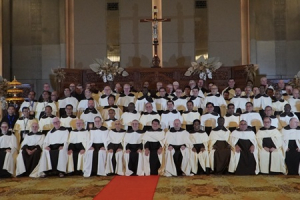
From the General Chapter | September 9-26, 2025
The Members Send a Message to the Carmelite Family at the Conclusion of the 2025 General Chapter
The Members of the General Chapter celebrated Morning Prayer together and then moved to the Chapter Hall for a final session. First order of business was the reading of the proposed Message of the Chapter to the Carmelite Family. Following its reading in the three languages of the Order, the members made some suggestions and then the message was unanimously approved.
Following a talk by the new prior general, Desiderio García Martínez, the Chapter was adjourned.
Later today the members will travel to the Cathedral of Malang for Mass with Bishop Henricus Pidyardo Gunawan, O. Carm. There they will sign the Acts of the Chapter.
pdf To Read the Final Message of the Chapter to the Carmelite Family(127 KB)
Inter-religious Dialogue with the Muslim Faith
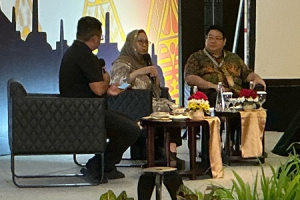
Sunday morning the Chapter members met in the Chapter Hall to hear a discussion on Inter-Religious Dialogue with Alyssa Wahid and FX Hariawan Adji, the recently elected Vice General of the Order. Hariawan holds a doctorate in Inter-Religious Studies (2017) and has much experience and interest in this topic. Alyssa Wahid is the founder of the Gusdurian Network Indonesia, a nationwide network that promotes democracy, human rights, interfaith dialogue, and advocates for minority rights. It was established to emulate the work of her father, President Abdurrahman Wahid, the fourth president of Indonesia.
Much of the discussion encouraged people to get out of their own comfort zone and get to know people of other cultures and faiths. If you stay just within what your are familiar with and comfortable with, then there is little possibility of finding points of common ground with others.
Huub Welzen, prior provincial of the Dutch province, wrote a short summary back to his members which is quoted here: The moderator asked both participants how more tolerance between religions could be achieved. I found Alyssa Wahid's answer interesting. She talked about the purpose of the Muslim faith. Islam is not there for the benefit of Islam. Islam is there for the benefit of the entire universe … Fundamentalism and extremism naturally lead to intolerance. Within one's own faith, those who do not share the same views are considered lesser Christians or lesser Muslims. Intolerance towards other faiths is even greater. They must be destroyed. Religious leaders have a major task here to show that this kind of extremism is not part of the inclusive nature of most religions.
Remaining Schedule of the General Chapter
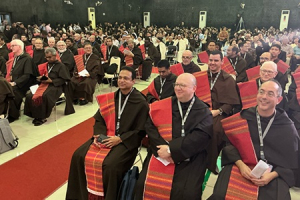
The business portion of the General Chapter finished on Wednesday, September 24. The members were given a free day on Thursday, September 25. But the Chapter will officially conclude on Friday, September 26, with a closing Mass at the Cathedral of Our Lady of Mount Carmel in the Diocese of Malang. The Chapter Acts will be signed at that time as well.
As announced previously, the Closing Mass will be live streamed beginning at 4:30PM (GMT 7+) by the Indonesian Communications Office. In order to watch, go to https://www.youtube.com/live/hyoJCFPeaZI?si=D0aDgd8Ppup_55UH
Oss, Netherlands Unveils Monument to St. Titus

Oss, Netherlands Dedicated Monument to Long Time Resident St. Titus Brandsma
The city of Oss is closely linked to the figure of Tito Brandsma. He lived there after his return from Rome in 1909 until 1923, when he moved to Nijmegen to teach at the newly established Catholic University Nijmegen (now Radbound University).
It was in Oss that he edited the local newspaper (De Stad Oss) for several years, founded a school, and worked generously in the pastoral field. He has sometimes been called “de Friese Brabander” (“the Frisian from Brabant”), [Oss being located in the province of North Brabant] and was named an honorary citizen in a solemn ceremony at the Oss Town Hall in November 2015.
A few days ago, a new and unusual monument dedicated to Titus Brandsma was unveiled in Oss. It consists of three pairs of glasses placed in the center of the “Titus Brandsmaplein.” Each pair represents a different aspect of the Carmelites life: educator, journalist, and Carmelite.
The artists' idea (in addition to paying tribute to the multifaceted Carmelite) is to “look at the city through the lenses of Fr. Tito.”
Celebrating At Home - 26th Sunday in Ordinary Time

Fortunes Reversed
(Luke 16:19-31)
The story Jesus tells in the Gospel is about a rich man, his five brothers and a poor man, and how their fortunes get reversed.
The rich man does nothing particularly evil. He lives like a rich man, dresses like a rich man and dines like a rich man. But he does not see the poor man sitting at his door. He does not even notice him.
The story is told against the background belief that riches were a sign of God’s blessing. By the time of Jesus, the teaching of the prophets that blessing brings responsibility seems to have been forgotten.
So the story asks the hearers: will they follow the example of the rich man or heed Jesus’ teaching (and that of the prophets) about the care of the needy and prove themselves true children of Abraham and take their place at the eternal banquet?
Injustice and greed breed violence and often result in the exploitation of the poor. As Pope Paul VI once said, “If you want peace, work for justice”.
We are not called to hoard God’s blessings, but to be distributors of them so that all have a fair share of this world’s goods and can live with dignity and respect.
- pdf Celebrating At Home - 26th Sunday in Ordinary Time [PDF](2.92 MB)
- default Celebrating At Home - 26th Sunday in Ordinary Time [ePub](3.32 MB)
- pdf Celebrando en Familia - XXVI Domingo del Tiempo Ordinario(500 KB)
- pdf Celebrando in Casa - XXVI Domenica del Tempo Ordinario(492 KB)
- pdf Celebrando em família - XXVI Domingo do Tempo Comum(330 KB)


