
Menu

carmelitecuria logo es

  • image
  • image
  • image
  • image
  • image
  • image
  • image
  • image
  • image
  • image
  • image
  • image
  • image
  • image
  • image
  • image
  • image
  • image

National Shrine of Our Lady of Mount Carmel Declared Place of Pilgrimage during the Year of Mercy

Pope Francis has announced an Extraordinary Jubilee Year of Mercy to be celebrated from December 8th, 2015—the Feast of the Immaculate Conception and the 50th anniversary of the closing of Vatican II— to the Solemnity of Christ the King on November 20, 2016.

During this special period of time in the Church, Pope Francis calls all Catholics to be witnesses to God’s mercy.  Pope Francis has called on Catholics around the world to use the ongoing Jubilee year of mercy to “open wide” the doors of their hearts to forgive others and to work against social exclusion, even of those that may have caused them bother or upset.

Pope Francis said that walking through any of the holy doors open in dioceses around the world for the Jubilee year should be a sign of “true conversion of our heart.”  He said: “When we go through that door, it is good to remember that we must also open wide the doors of our heart. 

During this yearlong year of Mercy Pope Francis challenges all to put mercy before judgment.

Pope Francis said: "How much wrong we do to God and his grace when we affirm that sins are punished by his judgment before putting first that they are forgiven by his mercy. 

While most Jubilees have been focused on calling pilgrims to Rome to receive an indulgence, Francis has widely expanded his Jubilee, asking that dioceses throughout the world open their own holy door at a cathedral or other church to expand the practice globally.

A holy door is a door normally designated in special churches -- like the four papal basilicas in Rome -- to be opened only during Jubilee years as a sign of the possibility of re-entering into God’s grace.

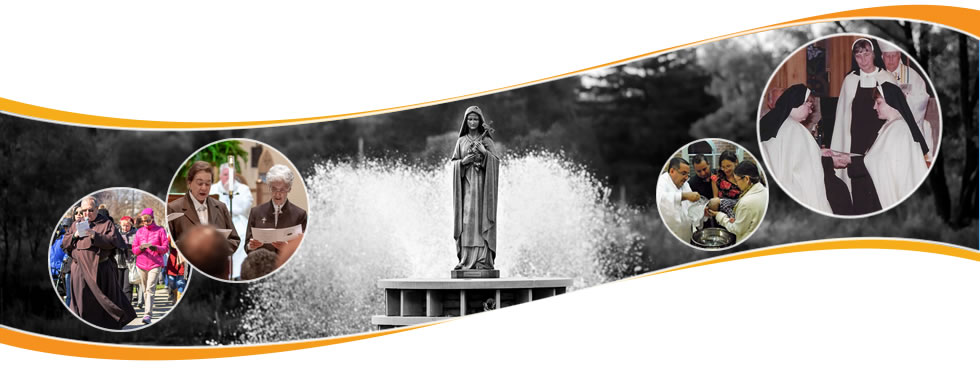
    In the Archdiocese of New York, Cardinal Timothy Dolan announced that the National Shrine of Our Lady of Mount Carmel in Middletown, NY is a one of five holy sites and places of pilgrimage where a Holy Door, a Door of Mercy, is opened to pilgrims who would like to receive a Jubilee Indulgence. 

Parish groups and individuals are invited to come and enter the Door of Mercy at the National Shrine. 

If you are interested in planning a day of pilgrimage to the Shrine please call 845-343-1879845-343-1879 or email Esta dirección de correo electrónico está siendo protegida contra los robots de spam. Necesita tener JavaScript habilitado para poder verlo..

OLMC National Shrine
70 Carmelite Dr.
PO Box 2163
Middletown, NY 10940
http://www.ourladyofmtcarmelshrine.com

Jueves, 04 Febrero 2016 11:27

Carmelites & the Year of Mercy

Written by

by Fr. David Hofman, O.Carm.

The Church begins a Jubilee Year of Mercy.

Pope Francis’ idea is that the whole Church will spend the year practising mercy at every level – from priests celebrating the sacrament of Reconciliation to people feeding the hungry and clothing the naked.

Christians are called to be the living presence of God in the world - people who uncover the face of God and the heart of God in the words and actions of their everyday life.

That's how Jesus is born, not only in one moment of history, but in every moment of history.

To live a merciful life is to see, love and act as Jesus himself does.

The practise of virtue is an integral part of the process of Christian transformation – of changing our minds and hearts, of allowing God’s grace to re-fashion us in the image of his Son.

That’s what contemplation is all about life – allowing the heart of God to grow within our own, our values and attitudes to be changed and transformed so that we come to see with God’s eyes, feel with God’s heart and act with God’s intentions toward the world and its peoples.

For us Carmelites, our contemplative experiences of God’s love enable us to see others as our brothers and sisters.

Our charism of ‘community’ is much more than just being part of a group. It’s about ‘fraternity’, becoming a brother or sister to others and acting towards them as a true brother or sister would – welcoming them into my life, standing with them in times of trouble and distress, looking after their needs, encouraging and affirming them, celebrating achievements. It’s about easing the burdens and lightening the load for each other. It’s about creating moments of grace in each other’s’ lives.

To act with mercy is to act with compassion, with the same depth of the feelings of love and concern a mother has for her child.

It is not an abstract, intellectual thing, but a real choice to live and act with deep respect and profound compassion towards others in the concrete circumstances of our daily lives.

It is not an exercise of the mind but a movement of the heart.

Concrete actions bring goodness into the lives of others. That’s the ‘action’ in the Carmelite Charism - a ‘ministry of mercy’, of respectful, compassionate behaviour towards other human beings.

So we do our best to feed the hungry, clothe the naked, visit the sick, do what we can for those in any kind of need. We refrain from the ‘terrorism of gossip’ (as Pope Francis put it), from the need to tear people down. We don’t make fun of people or put them down. We don’t use positions of power to ‘lord it over’ each other or control other peoples’ lives. We do everything we can to be a source of blessing for them – to be people who heal, build up, nourish, strengthen and love.

The Carmelite Way influences everything in our lives, from how we pray to how we drive our cars.

It takes practice and patience to become a merciful person. It begins with the realisation of how much God actually loves us in spite of how we often behave.

This Year of Mercy gives us new energy in our striving to allow the heart of God to be our own and to reveal that heart in the simple goodness of our lives.

Jueves, 04 Febrero 2016 11:16

Thoughts from the Carmelite Chaplain - Holy Door

Written by

Father Michael Manning, O.Carm.

Since the year 1300 when Pope Boniface VIII declared the first Holy Year, the Catholic Church has regularly celebrated “Holy Years,” usually every twenty-five years, except for special circumstances.

A major aspect of the Holy Year has been that of pilgrimage either to Rome or to a number of doors which have been opened in diocese around the world to make a symbolic entry through the Holy Door; to make reparation for sin and to renew the conversion of one’s life.

Christ identified Himself as the door, saying.  “Truly, I tell you, I am the gate for the sheep.    I am the gate. Whoever enters by me will be saved, and will come in and go out and find pasture” (John 10:7, 9).  Using this symbolic image Jesus tells us that the only way to the father is through him, the only begotten Son, the saviour.   Another aspect is the phrase ‘they…will come in and go out and find pasture’.  In other words this going through the gate is not a one-way journey.  We enter, are strengthened with grace and then go out to bring this grace to others through our actions.  There is only one way that opens wide the entrance into this life of communion with God:  This is Jesus, the one and absolute way to salvation.

Passing through the Holy Door is to open oneself to the transforming grace of God and to confess your faith in Jesus Christ as Son of God, Lord and saviour who suffered, died and rose for our salvation.

Therefore to pass through the door from the outside of St. Peter’s into the basilica is to pass from this world into the presence of God, just as in the old Temple of Jerusalem, the High Priest on the Feast of Yom Kippur passed through the veil covering the doorway of the Holy of Holies to enter into the presence of God to offer the sacrifice of atonement.   Moreover, to pass through the door is to confess with firm conviction that Jesus Christ is the Son of God, the Lord, and the Saviour who suffered, died, and rose for our salvation.

Pope Francis announcing the opening of the Holy Doors  says “To experience and obtain the Indulgence, the faithful are called to make a brief pilgrimage to the Holy Door, open in every Cathedral or in the churches designated by the Diocesan Bishop, and in the four Papal Basilicas in Rome, as a sign of the deep desire for true conversion. Likewise, I dispose that the Indulgence may be obtained in the Shrines in which the Door of Mercy is open and in the churches which traditionally are identified as Jubilee Churches. It is important that this moment be linked, first and foremost, to the Sacrament of Reconciliation and to the celebration of the Holy Eucharist with a reflection on mercy. It will be necessary to accompany these celebrations with the profession of faith and with prayer for me and for the intentions that I bear in my heart for the good of the Church and of the entire world”.  So we can see that the thoughts of Holy Father in his pastoral role as Bishop of Rome go “to all the faithful who, whether in individual Dioceses or as pilgrims to Rome, will experience the grace of the Jubilee. I wish that the Jubilee Indulgence may reach each one as a genuine experience of God’s mercy, which comes to meet each person in the Face of the Father who welcomes and forgives, forgetting completely the sin committed”.

Photo: Fr Kevin Melody, O.Carm, represented the Prior Provincial of the British Province and opened our Door of Mercy at the National Shrine of Saint Jude on 13 December 2015. Photos below.

Paul VI Hall Thursday 21 January 2016

Dear brothers and sisters, good morning!

I cordially welcome all of you, people who work in pilgrimages and shrines. Going on pilgrimage to shrines is one of the most eloquent expressions of the faith of the people of God. It manifests the piety of generations of people who, with simplicity, have believed and entrusted themselves to the intercession of the Virgin Mary and the saints. This popular religiosity is a genuine form of evangelisation, which needs to be increasingly promoted and valued, without minimising its importance. It’s interesting: Blessed Paul VI, in Evangellii nuntiandi, speaks of popular religiosity, but says it is better to call it “popular piety”; and then, the Latin American Bishops in their Aparecida Document go a step further and speak of “popular spirituality”. All three concepts are valid, but together. At shrines, in fact, our people live their profound spirituality, that piety which for centuries has shaped the faith with devotions that are simple but very meaningful. We think to how intensified, in some of these places, is prayer to Christ crucified, or that of the Rosary, or the Way of the Cross

It would be a mistake to assume that those who go on pilgrimage live a spirituality that is not personal but rather “en masse”. In fact, the pilgrim carries with them their own story, their own faith, the lights and shadows of their lives. Each carries in their heart a special desire and a particular prayer. Whoever enters the shrine immediately feels at home, welcomed, understood and supported. I really like the biblical figure of Anna, the mother of the prophet Samuel. In the temple of Shiloh, her heart full of sadness, she prayed to the Lord to have a child. Eli the priest instead thought she was drunk and wanted to throw her out (cf. 1 Samuel 1:12-14). Anna represents well so many people we can meet in our shrines. Eyes fixed on the Crucifix or the image of the Virgin Mary, a prayer said with tears in his eyes, full of confidence. The sanctuary is really a privileged space to meet the Lord and touch his mercy with your hands. To go to confession in a shrine is to have the experience of touching the mercy of God with your hand.

This is the key word that I wish to underline together with you today: welcome. Welcome pilgrims. It could be said that everything depends on welcome. A welcome that is loving, festive, heartfelt, and patient. It also takes patience! The Gospels present Jesus as always welcoming towards those who approach him, especially the sick, the sinners, the marginalized. And remember that expression: “He who receives you receives me, and whoever receives me receives him who sent me” (Matthew 10:40). Jesus spoke about welcome, but mostly he practiced it. When we are told that sinners – such as Matthew and Zacchaeus – welcomed Jesus into their homes and at their tables, it is first of all because they had felt welcomed by Jesus, and that had changed their lives. It’s interesting that the Book of the Acts of the Apostles ends with the scene of Saint Paul who, here in Rome, “welcomed all who came to him” (Acts 28:30). His home, where he lived as a prisoner, was the place where he announced the Gospel. Welcome is truly the determining factor for evangelisation. Sometimes, just a word or a smile is enough to make a person feel a heartfelt welcome.

The pilgrim who comes to the shrine is often tired, hungry, thirsty … And many times this physical condition also reflects the interior. Therefore, this person needs to be well received in both material and spiritual terms. It is important that the pilgrim who crosses the threshold of the sanctuary feels treated more like a member of the family than as a guest. He or she should feel at home, awaited, loved, and looked at with eyes of mercy. Anyone, young or old, rich or poor, sick or troubled, and curious tourists, can find the welcome due to them, because in each one there is a heart that seeks God, sometimes without being fully aware of it. We ensure that every pilgrim has the joy of finally feeling understood and loved. In this way, when they return home they will feel nostalgia for what they have experienced and a desire to come back, but also wanting to continue the journey of faith in their ordinary life.

A very special form of welcome is that given by the ministers of God’s forgiveness. The shrine is the home of forgiveness, where everyone encounters the tenderness of the Father who has mercy on everyone, without exception. Those who approach the confessional do so because they are repentant, repenting their sins. He or she feels the need to approach there. He/she clearly perceives that God does not condemn, but welcomes him/her and hugs him/her, like the father of the prodigal son, who restores his filial dignity (cf. Luke 15:20-24). Priests who carry out a ministry in sanctuaries must have hearts impregnated by mercy; their attitude must be that of a father.

Dear brothers and sisters, we live this Jubilee with faith and joy: let us live as one big pilgrimage. You, especially, live your service as a work of corporal and spiritual mercy. I assure you of my prayers for this, through the intercession of Mary our Mother. And please, with your prayers, accompany me in my pilgrimage. Thank you.

from http://www.carmelite.org

Carmelites from Britain, the Philippines and Poland took part in a gathering held in Rome in mid-January 2016 of those involved in the work of pilgrimage and shrine ministry.

As part of the Extraordinary Jubilee Year of Mercy, Pope Francis has invited people to come to Rome as pilgrims to reflect on some of the Church's particular ministries of mercy. Over the course of the Jubilee Year there will be gatherings of: people who are sick or disabled; those involved in the spirituality of Divine Mercy; priests; deacons; catechists; volunteers of Mercy; and others.

The Holy Father wanted the first gathering to be of those who are involved in the work of pilgrimages and shrines, since going on pilgrimage is often an experience that gives people a special encounter with the love and mercy of God.

Pilgrimage and shrine ministry are important apostolates of the Carmelite Family worldwide, and Carmelites were among the approximately 1,000 participants at the Jubilee which took place between 19th and 21st January.

The British Province of Carmelites was represented by: Fr. Francis Kemsley, O.Carm. from Aylesford Priory (a major site of pilgrimage in southern England); Mr. Matthew Betts, Development Manager at the National Shrine of Saint Jude (which the Carmelites established 60 years ago); and Mr. Johan Bergström-Allen, T.O.C., the Province's Communications & Outreach Manager who coordinates an annual Carmelite pilgrimage to Lourdes, organises special pilgrimage events (such as to Avila for the 'Teresa 500' celebrations last year), and is a Guardian of the Shrine of Our Lady of Doncaster.

Two Associates of the Carmelites in the Philippines, Butch and Marissa Cos Alcantara, travelled from Asia to take part in the gathering. These Lay Carmelites operate Pirkk & Troy Tours, a travel agency that organises pilgrimages to the shrines of Europe and the Holy Land. Marissa is very involved with the Order's Institute of Spirituality in Asia (ISA).

Another Carmelite taking part in the Jubilee was a Discalced friar from Poland.

The Jubilee programme consisted of talks, times for prayer, and the opportunity for those involved in pilgrimage ministry to meet one another and share ideas.

The three Carmelites from Britain began their pilgrimage to Rome by visiting the Carmelite Church of Santa Maria in Traspontina.


Fr. Francis Kemsley (left) and Matt Betts in front of the image of
Our Lady of Mount Carmel in Traspontina Church.


Directly opposite Traspontina Church is the Jubilee Year of Mercy Office where pilgrims officially register.


Collecting passes and programmes from the Jubilee Office.


Participants in the Jubilee were divided into language groups: Italian, English, Spanish, French and German.

The English-language delegates, who came from over 25 different nations, gathered in the Basilica di Santa Croce in Gerusalemme (Holy Cross in Jerusalem). Coordinating the Year of Mercy - including the - has been entrusted to the Pontifical Council for the Promotion of the New Evangelisation, and a word of welcome was given to the delegates by Fr. Geno Sylva, an American priest who serves as the English-language representative at the Pontifical Council.


Fr. Geno Sylva welcoming English-language participants at the Jubilee.


The first presentation to the English-language group was given by Fr. Richard Gibbons, Rector of the Irish National Shrine at Knock. He spoke on the topic "Pilgrims in the Footsteps of Jesus: The Shrine as an Experience of Mercy". Father Gibbons said that where the Church is dwindling in numbers shrines should not be simply the last bastions of Catholic identity; rather they should be at the cutting edge of the deep questions in life, helping pilgrims to reflect on the meaning of life, and the need for conversion and forgiveness. He advised those involved in shrine ministry not to get caught up in the practicalities of projects, but to make the space and time to remember the purpose of a shrine, always bearing in mind Pope Francis' image of the Church as a field hospital located in the messiness and dirt of people's lives. Speaking of mercy from the sacramental perspective, Fr. Gibbons spoke of the confessional as the "engine room" of a shrine, helping people to encounter God's forgiveness. He described holy sites and sanctuaries as part of the everyday life of the Church, but having a special role where the sacrament of reconciliation can often happen more than in most parishes. This year in Knock, the acts of penance being given to pilgrims in the confessional are to do corporal works of mercy. He described the work of priests, religious and lay people working at shrines as a "ministry of hovering", being available for people to talk to, which is as much a work of evangelisation as going out to engage people elsewhere. Reflecting on the image of the "Holy Doors" that have been established at shrines around the world in this Jubilee Year, Fr. Gibbons spoke of the need to invite people through the door, rather than forcing them through, which requires a spirit of hospitality and patience.


Fr. Gibbons spoke to the English-language participants in the majestic setting of the Basilica that houses relics of Christ's passion brought back from the Holy Land by Saint Helena.


All the language groups gathered together for the first time at the cathedral of Rome, the Basilica of Saint John Lateran. This is one of Rome's four "major basilicas", each of which has a Holy Door through which pilgrims can pass in this Jubilee Year as a sign of their entering into a deeper relationship with God.

 
Pilgrims passing through and touching the Holy Door at St. John Lateran.


At each Jubilee site in Rome pilgrims are welcomed by volunteers in distinctive tabards; many are from organisations that accompany pilgrims to Lourdes.


Pilgrims from all the language groups gathering at the Lateran Basilica.


The pilgrim delegates gathered at the Lateran for a celebration of Mass presided over by Archbishop Rino Fisichella, President of the Pontifical Council for Promoting the New Evangelisation.


Archbishop Rino preaching at the Eucharist.


Many pilgrimage organsations and shrines took part in the Jubilee gathering.
The Order of Malta, for example, accompanies pilgrims to Lourdes and elsewhere from many different parts of the world.


The British Province delegates took the opportunity of the Jubilee for Pilgrimage Supporters and Workers to build fraternal links with fellow Carmelites, and to make a pilgrimage to some of the Order's holy sites in the Eternal City. Warm hospitality was offered by the friars at the Basilica of San Martino ai Monti.


British Carmelites at San Martino ai Monti with brothers from Italy, Colombia and India.


Excavations under the Basilica of San Martino have revealed ancient architecture of the Roman Empire, and places where Christians have prayed for centuries.


The second day of the Jubilee gathering began with morning prayer in the various churches being used by the different language groups. The English-language delegates were given a reflection on the topic "From the Shrine to the Parish: Pilgrimage as an integral part of pastoral work in parishes" by Fr. John Armitage, Rector of the National Shrine of Our Lady at Walsingham, England.


Fr. John Armitage, Rector of Walsingham


Father Armitage spoke of pilgrimages as grace-filled moments that lead people to conversion of heart, just as in the gospels people came to Jesus wanting to touch him and hear him speak. The impulse to go on pilgrimage often comes from a deep sense of either loss or fulness; a profound need for God, or a desire to thank God. Shrines and relics have a place in evangelisation because spreading the Good News of God's love is not a programme but an encounter with the Lord. Sometimes, he said, Christians feel too rational and sophisticated to go to particular sites and venerate relics, but we are incarnational people and whilst pilgrimage and relics are not essential to a Christian life, they can be helpful pointers towards God. The Rector spoke of how shrines, such as Lourdes, give us a glimpse of how the world can be; a reflection of God's kingdom. It is important, he said, for shrines to convey their story or message clearly, but to help people see the connection with their own life story; in this way curious tourists who come out of historical or artistic interest can become pilgrims who encounter the living God. Parishes have a responsibility to help people come on pilgrimage, especially the young who often find a deeper sense of community and commitment on visits to places like Lourdes or gatherings such as World Youth Day.


Fr. Francis responding to the presentations.


The final English-language presentation was a Catechesis on Mercy given by Archbishop Arthur Roche, now working at the Vatican as Secretary  of the Congregation for Divine Worship, but known to the British delegates from his previous service as Bishop of Leeds.


Archbishop Arthur Roche spoke on the nature of Mercy.


Archbishop Roche began by observing that the work of pilgrimage is not simply a job but a vocation, a calling to draw people to Christ's mercy. God the Father gazes on each human being as a treasure, seeing in each the image of his Son, and therefore when we welcome pilgrims to shrines we welcome God's treasure, and give hospitality to those for whom God has given everything. Drawing on notions closely connected to Carmelite spirituality, the Archbishop invited the pilgrimage personnel to stop working for a moment and simply be loved in the presence of God. He encouraged pilgrimage workers to 'practice the presence of God', taking a few seconds throughout the day to consciously acknowledge and love the Lord.


Archbishop Roche's presentation was prayerful and informative.


Archbishop Roche went on to speak of the term 'Mercy' and its various derivative Hebrew and Greek terms in the Bible. He said it occurs some 500 times in the Bible, including the Psalms, compared with only 170 references to grace and just 54 references to Hell, which gives us a proper perspective on how - according to the title of the Pope's new book - "The name of God is Mercy". As an expert on liturgy, Archbishop Roche noted how every Mass begins with the 'Kyrie Eleison' calling on God's mercy. He spoke of Mercy as a tender and materal quality, which is fundamental to God's nature. The Archbishop spoke of the Gospel (especially Matthew 25) and Church Tradition as the basis for the 'Corporal and Spiritual Works of Mercy'. He said that mercy needs to be offered in our own time to refugees seeking asylum. He closed by talking about our need to offer as well as receive mercy, advising that if we have been hurt, wounded, or betrayed by another, and find it hard to forgive, we needn't worry; simply ask God for the grace to be able to forgive, since 'to err is human, but to forgive divine'.


Jubilee pilgrims from England and Wales. As well as the Carmelites, a number of groups and shrines were represented, including pilgrimages to Lourdes by dioceses and groups (such as HCPT), the Catholic Grandparents Association, and the newly-established Shrine of Saint Augustine in Ramsgate.


Among the speakers addressing the French-language group was
Fr. Horacio Brito, former Rector of Lourdes.


After the final language-group presentation the British Province pilgrims visited the Curia (international headquarters) of the Carmelite Order.


Matt and Francis with (left) the Vice Prior General of the Order Fr. Christian Körner,
and (right) the Councillor General for Europe Fr. John Keating.


The final afternoon of the Jubilee gathering was a time for prayer, with Adoration of the Blessed Sacrament and the Sacrament of Reconciliation available in a number of 'Jubilee Churches' near the Vatican.


Jubilee pilgrims at prayer before the Blessed Sacrament.


The British Province pilgrims visited a number of sites including the Holy Door at the Basilica of Saint Mary Majors (pictured), the shrine of Our Lady of Perpetual Help, and the Venerable English College.


On the final morning of the international gathering, priests, shrine rectors, religious, lay personnel, and all those involved in pilgrimage ministry passed through the Holy Door at St. Peter's Basilica.


Pilgrims processing past the Jubilee Office towards St. Peter's.


Johan Bergström-Allen and Fr. Francis Kemsley at the Holy Door in St. Peter's.


The Holy Door is normally only opened for jubilees every 25 years,
or extraordinary jubilees such as the Year of Mercy.


Going to St. Peter's was a special opportunity for the British Carmelites to pray at the altar of Saints Simon and Jude. It is from here that the relics of Saint Jude revered at his National Shrine in Faversham come.


Matt (Director of the National Shrine of Saint Jude at Faversham) and Fr. Francis (former Chaplain to the Shrine) in front of the Chapel of Simon and Jude in St. Peter's Basilica.


As Development Manager of the National Shrine of Saint Jude, Matt Betts took the opportunity to pray for the Shrine and its ministry in its Diamond Jubilee year (it was established by Carmelite friars 60 years ago). To mark the Jubilee, Matt had brought a statue of Saint Jude from Faversham to present to Pope Francis.


Matt holding the statue of Saint Jude from Faversham.


Next to the Chapel of Saints Simon and Jude in St. Peter's is the confessional staffed by friars of the Carmelite Order, a powerful symbol of God's love in this Year of Mercy.


From St. Peter's the Jubilee delegates walked to the Paul VI Auditorium for an audience with the Holy Father, which was preceded by a concert performed by an orchestra from Aquila, an Italian town devastated by an earthquake in 2009.


The orchestra from Aquila included many young people,
given hope by music after the devastation of their town.


When the Holy Father arrived to great applause from the Jubilee pilgrims, Archbishop Rino Fisichella told him about the gathering and the diversity of places from where participants had come.


Archbishop Fisichella addressing the Holy Father.


Pope Francis then spoke for a few minutes on the ministry of pilgrimage and shrine work. In his address the Holy Father spoke of how coming on pilgrimage allows people to express their Christian faith in simple but profound ways. He described religious sanctuaries as privileged spaces to meet the Lord and touch his mercy with your hands. The Pope said that the key word he wanted to underline is "welcome"; that pilgrimage and shrine personnel need to welcome the sick, the sinner, the marginalised just as Christ did, for in receiving them we receive Christ himself. Jesus not only spoke of welcome but practiced it, which transformed the lives of those he met. Welcoming is truly the determining factor for evangelisation, the Holy Father said. Speaking of the sacrament of reconciliation, the Pope said that "A very special form of welcome is that given by the ministers of God's forgiveness ... Priests who carry out a ministry in sanctuaries must have hearts impregnated by mercy; their attitude must be that of a father."


Pope Francis addressing the delegates at the Jubilee for Pilgrimage Workers.


Before imparting his apostolic blessing, Pope Francis asked the delegates to pray for him on his own pilgrimage through life.


Among the participants specially chosen to meet the Holy Father personally were the Lay Carmelites from the Philippines, Butch and Marissa Cos Alcantara.


 Butch & Marissa Cos Alcantara meeting Pope Francis.


On behalf of the Carmelite Family, Matt Betts was able to present the Pope with a statue of Saint Jude from the Apostle's National Shrine at Faversham.


Matt presenting the statue of St. Jude to the Holy Father.


With delight Pope Francis asked Matt: "Is the statue for me?"


Pope Francis with the statue of Saint Jude from the Carmelites in Britain.


To watch video footage of the papal audience (in Italian) click on the arrow in the YouTube box below.


An ancient tradition of pilgrims to Rome is to get a certificate. The delegates from the British Province rounded off their experience by getting this document from the Jubilee Office.


The British Province delegates with their Year of Mercy pilgrimage certificates.


The Carmelites who took part in the Jubilee went home inspired and encouraged in their ministry of pilgrimage hospitality.


Photography:

Religious Men and Women bound to the cloistered life can obtain the Jubilee Indulgence according to the now usual practices granted for Jubilees.

According to the indications given by the Holy Father’s letter dated 1 September, 2015, and addressed to S.E. Mons. Rino Fisichella, cloistered Religious are among the category of those “for whom, for various reasons it will be impossible to enter the Holy Door”.  Therefore, they will obtain the Jubilee indulgence through a visit to the chapel of their own monastery, along with the profession of faith and prayer for the intentions of the Holy Father, as well as the usual conditions of sacramental Confession and Eucharistic Communion.

In addition, in the same letter, the Pope expressed this further instruction: “I have asked the Church in this Jubilee Year to rediscover the richness encompassed by the spiritual and corporal works of mercy.  The experience of mercy, indeed, becomes visible in the witness of concrete signs as Jesus himself taught us.  Each time that one of the faithful personally performs one or more of these actions, he or she will certainly obtain the Jubilee Indulgence”.

Pope Francis

Pope Francis: Message for the Jubilee of Mercy for Young Boys and Girls

“Merciful Like the Father”

Dear Young Friends,

The Church is celebrating the Holy Year of Mercy, a time of grace, peace, conversion and joy.  It is meant for everyone: people of every age, from far and near.  There are no walls or distances which can prevent the Father’s mercy from reaching and embracing us.  The Holy Door is now open in Rome and in all the dioceses of the world.

This grace-filled moment also concerns you, dear young people.  I encourage you to take an active part in this celebration and to realize that each of you is a child of God (cf. 1 Jn 3:1).  I would like to invite you, one by one, calling you by name, as Jesus does each day.  For you know that your names are written in heaven (Lk 10:20), in the heart of the Father, that Merciful Heart which is the source of all reconciliation and kindness.

The Jubilee is a year-long celebration, in which every moment becomes a chance for us to grow in holiness.  It is a time when we can discover that life together as brothers and sisters is like a great party, perhaps the most beautiful party we can imagine, the endless party that Jesus has taught us to celebrate by his Spirit.  The Jubilee is the party to which Jesus invites us all, without excluding anyone.  That is why I also wanted to have some days of prayer and celebration with you.  I am looking forward to seeing many of you in April.

 “Merciful like the Father”.  This is the theme of the Jubilee, but it is also the prayer we make for all of you as we welcome you in the name of Jesus.  To be merciful means to grow in a love which is courageous, generous and real.  It means to grow physically and spiritually.  You are preparing to be Christians capable of making courageous choices and decisions, in order to build daily, even through little things, a world of peace.

Yours is a time of life which is full of amazing changes.  Everything seems possible and impossible all at once.  I repeat what I said to some of your friends: “Remain steadfast in the journey of faith, with firm hope in the Lord.  This is the secret of our journey!  He gives us the courage to swim against the tide.  Pay attention, my young friends: to go against the current; this is good for the heart, but we need courage to swim against the tide.  Jesus gives us this courage! … With him we can do great things; he will give us the joy of being his disciples, his witnesses.  Commit yourselves to great ideals, to the most important things.  We Christians were not chosen by the Lord for little things; push onwards toward the highest principles.  Stake your lives on noble ideals” (Homily at the Conferral of the Sacrament of Confirmation, 2013).

Here I cannot forget those of you who are living in situations of war, extreme poverty, daily troubles and loneliness.  Don’t ever lose hope!  The Lord has a great dream which, with your help, he wants to come true!  Your friends, young people your age living in less trying conditions than your own, have not forgotten you; they are working for peace and justice for everyone everywhere.  Don’t be taken in by the messages of hatred or terror all around us.  Instead, make new friends.  Give of your time and always show concern for those who ask your help.  Be brave and go against the tide; be friends of Jesus, who is the Prince of Peace (cf. Is 9:6).  “Everything in him speaks of mercy.  Nothing in him is devoid of compassion” (Misericordiae Vultus, 8). 

I realize that not all of you can come to Rome, but the Jubilee is truly for everyone and it is also being celebrated in your local Churches.  You are all invited to this moment of joy.  Don’t just prepare your rucksacks and your banners, but your hearts and your minds as well.  Think carefully about the hope and desires you will hand over to Jesus in the Sacrament of Reconciliation and in the Eucharist which we will celebrate together.  As you walk through the Holy Door, remember that you are committing yourselves to grow in holiness and to draw nourishment from the Gospel and the Eucharist, the Word and the Bread of life, in order to help build a more just and fraternal world.

May the Lord bless your journey towards the Holy Door.  I pray that the Holy Spirit will guide your steps and enlighten you.  For you and your families, and for all who help you to grow in goodness and in grace, may the Blessed Virgin Mary, Mother of us all, be true Door of Mercy.

From the Vatican, 6 January 2016, Solemnity of the Epiphany of the Lord

Domingo, 31 Enero 2016 21:56

Lectio Divina February 2016

Written by

Pope's prayer intention for February 2016

UniversalCare for Creation - That we may take good care of creationa gift freely given cultivating and protecting it for future generations.

EvangelizationAsia - That opportunities may increase for dialogue and encounter between the Christian faith and the peoples of Asia.

Lectio Divina February-febrero-febbraio 2016

 
Ipad-Iphone
Kindle
PDF
English
Download ibook
Download Kindle
Download PDF
Español
Descarga iBook
Descarga Kindle
Descarga PDF
Italiano
Scarica iBook
Scarica Kindle
Scarica PDF


Página 143 de 268

Aviso sobre el tratamiento de datos digitales (Cookies)

Este sitio web utiliza cookies para realizar algunas funciones necesarias y analizar el tráfico de nuestro sitio web. Solo recopilaremos su información si rellena nuestros formularios de contacto o de solicitud de oración para responder a su correo electrónico o incluir sus intenciones y solicitudes de oración. No utilizamos cookies para personalizar contenidos y anuncios. No compartiremos ningún dato con terceros enviados a través de nuestros formularios de correo electrónico. Su información debería ser su información personal.