











O.Carm
Celebrating At Home - 4th Sunday in Lent

Journey Into the Light
(John 9:1-41)
When the man returns home there is no rejoicing or welcome from his neighbours and friends. Instead, he is greeted with many questions and much suspicion. They seem blind to what has happened to the man. These same neighbours and friends march the man off to the religious authorities to see what they make of the situation. But they, too, greet the man with many questions and great suspicion and finally drive him away. They, too, are blind to the work of God both in the man and in Jesus who cured him.
Jesus seeks the man out and asks if he believes. The man asks in whom he should believe. Jesus answers, ‘in me’. The man, who now sees clearly who Jesus is, believes and worships.
The man’s whole world has been totally transformed from total darkness into light through the loving action of Jesus. Bit by bit throughout the reading the man has gradually come to realise who Jesus is. At first Jesus is simply ‘a man’, then ‘a prophet’, then ‘Son of Man’ and finally, ‘Lord’.
We, too, can be blind to the many ways God is present in our lives and in those around us. It can take some time on our journey of faith to realise just who Jesus is and to allow our lives to be filled with Light.
The candles we use in our churches remind us of the vitality and life of Christ which has been entrusted to us. With our minds lit and our hearts warmed by the Spirit of Christ we, too, develop true insight and as God’s heart begins to beat within our own, we become light and warmth for each other.
May the light of Christ burn strongly within us!
- pdf Celebrating At Home - 4th Sunday in Lent [PDF](2.79 MB)
- default Celebrating At Home - 4th Sunday in Lent [ePub](3.57 MB)
- pdf Celebrando en Familia - IV Domingo del Tiempo de Cuaresma(689 KB)
- pdf Celebrando in Casa - IV Domenica di Quaresima(689 KB)
- pdf Celebrando em família - Quarto Domingo da Quaresma(688 KB)
Carmelite NGO Calls for Urgent Action on Poverty at UN
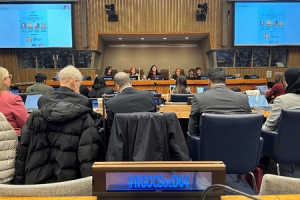
Carmelite NGO Urges Renewed Global Action on Poverty and Inequality at UN Social Development Meeting
I am writing this from the United Nations headquarters in New York just as the 64th annual meeting of the Commission for Social Development (CSocD64) approaches its conclusion. While here, I have attended various plenary sessions and side events.
A recurring theme during this year’s gathering was the importance of the Doha Political Declaration, the document that came out of the Second World Summit for Social Development, held in Doha, Qatar, this past November.
In a nutshell, the Doha Declaration was an agreement among nations to recommit their efforts to the cause of social development, including the eradication of extreme poverty, the enhancement of social protections for all people, and the promotion of universal human rights. The Summit and the Declaration were meant to jump-start a final push toward meeting the Sustainable Development Goals (SDGs, also known as the 2030 Agenda).
The Summit and CSocD64 have been about “leaving no one behind.” Sadly, progress on the SDGs has been mixed. Many people are, in fact, being left behind. A renewed and reenergized commitment and follow-up in the promotion of genuine social development is certainly needed.
The CSocD64 gathering this month saw many worthwhile conversations and expressions of solidarity and commitment to action. We heard about unpaid caregiving, which is mostly done by women across the globe. If this vital labor was paid, it would be one of the largest segments of the economies of many countries. This is something that must be addressed. (Author’s note: it is revealing and disturbing to contemplate all of the destructive work around the world that is generously paid, yet the critical work of caring for others can be unpaid without apology.)
We also heard at CSocD64 laments about the “overlapping global crises,” which includes growing inequality. Pope Francis called inequality “the root of social evil.” As a sociologist, I can attest to its destructive power. We must address the widening gap between the few very wealthy and the many across the globe who have so little.
It was also said—many times—at CSocD64 that taking action to expand access to education and healthcare and to protect the poor and vulnerable should not be looked upon as “costs,” but rather, they are “investments” in the future of individual countries and the world. The return on proper investments in such things is extraordinarily significant.
Finally, at the Civil Society Forum at CSocD64, it was said that civil society (including NGOs, religions, academic institutions and trade unions) have played and will continue to play a critical role in furthering social development. We are close to the people, so we know the struggles, and we are positioned to have real impact if we engage with our governments and demand action on social development in our own nations and in the world. We need to rise to the challenge!
Dennis Kalob, Ph.D.
Chief Administrative Officer of the Carmelite NGO
The True Face of St. John of the Cross Brought to Life
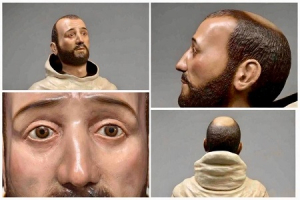
The exhibition San Juan de la Cruz, Esperanza de alto Vuelo, opened to the public in Alba de Tormes as part of the San Juan de la Cruz exhibition. As part of the celebrations for the centenary of the Saint, the displays include one of the most important elements from a historical and scientific point of view: the reconstruction of the face of St. John of the Cross.
The study, entitled Fisonomía original de San Juan de la Cruz (Original Appearance of St. John of the Cross), traces the process that made it possible to approximate the true face of the mystical doctor. This process began in 1992 in Segovia with canonical recognition on the fourth centenary of the saint’s death. Under the direction of Dr. Massimo Benedettucci, the scientific reconstruction of the face was carried out starting from the skull of St. John of the Cross.
The technique used consisted of making a plaster cast, anatomically reconstructing the muscles and soft tissues, and interpreting the features not directly defined by the bone structure based on historical descriptions. In this case, the work of Fr. Jerónimo de San José (Ezquerra de Rozas) was heavily relied upon.
The reconstruction was then used to create a bronze bust by the Fonderia Artistica Cavallari in Rome, using the lost wax technique. This process involves creating a wax sculpture, encasing it in a heat-resistant mold, melting out the wax, and pouring molten metal into the cavity. The artist Alejandro López Araguez has now created a bust in traditional oil polychrome, giving greater realism and expressive depth to the figure.
Used with permission from the Secretary for Information OCD
Two Centenaries
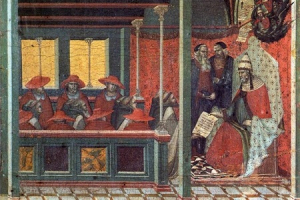
From the Archives and General Library of the Carmelite Order
This year marks two important centenaries for the Carmelite Order. On January 30, 1226, Pope Honorius III issued a bull, in the form of a mandatum, or command, which began with the words Ut vivendi normam: with it, the pontiff commanded the hermits on Mt. Carmel to faithfully observe the Formula of Life, given a few years earlier (between 1206 and 1214) by the Patriarch, Albert of Jerusalem. By observing it and living “in holy penance,” the Carmelites would obtain an indulgence. This was not yet the approval of the Rule, which would only take place on October 1, 1247, with Innocent IV, but a first recognition of the community of Carmelite hermits and their Formula of Life.
A century later, on February 3, 1326, John XXII granted all the privileges already enjoyed by the Franciscans and Dominicans with the constitution Super cathedram. Thus was completed the rather bumpy journey of transforming Carmel into a mendicant order.
Vitam Coelo Reddiderunt
|
24-01-26 |
04-11-30 |
08-09-51 |
08-09-54 |
01-07-56 |
|
27-01-26 |
|
|
|
|
|
01-02-26 |
|
|
|
|
|
01-02-26 |
22-10-43 |
22-08-63 |
27-08-66 |
04-07-70 |
|
11-02-26 |
22-03-51 |
08-09-73 |
20-11-77 |
20-05-79 |
Celebrating At Home - 3rd Sunday in Lent

Come and Drink
(John 4:5-16, 19-26, 39-42)
The Gospels of the next three Sunday make clear that the Way from temptation to transfiguration is in and through Jesus Christ who is Living Water, Light and Life for the would-be disciple. They are three great stories from John about responding in faith:
• The Woman at the Well – coming to faith despite barriers, personal history, differences of religious tradition, circumstances of life.
• The Man Born Blind – Faith grows amidst all sorts of trials and the doubt of others.
• The Raising of Lazarus – Faith tested by the ultimate: death.
The first of the three ‘great Gospels’ of Lent is ours this weekend: the encounter between Jesus and the Samaritan woman.
The ground-work for the Gospel is laid in the first reading from Exodus. The people are thirsty, God gives them water even though they grumble against him and ‘put him to the test’. From the story of Jesus’ encounter with the woman we might gather that faith comes through personal encounter with Jesus who offers us the living water of his Spirit. Jesus offers us his spirit in spite of all kinds of barriers, our personal history or circumstances and our often stubborn reluctance. Faith is a journey – it takes time to understand what is being offered and who is offering it. Some barriers about religion or religious practice need to be transcended to enter fully into faith which does not depend on cultic rituals. Faith makes us into missionaries, evangelists, proclaimers of Good News.
Water is a powerful symbol of life. You can last many days without food, but only a few without water. In our Christian tradition water is a strong symbol of the life of God which sustains us and brings our hearts to life. That is why we use it in Baptism and to bless objects and ourselves. The living water Jesus promises is his Spirit. A spirit which heals and transforms; which revels in the experience of God’s love and mercy; which cannot help but proclaim God’s goodness.
Our fresh encounter with the spirit of Christ this Lent heals and transforms us, and makes us into a “living gospel for all to hear”.
- pdf Celebrating At Home - 3rd Sunday in Lent [PDF](2.98 MB)
- default Celebrating At Home - 3rd Sunday in Lent [ePub](5.41 MB)
- pdf Celebrando en Familia - Tercer Domingo del Tiempo de Cuaresma(768 KB)
- pdf Celebrando in Casa - III Domenica di Quaresima(759 KB)
- pdf Celebrando em família - Terceiro Domingo da Quaresma(759 KB)
The Philippine Province Elects New Leadership
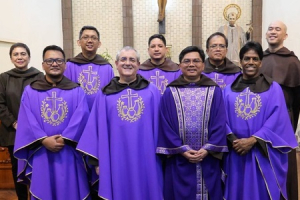
Philippine Province of St. Titus Brandsma Holds 5th Chapter to Elect New Leadership
The 5th Chapter of the Philippine Province of St. Titus Brandsma was held from February 23-27, 2026, at the Pope Pius XII Catholic Center in Paco, Manila. Sixty-four professed members serving in the Philippines, as well as missionaries assigned in Papua New Guinea, Canada, and the Netherlands, participated.
Animated by the theme “Vessels of Hope: Listening Hearts and Serving Hands as Contemplatives in the World,” the gathering was further enriched by the presence of Desiderio García Martínez, O. Carm., prior general, and Robert Thomas Puthussery, O. Carm., councilor for Asia–Australia–Oceania.
In his address, the prior general highlighted the two fundamental challenges facing the Order today: the renewal of consecrated life and fidelity to the Carmelite charism. He underscored that authentic renewal begins with rediscovering the joy of following Christ through the evangelical counsels, especially evangelical poverty, lived with integrity and freedom. He reaffirmed contemplation, prayer, silence, and vibrant community life as the heart of Carmel, while addressing pressing issues such as formation, vocations, missions, reorganization, safeguarding, and strengthening the Carmelite Family.
Before the election, the Prior General reminded the gremiales that service, unity and humility were the foundations of authority, and that the provincial leadership should be the first to “put on the work apron” to serve their brothers and sisters.
The following members were elected to lead the province for the next triennium:
1st Councilor | 1er Consejero | 1o Consigliere
Fr. Irvin Mangmang, O. Carm.
2nd Councilor | 2do Consejero | 2o Consigliere
Fr. Melvin Lorono, O. Carm.
3rd Councilor | 3er Consejero | 3o Consigliere
Fr. Sheldon Tabile, O. Carm.
4th Councilor | 4to Consejero | 4o Consigliere
Fr. Edwin Magbago, O. Carm.
Carmelite Nuns of Fisciano Held their Elective Chapter
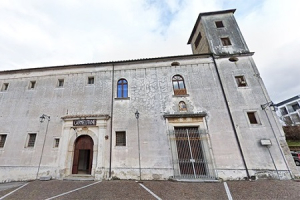
Elective Chapter Held in Carmelite Monastery "San Giuseppe" in Fisciano (SA)
The Carmelite Monastery of San Giuseppe in Fisciano, Italy celebrated its elective chapter on February 23, 2026.
The foundation of the monastery was prepared by the Venerable Seraphina of Divine Providence but was brought to fruition in 1691 by Sr. Archangela Fortune (d. 1734). St. Alphonsus de Liguori (d. 1787) visited the nuns at the monastery frequently.
In addition to the activities typical of cloistered life, they also do small jobs to finance themselves (party favors, sweets, wreaths, handicrafts), welcome groups for retreats, and provide discernment for young people.
The monastery is a member of the Federation of St. Mary Magdelene de' Pazzi and is in the Salerno-Campagna-Acerno diocese.
Those elected to leadership are:
Prioress | Priora | Priora:
Sr Maria Regina dell' Eucarestia, O. Carm.
1st Councilor | 1ª Consejera | 1ª Consigliera:
Sr Maria Carmela di San Gerardo, O. Carm.
2nd Councilor | 2ª Consejera | 2ª Consigliera:
Sr Maria Giuseppina di Gesù Misericordioso, O. Carm.
Treasurer | Ecónoma | Economa:
Sr Maria Arcangela di Gesù, O. Carm.
Formator | Formadora | Formatrice:
Sr Maria Arcangela di Gesù, O. Carm.
Sacristan | Sacristana | Sacrestana:
Sr Maria Giuseppina di Gesù Misericordioso, O. Carm.
Mass Attendance Skyrocketing Brings Troubles in Kenya
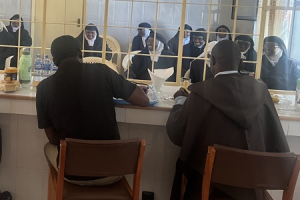
Skyrocketing Increase in Catholics at Mass Brings Troubles for the Carmelites Making Hosts in Kenya
According to Aid to the Church in Need (ACN), an international Catholic charity since 1947, the number of people returning to Church in Kenya is skyrocketing, while the equipment used by the Carmelite nuns for baking Eucharistic wafers has broken down.
The 26 Carmelite Sisters, who live in the Monastery of Our Lady of Mount Carmel in the Machakos Diocese, support themselves through their work. While their principal vocation is prayer, the nuns bake unleavened communion wafers and create liturgical items, including vestments, for the local Church. The Machakos Carmelite monastery, the first in Kenya, was established by Sisters from Utrera, Spain, in 1999. There are now three Carmelite monasteries in the country.
The prioress of the monastery, Sr. Mary Thérèse Ndinda, believes the increase in participation is due to covid. “The experience of the pandemic has led many people to come back to Church.”
The wafer-baking equipment at the monastery is quite old and frequently breaks down. So the work has become especially difficult. Sr. Mary Thérèse said the nuns, who come from many countries including Spain, Burkina Faso, Cameroon and Tanzania, could not afford new equipment, since their earnings barely cover their own very modest needs.
Kenya has a population of more than 55,300,000 which is 82.5 percent Christian, according to CAN’s 2025 Religious Freedom in the World report.
Christians in Indonesia Assist in Islamic Celebration
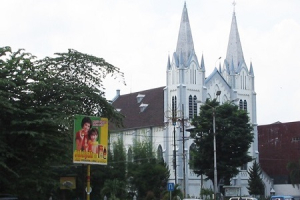
Christians in Indonesia Assist in Islamic Group’s Celebration
According to reports published by the Union of Catholic Asian News (UCA News), leaders of Nahdlatul Ulama (NU), Indonesia’s largest moderate Islamic organization, have lauded the support given by Christian churches during the recent centenary celebrations. The churches provided shelter and logistical support during the celebrations that took place February 8-9.
Eight Catholic and Protestant churches provided accommodation to thousands of Muslims from across Indonesia who traveled to Malang.
Muhammad Mahpur, a lecturer at Maulana Malik Ibrahim State Islamic University in Malang and deputy chairman of NU’s Malang branch, said that by offering support, Christians not only expressed fraternity but also demonstrated the deeper meaning of the Church’s presence in society.
“Besides proving that we are brothers and sisters of one nation, all of this demonstrates the Church’s presence as a place of refuge — a place of rest from fatigue, rain, heat and hunger,” he said.
For many Muslims, he added, churches are often perceived as distant places of worship, shaped by differing perceptions.
“Therefore, when they enter and see things beyond their expectations, such as the church altar, they experience it as a new spiritual and social experience,” he said.
Aan Anshori, coordinator of the Interfaith Intellectual Network and Dialogue, said Christians’ involvement in the NU event demonstrates respect not only for NU members but also for followers of other faiths.
“All of this proves the strong spirit of brotherhood that binds our community, and we hope this bond will grow stronger day by day,” he said.
Founded in 1926 and based in Jakarta, NU has an estimated 110 million members. Its two days of centennial celebrations at Gajayana Stadium in Malang drew between 104,000 and 107,000 participants from across the country.
During the Carmelite General Chapter in Malang, Allysa Wachid, the daughter of Abdurahman Wachid, the former leader of NU and fourth president of Indonesia, and the vice general, Hariawan Adji, spoke to the Carmelites about Christian-Muslim relations. Freedom of Belief is one of four focuses of The Carmelite NGO as well.
Our Lady of Mount Carmel Cathedral in Malang where Carmelite Henricus Pidyarto Gunawan is bishop opened its doors to assist participants as local hotels were fully booked. They offered temporary shelter for rest, food, prayer space and ablution facilities. They also provided livestream of the event.
The churches adjusted their Saturday and Sunday liturgy schedules to allow participants to join the program. The cathedral parish priest explained that the local faithful got involved as well. “When we explained the needs of our Muslim brothers and sisters, many donated snacks and drinks voluntarily,” the priest said. “This wasn’t just from church leaders — ordinary Catholics stepped up, turning it into a true community effort,” he added.
Indonesia is the world’s largest Muslim-majority nation, with about 87 percent of its estimated 287 million people identifying as Muslim. Other major religions include Christianity, Buddhism and Hinduism.


