













O.Carm
Lectio Divina November, 2025

Opening Prayer
Lord, the meaning of our life is to seek your Word, which came to us in the person of Christ. Make me capable of welcoming what is new in the Gospel of the Beatitudes, so that I may change my life. I would know nothing about you were it not for the light of the words spoken by your Son Jesus, who came to tell us of your marvels. When I am weak, if I go to Him, the Word of God, then I become strong. When I act foolishly, the wisdom of His Gospel restores me to relish God and the kindness of His love.
He guides me to the paths of life. When some deformity appears in me, I reflect on His Word and the image of my personality becomes beautiful. When solitude tries to make me dry, my spiritual marriage to Him makes my life fruitful. When I discover some sadness or unhappiness in myself, the thought of Him, my only good, opens the way to joy. Therese of the Child Jesus has a saying that sums up the desire for holiness as an intense search for God and a listening to others: "If you are nothing, remember that Jesus is all. You must therefore lose your little nothing into His infinite all and think of nothing else but this uniquely lovable all…" (Letters, 87, to Marie Guérin).
Celebrating At Home - 30th Sunday in Ordinary Time

We’ve All Met Them!
(Luke 18:9-14)
We’ve all met them: people who only seem to be able to bolster their self-image by putting everyone else down. We meet such a character in the Pharisee in the Gospel for this Sunday. Like the Pharisee in this week’s Gospel, we can sometimes see religion as a set of personal rituals, actions and prayers that cause us to think we have been faithful to God’s calling because we have done this or that.
Spirituality, however, is about practising our ‘faith’ with a profound sense of God’s presence, God’s love for us, and ours for one another. We live work and pray out of our relationship with God, deeply aware of God’s gift of abiding love and mercy that surrounds us.
The background for the Gospel is set in the First Reading from Ecclesiasticus (35:12-14, 16-19) – God’s judgement is not fooled by outward appearances of wealth, or power, or religious shows of piety. God cannot be fooled into judging against the injured, the poor, the widow or orphan.
It is the person ‘who with his whole heart serves God’ whose prayers are accepted.
The parable in this Gospel, we are told, is addressed to ‘people who prided themselves on being virtuous and despised everyone else’.
The Pharisee (people well respected due to their personal piety) prays to God, reminding God (and himself) what a good person he is and all the religious things he has done. He has thus fulfilled the duties of a ‘religious’ and ‘righteous’ person – unlike, he says, the tax collector.
However, the tax collector (considered a sinner in Jesus’ time), doesn’t see himself worthy to even lift his eyes to God and acknowledges that he has sinned and considers himself unworthy to be in the presence of God. But, as Jesus says, he leaves the temple ‘at rights with God’. His relationship with God is from the heart. Overcome with a deep awareness of God’s love for him, and his own unworthiness of it, he does not dare to even lift up his eyes. Whereas the Pharisee, through his lack of humility and apparent self-righteousness, leaves assuming that he is at rights with God.
Our prayer and worship should never be empty words or merely symbolic actions. They must truly come from our hearts and so lead us not only into a deeper relationship with God but also into the willing service of all.
- pdf Celebrating At Home - 30th Sunday in Ordinary Time [PDF] (3.12 MB)
- default Celebrating At Home - 30th Sunday in Ordinary Time [ePub] (4.25 MB)
- pdf Celebrando en Familia - XXX Domingo del Tiempo Ordinario (320 KB)
- pdf Celebrando in Casa - XXX Domenica del Tempo Ordinario (487 KB)
- pdf Celebrando em família - XXX Domingo do Tempo Comum (483 KB)
A Seal of the King of France

From the General Archives …
For the fourth consecutive year, we have completed another block of restorations of seals from our collection of parchments. As in previous years, the project was supported by contributions from the CEI's 8xMille fund and was carried out by Dr. Luca Becchetti, custodian of the seals of the Vatican Apostolic Archives.
Here are the before and after of a large round seal in natural wax belonging to King Francis I of France (1515-1547), which was in very poor condition before restoration, with fragments glued back together in a haphazard manner. The seal, now legible again despite the missing parts, shows on the front the effigy of the sovereign seated on the throne, crowned and with the scepter, inside a pavilion with cornflowers; under his feet, the silhouettes of two lions can be seen. On the back, traces of the shield of France can be seen.
The privilege to which it belongs (II Extra/1527.1) is dated Saint Denis, July 7, 1527: it is a royal letter in which the King of France writes to Prior General Niccolò Audet, putting an end to the dispute between him and Stephane Jovency, prior of the Province of Narbonne. When Audet was elected general on May 8, 1524, during the Chapter of Venice, Jovency refused to recognize his authority, causing a rift in the Carmelite Order. A week after the contested election, the prior of Narbonne had convened an anti-chapter in Montpellier, from which he emerged as prior general. Probably only the provinces of southern France participated in that chapter, but the clash between them and the rest of the Order was such as to cause a schism accompanied by excommunications. In fact, Audet had brought the matter before Pope Clement VII, obtaining a bull ordering the French to return to the jurisdiction of the Carmelite Curia in Rome. In turn, Jovency appealed to the King of France in an attempt to have the papal decision suspended, but the Royal Council ruled in favor of Audet, who governed from 1524 to 1562, distinguishing himself as an extraordinary reformer. His generalate was the second longest in the history of the Order, after that of Giovanni Grossi (1411-1430).
[from: ABiGOC: Archivio e Biblioteca Generali dell’Ordine Carmelitano, July 22, 2025]New Indonesian Province Dedicates Church

New Province in Indonesia Dedicates Church and Ordains 10 Members As Priests
On October 14, 2025, the Bishop of Maumere, Mgr. Edwaldus Martinus Sedu, dedicated the parish church of Maria Kusuma Karmel Bu Nuaria parish. Participating with the bishop were the prior provincial of Eastern Indonesia, Fr. Marselinus Barus, O. Carm., as well as the parish priest of Nuaria, Fr. Damaskus Sukutukan Belang, O. Carm., and the other concelebrating priests.
The following day, October 15, 2025, the feast of St. Teresa of Avila, 10 Carmelite deacons of the province were ordained to the priesthood.
The Eastern Indonesia Province was created on March 25, 2025, the Solemnity of the Annunciation of the Lord. It was placed under the patronage of St. Titus Brandsma. It was previously part of the Province of Indonesia which was established in 1923 by the Dutch province. Members were given the option of staying in the province or joining the new entity. The new province will consist of one hundred and seventeen (117) friars of solemn profession and sixty-five (65) friars of simple profession. The area of the new province covers the ecclesial provinces of Makasar, Ende, Kupang, and Merauke in the eastern part of Indonesia.
The new province has four canonically erected houses and three formation houses. Its prior provincial is Marselinus Barus, O. Carm.
Causa Nostrae Laetitiae

PROFESSIO TEMPORANEA
06-09-25 Maria Iuliana della Santa Famiglia (CAR) Luncani, Romania
ORDINATIO SACERDOTALIS
15-10-25 Andrianus Bado Rema (Indo-Est) Maumere, Indonesia
15-10-25 Georgius Ture (Indo-Est) Maumere, Indonesia
15-10-25 Daniel Seti Hali Tolang (Indo-Est) Maumere, Indonesia
15-10-25 Patrisius Rato (Indo-Est) Maumere, Indonesia
15-10-25 Blasius Wege (Indo-Est) Maumere, Indonesia
15-10-25 Hendrikus Nggala (Indo-Est) Maumere, Indonesia
15-10-25 Hilarius Abiops Sawokupu (Indo-Est) Maumere, Indonesia
15-10-25 Alexandro Putra Bei (Indo-Est) Maumere, Indonesia
15-10-25 Marianus Ronaldo Tiba (Indo-Est) Maumere, Indonesia
15-10-25 Yulianus Yesik M. Rudeng (Indo-Est) Maumere, Indonesia
St. Teresa of Jesus, Virgin and Doctor of the Church

15 October Feast
From the “Works” of Saint Teresa of Jesus, virgin
(book “The Book of Life,” chapter 22, 6-7, 14)
Let Us Always Remember the Love of Christ
Those who have Christ Jesus as their friend and follow such a magnanimous captain as he certainly can endure anything; for Jesus helps and gives strength, never fails, and loves sincerely. In fact, I have always recognized and still see clearly that we cannot please God and receive great graces from him except through the hands of the most sacred humanity of Christ, in which he said he was pleased.
I have experienced this many times, and the Lord himself has told me so. I have clearly seen that we must pass through this door if we desire that the supreme Majesty show us his great secrets. We must not seek another way, even if we have reached the summit of contemplation, because this way is sure. It is from him, our Lord, that all good things come to us. He will instruct us.
Meditating on his life, you will find no more perfect model. What more could we desire when we have such a good friend at our side who never abandons us in tribulations and misfortunes, as the friends of the world do? Blessed is he who truly loves him and always has him with him! Let us look at the glorious apostle Paul, who could not help but always have the name of Jesus on his lips, because he had it firmly fixed in his heart. Knowing this truth, I have considered and learned that some very contemplative saints, such as Francis, Anthony of Padua, Bernard, and Catherine of Siena, followed no other path. We must walk this path with great freedom, abandoning ourselves into God's hands. If he wishes to raise us up among the princes of his court, let us willingly accept this grace.
Every time we think of Christ, let us remember the love that prompted him to grant us so many graces and the ardent charity that God has shown us by giving us in him a pledge of the tenderness with which he follows us: for love demands love. Therefore, let us strive to consider this truth and inspire ourselves to love. If the Lord were to grant us the grace, once, to imprint this love in our hearts, everything would become easy for us and we would accomplish much, quickly and without effort.
Read more ...
Edizioni Carmelitane has published A Spirituality of Truth: Philosophical Explorations of St. Teresa of Jesus by renowned Philippino author Macario Ofilada Mina. It is available at from Edizioni Carmelitane.
We also offer a number of other books on the life of St. Teresa, her work, and legacy. We suggest reading the following books, available from Edizioni Carmelitane: The Heirs of St. Teresa of Avila and "I Consider the Labor Well Spent" A Mini-Course on the Interior Castle.
To access these and many other fine publications at Edizioni Carmelitane, click here.
Celebrating At Home - 29th Sunday in Ordinary Time

Don’t Give Up!
(Luke 18:1-8)
Jesus tells this story of a persistent widow who wins the day against an unjust judge. St Luke says that the story is “about the need to pray continually and never lose heart”. God is not like the unjust judge, who delays in answering and finally gives in only when threatened. God will hear and answer the persistent cry of his people.
We, too, can be tempted to lose heart as we live in the midst of the evils of our own day. When will there be justice for the poor, the hungry, the disabled, and the disadvantaged, we wonder.
Sometimes in prayer, we realise that we are called to play our part with concrete actions which help to relieve the suffering of others. We know we cannot do it all by ourselves, but perhaps there is something that we can do.
St Luke uses this story to encourage his community of believers – to urge them not to lose heart as, surrounded by the evils of their day, they wait for the return of Jesus. They should keep faith and rely always on God’s goodness. Their persistence in prayer is an expression of their trust in God. Perhaps their prayer will show them what to do as they wait.
Just as Moses keeps faith with God in the battle against the Amalekites (first reading), so the disciples must remain in a faithful relationship with God. Prayer, understood as nourishing our relationship with God, rather than ‘saying prayers’, keeps us in this faithful relationship with God as we wait for Jesus’ return. That is the kind of faith Jesus wonders about in the final sentence.
- pdf Celebrating At Home - 29th Sunday in Ordinary Time [PDF] (2.87 MB)
- default Celebrating At Home - 29th Sunday in Ordinary Time [ePub] (2.02 MB)
- pdf Celebrando en Familia - XXIX Domingo del Tiempo Ordinario (326 KB)
- pdf Celebrando in Casa - XXIX Domenica del Tempo Ordinario (491 KB)
- pdf Celebrando em família - XXIX Domingo do Tempo Comum (323 KB)
Pope Outlines Purpose of Journalism

Pope Outlines Purpose of Journalism during Meeting with MINDS International
Pope Leo XIV took time on Thursday, October 9, to address MINDS International, a global network of leading news agencies whose mission is to share the truth, often at tremendous risk to their personal safety. The pope said, “If today we know what is happening in Gaza, Ukraine, and every other land bloodied by bombs, we largely owe it to them [the news agencies].”
The pope described these "extraordinary eyewitness accounts" as the "culmination of the daily efforts of countless people who work to ensure that information is not manipulated for ends that are contrary to truth and human dignity.”
He called on media professionals to uphold the highest standards of integrity and truth because of the risks their colleagues take to ensure the world stays informed.
He also repeated his appeal for the release of journalists who have been unjustly detained or persecuted—calling out that the work of a journalist “can never be considered a crime. It is a right that must be protected.” It is the duty of media professional to hold fast to their ministry. “Your service requires competence, courage, and a sense of ethics,” said the pope.
The pope highlighted the confusion or crisis that is resulting from the line between truth and falsehood becoming blurred. The irony is that this is occurring as technological developments make news available faster than ever before.
Quoting his predecessor, Pope Francis, the pope repeated his call for "courageous entrepreneurs, courageous information engineers," to prevent the degradation of communication through clickbait, disinformation, and unfair competition. Media agencies, he noted, are on the frontlines and must find ways to balance economic sustainability with a commitment to accurate, balanced reporting.
The pope also raised the fact that the rise of artificial intelligence makes the situation of delivering the truth all the more difficult. "Who controls the algorithms, who directs it, and for what purposes?” he asked. He proposed that human beings remain at the center and that the power over these new tools not be concentrated in the hands of a few.
"With your patient and rigorous work," Pope Leo said, "you can act as a barrier against those who, through the ancient art of lying, seek to create divisions in order to rule by dividing."
The United Nations “World Press Freedom Day” will be celebrated May 3, 2026. This day is a celebration of the commitment to upholding the fundamental principles of press freedom and to defending the media from attacks on its independence. The UN General Assembly proclaimed the day in 1993, following a recommendation from UNESCO, to raise awareness about the importance of press freedom, assess its state globally, honor journalists who have lost their lives in the line of duty, and encourage media professionals to reflect on professional ethics.
Prior General of the Carmelites: “Our origins are Asian”
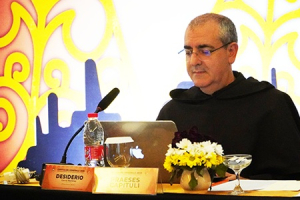
Fr. Desiderio García, new Prior General of the Carmelites: “Our origins are Asian”
In an interview with omnesmag.org, the recently elected prior general of the Carmelite Order, Fr. Desiderio García Martínez, gave insight into his vocation as a Carmelite and where he believes the Order is moving. An online magazine, OMNES is self-described as a Catholic media dealing with current issues from an analytical and reflective point of view, with a Catholic perspective. The interview was published in multiple languages.
Noting that the recent Carmelite General Chapter was held in Indonesia, the prior general remarked on the Carmelite Order’s origins being in the Holy Land. “We came from there, and now the Holy Spirit is taking us back there,” Fr. Desiderio said.
He described the strong growth of the Order in Asia as “only a round trip” since the Order started there. Statistics distributed at the Chapter show that the Asia-Australia-Oceania geographical area contains 722 of the Order’s approximately 2,000 members. Some 263 of these men are in formation. The area is still relatively new to the Order. The oldest Carmelite reality in the area is Australia, founded in 1881, followed by Indonesia in 1923. The Philippines followed in 1958. The Indian Province, the Vietnam Commissariat, the Indian General Commissariat, and the Eastern Indonesian Province are all more recent realities.
The Dutch Province founded the Order in Indonesia in 1923, 102 years ago. Today, in the largest Muslim country in the world, where the Catholic population is only 3%, the Carmelites province recently split, establishing an Eastern Indonesian Province while retaining the Indonesia Province covering the rest of the country. But the prior general cautioned, “The important thing, of course, is not the numbers, nor the strategies, nor the calculations. Rather, it is to see how the gift of the Carmelite charism, its values, its spirituality, under the action of the Holy Spirit, continues to bear fruit.”
Later in the interview, Fr. Desiderio spoke of “contemplation as not only the heart of the Carmelite charism, but also in itself the best gift we can offer to the world and to the Church.” Carmelites are involved in a broad spectrum of ministries and apostolates—“whatever we do, we pay special attention to people’s spiritual journeys.” The mission among the people is always carried out with “the richness of our contemplative life.”
“I believe that one of the great prophetic challenges of Carmel is to help today’s world cultivate the inner life. An inner life that does not distance us from the ordinary life of people, but on the contrary, immerses us more deeply in the sufferings of humanity. A person with a contemplative gaze is a person with compassionate hands.”
He then used the image, quoting the prophet Isaiah, of “the contemplative spreads his tent” to “make room for God and all who come with Him: humanity. Authentic contemplation leads us to tenderness and compassion, to touch the wounds of the Body of Christ and to heal wounds. I insist the quality of our compassion comes from the roots of contemplation.”
As for his priorities during the coming six years, the prior general spoke about his responsibility to watch over the common good of the entire Order, to ensuring that the Order grows in fidelity to its identity, as well as discerning creatively, looking at our world, the new paths along which God is leading us. This involves accompanying the entire Carmelite Family in cultivating our contemplative attitude in the life of prayer, fraternity, and service in proclaiming the Gospel. He reminds us that this is not done by remote control but “looking the brothers and sisters in the eye, getting to know the reality, and dialoguing with each culture. And above all, it involves deploying the “apostolate of listening.” Two areas of focus emerge from returning to our origins: “the renewal of community life as a place of accompaniment and unconditional welcome” and “the care of our mission, opening windows of hope to vulnerable, poor, and forgotten humanity.”
Although Fr. Desiderio is Spanish, he was born in Orange, France, an ancient Roman city and a World Heritage Site in Provence. “I am the son of immigrants,” he said explaining that his father worked at the vineyards of Châteauneuf du Pape, an important wine-producing center in France since the 14th century. When his grandparents grew old and needed assistance, the family returned to Spain. They settled in Onda, site of a major Carmelite foundation. That was where the future prior general was introduced to the Carmelites.
This article is based on an interview by Francisco Otamendi for omnesmag.org.
The full interview is available here in English.
Celebrating Jubilee of Consecrated Life in Rome
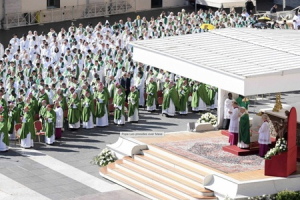
Church Comes Together in St. Peter’s Square to Celebrate Jubilee of Consecrated Life
An overflow crowd of religious sisters and brothers, monks and contemplatives, members of secular institutes, the Ordo Virginum, hermits, and members of “new institutes” from around the world converged on St. Peter’s Square on Thursday morning, October 9, 2025, to join with Pope Leo XIV in celebrating the Jubilee of Consecrated Life.
During his homily, Pope Leo XIV urged religious men and women to be “truly poor, meek, hungry for holiness, merciful,” and to “seek, ask, and knock” for God’s gifts, embodying the prophetic role of religious life. The pope spoke of “God as the fullness and meaning of our lives. For you—for us—the Lord is everything.” He reminded us that “an authentic experience of God always gives rise to generous outpourings of charity.” This can be seen in the lives of the founders and foundresses of the various orders and congregations present.
The pope concluded by urging all the religious “to treasure and cultivate what you have received. … Keep the simplicity of the ‘least ones’ of the Gospel,” in the words of St. Paul VI. “May you succeed in discovering this anew in an interior and closer relationship with Christ and in your direct contact with your brethren.”


