












O.Carm
St. Mary of Jesus Crucified (OCD), Virgin

25 August | Optional Memorial
Mariam Baouardy was born at Abellin in Galilee on 5th January 1846 to very poor parents who were good living and devoted Greek-rite Catholics. She was left an orphan after the death of her parents at only three years of age when, together with her brother Paul, she was entrusted to the care of an uncle,who had moved to Alexandria in Egypt a few years earlier. She never received any formal education and remained unable to read. At thirteen years of age, wanting to give herself only to God, she firmly refused the marriage which her uncle, according to the Eastern custom, had arranged for her. The next few years, she worked as a domestic in Alexandria, Jerusalem, Beirut and Marseilles.
At the beginning of Lent in 1865, she joined the Sisters of Compassion, but falling ill, she was forced to leave after a couple of months. Then she was received into the Institute of the Sisters of Saint Joseph of the Apparition but, after two years as a postulant, she was judged not to be suited for the cloistered life. Finally, on 14th June 1867, she entered the Carmel in Pau.
To read more ...
Bl. Angelus Augustine Mazzinghi, Priest

17 August | Optional Memorial
The Lord says, "The man who hears my commandments and keeps them, he it is who loves me." And the first of all commandments is: “Hear, O Israel: The Lord our God is one Lord; and you shall love the Lord your God with all your heart, and with all your soul, and with all your might. This is the greatest and first commandment." This cannot be observed without love of neighbor, because “he who does not love his brother whom he has seen, cannot love God whom he has not seen;" "and the second commandment is like it, You shall love your neighbor as yourself, 'namely, in the things and for the reason that you love yourself." His soul hates him who loves violence," says the Psalmist. Therefore, love your neighbor as yourself in good and not in evil, and "whatever you wish that men would do to you, do so to them" and "what you hate, do not do to anyone." Thus, you must love your neighbor, and so act that he becomes just if he is wicked, or remains just if he is good.
Again, you must love yourself, not because of yourself, but because of God. Whatever is loved because of itself is thus made a source of joy and a happy life, the hope of attaining which is comforting even on earth. But you must not place the hope of a blessed life in yourself or another man. “Cursed is the man who trusts in man and makes flesh his arm, whose heart turns away from the Lord." Therefore you must make the Lord the source of your joy and the happy life, as the apostle says: “But now that you have been set free from sin and have become slaves of God, the return you get is sanctification and its end, eternal life in Christ Jesus our Lord.”
If you understand this clearly, you must love God because of himself, and yourself, not because of yourself, but because of God; and, since you must love your neighbor as yourself, you must love him, not because of himself, nor because of yourself, but because of God, and what else is this but to love God in your neighbor? “By this we know that we love the children of God, when we love God and obey his commandments." In the preparation of your soul, you do all of this if you love God because of himself and your neighbor as yourself because of God. “On these two commandments depend all the law and the prophets.”
To read more ...
Bl. Isidore Bakanja, Martyr

12 August | Optional Memorial
On April 24, 1994, Blessed Isidore Bakanja, layman and martyr of the Scapular of the Virgin Mary of Mount Carmel, was beatified by Pope John Paul II. Today the Order comes together to celebrate the 31st anniversary of the Church's recognition of the holiness of this Congolese Catholic who would not give up his scapular.
Isidore Bakanja was born in Bokendela (Democratic Republic of Congo) around 1885. Leaving his village, he moved to Mbandaka, where he was baptized on May 6, 1906 and confirmed a few months later, on November 25, 1906. He was heavily influenced by the witness of the Trappist missionaries, cultivating a special devotion to Jesus and the Blessed Virgin Mary.
Despite the difficulties he encountered at work because of his fidelity to Christ, he remained steadfast in his faith. On February 2, 1909, he suffered an atrocious scourging because he refused to get rid of the scapular of the Virgin Mary of Mount Carmel which he wore over his shoulders. Following a terrible beating and sensing his impending death, he received the anointing of the sick on July 24, 1909. Just as Christ died having forgiven his wrongdoers, so Bakanja died having forgiven his executioner: “The white man hit me; that's his business. It's up to him and God. When I get to heaven, I'll pray a lot for him and ask God to forgive him.”
Bakanja died on the Feast of the Assumption, August 15, 1909, at the age of 24. In imitation of Christ, whom he had followed from the moment of his baptism, Isidore Bakanja lived in his own way, like Saint Paul, who wrote: “For me, to live is Christ.” (Philippians 1, 21). "For me, to live is to be a Christian."
On June 7, 1917, his remains were exhumed and buried at the Immaculate Conception Parish in Bokote. He was proclaimed Blessed on April 24, 1994. His cause for canonization is now underway. Popes Benedict XVI and Francis have recognized and proposed Blessed Isidore Bakanja as an authentic witness and example of faith for all Christians in the world. In his post-synodal Apostolic Exhortation Christus vivit, Pope Francis named Blessed Isidore Bakanja among the young saints who today mobilize Christians in their quest for holiness and inspire new conversions. In short, Blessed Isidore Bakanja is a spiritual and ecclesial heritage for the world.
To read more ...
Feast of St. Teresa Benedicta of the Cross

Pope John Paul II declared St. Teresa Benedicta of the Cross, along with St. Bridget of Sweden and St. Catherine of Siena, as co-patronesses of Europe on October 1, 1999. The pope gave his rationale in a motu proprio Spes aedificandi:
Accordingly, during the celebration of the Second Special Assembly for Europe of the Synod of Bishops, on the eve of the Great Jubilee of the Year 2000, it has seemed to me that the Christians of Europe, as they join their fellow-citizens in celebrating this turning-point in time, so rich in hope and yet not without its concerns, could draw spiritual benefit from contemplating and invoking certain Saints who are in some way particularly representative of their history. Therefore, after appropriate consulation, and completing what I did on 31 December 1980 when I declared Co-Patrons of Europe, along with Saint Benedict, two Saints of the first millennium, the brothers Cyril and Methodius, pioneers of the evangelization of the East, I have decided to add to this group of heavenly patrons three figures equally emblematic of critical moments in the second millennium now drawing to its close: Saint Bridget of Sweden, Saint Catherine of Siena and Saint Theresa Benedicta of the Cross. Three great Saints, three women who at different times—two in the very heart of the Middle Ages and one in our own century—were outstanding for their fruitful love of Christ's Church and their witness to his Cross.
We link to the full text of the motu proprio. Numbers 8 and 9 are specifically about Edith Stein-- St. Teresa Benedicta of the Cross. We hope you enjoy these inspiring words on St. Teresa Benedicta day.
To read more ...
St. Albert of Trapani, Priest

7 August | Feast
There are three general practices to which our profession obliges us: obedience, chastity, and the renunciation of ownership. These are common to the profession of all Orders. As far as these practices are concerned there is no difference between the Orders except in their dress; they are all essentially one, as it were, as long as they are equally strict, and all who observe the same practices with equal strictness are worthy of equal merit.
But in our Order, as in every other, these general practices are reinforced by others that are more particular, and by these the Orders are distinguished one from another, some being stricter than others. With regard to these practices any religious who has asked permission, even if it has not been granted, is allowed by common law to transfer from one Order to another to gain the benefit of a more perfect way of life.
“How great are your works! Your thoughts are very deep.” “The dull man cannot know these things indeed, nor the fool understand them.” “Who has known the mind of the Lord whose wisdom is beyond measure, or who has been his counsellor?” For the Lord, whose providence is unerring in its dispositions, designedly set some in the desert with Mary, when it was his purpose to array the garden of the Church Militant with a diversity of Orders, and others with Martha in the city. Those endowed with learning, industrious in the study of the Scriptures, and of adequate moral probity, he established in the city, so that they could exercise their zeal in nourishing the people with his word. Those of a simpler cast, however, those with whom he holds secret colloquy, he marked out to be sent into the desert with the Prophet who said: “Lo, I have journeyed afar in flight; I fixed my abode in the wilderness. I awaited him who saved me from faintheartedness, and from the tempest.”
He uses the word 'Lo' demonstratively, to draw attention to his words, as if to say: “See what I have done, and do likewise yourself. In my flight from the turmoil of the world I did not stay to dwell within the walls of the city, nor in its suburbs, nor amid its outlying gardens nor anywhere in the neighborhood, but I journeyed afar in flight, and ‘fixed my abode in the wilderness.’ And I ‘fixed my abode;’ there is truth: I did not return to the city after a few days, as they do now, but I fixed my abode in the wilderness, awaiting ‘him who saved me from faint-heartedness and from the tempest.’”
With such special care has the Lord provided for the guidance of all religious, whether in the desert or in the city, that in his infinite wisdom he has given them all, through those best qualified to draw up their Rules, their own distinct ways of life, the ways he knew to be best suited to each of the Orders in the circumstances its members would find themselves in.
To read more ...
Carmelite Nuns Celebrate Elective Chapter in Madrid

The Monastery of Our Lady of Maravillas in Madrid, Spain Celebrated Its Elective Chapter July 24-25
On July 24-25, 2025, the Carmelite nuns of the monastery of Nuestra Señora de las Maravillas in Madrid, Spain, held their elective chapter.
The monastery was founded by Joanna de Baraona in 1612 as a place for pious women to gather in order to practice Christian perfection. With the help of Antonio Pérez, prior provincial of the Castille Province, the beateria became an official Carmelite monastery with its reception of the papal enclosure.
The monastery founded San José de las Matas (1954) and Dumaguete (1958).
The monastery belongs to the Mater Unitatis Federation.
Those elected to leadership are:
Prioress | Priora | Priora:
Hna. Ma Brunilda Rodríguez Velasco
1st Councilor | 1ª Consejera | 1ª Consigliera:
Hna. Ma Inmaculada Ochoa Blázquez
2nd Councilor | 2ª Consejera | 2ª Consigliera:
Sr. Ma. Antonia Domínguez Cortés
3rd Councilor | 3ª Consejera | 3ª Consigliera:
Hna. Ma Luisa Ruiz Cerro
4th Councilor | 4ª Consejera | 4ª Consigliera:
Hna. Ma del Carmen Martínez Pérez
Treasurer | Ecónoma | Economa
Hna. Ma Cristina Gil Moreno
Formator | Formadora | Formatrice
Hna. Ma Antonia Domínguez Cortés
Sacristan | Sacristán | Sacrestana:
Hna. Ma del Carmen Ruiz Navas
Celebrating At Home - 18th Sunday in Ordinary Time

False Security
(Luke 12:13-21)
All too often we are made aware of the vulnerability and uncertainty of life. Things can suddenly change. We don’t know what will happen today, tomorrow or even in a few moments’ time. Such experiences can make us profoundly anxious, and we look for ways to protect ourselves and what we own against life’s adverse events. It is not only a problem for wealthy people like the rich man in the Gospel today. It can be a problem for all of us. We seem to have an instinctive need to build a sense of security by amassing goods and wealth.
A strong focus in the Luke’s Gospel is that nothing is more destructive of life and humanity than the need to acquire, hold on to and increase wealth. The problem is not the riches we possess but that our need to possess them gets in the way of our relationship with God, our only true security. That same need also gets in the way of our concern for others. We become reluctant to share what we have in case we may need it one day.
In many ways the Gospel is about the fundamental orientation of a disciple’s life - do we live for ourselves and our possessions, or for God and the Kingdom? Do we own our possessions, or do they own us? What do we value most in life?
Thirsting after material things distorts us, narrows our focus and corrupts our moral sense. As disciples of Jesus, we try to keep God at the centre of our lives. In Baptism and Confirmation we pledge ourselves to be willing workers with God in making God’s dreams and hopes for us all a reality.
A successful life in God’s eyes is not about storing up material treasure for ourselves (the parable of the rich man in this Sunday’s Gospel) but about being a source of real treasure for others (the servant parable in next Sunday’s Gospel). Quite often, the prayers of the Mass ask God to help us to use wisely the good things of the earth.
God’s wisdom always directs us towards using who we are and what we have to enrich the lives of others.
Living according to the heart of God helps us keep all things in their right order and opens us up to God’s wider vision of reality.
- pdf Celebrating At Home - 18th Sunday in Ordinary Time [PDF] (2.78 MB)
- default Celebrating At Home - 18th Sunday in Ordinary Time [ePub] (1.77 MB)
- pdf Celebrando en Familia - XVIII Domingo del Tiempo Ordinario (452 KB)
- pdf Celebrando in Casa - XVIII Domenica del Tempo Ordinario (444 KB)
- pdf Celebrando em família - XVIII Domingo do Tempo Comum (436 KB)
Lectio Divina August, 2025

Opening Prayer
God our Father and protector, without You nothing is holy, nothing has value.
Guide us to everlasting life by helping us to use wisely the blessings You have given to the world.
We ask this through our Lord Jesus Christ, Your Son, who lives and reigns with You and the Holy Spirit, one God, for ever and ever. Amen.
St. Titus Brandsma, priest and martyr

July 27 | Memorial
A new awareness of Thy love
Encompasses my heart:
Sweet Jesus, I in Thee and Thou
In me shall never part.
No grief shall fall my way but I
Shall see thy grief-filled eyes;
The lonely way that Thou once walked
Has made me sorrow-wise.
All trouble is a white-lit joy
That lights my darkest day;
Thy love has turned to brightest light
This night-like way.
If I have Thee alone,
The hours will bless
With still, cold hands of love
My utter loneliness.
Stay with me, Jesus, only stay;
I shall not fear
If, reaching out my hand,
I feel Thee near.
Translated by Fr. Gervase Toelle, O. Carm.
To read more ...
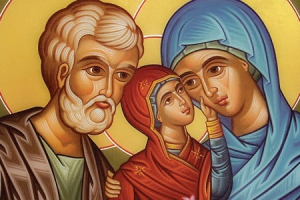
The Story of Anne and Joachim in Apocryphal Sources
26 July Memorial
According to some of the apocryphal traditions, Joachim was a very wealthy and generous man. However, he and his wife, Anne, were childless until they were advanced in years. One day, before Anne conceived Mary, Joachim arrived at the Temple to make an offering. It was rejected by a man named Rubim, most likely a Levitical priest, because Joachim was childless. Rubim rebuked Joachim for bringing offerings before he had a child. Children were exceedingly important at that time and someone childless was seen as in disfavor with God.
Distressed, Joachim left the Temple and studied the Scriptures to see if he could find anyone of importance who, like he and Anne, were childless. When he came upon Abraham, he recalled that Abraham was only given a child in his old age. Rather than returning home to Anne, Joachim embarked on a forty-day period of fasting and praying in the desert, beseeching God for a child.
Anne, for her part, also went to pray, asking God for a child. As she prayed, an angel appeared to her and communicated that God had heard her prayer and she would have a child who “will be spoken in all the world.” An second messenger from God appeared to Joachim and assured him that God had heard his prayer and that his wife would conceive. Nine months later, the child arrived and was names Mary.
Because of a vow Anne and Joachim had made, when Mary was only three, they brought her to the Temple where she took up residence until it was time for her to be married. She was educated by the priests and holy women and spent her days in prayer and union with God.
Though this story of the Blessed Virgin Mary’s birth and presentation in the Temple comes from apocryphal sources, the Presentation of Mary in the Temple is a liturgical feast first celebrated in the Eastern Church as early as the sixth century and the Western Church in the eleventh century. In the old city of Jerusalem, there still stands an ancient church next to the Temple Mount in which it is believed that the Blessed Virgin Mary was born and might have lived during her early days after being presented in the Temple.
Though not much more is known about Saints Joachim and Anne, devotion to them, especially to Saint Anne, began to grow as early as the sixth century. Churches were built in her honor, prayers were offered for her intercession, devotions were formulated, and patronages were attributed to her. It wasn’t until the sixteenth century that devotion to Saint Joachim began to grow when his feast day was placed on the General Roman Calendar.
St. Anne is now the patron saint of grandparents, grandmothers, mothers, cabinetmakers, carpenters, dressmakers, equestrians, expectant mothers, homemakers, housewives, lace workers, seamstresses, miners, old-clothes dealers, Canada, and France. Saint Joachim is also patron saint of grandparents as well as grandfathers, fathers, married couples, cabinetmakers, and linen traders.
To read more ...


