












O.Carm
Celebrating At Home - 24th Sunday in Ordinary Time

A Family Formed by Forgiveness - Part 2
(Matthew 18:21-35)
Today’s Gospel follows directly from last Sunday’s reading about how to deal with differences and disputes.
Peter has understood the point of last Sunday’s Gospel (forgiveness and pastoral care), but wants to know the limits – is forgiving someone seven times enough? Jesus’ reply indicates that there should be no limit to the number of times. Then he tells a parable about forgiveness and gratitude.
There is no doubt that genuine forgiveness, forgiveness ‘from the heart’, is a real challenge. The more personally we are hurt by another person the harder it is to forgive them. Forgiveness is often more a movement than a moment. Often we only come to forgiveness step by step over a long period of time.
If we can pray for those who hurt us we have already taken the first step on the road to forgiveness. Forgiveness does not imply that what a person did was OK.
The biblical idea of forgiveness is built on the awareness of God’s extraordinary compassion towards us; God’s refusal to hold our past against us - the theme of today’s first reading.
But that action of God must find its resonance in how we behave towards each other. It will only have that resonance when we experience personally God’s overwhelming love for us. That is what binds us into relationship with God and into acting towards others as God has acted towards us.
That experience of God’s compassion builds a gratitude in us which enables us to forgive each other.
For the disciple of Jesus, forgiveness must be real and genuine - from the heart - and built on the awareness of God’s compassion and mercy towards us. That is why Jesus includes forgive us our debts as we have forgiven those who are in debt to us in his great prayer. If God has forgiven us, then we must forgive each other.
We don’t live our Christian lives in some kind of fantasy-land filled with pious thoughts and lovely dreams. We live it in the often harsh realities and difficult situations that human beings encounter.
How we live it will depend on the degree to which we have the same mind and heart as God.
Real life is the proving-ground of faith.
- pdf Celebrating At Home - 24th Sunday in Ordinary Time [PDF] (2.81 MB)
- default Celebrating At Home - 24th Sunday in Ordinary Time [ePub] (1.79 MB)
- pdf Celebrando en Familia - 24 Domingo del Tiempo Ordinario (446 KB)
- pdf Celebrando in Casa - 24 Domenica del Tempo Ordinario (448 KB)
- pdf Celebrando em familia - 24 Domingo do Tempo Comum (448 KB)
Laudato Si’ Part 2 Being Written

Speaking to lawyers from the member countries of the Council of Europe, Pope Francis mentioned that he was writing a second part to the Laudato Si’ encyclical that was released on Pentecost in May 2015. The pope feels it necessary to update the encyclical because of “current issues.” The pope expressed his gratitude to the lawyers for their work in developing a legal frameword to protect the environment.
"We must never forget that the younger generations have the right to receive a beautiful and livable world from us, and that this implies that we have a grave responsibility towards creation which we have received from the generous hands of God,” said the Pope. “Thank you for your contribution."
Matteo Bruni, the director of the Holy See Press Office, later explained that the Laudato si version 2 will focus on the most recent extreme weather events and catastrophes affecting people across five continents.
New Foundation of Carmelite Nuns in Kenya

The Carmelite Monastery of Our Lady of Protection Museve Shrine was officially opened on September 1, 2023. The Rt. Rev. Joseph Mwongela, bishop of Diocese of Kitui, conducted the ceremony.
According to the sisters who took part, "The celebration was very joyous and colorful." Some 500 people were in attendance to witness the new growth of Carmel in Africa.
Also participating was the General Delegate for Kenya, Patrick Musyimi, O. Carm., as well as other members of the community and lay Carmelites.
Six of the nuns from Machakos will make up the new community: Sr. Margarita de Cristo Rey, O. Carm.; Sr. Mary Grace Mumbi, O. Carm.; Sr. Mary Leho Raissa, O. Carm.; Sr. Mary Lucy Nthule, O. Carm.; Sr. Mary Veronica Muthini, O. Carm.; Sr. Mary Lucy Munyiva, O. Carm.
Meeting for Formators of the Americas
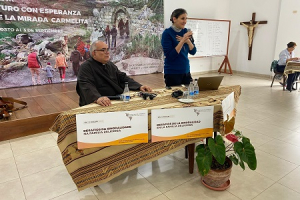
From the General Councilor for the Americas
FOCAM - Meeting for Carmelite Formators of the Americas -- Embracing the Future with Hope from a Carmelite Perspective
A meeting of FOCAM (Carmelite Formation in the Americas) was held from August 27 to September 3 in the Villa Carmelitas retreat house in Lurín, Perú. Friars, sisters and laity from Argentina, Bolivia, Brazil, Colombia, the United States, El Salvador, Peru, the Dominican Republic, Trinidad and Tobago, and Venezuela participated.
It was a week with much reflection, prayer and fraternity. The different themes developed invited and challenged us to meet as Carmelite Family, as Church, after the whole experience of the pandemic. It was a time of God, where friars, religious and laity turned their gaze to God from the Carmelite experience already initiated through the virtual meetings.
The motto of this meeting, "Embracing the Future with Hope from the Carmelite Point of View," simply reflects the desire of the heart to meet God, living the present and projecting towards the future.
At the end of the meeting we were able to confirm that what was planned was developed with a good dynamic and pedagogy helped by the following speakers: Marlom Francis, O. Carm. Prov. Fluminense; Vagner Sanagiatto, O. Carm., Commissariat of Paraná; Benny Phang, O. Carm., General Curia; Sister Liliana Franco Echeverri, ODN, president of CLAR and Licentiate Daniela Emmerich.
"We thank all the brothers and sisters who participated in this meeting of the Carmelite Family of the Americas. It was basically an experience of synodality, as our sister Liliana reminded us," said Luis Maza, General Councilor for the Americas.
There was great appreciation for the Secretariat of the Americas guidance in this FOCAM gathering. "We also thank God for the hospitality of the Carmelites of Peru. See you in Brazil in 2026," concluded Maza.
Vitam Coelo Reddiderunt

|
01-09-23 |
|
|
|
|
XXI General Chapter of the Sisters in Tales

The Hermanas de la Virgen María del Monte Carmelo celebrated their XXI General Chapter from July 19 to August 13.
The meetings were held in the congregation's House of Spirituality in Tales (Castellon). The theme of the Chapter was "Be a Transmitter of the Charism: From Our Vulnerability, in the Way of Sinodality".
The final act of the General Chapter was the election of the new general government of the Congregation. This took place on August 12.
The election results were:
Superior General –
Merry Teresa Sri Rejeki
Vicar General –
María del Carmen Aparicio Personal
2nd General Councilor and General Secretary –
Fabiola Ma Freitas Gusmao
3rd General Councilor and General Treasurer –
Ma Dolores Colon Molina
4th General Councilor –
María del Carmen Sanchez Mesa
Celebrating At Home - 23rd Sunday in Ordinary Time

A Family Formed by Forgiveness
(Matthew 18:15-20)
Chapter 18 of St Matthew’s Gospel is often referred to as the Sermon on the Church. It contains the teaching of Jesus about the life of the Christian community.
Today’s reading details a procedure for dealing with differences and disputes. It follows the Parable of the Lost Sheep which is concerned with seeking out and bringing back the one who gets lost.
In the same way, resolving disputes is not about being right and punishing an offender, but about conversion and reconciliation.
The three-stage process moves from individual dialogue to a small group trying to sort things out, to the whole community being involved in discernment and decision.
Traditionally, we have understood the words, ‘if he refuses to listen to the community, treat him like a gentile or a tax collector, to mean that the person should be expelled or excommunicated from the community.
However, Jesus was notorious for sharing meals with tax collectors and sinners and he called one of them, Matthew, into his inner circle of disciples. At the end of the Gospel, Jesus instructs the disciples not to reject the pagans but to invite them to become children of God. Excommunication doesn’t seem to fit either with the sentiments in the Lord’s prayer about forgiveness.
The parable of the Lost Sheep immediately before this passage seems to indicate that the church, following Jesus’ example, should never give up on any of the sheep, especially the lost ones. It has a responsibility to try to win them back.
The next verse about ‘binding and loosing’ extends to the community the power of authoritative decision- making given to Peter and the disciple-leaders in the Gospel of two Sundays ago. This decision-making follows community discussion and discernment about what is to be done.
If members of the community pray and discern together about how to win back the lost one, their prayer will be heard, even if only two pray. Jesus reminds then that whenever members of the community gather in his name he is present with them.
We share a common responsibility for the lives and faith of one another and for our community as a whole. Our presence, example and prayer encourage and confirm the faith and life of Jesus among us.
- pdf Celebrating At Home - 23rd Sunday in Ordinary Time [PDF] (2.87 MB)
- default Celebrating At Home - 23rd Sunday in Ordinary Time [ePub] (2.44 MB)
- pdf Celebrando en Familia - 23 Domingo del Tiempo Ordinario (439 KB)
- pdf Celebrando in Casa - 23 Domenica del Tempo Ordinario (441 KB)
- pdf Celebrando em familia - 23 Domingo do Tempo Comum (441 KB)
Celebrating At Home - 22th Sunday in Ordinary Time

Finding Real Life
(Matthew 16:21-27)
What a contrast there is between last Sunday’s Gospel, when Peter was proclaimed the ‘rock’ on which the church would be built, and this Sunday when Jesus rebukes him for being a different kind of rock - a ‘stumbling block’!
When Jesus starts to talk about his suffering, death and resurrection, it’s more than Peter can cope with - “This must not happen to you.” This is exactly what Jesus was afraid of when he bound the disciples to silence about his true identity in last Sunday’s Gospel. He was afraid that they would think of him as a warrior leading a victorious uprising against the Roman occupation of Israel - the popular image of the Messiah in Jesus’ day.
Last week, Jesus proclaimed Peter ‘blessed’ because of his God-given insight into who Jesus is. Now Peter is ‘Satan’ because it is not God-given insight, but human thinking, he now shows.
Can we cope with having a shepherd-king rather than a warrior-king as our God and Saviour?
Jesus then starts talking about the call of discipleship.
First of all, it has to be freely chosen. Discipleship is not something which can be forced on people.
Second, the disciple must learn to put God and others at the centre of his/her life. This is not some pious idea. People in true, loving relationships, especially parents, know exactly what it means to ‘take up your cross’ and follow Jesus by doing loving acts of service everyday - to put another’s needs ahead of your own.
Such people save their lives by living human life as Jesus taught and as God intended.
Those who set about trying to ‘save’ their lives through power, wealth and a comfortable life eventually lose the little life they have. Nothing can prevent the moment of death when all that is stripped away and becomes meaningless. That’s what the lines about gaining the whole world and ruining your life mean.
At the end of the day, the faithfulness of the disciple, shown in loving deeds, will be rewarded.
What Jesus says about discipleship is a very different way to live and seems totally opposite to the values of modern society where we think we are in control of our destiny; where life is about amassing wealth and living comfortably for ourselves rather than for others.
- pdf Celebrating At Home - 22th Sunday in Ordinary Time [PDF] (2.89 MB)
- default Celebrating At Home - 22th Sunday in Ordinary Time [ePub] (3.23 MB)
- pdf Celebrando en Familia - 22 Domingo del Tiempo Ordinario (459 KB)
- pdf Celebrando in Casa - 22 Domenica del Tempo Ordinario (461 KB)
- pdf Celebrando em familia - 22 Domingo do Tempo Comum (460 KB)
St. Teresa Margaret Redi (OCD), Virgin

1 September Optional Memorial
Saint Teresa Margaret Redi was born in Arezzo on 1st September 1747 into the noble family of Redi. In 1764, she entered the monastery of the Discalced Carmelites in Florence, changing her baptismal name of Anna Maria to that of Teresa Margaret of the Sacred Heart of Jesus.
An Ecumenical Dialogue on St Thérèse
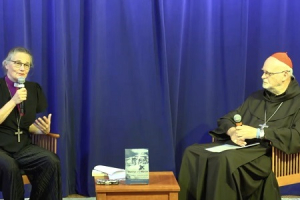
Dialogue with Anders Cardinal Arborelius, OCD, and Bishop Karin Johannesson (Lutheran Church)
The Center for Carmelite Studies at the Catholic University of America in Washington, DC, sponsored a dialogue between two leading experts on ecumenism in Sweden. The event was held at the St. John Paul II National Shrine in Washington, DC. A recording of the event is available online.
Anders Cardinal Arborelius, OCD, is the bishop of Stockholm since 1998. He converted to Catholicism at the age of 20. Bishop Karin Johannesson is the bishop of the Diocese of Uppsala and a professor of religion at Uppsala University.
The event began with some words from Dr. Peter Kilpatrick, the president of the Catholic University of America. Although his field of study is engineering, Dr. Kilpatrick spoke of his personal devotion to St. Thérèse of Lisieux.
Also present were a number of Catholic and Lutheran officials, particularly those with interest in and working on ecumenism between the two Churches.
Bishop Johannesson published a book on “receptive ecumenism” involving dialogues between Martin Luther and three Carmelites, St. Thérèse, St. John of the Cross, and St. Teresa of Avila. Dr. Johannesson became familiar with the Carmelites through reading books available at a local bookstore.
During the discussion, the Cardinal suggested that the rich tradition of publishing books on spirituality in Sweden has promoted the development of a deep spirituality in some of the people even if they are not church goers. Ecumenism, grounded in this spirituality, has been able to move forward. Bishop Johannesson found her own story, her own theology, her own spirituality coincided with that of Thérèse—particularly Thérèse’s idea that everything is grace. Grace is also fundamental to the life, theology, and spirituality of Martin Luther.
They discussed how the saints and mystics put flesh on dogmatic theology, This facilitates forward movement in the ecumenical dialogue. They stipulated that a unified, deeper approach to living faith together will enhance the ecumenical dialogue.
Shortly after 1 hour of the video, the audience is welcomed into the discussion with questions and comments
The conference can be viewed at: https://www.youtube.com/watch?v=-3QW1WqcDFw
The Center for Carmelite Studies was established by the Province of the Most Pure Heart of Mary of the Carmelite Order in 2019. Its purpose is to ensure the future of serious study of Carmelite spirituality and history through academic classes, lectures, and other activities. It is anchored in the School of Theology and Religious Studies in the Catholic University of America. The website for the Center for Carmelite Studies at the Catholic University of America.


