
















O.Carm
Letter to the Order on the Ministry of Carmelite Shrines

The General Commission for Liturgy and Prayer developed a document on the development of shrines and friaries in our Order. These houses offer a way of building up the church that is different to the work of parishes. With a view to continuing reflection on this question the General Council signed the commission's letter. It is being distributed to the Carmelite Family for further reflection. This is considered a step towards developing this ministry more, one in which our Carmelite identity can be much more to the fore. This may lead to a reflection on suggestions as to how our parishes should be run so that we give our full Carmelite contribution to the Church also through our parishes.
Celebrating At Home - 32nd Sunday in Ordinary Time

A work in progress
(Luke 20:27-38)
In this episode from Luke’s Gospel, it is the Sadducees, rather than the Pharisees, who confront Jesus. Like the Pharisees, the Sadducees were a Jewish sect. They rejected much of what the Pharisees believed in, including the possibility of life after death.
The rather ridiculous scenario they put to Jesus in today’s Gospel was meant to show how ridiculous belief in resurrection was.
Part of the flaw in their scenario was the assumption that life after death would be the same as life is now, with the same conditions applying. So, they based their scenario on marriage in this world in order to ask the question about whose wife the woman would be in the next.
Without ridiculing their beliefs, Jesus says that in the risen life we are dealing with a totally new situation, one not governed by the laws of this life.
Then Jesus also uses a quote from Moses to show that Moses himself implies that the dead rise again.
Jesus’ proclamation of the ‘God of the living’ gives us the right context for viewing eternal life. Not as separate to, but as a continuation of the relationship with God we already live here. This also helps make sense of the Kingdom or Reign of God as already being present among us – not just as something yet to come.
God’s life in us is a work in progress. The disciples of Jesus live the life of the Kingdom now to the extent that they share in the life of God and can enable that reign of God’s grace to be experienced by others through the good deeds they do.
Eternal life is not something yet to come, but something we have already begun to live here and now.
- pdf Celebrating At Home - 32nd Sunday in Ordinary Time [PDF] (3.06 MB)
- default Celebrating At Home - 32nd Sunday in Ordinary Time [ePub] (4.31 MB)
- pdf Celebrando en Familia - 32 Domingo del Tiempo Ordinario (732 KB)
- pdf Celebrando in Casa - XXXII Domenica del Tempo Ordinario (635 KB)
- pdf Celebrando em Família - 32 Domingo do Tempo Comum (637 KB)
155/2022: Vitam Coelo Reddiderunt

|
06-10-22 |
Ortus
|
P. Temp.
|
P. Soll.
|
Ord.
|
|
14-10-22 |
|
|
|
|
Conference on the Centenary of Clavis Ecclesiae
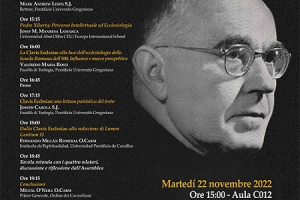
November 22 | Gregorian Pontifical University | 3 PM
The Gregorian University in Rome will host a 100 year anniversary celebration of the publication of Carmelite Bartolomé Xiberta's doctoral thesis, Clavis Ecclesiae. There celebration will take place on November 22, beginning at 3PM.
Speakers will include Josep M. Manresa Lamarca of the Universidad Abat Oliba CEU/Europa International School; Valfredo Maria Rossi of the Theology Faculty of the Pontifical Gregorian University; Joseph Carola, SJ, of the Theology Faculty of the Pontifical Gregorian University; and Fernando Millán Romeral, O. Carm., of the Instituto de Espiritualidad, of the Universidad Pontificia de Comillas in Madrid.
In 1921 Fr. Xiberta defended the idea that the Sacrament of Penance is an ecclesial act, administered in the name of the Church, and that the immediate principle benefit of the sacrament (res et sacramentum) is reconciliation with the Church. This thesis was progressively assimilated by theological reflection and subsequently influenced the drafting of Lumen Gentium 11 in the Second Vatican Council.
The commemoration is sponsored by the Gregorian University and the Carmelite Order.
Seminar on the Spirituality of Fr. Avertan Fenech
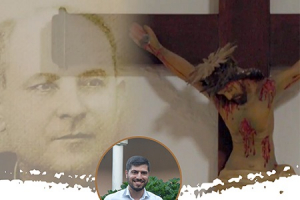
Seminar on Christ Our Perfection: The Christological Spirituality of Fr. Avertan Fenech, O. Carm.
Warren Borg Ebejer TOCS
October 29 | Kunvent Tal-Karmnu, Mdina
Carmelite Life revolves entirely around Christ Jesus as the only way to our union with God. The Carmelite Rule actually proposes a project of life through which the Carmelite "walks in the footsteps of Jesus Christ and serves him with a pure heart and a clean conscience" (n. 2). Every spiritual lifestyle claiming to be authentically Christian and therefore Carmelite keeps Christ at the heart of the person and the spiritual project.
In this seminar Mr. Warren J. Borg Ebejer, TOCS, explores the Christological spirituality presented in the writings and life of the Servant of God F. Avertan Fenech and shows us how Christology is not only talk and reasoning (logic) about the person and mystery of Christ, but implies also a life lived according to "the mind" or "the thought" and "the sentiments" of Christ (1 Cor 2:14-16). In one word, it implies that a person walks according to the logic of Christ. In this seminar we will have the possibility to sift through some of Fr. Avertan's writings and reflect on them.
Mr. Borg Ebejer will also launch his book, published by Edizioni Carmelitane, entitled Christ Our Perfection: The Christological Spirituality of Fr. Avertan Fenech, O. Carm.
Location: Carmelite Priory, Mdina
The seminary will be in English
There is also the possibility of following the seminar by Zoom: https://universityofmalta.zoom.us/j/99610101733?pwd=VkFPVVRGWmV3SE5OeFkyZHlFVlRlQT09
Meeting ID: 996 1010 1733
Passcode: 734107
Program:
October 29, 2022 from 10:00 to 01:00 p.m.
10.00 am First Session: Lecture
10.45 am Pause
11.00 am Second Session: Lecture
11.45 am Analysis of selected passages
12.30 pm Light lunch
To access this and many other fine publications at Edizioni Carmelitane, click here.
To place your order please contact Edizioni Carmelitane at This email address is being protected from spambots. You need JavaScript enabled to view it.
Celebrating At Home - 31st Sunday in Ordinary Time

Making assumptions
(Luke 19:1-10)
It is all too easy to make assumptions about other people which turn out not to be accurate. In the Gospel today, the crowd assumes that Zacchaeus is wicked and sinful, a traitor to his people because he is a tax collector.
The scene for the Gospel is, as usual, set by the first reading from the Book of Wisdom – in praise of a God whose love for what he has created allows him to overlook sins. God is all-powerful and all-merciful, the lover of all he creates and the lover of all life, ‘whose imperishable spirit is in all’. God corrects his people through forgiveness, drawing people away from evil and towards trust in himself.
This loving, forgiving action of God is on show in the Gospel story. Where we might have expected Jesus’ to condemn Zacchaeus, as the crowds do by excluding him and labelling him a ‘sinner’, Jesus recognises the good that Zacchaeus does even in his so-called ‘sinful’ situation (being a tax collector on behalf of the Roman government). Salvation does not lie in appearing to be good, but in being good. Such a person is truly a ‘son of Abraham’ – one of God’s chosen.
It might be helpful to note here that in Zacchaeus’ speech about intending to give half of his property to the poor and so on, the verbs are usually translated into future tense, as in the version which appears here. In the original Greek manuscripts, however, the verbs are unambiguously in the present tense. So Zacchaeus is describing how he presently conducts his life – a defence against the condemnation of the crowd that he is a ‘sinner’ and a traitor.
It is the crowd who turns out to be ‘what was lost’, not Zacchaeus.
Read against the background of Luke’s community, the story raises questions about judging on appearances, who is truly at rights with God, who is truly the sinner. An echo of last week’s parable about the Pharisee and the Tax Collector.
Most of all, building from the first reading, it is a story about the God who does not judge and punish as we would, but who loves, forgives, heals and reconciles people to one another.
When Jesus pronounces Zacchaeus a ‘son of Abraham’ he removes the barrier between the crowd and Zacchaeus and reconciles them.
- pdf Celebrating At Home - 31st Sunday in Ordinary Time [PDF] (3.49 MB)
- default Celebrating At Home - 31st Sunday in Ordinary Time [ePub] (3.18 MB)
- pdf Celebrando en Familia - 31 Domingo del Tiempo Ordinario (630 KB)
- pdf Celebrando in Casa - XXXI Domenica del Tempo Ordinario (629 KB)
- pdf Celebrando em Família - 31 Domingo do Tempo Comum (628 KB)
Assembly for the Federation of Nuns Held in Zaragoza

From October 17 to 22 the Assembly for the Mater Unitatis Federation of Carmelite nuns was held at the Casa de Espiritualidad "Santos Ángeles" of the Hermanas Angélicas in the city of Zaragoza, Spain.
The Federation was canonically erected on December 10, 1980 and comprises the enclosed monasteries of Caudete, Fontiveros, Huesca Asuncion, Huesca San Miguel, Madrid, Onteniente, Valencia, and Zaragoza.
The results of the elective chapter were as follows:
Federation President | Presidente de la Federación | Presidente della Federazione:
Rvda. Madre Ma del Sagrario Lorite Beltrán, O. Carm.
1st Councilor | 1ª Consejera | 1ª Consigliera:
Hna. Ma Mercedes de la Cruz Medina Zárraga, O. Carm.
2nd Councilor | 2ª Consejera | 2ª Consigliera:
Hna. Inés Nthenya Nzyuko, O. Carm.
3rd Councilor | 3ª Consejera | 3ª Consigliera:
Hna. Ana wairimu thuo O. Carm.
4th Councilor | 4ª Consejera | 4ª Consigliera:
Hna. Ma Brunilda Rodriguez Velazco, O. Carm.
Director of Novices | Maestra de Novicias | Maestra delle Novizie
Sr Maria Sabina Berneschi, O. Carm.
Treasurer | Ecónoma | Economa:
Hna. Inés Nthenya Nzyuko, O. Carm.
Secretary | Secretaria | Segretaria:
Hna. Mª Mercedes de la Cruz Medina Zárraga O. Carm.
Lectio Divina November 2022

Available in Spanish the book 'The Price of Truth' on St. Titus

The Price of Truth: Titus Brandsma, Carmelite (in Spanish)
by Miguel Maria Arribas, O. Carm.
The biography of the Church's most recent martyr--a dangerous friar according to the Nazis--Fr. Arribas succeeds in capturing the heart and soul of St. Titus Brandsma's lessons for us today. We all know the life of Titus, but in this book Fr. Arribas explores the documentation behind the canonization process to show why Titus is so important for today.
A simple and cordial Carmelite, a multi-faceted priest who was at times a mystic, a passionate journalist, a university rector and, throughout his life, a driven witness for Christ to the point of giving his own life for the truth.
The author, now deceased, traveled to the Netherlands and Germany, to the places of birth, life and death of St. Titus, to better understand this "martyr of freedom of expression".
Edizioni Publishes 'Meditations' of John of St. Samson
A book of 30 meditations by John of St. Samson inviting us to listen in on his prayers of aspiration as the Church makes its way through the liturgical year and through the various Mysteries of Christ and His Church. John of St. Samson was a French Carmelite and mystic. He is known as the soul of the Touraine Reform of the Carmelite Order, which stressed prayer, silence, and solitude.
John was blind from the age of three after contracting smallpox and receiving poor medical treatment for the disease. He insisted very strongly on the mystical devotion of the Carmelites. After a series of healings word spread and the local bishop asked his theologian his opinion of the healings. The theologian replied, "If people had the faith of Br. John, and lived as authentically as he, the gift of healing the sick would be far more common."
Donatien of St. Nicholas, a disciple and editor of his works "it is certain that this illuminated blind brother has been chosen and given to us by God to be the teacher and director of the spiritual life of our Reform." Donatien later wrote "his face was frequently beheld to be divinely radiant, resplendent with as it were some luminous ray, as I myself and other very trustworthy brothers have witnessed." John of St. Samson has been referred to as the "French John of the Cross" by students of Christian mysticism.
The work is expertly translated from the French by Carmelite nun Sr. Veronica of the Immaculate Heart of Mary of the Wahpeton cloistered Carmel. In his preface to the book, Fr. Charlò Camilleri writes "Notwithstanding the fact that blindness impeded him from using visual imagery to clarify his ideas, and that the texts are generally full of crowded ideas, digressions, and loosely connected concepts, his doctrine is sound and inspires the reader to live radically the call to divine transformation."


