
















The 50th anniversary of the Carmelites' arrival on the island of Flores, Indonesia
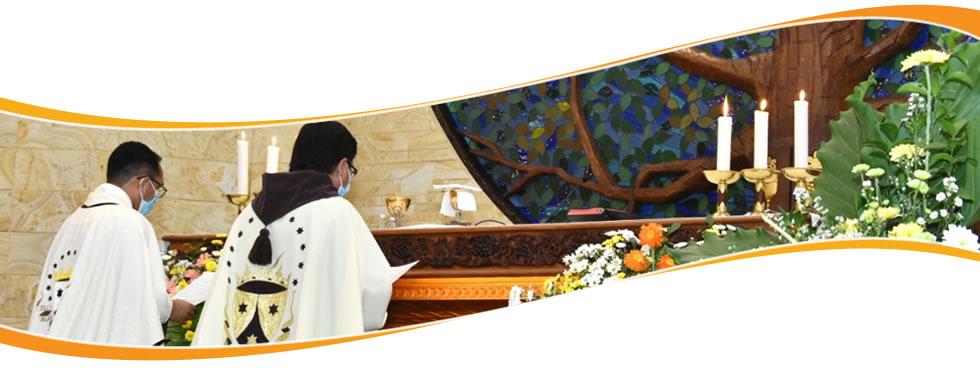
October 4, 2018 was a great day for “East Indonesian” Carmelites in the Province of Indonesia. They opened the 50th anniversary celebration of Carmel’s arrival on the island of Flores which contains Indonesia’highest Catholic population. Carmelites have served in Flores since 1969. The celebration took place in The Holy Cross Parish of Mauloo-Maumere-Indonesia in a Mass attended by Carmelite friars, sisters of various congregations and many local parishioners. Fr. Barnabas Krispinus Ginting, O.Carm, the 1st Conciliarius led the service together with Fr. Telesforus Jenti, O.Carm.,Vicar of Maumere Diocese, Fr. Frumentius Ebu, O.Carm., parish priest of Mauloo and dozen of Carmelite priests.
In his sermon, Fr. John don Bosco Djawa, O.Carm. shared the message of Jesus’ Transfiguration on Mount Tabor. He emphasized that Jesus was “always in prayer” no matter the situation. This notion of being “always in prayer” has also been fundamental to Carmelite spirituality along with service and fraternity. Prayer provides the basis of for authentic service and fraternity. For this reason, Fr. John urged Carmelites to be “always in prayer”. “If this happens all people will experience Jesus transfiguration because of our presence as carmelites” said the former Commissary of the East Indonesia Commissariat (part of the Indonesia Province).
Fr. Jenti, the Vicar of Maumere, who has been the chairman of the celebration committee, gave his impressions in a speech after the service. He emphasized the importance of this occasion and explained why Mauloo was chosen for the opening celebration. According to our history, three pioneers began Carmel’s work among the people of Flores Island. They were Fr. Ignasius Widodo, O.Carm, Fr. Fransiskus Sardjono, O.Carm and Br. Yakobus Suradji, O.Carm. “Their work”, said the first East Indonesia Carmelite to become Vicar of Maumere Diocese, “has given root to Carmel’s service to the Catholic Church of East Indonesia”. Fr. Jenti also thanked everyone, especially parishioners of Mauloo, who have been supporting Carmelites since the beginning of their presence in Flores.
The mission of our Order in Flores depended on an agreement between Mgr. Donaus Djagom, SVD (the Archbisop of Ende-Flores) and Fr. Hardjoko Hardjomardjojo, O.Carm (the first Prior Provincial of Indonesia). The Archbishop wanted to invite as many religious congregations as possible to help in the SVD mission. The SVDs sought to strengthen the local Church. The Carmelites of the Indonesia Province enthusiastically answered this invitation and the Holy Cross Parish of Mauloo-Maumere was the starting point to begin this evangelical mission. Thus, on October 4th, 1969, the three were welcomed by Mgr. Donatus and many parishioners into the gate of Mauloo Parish.
The great works of these three pioneers has been a blessing to many especially to our Order in the Eastern part of Indonesia. As we know, Flores Island has been a place where many Indonesian Carmelites come from nowadays. There are three formation houses which have more than 30 members: promising numbers for the future of our Order.
The opening celebration of the 50th Anniversary Carmel’s arrival in Flores Island was closed with a dinner. The foods were very traditional prepared by the parishioners. As usual, there was traditional dancing. All sang in joy and happiness. According to the plan, there will be many activities until October 4th, 2019. They include sporting events, biblical games, youth camp, musical and arts performances, charity bazaars and reforesting activities.
Pope's Prayer Intentions for October 2018
Evangelization: The Mission of Religious
That consecrated religious men and women may bestir themselves, and be present among the poor, the marginalized, and those who have no voice.
Lectio Divina: October – octubre – ottobre 2018
|
|
|
|
ENGLISH | |||
ESPAÑOL | |||
ITALIANO |
 IPAD-IPHONE
 KINDLE
 PDF
PDF
Monday, October 1, 2018
Tuesday, October 2, 2018
Wednesday, October 3, 2018
Thursday, October 4, 2018
Friday, October 5, 2018
Saturday, October 6, 2018
Sunday, October 7, 2018
Monday, October 8, 2018
Tuesday, October 9, 2018
Wednesday, October 10, 2018
Thursday, October 11, 2018
Friday, October 12, 2018
Saturday, October 13, 2018
Sunday, October 14, 2018
Monday, October 15, 2018
Tuesday, October 16, 2018
Wednesday, October 17, 2018
Thursday, October 18, 2018
Friday, October 19, 2018
Saturday, October 20, 2018
Sunday, October 21, 2018
Monday, October 22, 2018
Tuesday, October 23, 2018
Wednesday, October 24, 2018
Thursday, October 25, 2018
Friday, October 26, 2018
Saturday, October 27, 2018
Sunday, October 28, 2018
Monday, October 29, 2018
Tuesday, October 30, 2018
Wednesday, October 31, 2018

Never again! Never forget!
Statement of the Student Friars of the Order of Carmelites
Province of Bld. Titus Brandsma
While many supporters of the late dictator Ferdinand Marcos are trying to revise history, glorifying the late dictator and dubbing his brutal and vicious martial law years as the “golden age” of our country’s economy or denying the liabilities of the family members on their role in the atrocities of those times, the dead, the disappeared, the torture victims, the poor who have been robbed of their future, and the whole country who have been stripped of its dignity, continues to call for justice and for the country, for all of us, to never forget.
But we have forgotten, and many of the young people who never experienced martial law and even those who did experience martial law seemed to have forgotten.
The Marcoses are back in power, one even trying to grab the second highest seat of the land, while we have a tyrannical president who publicly extols his family’s relationship with the late dictator and even shamelessly propagandizing the ambition of the younger Marcos for the presidency
Today, we allow ourselves to be ruled by a president who, by all indications, is more inclined in replicating the horrors of martial law rather than to address the concerns of the country such as rising inflation that leads to the rising cost of basic goods and the weakening economic power of the people; increasing number of extra-judicial killings and the rising criminality, which sadly, have implicated many police officers and other government officials who are supposed to protect the welfare of the people; and the continuing suppression, intimidation, and harassment of church people and development workers who are working to help the poor and the people in the margins.
Have we forgotten?
We, the Student Friars of the Order of Carmelites in the Philippines, celebrate the life and contemplate on the sacrifices of our Carmelite brothers and sisters – lay, religious, and priests – who offered their life for the freedom of our country from the tyrannical Marcos dictator.
We remember the Escalante Massacre of September 20, 1985 which killed 20 of our lay faithful in Escalante and injured around 30 others.
We remember Bro. Isagani Valle, whose love for the poor granted him the crown of martyrdom on May 14, 1983, killed by the police in Buenavista, Agusan del Norte. His bullet-ridden body was later put on public display in front of the municipal hall.
We remember Fr. Engelbert van Vilsteren who was hacked to death on January 1973 when he attempted to recover the body of a murdered teacher in one of the mountain barangays of Agusan del Sur.
We remember Fr. Jan Simon Westendorp, Sr. Henrica Berentsen of the Julie Postel Sisters and all the religious, priests and lay faithful who were martyred when, on their way to Cebu as part of their involvement with the rural missions amidst the repression of the Marcos dictatorship, their ship, M/V Doña Cassandra, sank off the coast of Camiguin on November 21, 1983.
And then there are our lay partners who were killed mercilessly for their involvement, most especially in the building of the Basic Ecclesial Communities during the Martial Law years, especially Manoling Malicay, Boy Lagurin, Loloy Algunas, and Ani Mariano.
These are but some of our brothers and sisters in the Carmelite Order – lay, priests, nuns, and brothers – who gave their lives to bring light in the darkest period of our country’s history and fight the evils of the dictatorship of Marcos. There are, of course, all those other victims of the Marcos atrocities.
Today, as we remember the declaration of the Martial Law in 1972, we are faced with the growing tyranny marked by a culture of impunity that denied justice for many victims of extrajudicial killings, torture, enforced disappearances and other unjust and inhuman acts.
Let us not forget and together, let us shout, “Never again to Martial Law!”
Septemper 2018
St. Elijah Student Friars Community
Order of Carmelites
Province of Bl. Titus Brandsma - Philippines

In Sassone (Rome) from September 15 to 20, 2018, an International Congress of Carmelite Laity was celebrated, with the participation of some 250 people from 24 different nations around the world, mostly lay people and also some Carmelite friars and sisters.
The theme of the Congress was "Our Lady of Mount Carmelo: Mother of the Family". The main speakers included, Archbishop Antônio Muniz, O.Carm., Archbishop of Maceío (Brazil); Fernando Millán Romeral, O.Carm., Prior General of the Order; Ms. Christine Wade, TOC of Australia; and Giovanni Grosso, O.Carm., President of the Institutum Carmelitanum. In addition to the conferences and the work in linguistic groups, the participants had the opportunity to listen to some testimonies and experiences of the Carmelite vocation in the life of lay people.

The objective of the meeting was to deepen the Marian spirituality of our Order, strengthen the bonds of international fraternity among the various national and provincial groups and encourage the multiplying element of the laity within the Carmelite Family.
This congress was carried out thanks to the work and organization of the current General Commission for Carmelite Laity composed of Raúl Maraví, O.Carm. (President), Joseph Hung Tran, O.Carm., Désiré Unen Alimange, O.Carm., Normita Lacanilao, Jennifer Wanjiku, María José García de la Barrera, Michele Bonanno, José Araújo and José Luis Laghi.
The Elective Chapter of the Carmelite Monastery of Carpineto Romano, Italy, was held 21 September 2018. The following were elected:
- Prioress: Sr. M. Noemi Malagesi, O.Carm.
- 1st Councilor: Sr. M.Valentina Rossin, O.Carm.
- 2nd Councilor: Sr. M. Paola Ricci, O.Carm.
- 3rd Councilor: Sr. M. Emanuela Migliore, O.Carm.
- 4th Couniclor: Sr. M. Carla Zinno, O.Carm.
- Director of Novices: Sr. M. Valentina Rossin, O.Carm.
- Treasurer: Sr. M. Agnese Talano, O.Carm.
- Sacristan: Sr. M. Mihaela Catana, O.Carm.
During the Provincial Chapter of the Maltese Province held on 10-14 September 2018 following earlier elections were confirmed:
- Prior Provincial: Fr. Joseph Saliba, O.Carm.
- First Councilor: Fr. Mark Attard, O.Carm.
- Second Councilor: Fr. Charlò Camilleri, O.Carm.
- Third Councilor: Fr. Jurgen Cucciardi, O.Carm.
- Fourth Councilor: Fr. Anthony Cilia, O.Carm.
Pope's Prayer Intentions for September 2018
Universal: Young People in Africa
That young people in Africa may have access to education and work in their own countries.
Lectio Divina: September - septiembre – settembre 2018
|
|
|
|
ENGLISH | |||
ESPAÑOL | |||
ITALIANO |
Saturday, September 1, 2018
Sunday, September 2, 2018
Monday, September 3, 2018
Tuesday, September 4, 2018
Wednesday, September 5, 2018
Thursday, September 6, 2018
Friday, September 7, 2018
Saturday, September 8, 2018
Sunday, September 9, 2018
Monday, September 10, 2018
Tuesday, September 11, 2018
Wednesday, September 12, 2018
Thursday, September 13, 2018
Friday, September 14, 2018
Saturday, September 15, 2018
Sunday, September 16, 2018
Monday, September 17, 2018
Tuesday, September 18, 2018
Wednesday, September 19, 2018
Thursday, September 20, 2018
Friday, September 21, 2018
Saturday, September 22, 2018
Sunday, September 23, 2018
Monday, September 24, 2018
Tuesday, September 25, 2018
Wednesday, September 26, 2018
Thursday, September 27, 2018
Friday, September 28, 2018
Saturday, September 29, 2018
Sunday, September 30, 2018

During the recent floods that affected India (mostly in the State of Kerala), producing 1000 fatalities and damaging thousands of homes, Carmelites, both of the Province of St. Thomas and the General Delegation of St. Therese and St. Albert, have been providing assistance to the people most affected by the floods. One example is in Chris Cappell College where shelther and all their basic necessities have been offered to some 650 people. The college buildings can be reached only by boat. Even though the level of the water is going down, many families are unable to return to their homes, and in some cases have lost their homes and continue to live in a state of emergency.

If anyone wishes to offer financial assistance to the work of the Carmelites in Kerala, that may be done through the Carmelite Curia, using the normal channels.
Carmelite course on Preaching in Fatima (Evangelization and Mission Commission)
The Carmelite General Commission for Evangelization and Mission is offering a workshop on preaching based on the section entitled: Proclamation of the Word from the 2014 Exhortation Evangelii Gaudium of Pope Francis. All provincials, commissaries and general delegates have been informed of this in May 2018.
While the course is open to the whole Carmelite Family, the one condition is that all the participants should have a clear reference group (province, community, Third Order Chapter….) for whom the participants afterwards can organise a course similar to the one that the Commission is offering. This ought to be done with the support of the local province and approved by the provincial.
The course will deal with the meaning, the mission and the art of preaching. Among the principle speakers are Timothy Radcliff, O.P, Professor Donna Orsuto, and Carmelites, Alexander Vella, Huub Welzen, Miceal O’Neill and others.
The four-day course will take place in Fatima (Portugal) at the Casa Sao Nuno, from the 15th (arrivals 14th) to the 18th of January 2019 (departures morning of the 19th). The letter of convocation and application forms can be found on the Order’s website at this link.
For those who have not yet made application, this ought to be sent before the 30th of September 2018.
During the Provincial Chapter of the Province of Indonesia held on 12-18 August 2018 were elected:
- Prior Provincial: Fr. Ignasius Budiono, O.Carm.
- Vice Prior Provincial: Fr. F.X. Hariawan Adji, O.Carm.
- First Councilor: Fr. Barnabas Krispinus Ginting, O.Carm.
- Second Councilor: Fr. Yosef Arnoldus Devanto, O.Carm.
- Third Councilor: Fr. Aditya Permana Perangin-angin, O.Carm.
- Fourth Councilor: Br. Antonius Sumardi, O.Carm.

More...
The Elective Chapter of the Carmelite Monastery of Aracena, Spain, was held 13-14 July 2018. The following were elected:
- Prioress: Sr. M. Remedios Alvarez Soriano, O.Carm.
- 1st Councilor: Sr Elena M. López Font, O.Carm.
- 2nd Councilor: Sr M. Leonor Parrilla de la Cruz, O.Carm.
- 3rd Councilor: Sr. M. Sampedro Corchero Sánchez, O.Carm.
- 4th Couniclor: Sr. Mª Winfred Nzisa Mutua, O.Carm.
- Director of Novices: Sr. M. Elena M. López Font, O.Carm.
- Treasurer: Sr. Elena M. López Font, O.Carm.
- Sacristan: Sr. Elsy Arackal Inasu, O.Carm.
Course for Carmelite students in initial formation on Bl. Titus Brandsma
Carmelite Students in Initial Formation, from twenty-five countries around the world, gathered in the Netherlands and Germany to find inspiration and learn from the life of Bl. Titus Brandsma. The course took place in Nijmegen - Mainz - Dachau, from the 22nd of July to the 3rd of August 2018. The theme was Bl. Titus Brandsma as a Carmelite, Academic, Journalist and Martyr “Contemplation as the Dynamic Element that Unifies them All” (RIVC #28).
The course was planned and organized by the General Formation Commission: Frs. Benny Phang, Noel Rosas and Quinn Conners; in collaboration with the local organizers: Hettie Berflo and Sanny Bruijns from the Dutch Province and Br. Andreas Scholten from the German Province. Both provinces provided support to the course with the presence of the Priors Provincial, Frs. Jan Brouns and Peter Schröder, who offered great hospitality to the participants. The translations were aided by Frs. Raul Maravi and Nico Hofstede.

The students were guided and enriched by a series of presentations from Anne Marie Bos, Sanny Bruins and Fr. Kees Waaijman from the Dutch Province, Fr. Benny Phang, Fr. François Manga, Br. Andreas Scholten together with the Prior General Fr. Fernando Millán Romeral, The participants were offered the opportunity to personally integrate the information through group discussions and reflection. Together with the talks, the participants made pilgrimages to important places connected with the life of Bl. Titus, including Megen, Boxmeer, Oss, Nijmegen, Mainz, and the concentration camps at Amersfoort, Netherlands, and Dachau, Germany.
They were very grateful for the opportunity to build up the international community of simple professed Carmelites.
Pope's Prayer Intentions for August 2018
Universal: The treasure of Families
That any far-reaching decisions of economists and politicians may protect the family as one of the treasures of humanity.
Lectio Divina: August - agosto - agosto 2018
|
|
|
|
ENGLISH | |||
ESPAÑOL | |||
ITALIANO |
Wednesday, August 1, 2018
Thursday, August 2, 2018
Friday, August 3, 2018
Saturday, August 4, 2018
Sunday, August 5, 2018
Monday, August 6, 2018
Tuesday, August 7, 2018
Wednesday, August 8, 2018
Thursday, August 9, 2018
Friday, August 10, 2018
Saturday, August 11, 2018
Sunday, August 12, 2018
Monday, August 13, 2018
Tuesday, August 14, 2018
Wednesday, August 15, 2018
Thursday, August 16, 2018
Friday, August 17, 2018
Saturday, August 18, 2018
Sunday, August 19, 2018
Monday, August 20, 2018
Tuesday, August 21, 2018
Wednesday, August 22, 2018
Thursday, August 23, 2018
Friday, August 24, 2018
Saturday, August 25, 2018
Sunday, August 26, 2018
Monday, August 27, 2018
Tuesday, August 28, 2018
Wednesday, August 29, 2018
Thursday, August 30, 2018
Friday, August 31, 2018


