











Some Aspects of Christian Meditation
I. Introduction
1. Many Christians today have a keen desire to learn how to experience a deeper and authentic prayer life despite the not inconsiderable difficulties which modern culture places in the way of the need for silence, recollection and meditation. The interest which in recent years has been awakened also among some Christians by forms of meditation associated with some eastern religions and their particular methods of prayer is a significant sign of this need for spiritual recollection and a deep contact with the divine mystery. Nevertheless, faced with this phenomenon, many feel the need for sure criteria of a doctrinal and pastoral character which might allow them to instruct others in prayer, in its numerous manifestations, while remaining faithful to the truth revealed in Jesus, by means of the genuine Tradition of the Church. This present letter seeks to reply to this urgent need, so that in the various particular Churches, the many different forms of prayer, including new ones, may never lose their correct personal and communitarian nature.
These indications are addressed in the first place to the Bishops, to be considered in that spirit of pastoral solicitude for the Churches entrusted to them, so that the entire people of God—priests, religious and laity—may again be called to pray, with renewed vigor, to the Father through the Spirit of Christ our Lord.
2. The ever more frequent contact with other religions and with their different styles and methods of prayer has, in recent decades, led many of the faithful to ask themselves what value non-Christian forms of meditation might have for Christians. Above all, the question concerns eastern methods.1 Some people today turn to these methods for therapeutic reasons. The spiritual restlessness arising from a life subjected to the driving pace of a technologically advanced society also brings a certain number of Christians to seek in these methods of prayer a path to interior peace and psychic balance. This psychological aspect is not dealt with in the present letter, which instead emphasises the theological and spiritual implications of the question. Other Christians, caught up in the movement towards openness and exchanges between various religions and cultures, are of the opinion that their prayer has much to gain from these methods. Observing that in recent times many traditional methods of meditation, especially Christian ones, have fallen into disuse, they wonder whether it might not now be possible, by a new training in prayer, to enrich our heritage by incorporating what has until now been foreign to it.
3. To answer this question, one must first of all consider, even if only in a general way, in what does the intimate nature of Christian prayer consist. Then one can see if and how it might be enriched by meditation methods which have been developed in other religions and cultures. However, in order to achieve this, one needs to start with a certain clear premise. Christian prayer is always determined by the structure of the Christian faith, in which the very truth of God and creature shines forth. For this reason, it is defined, properly speaking, as a personal, intimate and profound dialogue between man and God. It expresses therefore the communion of redeemed creatures with the intimate life of the Persons of the Trinity. This communion, based on Baptism and the Eucharist, source and summit of the life of the Church, implies an attitude of conversion, a flight from "self" to the "You" of God. Thus Christian prayer is at the same time always authentically personal and communitarian. It flees from impersonal techniques or from concentrating on oneself, which can create a kind of rut, imprisoning the person praying in a spiritual privatism which is incapable of a free openness to the transcendental God. Within the Church, in the legitimate search for new methods of meditation it must always be borne in mind that the essential element of authentic Christian prayer is the meeting of two freedoms, the infinite freedom of God with the finite freedom of man.
II. Christian Prayer in the Light of Revelation
4. The Bible itself teaches how the man who welcomes biblical revelation should pray. In the Old Testament there is a marvelous collection of prayers which have continued to live through the centuries, even within the Church of Jesus Christ, where they have become the basis of its official prayer: The Book of Praises or of Psalms.2 Prayers similar to the Psalms may also be found in earlier Old Testament texts or re-echoed in later ones.3 The prayers of the book of Psalms tell in the first place of God's great works on behalf of the Chosen People. Israel meditates, contemplates and makes the marvels of God present again, recalling them in prayer.
In biblical revelation Israel came to acknowledge and praise God present in all creation and in the destiny of every man. Thus He is invoked, for example, as rescuer in time of danger, in sickness, in persecution, in tribulation. Finally, and always in the light of his salvific works, He is exalted in his divine power and goodness, in his justice and mercy, in his royal grandeur.
5. Thanks to the words, deeds, Passion and Resurrection of Jesus Christ, in the New Testament the Faith acknowledges in Him the definitive self-revelation of God, the Incarnate Word who reveals the most intimate depth of his love. It is the Holy Spirit, he who was sent into the hearts of the faithful, he who "searches everything, even the depths of God" (1 Cor 2:10), who makes it possible to enter into these divine depths. According to the promise Jesus made to the disciples, the Spirit will explain all that he had not yet been able to tell them. However, this Spirit "will not speak on his own authority," but "he will glorify me, for he will take what is mine and declare it to you" (Jn 16:13f.). What Jesus calls "his" is, as he explains immediately, also God the Father's because "all that the Father has is mine; therefore I said that he will take what is mine and declare it to you" (Jn 16:15).
The authors of the New Testament, with full cognizance, always spoke of the revelation of God in Christ within the context of a vision illuminated by the Holy Spirit. The Synoptic Gospels narrate Jesus' deeds and words on the basis of a deeper understanding, acquired after Easter, of what the disciples had seen and heard. The entire Gospel of St. John is taken up with the contemplation of him who from the beginning is the Word of God made flesh. Paul, to whom Jesus appeared in his divine majesty on the road to Damascus, instructs the faithful so that they "may have power to comprehend with all the saints what is the breadth and length and height and depth (of the Mystery of Christ), and to know the love of Christ which surpasses all knowledge, that you may be filled with all the fullness of God" (Eph 3:18 ff.). For Paul the Mystery of God is Christ, "in whom are hidden all the treasures of wisdom and knowledge" (Col 2:3) and, the Apostle clarifies, "I say this in order that no one may delude you with beguiling speech" (v. 4).
6. There exists, then, a strict relationship between Revelation and prayer. The Dogmatic Constitution Dei Verbum teaches that by means of his revelation the invisible God, "from the fullness of his love, addresses men as his friends (cf. Ex 33:11; Jn 15:14-15), and moves among them (cf. Bar 3:38), in order to invite and receive them into his own company."4 This revelation takes place through words and actions which have a constant mutual reference, one to the other; from the beginning everything proceeds to converge on Christ, the fullness of revelation and of grace, and on the gift of the Holy Spirit. These make man capable of welcoming and contemplating the words and works of God and of thanking him and adoring him, both in the assembly of the faithful and in the intimacy of his own heart illuminated by grace.
This is why the Church recommends the reading of the Word of God as a source of Christian prayer, and at the same time exhorts all to discover the deep meaning of Sacred Scripture through prayer "so that a dialogue takes place between God and man. For, 'we speak to him when we pray; we listen to him when we read the divine oracles.'"5
7. Some consequences derive immediately from what has been called to mind. If the prayer of a Christian has to be inserted in the Trinitarian movement of God, then its essential content must also necessarily be determined by the two-fold direction of such movement. It is in the Holy Spirit that the Son comes into the world to reconcile it to the Father through his works and sufferings. On the other hand, in this same movement and in the very same Spirit, the Son Incarnate returns to the Father, fulfilling his Will through his Passion and Resurrection. The "Our Father," Jesus' own prayer, clearly indicates the unity of this movement: the Will of the Father must be done on earth as it is in heaven (the petitions for bread, forgiveness and protection make explicit the fundamental dimensions of God's will for us), so that there may be a new earth in the heavenly Jerusalem.
The prayer of Jesus6 has been entrusted to the Church ("Pray then like this", Lk 11:2). This is why when a Christian prays, even if he is alone, his prayer is in fact always within the framework of the "Communion of Saints" in which and with which he prays, whether in a public and liturgical way or in a private manner. Consequently, it must always be offered within the authentic spirit of the Church at prayer, and therefore under its guidance, which can sometimes take a concrete form in terms of a proven spiritual direction. The Christian, even when he is alone and prays in secret, is conscious that he always prays for the good of the Church in union with Christ, in the Holy Spirit and together with all the Saints.7
Letter to the Bishops of the Catholic Church on Some Aspects of Christian Meditation
Congregation for the Doctrine of the Faith
October 15, 1989
The Christian Way to Union with God
13. To find the right "way" of prayer, the Christian should consider what has been said earlier regarding the prominent features of the way of Christ, whose "food is to do the will of him who sent (him), and to accomplish his work" (Jn 4:34). Jesus lives no more intimate or closer a union with the Father than this, which for him is continually translated into deep prayer. By the will of the Father he is sent to mankind, to sinners. to his very executioners, and he could not be more intimately united to the Father than by obeying his will. This did not in any way prevent him, however, from also retiring to a solitary place during his earthly sojourn to unite himself to the Father and receive from him new strength for his mission in this world. On Mount Tabor, where his union with the Father was manifest, there was called to mind his passion (cf. Lk 9:31), and there was not even a consideration of the possibility of remaining in "three booths" on the Mount of the Transfiguration. Contemplative Christian prayer always leads to love of neighbor, to action and to the acceptance of trials, and precisely because of this it draws one close to God.
14. In order to draw near to that mystery of union with God, which the Greek Fathers called the divinization of man, and to grasp accurately the manner in which this is realized, it is necessary in the first place to bear in mind that man is essentially a creature,16 and remains such for eternity, so that an absorbing of the human self into the divine self is never possible, not even in the highest states of grace. However, one must recognize that the human person is created in the "image and likeness" of God, and that the archetype of this image is the Son of God, in whom and through whom we have been created (cf. Col 1:16). This archetype reveals the greatest and most beautiful Christian mystery: from eternity the Son is "other" with respect to the Father and yet, in the Holy Spirit, he is "of the same substance." Consequently this otherness, far from being an ill, is rather the greatest of goods. There is otherness in God himself, who is one single nature in three Persons, and there is also otherness between God and creatures, who are by nature different. Finally, in the Holy Eucharist, as in the rest of the sacraments—and analogically in his works and in his words—Christ gives himself to us and makes us participate in his divine nature,17 without nevertheless suppressing our created nature, in which he himself shares through his Incarnation.
15. A consideration of these truths together brings the wonderful discovery that all the aspirations which the prayer of other religions expresses are fulfilled in the reality of Christianity beyond all measure, without the personal self or the nature of a creature being dissolved or disappearing into the sea of the Absolute. "God is love" (1 Jn 4:8). This profoundly Christian affirmation can reconcile perfect union with the otherness existing between lover and loved, with eternal exchange and eternal dialogue. God is himself this eternal exchange and we can truly become sharers of Christ, as "adoptive sons" who cry out with the Son in the Holy Spirit, "Abba, Father." In this sense, the Fathers are perfectly correct in speaking of the divinization of man who, having been incorporated into Christ, the Son of God by nature, may by his grace share in the divine nature and become a "son in the Son." Receiving the Holy Spirit, the Christian glorifies the Father and really shares in the Trinitarian life of God.
Letter to the Bishops of the Catholic Church on Some Aspects of Christian Meditation
Congregation for the Doctrine of the Faith
October 15, 1989
Lectio Divina October 2016
Pope's prayer intentions for October 2016
Universal: Journalists - That journalists, in carrying out their work, may always be motivated by respect for truth and a strong sense of ethics.
Evangelization: World Mission Day - That World Mission Day may renew within all Christian communities the joy of the Gospel and the responsibility to announce it.
Lectio Divina October - Octubre - Ottobre 2016
 IPAD-IPHONE IPAD-IPHONE |  KINDLE KINDLE |  PDF PDF | |
| ENGLISH | Download iBook | Download Kindle | Download PDF |
| ESPAÑOL | Descargar iBook | Descargar Kindle | Descargar PDF |
| ITALIANO | Scarica iBook | Scarica Kindle | Scarica PDF |
- Saturday, October 1, 2016
- Sunday, October 2, 2016
- Monday, October 3, 2016
- Tuesday, October 4, 2016
- Wednesday, October 5, 2016
- Thursday, October 6, 2016
- Friday, October 7, 2016
- Saturday, October 8, 2016
- Sunday, October 9, 2016
- Monday, October 10, 2016
- Tuesday, October 11, 2016
- Wednesday, October 12, 2016
- Thursday, October 13, 2016
- Friday, October 14, 2016
- Saturday, October 15, 2016
- Sunday, October 16, 2016
- Monday, October 17, 2016
- Tuesday, October 18, 2016
- Wednesday, October 19, 2016
- Thursday, October 20, 2016
- Friday, October 21, 2016
- Saturday, October 22, 2016
- Sunday, October 23, 2016
- Monday, October 24, 2016
- Tuesday, October 25, 2016
- Wednesday, October 26, 2016
- Thursday, October 27, 2016
- Friday, October 28, 2016
- Saturday, October 29, 2016
- Sunday, October 30, 2016
- Monday, October 31, 2016
Titus Brandsma - Letter from Prison to the Prior
Letters from Prison Kleve, May 28, 1942
Dear Father Prior, etc.,
At the beginning of May you will have been expecting a letter from Amersfoort, because there I would have been allowed to write again on May 1st, but a few days before, on April 28, I was suddenly taken back to Scheveningen. There one writes every three weeks, but one has to be there at least three weeks before one is allowed to write. Before that term had passed, on May 16th, I was put on the way towards Dachau. Fortunately the voyage did not continue uninterruptedly, and for the time being we are in the prison of Kleve, to be transported from there in groups to different destinations in Germany. One always stays here one or two weeks. Each week about forty leave. Although usually one is allowed to write only from the place of destination, I got permission to write from here, because it is so long ago, and also because it is not yet determined when I am to go on.
In The Hague I have been tried more in detail about some letters. On my departure from Amersfoort I have also been informed that I will he kept prisoner because I am inimically disposed towards Germany and because it is to be feared that I will abuse my liberty against Germany.
Being sent to Dachau does mean that I'll be detained until the end of the war. Dachau near Munich is a camp with various branches. You will hear later on in which section I'll be, if anyhow they stick to this sentence. The Provincial could attempt to have it commuted to a transfer to a German monastery (Mainz, Vienna, Bamberg, Straubing), with eventual extensive restriction of freedom and of permission to work, with the obligation of remaining in that city or perhaps in the convent and of reporting in on a regular basis, of having no correspondence with Holland, etc. Pastor Bulters of The Hague was duly freed on condition that he transfer to Venray. In my opinion, the better thing would be to speak of this matter at The Hague with Mr. Hardegen, Provincial Dept. of the German Security Police, Binenhof 7, Room 137. It was he who always interrogated me and who also told me that Brandsma the lawyer from Zwolle had been there for me and that he gave him my large suitcase. He would not obtain anything else for me, but I feel I should be very grateful to him for his interest.
He could go for a talk even now, alone or with Fr. Provincial or someone named by him. This doesn't seem bad to me, but I leave the decision to you.
Of the more than six weeks in Amersfoort, I have been ill more or less for five. Providential. A rather light dysentery. Yet, this continual diarrhea weakened me. When it had gone, I got into trouble with my stomach, and these spasms rather bothered me. Little by little it has passed. Now I am all right again. My complaint, the kidney inflammation, although completely uncared for, bothers me next to nothing. In all those four months, it has caused me trouble and pain only three times, and then only slightly. In fact, considering the circumstances, I'm doing wonderfully well. I have a continuous appetite, as I have never known in my life before.
It was a great privilege that on May 17th, I could attend Holy Mass, and that on Pentecost Sunday and Monday, I also have been able to receive Holy Communion, after more than four months.
The suit you sent by express mail to Scheveningen, I fortunately received on May 16 on my departure from there. I already despaired of receiving it. Many thanks for everything. It contained everything I had asked for, but in case you sent more, or sent a letter with it, I haven't received these. I was looking forward to it, and would be happy to hear something.
Here I was allowed to keep Breviary, Missal and rosary. How will it be in Dachau? I hear though that there is Holy Mass on Sundays. I hope eventually to meet colleague Regout, Galena the Pastor and various other priests.
Please pay a personal visit to Professor Hoogveld, von Genechten, Bellon and Sassen to thank them by taking my place. Extend my condolences to the former on the death of Scintilla. The family will be comforted to know that after such deep preparation in such a sublime frame of mind and with an expression of such great affection for her family members she went to face death. It's good that she joined the Third Order. Many greetings to all. It's better so. You should remain the Director. The other changes are also very good. Greetings and thanks to Mrs. Span. Tell Hubert that in my solitude I've decided first of all to finish the edition of St. Teresa. Today is Teresa's birthday. I am spiritually at Jonge-mastate. On leaving Amersfoort, Father Hettema arrived. He thought they would free me. He is in good spirits and I heard he feels well.
Kindest regards to all. Pray for me.
In Christ, your Titus, Carmelite.
October as a month of Mary
Warren Schmidt
The historical roots of October as a month of Mary are unclear. Some attribute the association between October and Mary to the devotion to Our Lady of Fatima. On October 13, 1917, in Cova de Iria outside of Fatima, Portugal, the last of six monthly Marian apparitions to three shepherd children is said to have taken place. On this day, a crowd of approximately 70,000 pilgrims reported witnessing what became known as “the miracle of the sun,” in which the sun appeared to “dance” about in the sky and could be looked upon directly without burning one’s eyes.
Others associate October with Our Lady of the Rosary, while May, the month of the first Fatima apparition, is more traditionally the month to celebrate the devotion to Our Lady of Fatima. In fact, October 7 is the feast day of Our Lady of the Rosary. It began as the feast of Our Lady of Victory, instituted in 1571 after a Christian military victory in the Battle of Lepanto. In 1573, this feast day was renamed Our Lady of the Rosary by Pope Gregory XIII, and in 1716, Our Lady of the Rosary was celebrated as a feast of the universal Church for the first time.
Devotion to the Rosary was nothing new by 1716. It may have had early medieval monastic origins. Instead of praying the full 150 Psalms of the Bible in a cycle as monks did at the time (and many still do), laypeople, many of whom were illiterate, were encouraged to substitute 150 beads, arranged in a circle, on which they would repeat basic prayers by rote: the Our Father, the Hail Mary, and the Glory Be. While they recited these prayers, the people meditated on the events (mysteries) of the life of Jesus. Therefore, the Rosary became a valuable instrument of prayer and meditation, as well as a powerful means of teaching of the truths of the Christian faith.
Fr. Jim Phalen, CSC, President of Family Rosary International, puts forward another possible connection between the Rosary, Mary, and the months of May and of October. Fr. Phalen observes that, in the northern hemisphere, May is a month of new life; of spring. October, conversely, is when the green leaves of spring and summer slowly die, but “in their dying they become more beautifully colorful than ever.” Of course, the opposite is true in the southern hemisphere, where in October the earth brings forth new life. Nevertheless, these two months are excellent times to remember the life of Jesus through the Rosary, and the role of his mother, Mary as first disciple in this plan of God, from Jesus’ conception via the Holy Spirit in her womb, to the agony and yet triumph of the cross, to the glory of Christ’s resurrection and ascension, and to the birth of the Church at Pentecost.
All these thoughts as to the origins of October as a Marian month make ascertaining the beginnings of such a designation essentially impossible. There are many reasons for celebrating Mary, in October or at anytime. She is also rightly celebrated under many titles. The First Council of Ephesus in 431 first defined Mary dogmatically as Theotokos, or God-bearer, in Greek. More recently, Vatican II’s Dogmatic Constitution on the Church, Lumen Gentium (1964), devoted its entire final chapter to a reflection on Mary. These among other documents, as I see them, affirm at the highest level of Church teaching Mary’s importance for our faith. Mary is not so much exalted in her own right, but because she points us in two directions: Through her are revealed truths first about her Son, Jesus, fully both human and divine and, second, about us.
In October, in a special way, we remember Mary both as Mother of God and as our mother. This month includes the feasts of Our Lady of the Rosary (October 7), as well as those of Blessed John Paul II (October 22), and of a Canadian, Blessed Marie-Rose Durocher (October 6), both great devotees of Mary. October also begins with the memorial of St. Thérèse of the Child Jesus. The French Carmelite once wrote that she was drawn especially to Mary, not so much because she is Queen of heaven, but because she is our mother. Let us, with St. Thérèse among all God’s saints, this October and forever, rejoice that we are children of so great a mother.
Recent appointments
In July 2016 Fr. Craig Morrison, O.Carm., from the PCM Province, was appointed by the General of the Society of Jesus, Ordinary Professor at the Faculty of Ancient Near Eastern Studies of the Pontifical Biblical Institute in Rome.
In September 2016 Fr. Richard Byrne, O.Carm., Prior Provincial of the Irish Province, was appointed as the chairperson of the Catholic Schools Partnership, an association established by the Irish Bishops’ Conference and the Conference of Religious of Ireland to foster coherence in Catholic Education.
Congratulations to Fr. Craig and Fr. Richard on these important appointments.
Today’s Contemplative Prayer Forms: Are They Contemplation?
Ernest E. Larkin, O.Carm.
A simpler title could be:
Contemplation and today’s contemplative prayer—are they the same or different? And, if different, what is their content and how are they related? This paper attempts a clarification of terms.
But more than semantics is involved. The deeper question at issue is: What are we doing when we practice contemporary forms of contemplative prayer, such as centering prayer or the “Christian Meditation” of John Main? Are we praying actively, calling on our human resources under the impulse of grace, or are we submitting passively to some presumed action of God within us, such as infused contemplation that is too subtle to recognize? Do these prayer forms presume we have reached a state of contemplation beyond the level of ordinary meditation? Or may anyone, beginner or experienced, take them up? Or, bluntly, could our silence and quietude, our disengagement from the work of imagination and intellect in our prayer, be an exercise in woolgathering, daydreaming, spinning our wheels, and thus wasting time by willful inactivity? Worse still, could we be falling into the error of quietism, cultivating idleness and passivity, with nothing going on inside? This error gave contemplative prayer a bad name from the 17th century to the beginning of the 20th. It could crop up again today.
What do we mean by contemplative prayer and contemplation? For many writers the two terms are interchangeable and their content is variable, running the gamut of mental prayer from ordinary meditation to infused contemplation. John Main, the architect of Christian Meditation, begins a series of talks by saying, “I am using the term meditation as synonymous with contemplation, contemplative prayer, meditative prayer, and so forth.”[i] Sometimes the two terms mean infused contemplation, the classical mystical experience of the felt presence of God, as in the following: “Whenever I experienced contemplative prayer, there was absolutely no doubt that I was in God’s presence. The silence was of varying degrees, sometimes so deep that the mind could not even think, other times a bit more shallow as in the prayer of quiet.”[ii] In other places the words are used more fluidly and less restrictively, as in the very title of William H. Shannon’s article— ’’Contemplative Prayer, Contemplation”—in the New Dictionary of Catholic Spirituality. This article equates the two and surveys their historical development in a variety of meanings. Thomas Keating follows this usage in referring to centering prayer, perhaps the most popular form of contemplative prayer in the United States today, equating the two as a resting in God that is open to all seekers of goodwill.
As a step toward defining the two terms in their contemporary context, I propose a distinction between contemplative prayer and contemplation: Contemplative prayer is the way, contemplation the terminus. The distinction is an inadequate one, for there is certainly an intimate and organic connection between the way and the goal; one includes the other. Contemplative prayer is designed to achieve contemplation; what begins as contemplative prayer quickly becomes contemplation. But I make the distinction for clarity’s sake, not just to be splitting hairs.
Contemplative prayer begins with one’s own activity, however simple and non discursive; and it seeks silence before God, silent presence beyond thinking, imagining, and making affections. Edwina Gateley has seized the genius of this contemplative prayer in the following psalm titled “Let Your God Love You”:[iii]
Be silent Be still Alone. Empty. Before your God Say nothing Ask nothing. Be silent. Be still | Let your God Look upon you. That is all. He knows. He understands. He loves you with An enormous love. | He only wants to Look upon you With his love. Quiet. Still. Be. Let your God Love you.
|
This poetic catalogue intimates what happens when people practice centering prayer or Christian Meditation. Are these prayer forms contemplation? Yes; they seek and find the experience of God’s love and presence, and this is contemplation in the general sense. Neither prayer form directly describes the experience of classical infused contemplation.
William Johnston shows great insight in seeing the typical forms of today’s contemplative prayer as neither Eastern nor Western, but something new in the world, “a third way, a tertium quid,... the Gospel of Jesus Christ in a new world.” He lists some of the methods and then relates them to mystical prayer in the strict sense: For the fact is that everywhere we see Christians of all ages and cultures sitting quietly in meditation. Some sit before a crucifix or an ikon in one-pointed meditation. Others sit and breathe as they look at the tabernacle. Others practice mindfulness, awareness of God in their surroundings. Others recite the mantra to the rhythm of their own breath. Others, influenced by Zen or yoga or vipassana, open their minds and hearts to the presence of God in the universe. Others just talk to God. ... Assuredly these ways cannot immediately be called mystical. But they are gateways to mysticism. They all lead to silence and to the wordless state that St. Teresa calls the prayer of quiet [and] to the higher mansions.[iv] William Johnston has thus related contemplative prayer to contemplation in a heuristic fashion and with a distinction. Today’s methods of contemplative prayer are not automatically mystical, but are steps in that direction. The word contemplation has no clear boundaries in common usage today.
Contemplation is generally a broader and less precise category than infused contemplation in the strict sense. Contemplation in the Spiritual Exercises of St. Ignatius, for example, is more inclusive than Teresa’s prayer of quiet or John of the Cross’s infused knowledge and love. William McNamara’s well-known description of contemplation as “a long, loving look at the real” fits the contemplative prayer forms Johnston refers to above (and fits infused contemplation as well). The phrase appealed to the Jesuit Walter Burghardt because of its down-to-earth, fully human, and existential quality. It became the title of his famous article on contemplation, which is a moving reflection, not on the contemplation of Teresa or John, but about the bodily, emotional, and spiritual awareness of concrete singulars in creation and their rootedness in God.[v] It is the “mindfulness” Johnston mentions.
Infused Contemplation
There are exceptions to this generic usage. In the Carmelite and Dominican traditions, contemplation means infused contemplation. Occasionally, of course, writers within these traditions use the term in a broader sense. But, in Teresa of Avila and John of the Cross, contemplation is specific and exclusive. It is the general, loving, obscure experience of God that begins with the passive dark night of the senses. It is infused knowledge and love; it is mystical; it is a pure gift of God that cannot be achieved by human effort under the ordinary working of grace. There are other forms of infused contemplation in the strict sense besides this apophatic experience, but all of them have in common their passive and mystical quality.
In today’s spiritual theology the distinction between active and passive prayer tends to be down played. Long ago Thomas Merton rejected the distinction between infused and acquired contemplation as being irrelevant. The experience is the thing, not an abstract explanation of its principles.
Moreover, the mystical or grace character of the entire spiritual life is being emphasized in many sectors, for example, in twelve-step spirituality and in writings inspired by Karl Rahner’s theology.
For Karl Rahner, all experience of God is the expression of faith and love, all of it is rightly called mystical, and all knowledge and love of God are infused. Not only prayer experiences, but even the mundane experiences of average Christians which are products of faith are movements of the Holy Spirit and constitute “ordinary mysticism” or the “mysticism of everyday life.” In Rahner’s view, what has been designated as infused contemplation in the tradition is a high degree of the one basic experience of a loving faith.
The classical mystical experience of the saints remains “extraordinary,” not because of its principles, but because of its perfection and rarity. Theologically, the experience of God in meditation or in human activity or in classical infused contemplation is the same one gift of God working within us, the same one reality, different not in kind but in degree.
In the light of this Rahnerian theology, the question raised in this paper is less urgent: the contemplative prayer forms are contemplation in one or the other sense, broad or strict, ordinary or extraordinary, and the two outcomes are only different degrees of the same one gift of God. Our question remains valid, however, because the two kinds of contemplation remain distinct experiences. Rahner’s theology does not erase the considerable differences between the two on the experiential level, and this is the terrain of our inquiry. We are asking questions that are important for spiritual direction, whatever the explanations offered by systematic theology.
Rahner does make the immense contribution of helping us to see the spiritual life as a unity and to think in terms of process, development, and transitions. Contemplative prayer and contemplation fit into the four steps of lectio divina. The first three steps— reading, meditation, prayer—are obviously active; and the fourth step, contemplation, indicates rest, quiet, and passivity. Where does the contemplative prayer we are discussing, fit in this conspectus? I like to locate it between the third and fourth steps. It is a specially designed form of active prayer, consisting in simplified efforts to quiet down, to be attentive, and to be open to the divine influence. But it is rightly called “contemplative,” since it anticipates and moves as quickly as possible to its terminus of resting in the Lord. In this perspective it is easy to see why most writers identify contemplative prayer and contemplation as the same thing. One of the classic definitions of the fourth step of lectio divina comes from the 12th-century Ladder of the Monks by Guigo II, which describes contemplation as happening “when the mind is in some sort lifted up to God and held above itself, so that it tastes the joys of everlasting sweetness.”[vi] This flowery language can well be describing infused contemplation; but it is also obvious that, as the term of the process of lectio divina, it is an ordinary experience at prayer.[vii]
Meditation and Contemplation
Further light can be thrown on the nature of contemporary contemplative prayer if we look at the traditional Catholic teaching about meditation and contemplation. Does contemplative prayer in the form of centering prayer or Christian Meditation belong to meditation or to contemplation as these words are used in the Catholic tradition? Meditation is active prayer, discursive in method, controlled by the practitioner, and available to all persons of goodwill. Contemplation is knowledge by way of love, the fruit of a search, the experience of God’s love poured forth in our hearts by the Holy Spirit who is given us (see Rm 5:5). Contemplation is given, as pure gift, when the person is disposed to receive it. These descriptions leave intact what we have said about the two kinds of contemplation.
Jurgen Moltmann offers an analysis of meditation and contemplation that clarifies the distinction. Meditation, for Moltmann, is reflection on the cross, the paschal mystery, the gospel message of Christ-for-us. Contemplation too is biblical and Christological because it is the awareness of the knowledge and love evoked in oneself by this reflection, and hence it is a return to selfawareness. Contemplation is the awareness of Christ-in-us. He writes:
I understand by meditation the loving, sympathetic, and participatory recognition of something, and by contemplation the reflecting coming to awareness of oneself in this meditation. He who meditates sinks himself in the object of his meditation. He is absorbed in it and “forgets himself.” The object of his meditation in turn sinks itself in him. Then in contemplation he comes again to self-awareness. He registers the changes in himself.[viii]
Contemplation, accordingly, is the experience of what God is doing in my own being in Christ. It is what is left over in my body, soul, and spirit as the aftermath of my meditation. There are moments of contemplation in every meditation. Such moments, prolonged and deliberately indulged to the exclusion of further meditation (that is, further thinking, imagining, or making affections), are what the contemporary methods mean by contemplation. They are the fourth act in lectio divina, pursued directly and immediately as the total intent of the prayer.
In this frame of reference, we can see that centering prayer and Christian Meditation do not fit handily in the category of either meditation or contemplation. They are something new in contemplative prayer practice. Thomas Keating has emphasized that centering prayer is not lectio divina, but a form of prayer designed to give new life to lectio and to the whole Christian life.
Centering prayer is one’s own doing, but it is contemplative in its very structure. It is ordered directly to the heart of the matter, contemplation itself. It depends on but it is contemplative the prior endowment of grace, the divine indwelling, and the presence of faith, hope, and charity. One needs to have put on the Lord Jesus Christ through the word of God heard, appropriated, and welcomed through the agency of meditation in its many forms, through liturgy and common prayer, through community, and through spiritual discipline. Centering prayer or any legitimate form of contemplative prayer comes along to harvest the fruits, fine-tune the process of Christian living, highlight the gift aspect of the whole journey, and give one rest and enjoyment in this new life in Christ.
Centering prayer pulls the spiritual life together and goes far beyond “morsels of spirituality,” John of the Cross’s phrase for the moments of contemplation that are the fruit of active meditation or are the underlying grace in psychic phenomena like visions and locutions.
Teresa of Avila and John of the Cross
How does this analysis relate to the teaching of Teresa of Avila and John of the Cross? Teresa’s “active recollection,” which she developed out of her own life experience and, in The Way of Perfection (chaps. 28-29), described in doctrinal terms as simple presence to God, is a transitional prayer formthat is between meditation and contemplation and is very similar to modern contemplative prayer.[ix] Active recollection is the equivalent of centering prayer, the image or memory from the gospel focusing, for Teresa, a person’s attention, just as the mantra does in centering prayer. For Teresa, in the Fourth Mansions, contemplation begins with passive recollection or the prayer of quiet, both of which are mystical. In the imagery of the waters, contemplation happens when the bucket or aqueduct is no longer necessary because the water bubbles up from an inner spring. Active recollection is the personal cultivation and enjoyment of the divine presence through one’s own efforts. It is the door to the mystical prayer of quiet and union, as indeed are centering prayer and Christian Meditation in due time.
John of the Cross has no explicit counterpart to Teresa’s active recollection or to the new forms of contemplative prayer. For him, the first fruits of contemplation are experienced in the passive dark night of the senses, when the person cannot pray in the old ways, finds no satisfaction in any particular goods, and has a profound yearning for God. Before that time one is to use one’s faculties in the practice of meditation. John has no transitional form between meditation and contemplation; the pray-er is praying one or the other. He does counsel simple attention or loving awareness at the onset of the dark night. While it is tempting to identify this practice with our contemplative prayer, the advice applies to a different situation. The simple attention presupposes the presence of God’s special action infusing light and love in a subtle way, at times so subtle that the divine action may go unrecognized.[x] We are dealing with the beginning of infused contemplation in the strict sense. The three signs will validate its presence, and the person gives a loving attention that is passive, “without efforts ... as a person who opens his eyes with loving attention.”[xi] For John of the Cross, contemplation is pure gift and simply received; there is no room for active collaboration. John’s contemplation is not the immediate horizon of contemporary contemplative prayer forms.[xii]
Concluding Observations
Throughout this paper we have seen that contemplative prayer and contemplation have two levels or degrees of perfection, which we have designated as ordinary and extraordinary, or general and infused. Their identity depends on how fully they emanate from the human heart, which is the seat of all valid prayer. The Catechism of the Catholic Church describes the role of the heart in these words:
The heart is our hidden center, beyond the grasp of our reason and of others; only the Spirit of God can fathom the human heart and know it fully. The heart is the place of decision, deeper than our psychic drives. It is the place of truth, where we choose life or death. It is the place of encounter, because as image of God we live in relation; it is the place of covenant. (§2563)
In John of the Cross, the level of the heart is the realm of the spirit (as opposed to the sensibility). It is the ground of our being, the fine point of the soul, the center that holds our whole being, the place where God dwells within us. It is not a physical place, but a level of our operation in which God is the agent and we are receivers. God comes in fullness when we are empty and pure of heart. God comes in proportion to our openness, our freedom, our poverty of spirit. God as Holy Spirit possesses us and forms us in the image of the Son. This is the work of grace within us. The Spirit is operative in all good actions and completely takes over when we are acting on the level of the spirit, when we let go of ourselves in some complete fashion. This action of God within us is contemplation, and it takes place in proportion to our poverty of spirit. This poverty of spirit is practically the same thing as the contemplation itself.
Centering prayer and Christian Meditation are more fully prayer from the heart than discursive prayer is. They attempt to move the spiritual life to deeper levels than exterior, psychic, or conceptual activity. They take their practitioners to the center, to true, authentic, and mature spirituality beyond mere sensibility. But, unlike infused contemplation in the strict sense, they are not mystical or fully passive forms; they have an active element, and they depend on human collaboration.
The dynamics of centering prayer and Christian Meditation are similar, but they differ in emphasis. Both call the person to enter within, to move to the realm of silence and solitude, the level of the heart, to let go of thinking and imagining or controlling and to cultivate simple presence to the Divine Presence. One is lovingly attentive to the Divine Indwelling.
Centering prayer suggests the saying of the mantra, some simple word like Jesus, as a way to express consent to God’s working in the soul. It is the response to God’s love, accepting and welcoming the action of God. The mantra as a sign of consent is to be used to focus attention as needed.
In Christian Meditation, the mantra— which is usually the word Ma-ra-na-tha (“Come, Lord Jesus”) - is spoken throughout the prayer as an effort, not only to be totally attentive, but to be empty and silent and alone before God. The mantra is the instrument that creates the emptiness; it hollows out the soul.
Meditation takes seriously the teaching of the masters that creating silence and emptiness is the best invitation to the Spirit. In the dyad of poverty and contemplation, Christian Meditation goes through the door of poverty. Centering prayer takes the other door of simple, loving presence to God. In the end the two methods are searching for the same fullness and emptiness.
My sense is that other popular forms of contemplative prayer follow the same lines that we have drawn for the two exemplars. These prayer forms are gifts for our time, making more available the entrance to a deeper life with God. A figure from twelve- step experience may help us understand the widespread attraction of these new forms of contemplative prayer and at the same time serve as a bridge to St. John of the Cross. The figure is this: It used to be said that a person had to “hit bottom” before he or she would be a candidate for the twelve-step program. Today, I am told, clients are advised to “raise the bottom” and begin the program before a crisis occurs. Something like this may be working in contemplative prayer today. The forms do not presuppose infused contemplation or even an advanced spiritual state. They teach the person to be appropriately active in the prayer, and they promise a fuller outpouring of the Spirit. In this time of ours, contemporary contemplative prayer forms are a providential gift of the Holy Spirit.
[i] Talks on Meditation (Montreal, 1979), p. 10.
[ii] Philip St. Romain, in the newsletter “Christian Prayer and Contemplation Forum,” no. 8 (April 1997): 4. Address: Chiloquin, Oregon 97624.
[iii] From There Was No Path So I Trod One: Poems (page 17) by Edwina Gateley, copyright @ 1996 by Edwina Gateley. Reprinted with permission of the publisher: Source Books; Box 794; Trabuco Canyon, California 92678.
[iv] Mystical Theology (London: Harper Collins, 1995), p. 134.
[v] Walter J Burghardt, “Contemplation, a Long, Loving Look at the Real,” in Church 5 (Winter 1989): 14-17.
[vi] Cited in Lawrence S. Cunningham and Keith J. Egan, Christian Spirituality (New York: Paulist Press, 1996), pp. 93-94.
[vii] A Monk of New Clairvaux, Don’t You Belong to Me? (New York: Paulist Press, 1979), pp. 114-149.
[viii] “Theology of Mystical Experience,” Scottish Journal of Theology 32 (1980): 505. Moltmann cites Thomas Merton, Contemplation in a World of Action, and The Cloud of Unknowing for these distinctions, and also J.V. Taylor, The Go-Between God (London, 1972), whose revealing thesis is that “the thought of the awareness of awareness [is] an experience of the Holy Spirit.”
[ix] The present author has discussed Teresa's early personal prayer style in "St. Teresa of Avila and Centering Prayer," Carmelite Studies 3 (Washington: Institute of Carmelite Studies, 1984), pp. 191-211.
[x] According to Max Huot de Longchamp, the subtlety of the grace of infused contemplation is partially due to the fact that the infused light and love go directly to the object without any return to the self. Huot gives a convincing analysis of St. John of the Cros s for this opinion. Infused contemplation in this view does not find its full explanation in the analysis of Moltmann above. See Saint Jean de la Croix: Pour Lire le Docteur Mystique (Paris: Fac-editions, 1991), p. 164.
[xi] Living Flame 3.33.
[xii] The dark night is the entree to the infused contemplation of John of the Cross. But even the dark night has a wide sense that does not include the presence of contemplation as described in the third sign of The Ascent of Mount Carmel 2.13.4, according to James Arraj in a tape titled “Are There Contemplatives Today?” and published by his own Inner Growth Ministries in Chiloquin, Oregon. Without that express contemplation, the person experiencing the dark night needs to make acts of faith and love and not be simply idle in the prayer. This is to avoid the error of quietism. There is no contradiction here to the conclusions of this paper.
All Africa Carmelite Family Conference
Representative members of the Carmelite Family in Africa (O.Carm), met at St Teresa of Avila Spiritual Centre, Boko, Dar es Salaam, Tanzania from 21-28 July 2016. The 38 participants were drawn from the following countries: Burkina Faso, Cameroun, the Democratic Republic of Congo, Kenya, Mozambique, Tanzania and Zimbabwe. All branches of Carmel were represented: laity, consecrated religious sisters and the friars. The theme of the Conference was: “United, Heart and Soul (Acts 4:32): Being Carmelite in Africa – One Rule, Multiple Expressions”. The Conference consisted of expert input, personal and group reflection. Sanny Bruijns from the Dutch Province led three of the reflections: 1. The Historical Origins of the Carmelite Rule and Its Spirituality; 2. The Rule in relation to Mary in Carmelite Spirituality; 3. The Rise of Women (Nuns and Laity) in the Carmelite Tradition and Its impact on Carmelite Spirituality Today.
Fr. Conrad Mutizamhepo, General Councillor for Africa, spoke to the theme of the meeting. On this he stressed what it means to be Carmelite in Africa. He pointed out that the modern challenges in Africa – socio-economic, political and religious realities affecting every facet of Carmel. Carmelites ought to journey into the reality of globalization with a contemplative attitude expressed through deep and sincere prayer, growth in communion and witnessing to the Church’s call to evangelization. Fr. Míceál O’Neill (Prior of CISA) helped with the Conference and was the main translator.
The excursion to the historical town of Bagamoyo, a centre of slave trade in 18th century as well as the first Catholic mission established in East Africa by the Spiritans, brought to the fore the long struggle for justice and peace in Africa.
The participants expressed their vision for the future to be a contemplative fraternity at the service of our societies by witnessing to lives of prayer, fraternity and service according to our station in life. The experience of the Conference set challenges to develop stronger bonds of cooperation and collaboration through communication, other means of sharing and to share in the areas of initial and ongoing formation, and also the fostering of financial self-reliance mechanism for the cultivation of an authentic African Carmel.
Lectio Divina September 2016
Universal: Centrality of the Human Person
That each may contribute to the common good and to the building of a society that places the human person at the center.
Evangelization: Mission to Evangelize
That by participating in the Sacraments and meditating on Scripture, Christians may become more aware of their mission to evangelize.
Lectio Divina September - septiembre - settembre 2016
| IPAD-IPHONE | KINDLE | PDF | |
| ENGLISH | Download iBook | Download Kindle | Download PDF |
| ESPAÑOL | Descargar iBook | Descargar Kindle | Descargar PDF |
| ITALIANO | Scarica iBook | Scarica Kindle | Scarica PDF |
- Thursday, September 1, 2016
- Friday, September 2, 2016
- Saturday, September 3, 2016
- Sunday, September 4, 2016
- Monday, September 5, 2016
- Tuesday, September 6, 2016
- Wednesday, September 7, 2016
- Thursday, September 8, 2016
- Friday, September 9, 2016
- Saturday, September 10, 2016
- Sunday, September 11, 2016
- Monday, September 12, 2016
- Tuesday, September 13, 2016 - 09
- Wednesday, September 14, 2016
- Thursday, September 15, 2016
- Friday, September 16, 2016
- Saturday, September 17, 2016
- Sunday, September 18, 2016
- Monday, September 19, 2016
- Tuesday, September 20, 2016
- Wednesday, September 21, 2016
- Thursday, September 22, 2016
- Friday, September 23, 2016
- Saturday, September 24, 2016
- Sunday, September 25, 2016
- Monday, September 26, 2016
- Tuesday, September 27, 2016
- Wednesday, September 28, 2016
- Thursday, September 29, 2016
- Friday, September 30, 2016
The Episcopal Ordination of Henricus Pidyarto Gunawan, O.Carm.
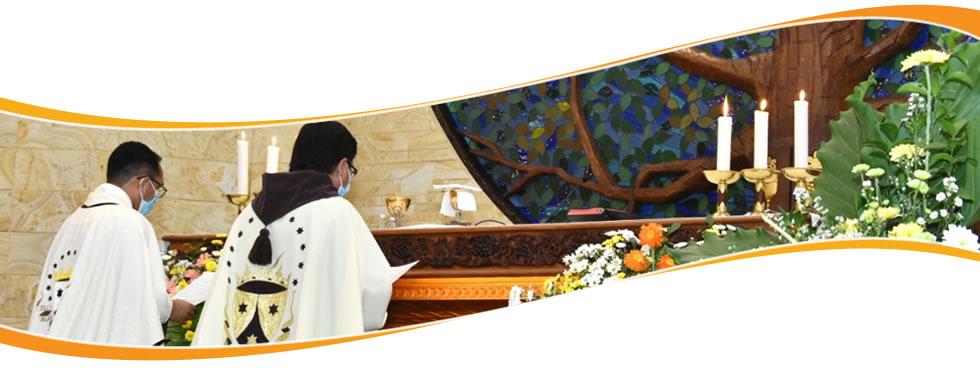
On Saturday, the 3rd of September, in Gajayana Stadium in Malang – Indonesia, the episcopal ordination of Fr. Henricus Pidyarto Gunawan, O.Carm. took place. This solemn mass was attended by 38 bishops from all over Indonesia, one Indonesian Cardinal and the Apostolic Nuncio, Antonio Guido Filipazzi; also around 15.000 faithful from all over the diocese of Malang and from outside. The main celebrant was Mgr. Ignasius Suharyo, the Archbishop of Jakarta. The concelebrants included a large number of priests from within the diocese and from other dioceses, among them were Fr. Benny Phang Khong Wing, O.Carm., the General Councillor of Asia-Australia-Oceania, the Provincial of Indonesian Province, Fr. Ignasius Budiono, O.Carm., the Provincial Commissary of Eastern Indonesia, Fr. Yohanes Bosco Djawa, O.Carm. and many Carmelites from Indonesia and Hong Kong.
The solemn and joyful celebration included the attendance of Carmelite students, different groups of lay Carmelites, the Hermanas Carmelitas, Putri Karmel, Carmelites of St. Elijah, and the cloistered nuns from the monastery of Flos Carmeli – Batu. The dignitaries from the local, provincial and national government were also present after the mass to congratulate the new bishop and to show their support.
The following day, the 4th of September, Bishop Henricus took possession of the diocese of Malang, replacing the now emeritus Bishop H.J.S. Pandoyoputro, O.Carm., forming part of the celebration of the Eucharist in the Malang cathedral.
The motto chosen by the new bishop is, “Fideliter praedicare evangelium Christi.” Congratulations Bishop Henricus, ad multos annos!


