













O.Carm
Lectio Divina August, 2026
Opening Prayer
God our Father and protector, without you nothing is holy, nothing has value.
Guide us to everlasting life by helping us to use wisely the blessings you have given to the world.
We ask this through our Lord Jesus Christ, your Son, who lives and reigns with you and the Holy Spirit, one God, for ever and ever. Amen.
St. Titus Brandsma, priest and martyr
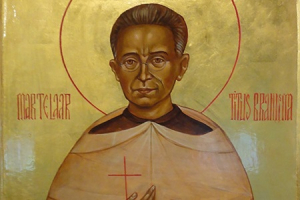
July 27 | Obligatory Memorial (Feast: Ger, Phil, Del Colombia)
A noted writer and journalist, in 1935, St. Titus was appointed adviser to the Dutch bishops for Catholic journalists. In the period leading up to and during the Nazi occupation in the Netherlands, he argued passionately against the National Socialist ideology, basing his stand on the Gospels. He continually defended the right to freedom in education and for a free the Catholic Press. As a result, he was imprisoned.
He passed from one prison or camp to another until he arrived in Dachau where he was killed on July 26, 1942. He was beatified as a martyr by Pope John Paul II on November 3, 1985 and was canonized by Pope Francis on May 15, 2022, in St Peter’s Square.
The Order’s petition to have the celebration of St. Titus Brandsma changed from an optional memorial to an obligatory memorial for the whole Order was accepted. The Provinces of Germany and the Philippines as well as the General Delegation in Columbia who have St. Titus as their patron celebrate the day as a feast.
Read more about the life of St. Titus Brandsma
Edizioni Carmelitane offers an incredible collection of writings, speeches, and letters by Tito Brandsma, the Carmelites’ most recent saint, including a play, a professional television production on DVD, and books in various languages.
St. Joachim and St. Anne, Protectors of the Order
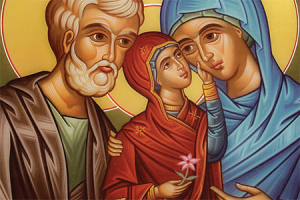
26 July Memorial
The names of the parents of Mary are known from the apocryphal “Proto-Gospel of James” (II century). The cult to Saint Anne is documented in the East in the VI century, in the West in the X century; that of Saint Joachim in the XIV century. In the Byzantine rite the 25 of July reminds us the dedication in Constantinople of a Basilica in honour of Saint Anne.
To read more ...
Blessed John Soreth, priest
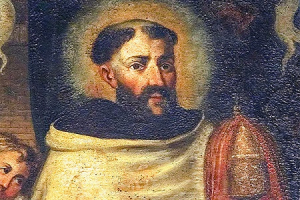
July 24 | Memorial
John Soreth was unflagging in his efforts at renewal, during what was an especially critical period for both the Church and the Order. He dedicated himself entirely to the reform of the Order, travelling across Europe, making canonical visitations and promoting a more faithful observance of religious life both in the older Provinces and convents and in the Mantuan Reformed Congregation.
He was instrumental in the development of the Lay Carmelite Third Order.
Read more ...
Books on John Soreth (in Italian) from Edizioni Carmelitane, the Carmelites' online bookstore:
Expositio paraenetica in regulam carmelitarum: Un commento alla regola del Carmelo
Giovanna D’Aniello, O. Carm.
Il B. Jean Soreth (1394-1471). Priore generale, riformatore e maestro spirituale dell’Ordine Carmelitano
Giovanni Grosso, O. Carm.
Celebrating At Home - 17th Sunday in Ordinary Time

Close Encounters with the Kingdom of God
(Matthew 13:44-52)
In the Gospel, Jesus compares the Kingdom to treasure hidden in a field, to a merchant on the lookout for fine pearls and to a fisherman’s dragnet which brings in a very mixed catch.
The point of the parables is the behaviour of the people in them.
In the first parable someone stumbles across the treasure by chance. Sometimes that can happen to us, too. We are happily living our lives when, by chance, something happens or we meet someone and our lives change for ever. On reflection we discern the presence of God in that encounter.
In the second parable the Kingdom is found after a long search. It is a reassurance that those who seek always find, and those who knock on the door will always have it opened.
The third parable introduces a note of reality: the Kingdom is a mixture of all kinds of things and some sorting out is needed.
In the first two parables the joy and delight of those who find (experience) the Kingdom is obvious. It is so strong that nothing is spared in order to posses the Kingdom.
The purpose of parables is not to provide answers to questions but to get us to think.
As we know, the Kingdom of God is not a ‘thing’ or a ‘place’. It is an experience or an encounter with the life of God.
In the life and ministry of Jesus many people experienced the Kingdom through their encounter with him which brought dignity, love, forgiveness, release from illness, disability, guilt, shame and even death. Jesus made present the reign of God’s grace for people in all kinds of need.
While we are sometimes overwhelmed by the experience of the presence of God within our hearts, more often we experience the reign of God’s grace through others. These people, like Jesus, somehow make present, make real the presence and action of God especially (but not only) in our moments of need. Having experienced that, we too, want to possess, to find and hold onto, the Source which touched us so deeply and brought us hope, comfort and freedom.
The kingdom, as we are reminded in the third parable, is a mixed bag of good and rotten fish, saints and sinners. It is not the task of members of the kingdom to judge; the final sorting out belongs to God alone. In the meantime, patience and tolerance must guide the practice of those in the kingdom.
The people of the kingdom seek the things that are of real value in life. They are prepared to make great sacrifices in order to make them their own. They live their lives with virtue and wisdom and their lives are a blessing for others as they draw from their rich store of values and virtues, of wisdom and grace. They never stop seeking the things of real value, the riches of the kingdom and they never stop making God present for those around them.
Video History of the Carmelites in Zimbabwe – Part 2
Video History of the Zimbabwean Commissariat – Part 2
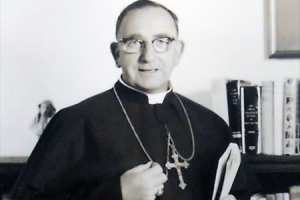
The second video of this excellent series produced by the Carmelites in Zimbabwe as part of their 80th anniversary celebration has been released. It is available on YouTube at https://www.youtube.com/watch?v=eWixb2EvTFw
This second part of the Commissariat’s history is entitled A Church Finds Its Voice. It covers the years 1966-1986. The story of Bishop Donal Lamont’s opposition to the racist government of Ian Smith is recalled. This included the bishop working to get the Zimbabwean Church hierarchy to speak out and stand firmly alongside the people. The Carmelites adoption of a ministry of presence with the people is recalled in some detail. The founding and ministry of the Handmaids of Our Lady of Mt Carmel and the Mount Carmel Guild for women were also presented.
Avvenire Highlights Prior General’s July 16 Reflection
Avvenire Uses Prior General’s Letter to Promote Reflection on the Meaning of July 16th
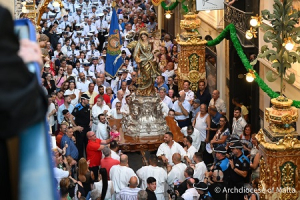
The Catholic news service Avvenire ran an article on July 15 echoing the deeper meaning of the Solemnity of Our Lady of Mount Carmel suggested by Desiderio Garcia Martínez, the prior general, in his letter to the Carmelite Family on the occasion of the Solemnity. The prior general’s letter was distributed well before the feast to provide time for reflection by the members of the Carmelite Family as well as others desiring to benefit spiritually from the feast.
The prior general reflected on the opportunity each person has to “to invoke Mary, Mother of Life, who looks upon us with mercy.” He further suggested that we remember that the scapular Carmelites wear recalls the responsibility we each have as a result of our baptism.
The article also highlights our Carmelite enclosed monastery in Biella, Italy, describing it as “an oasis of rest to renew the spirit during life’s difficult and trying moments.” Avvenire is headquartered in Milan, Italy.
The article was written by Laura Badaracchi.
The full article can be read here.
The Carmelite Family Gathers in Colombia
General Delegation of Colombia Gathers to Discern Its Mission
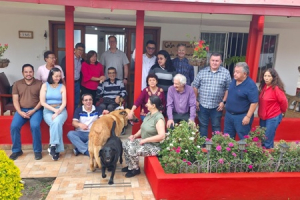
The Carmelite Family in Colombia, friars and laity together, gathered in Manizales on July 11 for a day of prayer, reflection, and dialogue on the vocation and mission of Carmel in the country, taking up the General Chapter's call to discern that mission together. About twenty people took part, some from the Manizales community itself, others arriving from across the country.
Fr. Pedro Arenas, one of the founders of the Delegation, opened with a look back at its history: a presence that began in 1971 and grew, over five decades, into small mixed communities of friars and laity marked by simplicity, hospitality, and shared responsibility.
The gathering came at the end of a full week for the Delegation. The community in Bogotá, made up of two friars and joined by members of the Carmelite Family, hosted pastoral outreach in the western foothills of the Cordillera Oriental, around La Vega, staying at the house of Jorge Millan and Ángela Herrera de Millan, longtime members of the Carmelite Family whose home has become a point of reference for many people in the surrounding countryside. From there, friars and lay Carmelites reached mountain communities where the faithful have little regular access to the sacraments: celebrating the Eucharist in family living rooms, anointing the sick, and simply sitting with people in their homes. The journey then continued to Manizales, seven hours through the Andes, where friars and lay members share a household and welcomed the group for the final days. Fr. Nepi Willemsen, General Councilor for the Americas, joined the week as part of a fraternal visitation.
The week closed with the community's regular Sunday Eucharist in Manizales, live streamed every week for the wider community of faithful in Colombia and beyond. It was a fitting close to a week that showed, once again, how far a small Delegation's reach can go.
Elijah and His Portrayal in Modern Art
20 July Solemnity
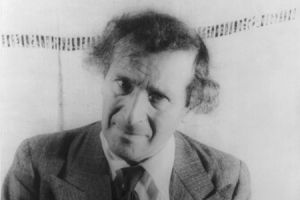
Many representations are now on display in churches and museums around the world of the Prophet Elijah. Their quality varies greatly but each has the potential to draw the viewer into prayer and reflection on the various actions the Prophet of God performed. Marc Chagall (1887-1985) is a more recent artist who attempted to bring the Old Testament stories to life as part of his 105-etching series of the Old Testament.
The prints, created between 1930 and 1956 contain a number specific to Elijah and are referred to as the “Elijah Series.” They include Elijah's vision, his interactions with the widow of Zarephath, and his fiery ascent to heaven in a chariot of fire.
Born Moishe Shagal in 1887, in the Pale of Settlement under Imperial Russia (today: Belarus), Chagall was a devoutly cultural and spiritual Hasidic Jew. He was not strictly observant. Yet his art mixed his ideas of Eastern European culture and Jewish folklore. Flying figures, elements of Jewish tradition, peasant life, and animals are frequent motifs in his art.
Jackie Wullschlager, who wrote a biography of Chagall, says his work on the biblical scenes portrayed a "human story, ... not with the creation of the cosmos but with the creation of man, and his figures of angels are rhymed or combined with human ones." Drawing on an example of an earlier work “Abraham and the Three Angels," she points out that the angels sit and chat over a glass of wine "as if they have just dropped by for dinner."
The Elijah etchings—such as Elijah on Mount Carmel and Elijah Touched by an Angel—are celebrated for their dreamlike, expressionistic style. Rather than focusing on historical realism, Chagall infused these Old Testament scenes with spiritual intensity and mysticism, utilizing light and shadow to distinguish the mortal from the divine. They provide us with the opportunity to enter deeply into the biblical event.
To read more ...
Causa Nostrae Laetitiae
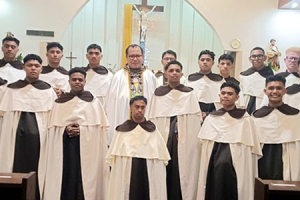
|
INITIUM NOVITIATUS |


