












O.Carm
St. Nuno Alvares Pereira, Religious

6 November Memorial
43. The evangelical counsels of chastity dedicated to God, poverty and obedience are based upon the words and examples of the Lord. They were further commanded by the apostles and Fathers of the Church, as well as by the doctors and pastors of souls. The counsels are a divine gift, which the Church received from its Lord and which it always safeguards with the help of His grace. Church authority has the duty, under the inspiration of the Holy Spirit, of interpreting these evangelical counsels, of regulating their practice and finally to build on them stable forms of living. Thus it has come about, that, as if on a tree which has grown in the field of the Lord, various forms of solidarity and community life, as well as various religious families have branched out in a marvelous and multiple way from this divinely given seed. Such a multiple and miraculous growth augments both the progress of the members of these various religious families themselves and the welfare of the entire Body of Christ.(1*) These religious families give their members the support of a more firm stability in their way of life and a proven doctrine of acquiring perfection. They further offer their members the support of fraternal association in the militia of Christ and of liberty strengthened by obedience. Thus these religious are able to tranquilly fulfill and faithfully observe their religious profession and so spiritually rejoicing make progress on the road of charity.(2*)
From the point of view of the divine and hierarchical structure of the Church, the religious state of life is not an intermediate state between the clerical and lay states. But, rather, the faithful of Christ are called by God from both these states of life so that they might enjoy this particular gift in the life of the Church and thus each in one's own way, may be of some advantage to the salvific mission of the Church.(3*)
44. The faithful of Christ bind themselves to the three aforesaid counsels either by vows, or by other sacred bonds, which are like vows in their purpose. By such a bond, a person is totally dedicated to God, loved beyond all things. In this way, that person is ordained to the honor and service of God under a new and special title. Indeed through Baptism a person dies to sin and is consecrated to God. However, in order that he may be capable of deriving more abundant fruit from this baptismal grace, he intends, by the profession of the evangelical counsels in the Church, to free himself from those obstacles, which might draw him away from the fervor of charity and the perfection of divine worship. By his profession of the evangelical counsels, then, he is more intimately consecrated to divine service.(4*) This consecration will be the more perfect, in as much as the indissoluble bond of the union of Christ and His bride, the Church, is represented by firm and more stable bonds.
The evangelical counsels which lead to charity (5*) join their followers to the Church and its mystery in a special way. Since this is so, the spiritual life of these people should then be devoted to the welfare of the whole Church. From this arises their duty of working to implant and strengthen the Kingdom of Christ in souls and to extend that Kingdom to every clime. This duty is to be undertaken to the extent of their capacities and in keeping with the proper type of their own vocation. This can be realized through prayer or active works of the apostolate. It is for this reason that the Church preserves and fosters the special character of her various religious institutes.
The profession of the evangelical counsels, then, appears as a sign which can and ought to attract all the members of the Church to an effective and prompt fulfillment of the duties of their Christian vocation. The people of God have no lasting city here below, but look forward to one that is to come. Since this is so, the religious state, whose purpose is to free its members from earthly cares, more fully manifests to all believers the presence of heavenly goods already possessed here below. Furthermore, it not only witnesses to the fact of a new and eternal life acquired by the redemption of Christ, but it foretells the future resurrection and the glory of the heavenly kingdom. Christ proposed to His disciples this form of life, which He, as the Son of God, accepted in entering this world to do the will of the Father. This same state of life is accurately exemplified and perpetually made present in the Church. The religious state clearly manifests that the Kingdom of God and its needs, in a very special way, are raised above all earthly considerations. Finally, it clearly shows all men both the unsurpassed breadth of the strength of Christ the King and the infinite power of the Holy Spirit marvelously working in the Church.
Thus, the state which is constituted by the profession of the evangelical counsels, though it is not the hierarchical structure of the Church, nevertheless, undeniably belongs to its life and holiness.
To read more ...
Blessed Frances d’Amboise, Religious

5 November Optional Memorial
Frances was probably born in Thouars on September 28, 1427, to Louis, Viscount of Thouars, and Marie de Rieux, Baroness of Encenis. Promised in marriage at the age of four to Peter, second son of the Duke of Brittany, she spent the rest of her youth with her future mother-in-law Joan, sister of Charles VII, King of France, who instilled in her the deeply Christian spirit she had received from the teachings of St. Vincent Ferrer. Peter, whose father and older brother had died before him, ascended the ducal throne of Brittany and was crowned together with Frances in Rennes Cathedral in 1450. She had a profound beneficial influence on her husband, the duke, on the running of the court and on affairs of state, and the seven years of his reign are remembered by the people as “the times of the blessed duchess.”
Widowed in 1457, despite pressure from her father and the King of France, she not only opposed remarriage but turned towards religious life. After repeated discussions with Blessed John Soreth, prior general of the Carmelites, she decided to join the Carmelite Order, making her possessions available for the foundation of the first Carmelite convent in France. It was established in Bondon, near Vannes, in 1463, with the nuns whom Blessed Soreth had transferred from the monastery in Liège. On March 25, 1468, Frances joined them. Wanting to bridge the social gap with her sisters, she asked them to replace the title of duchess with that of “handmaid of Christ.”
In 1477, under the protection of Our Lady of Couëts (de Scotiis), she founded a second monastery in Nantes, which two years later welcomed the remaining nuns from the former monastery in Bondon. For these foundations and for her influence on the legislation adopted in her and other French Carmelite monasteries, Frances is recognized as the founder of the Carmelites in France. She was responsible for introducing the practice of frequent Communion (and even daily Communion for the sick) and imposing, under penalty of excommunication, the strictest enclosure, which prevented both access to the monastery by all outsiders (including women) and the nuns from leaving the cloistered enclosure. With this vow, she anticipated the legislation of St. Pius V by a century and preserved her religious sisters from the damage that the lack of enclosure caused in other places.
She died in Nantes on November 4, 1485. During the French Revolution, the nuns were forced to abandon the convent, the memories of the blessed were scattered, and her body was desecrated. She is credited with some cloistered instructions, the manuscript of which has been lost, and some meditations published by Christophe Le Roy. Her cult was recognized by Pius IX on July 16, 1863. She is usually depicted with her eyes turned toward the crucifix she holds in her hands; on her Carmelite habit she wears an ermine cape (instead of wool) to recall her rank as a duchess.
To read more ...
International Carmelite Congress for the Laity 2024


Descarga el Material y llena el Cuestionario
Scarica il Materiale e compila il Questionario
Download the Material and fill out the Questionnaire
Baixe o Material e preencha o Questionário
Download Materi dan isi Pertanyaan
---------------------------------
Español
Italiano
English
Português
Indonesia
News | Noticias | Notizie
The Congress of Lay Carmelites Held in Rome
Concluye el Congreso de Laicos Carmelitas en Roma
Concluso il Congresso dei laici carmelitani a Roma
Playlist on the OCarm YouTube channel 2024
Photos of the International Carmelite Congress for the Laity 2024
Fotos del Congreso Internacional para Laicos Carmelitas 2024
Immagini del Congresso Internazionale dei Laici Carmelitani 2024
Imagens do Congresso Internacional dos Leigos Carmelitas 2024
---------------------------------
-

-
-
-
-
-
-
-
-
-
-
-
View the embedded image gallery online at:
https://ocarm.org/en/itemlist/user/654-marcopellitero?start=120#sigProId847d2ba7c2


https://ocarm.org/en/itemlist/user/654-marcopellitero?start=120#sigProId847d2ba7c2
Jubilee for World of Education Celebrated in Rome
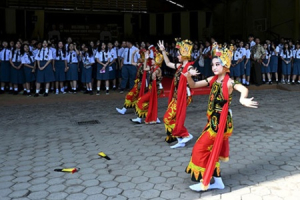
60th Anniversary of Gravissimum Educationis Celebrated at Jubilee for World of Education
The Pontifical Universities joined with Pope Leo XIV in celebrating the 60th anniversary of the Second Vatican Council document Gravissimum Educationis at a Mass on Monday, October 27, as part of the Jubilee of the World of Education. The pope also signed an Apostolic Letter, Drawing New Maps of Hope, reflecting on the relevance of the Conciliar document in today’s world and on the challenges of education today with particular attention to Catholic schools and universities. He wrote that the Vatican II document “reminded the Church that education is not an ancillary activity but forms the very fabric of evangelization.”
The pontifical universities and institutes in Rome enroll more than 15,000 students from some 125 nations. There are pontifical universities or universities with a pontifical faculty in many parts of the world as well.
Commenting on the fact that many millions of children around the world have no access to primary education, the Holy Father reminded the Church that in his Apostolic Exhoration, Dilexi te, he wrote of education as “one of the highest expressions of Christian charity.” He later repeated another part of Delexi te where he wrote “For the Christian faith, the education of the poor is not a favor but a duty.”
In his homily at the Mass in St. Peter’s, Pope Leo spoke of the deep symbolism of pilgrimage. “Life makes sense only when it is lived as a journey,” he remarked. "It is a continual ‘passing over,’ from death to life, from slavery to freedom, and experience of the Paschal Mystery that calls us to a constant renewal and hope."
Pope Leo addressed the fragmentation in the overall vision, uniting knowledge with meaning. He spoke of this question being addressed by Augustine, Thomas Aquinas, as well as Carmelite Saints Teresa of Ávila and Edith Stein. “The Church needs this unified perspective for both today and tomorrow,” he continued, encouraging students and professors alike to ensure that their academic work does not remain “an abstract intellectual exercise,” but rather that it becomes a force that transforms life, deepens faith, and strengthens witness to the Gospel.
The pope described the mission of educators as a true work of mercy. Teaching, he said, is like the miracle in the Gospel, “for the activity of the educator is to lift people up, helping them become themselves and able to develop informed consciences and the capacity for critical thinking.”
Feeding that hunger for truth which is in everyone is not merely an academic duty but a vital human task. "To feed the hunger for truth and meaning is an essential task, since without them we would fall into emptiness and even succumb to death", he said.
Making reference back to the Gospel for the day (Luke 13: 10-17) in which Jesus heals the woman bent over for eighteen years, the Pope prayed that all those engaged in the academic vocation may be “men and women who are never bent in on themselves but always upright," carrying with them “the joy and consolation of the Gospel wherever you go.”
The Carmelite Family around the world educates thousands of students—from pre-school through university. Many Carmelites are involved in education in various universities. There are 30 schools administered by the Order and many of the affiliated Congregations also have schools. The Order’s programs on ongoing formation—in the schools, parishes, and retreat centers—allow adults to continue deepening their faith through a variety of programs.
For the celebration of the Jubilee of the World of Education a number of events took place in and around the Vatican coordinated by the Dicastery for Culture and Education. Three gatherings with Pope Leo, in addition to the Mass on October 27, took place. A second Mass is scheduled for Saturday, November 1 for the declaration of St. John Henry Newman as a doctor of the Church.
A 15th-Century Gem Found in the Carmelite Library

From the Carmelite Archives
A gem from the Carmelite Library: an incunabulum from 1495
From the book depository of the General Carmelite Library, an elegant incunabulum printed in Brescia on September 13, 1495, has come to light. It was from the printer and bookseller Bernardino Misinta, active from 1490 to 1509 in Lombardy and Veneto.
The volume contains the Latin translation of the work De anima by the Greek philosopher and Aristotelian commentator Alexander of Aphrodisias (2nd-3rd centuries). The translation was done by the Venetian Girolamo Donati (1456-1511).
The incunabulum – from the Latin incunabulum, meaning in the cradle, to indicate the first books printed in the 15th century – does not yet feature the typical title page that would only appear from 1500 onwards, but an incipit page, very similar to those found in contemporary manuscripts, with a rubricated initial letter, larger in size, on a floral background, executed using the woodcut technique [photo 1]. Accompanying the text is a hand-drawn plant frieze that unfolds on three sides of the page, except for the bottom margin. The three stamps can be seen, including that of the Carmelite Library can be seen at the bottom [photo 1].
As was customary for early printed books, the typeface used (the so-called “Roman type”) reproduces the appearance of the humanistic script used in 15th-century manuscripts.
The influence of handwritten books is also visible inside the volume, where there are blank spaces reserved for decoration, accompanied by “guide letters” corresponding to the major initials of the text, which were to be printed at a later stage [photo 2].
On the last page of the copy is the colophon, which contains information about the printing, such as the name of the printer, the date, and the printer’s location [photo 3].
Finally, since books were stored horizontally at the time, the author's name and the title of the work were added by hand on the lower edge [photo 4].
[from: ABiGOC: Archivio e Biblioteca Generali dell’Ordine Carmelitano]Pope Leo XIV Addresses FAO on Its 80th Anniversary
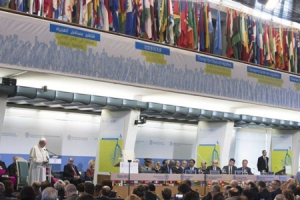
Each of the popes since Paul VI, except John Paul I during his short reign, have had interactions with FAO, concretizing the Holy See’s continued support of the UN agency in accomplishing its mission. This was Pope Leo’s first visit and during his talk, the pope reaffirmed the mission of the organization to end hunger and to build resilient agrifood systems across the globe. He also took the opportunity to urge the international community to redouble its efforts to eradicate hunger, malnutrition, and food insecurity — evils he described as “a moral wound that afflicts the whole human family.”
The Director-General, acknowledging the presence of the pope and many other leaders from around the world, said, “Your presence here today is a true reflection that hunger knows no borders, and that the challenge of food security demands unity among nations.” He implored that there be continued action in this area. “The world’s leaders and people everywhere must come together united by our collective belief that the right to food is a basic human right, and that peace is a prerequisite for food security,” he said.
In his address, the pope spoke of the unacceptable use of food as a weapon of war, which he said contradicts all of the awareness-raising work carried out by FAO over the past eight decades. “Eighty years after the establishment of FAO, our conscience must once again challenge us in the face of the ever-present scourge of hunger and malnutrition,” the pope said. “In this regard, I consider it a true success that World Food Day is being celebrated this year under the theme ‘Hand in Hand for Better Foods and a Better Future.’ At a historical moment marked by deep divisions and contradictions, feeling united by the bond of collaboration is not only a beautiful ideal, but a resolute call to action.”
Continuing to stress the need to move from talking to action, the pontiff said, “We cannot be content with proclaiming values; we must embody them.” He continued “Slogans do not lift people from misery. We must place the human person above profit and guarantee food security, access to resources, and sustainable rural development.”
Established by a United Nations resolution in 1979 and first observed in 1981, World Food Day is celebrated annually on October 16. It is now one of the most widely celebrated UN observances, with events held in over 150 countries. The Day provides an opportunity for people to reflect on the responsibility to care for the land and water, support those who cultivate it, and strengthen the systems that bring food to every table.
The mission of Food and Agriculture Organization of the United Nations (FAO) is to defeat hunger, food insecurity, and malnutrition in a sustainable way while upholding the dignity of every human being. This is more important than ever in a world where conflict, the climate crisis, forced migration and a widening gap between the rich and poor, cast doubt on the goodwill of the international community to place the human person above profit in the name of justice and peace.
ALACAR Meeting Unites Carmelite Family
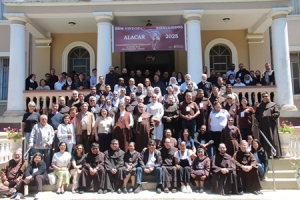
ALACAR Meeting Yields Much Unity in the Carmelite Family
The Asociación Latinoamericana de los Carmelitas (Latin American Association of Carmelites) (ALACAR), held a gathering at the Centro Teresiano de Espiritualidade in São Roque, Brazil, from October 20–25, 2025. It was hosted with exceptional hospitality, care, and contemplative spirit by our Discalced Carmelite (OCD) brothers and sisters.
ALACAR is composed of religious of the Order of Carmel (OCARM) and the Order of Discalced Carmelites (OCD), members of various Carmelite congregations, and Lay Carmelites of the Third Order from across Latin America. This year’s assembly brought together over 90 participants, representing the richness and diversity of the Carmelite family; friars, nuns, sisters, and lay Carmelites from every region of the continent.
The theme of the conference was “María, maestra de oración” (Mary, Teacher of Prayer). Eight lectures were scheduled. They included: Missionary Mary Visits Latin America—Features of a Marian Mission Since the Guadalupe Event by Cándido Celestino Gonzalez, OCD and Mary, Ark of the Covenant—Marian Presence in the Shrines of Latin America by Renê Augusto Vilela da Silva, O. Carm.
On Wednesday, the talks were Mary, Woman and Mother—A Feminine Interpretation by Liliana Franco of the Company of Mary and Mary, Magnificat—An Approach from Carmelite and Ecological Spirituality by Miguel Márquez, OCD, Superior General of the Discalced Carmelites. On the third full day, the lectures were Mary Queen and Beauty of Carmel by Martín Martínez, OCD and Mary in Everyday Life—A Mariological Approach in the Light of St. Teresa of the Andes by Luisa Escobar, CM. The final two talks were Mary, Follower of Jesus—A Biblical Approach to Mary from the Beatitudes by Jairo Gómez, OCD and Mary, Mystagogue—Mary’s Role in Initial and Ongoing Formation by Edimar Fernando Moreira, O. Carm.
The gathering included the participation of leadership from both Orders: Fr. Miguel Márquez, OCD, Superior General; Fr. Martín Martínez Larios, OCD, Definitor General for Latin America; and Fr. Nepi Willemsen, O. Carm., General Councilor for the Americas. Their participation was a strong sign of communion and shared vision in the Carmelite family.
On Wednesday, Bishop João Bosco Barbosa de Sousa, OFM, presided at the Eucharist. He is the third bishop of Oasaco in the state of São Paulo, where the conference was held.
Throughout the week, participants reflected on Mary as the living model of prayer, a woman of silence and interiority, of listening and intercession, of mercy and prophetic faith. Far from being a merely devotional figure, Mary emerged as the true teacher of discipleship and contemplative prayer, guiding the Carmelite family to rediscover its contemplative roots and prophetic mission.
The week was also marked by a profound experience of communion and fraternity among all branches of the Carmelite family. The exchanges, liturgies, and shared reflections deepened the awareness that we are one family in Carmel, united in diversity, and called to pray and serve together for the life of the Church.
The ALACAR gathering, held every four years, will next be organized by the Order of Carmel (OCARM) and is projected to take place in October 2029.
Celebrating At Home - Commemoration Of All Souls

Giving Thanks With Grateful Hearts
(Luke 7:11-17)
This weekend we celebrate those who are now in God’s care.
We pray for them with faith and hope.
As St Paul says, what proves that God loves us is that Christ died for us while we were still sinners, and by his death we have been made righteous in the eyes of God (Romans 5:8-10). God does not wait for us to be perfect before reaching out to us in love.
We thank God for the presence of our departed sisters and brothers in our lives. We recognise them as a gift and blessing to us. Even in the midst of our sadness we are aware of God’s graciousness in sharing them with us and we pray for them with grateful hearts. Our prayer for them expresses our Christian hope that death is not the end of life, and that we will meet each other again in God’s kingdom.
Giving thanks to God is a fundamental character of our liturgy. The word Eucharist means ‘to give thanks’. The word liturgy means ‘to do one’s public duty’. When we talk about the Liturgy of the Eucharist we are talking about the time we spend at mass doing our public work of giving thanks to God.
The Gospel for our commemoration today is both emotional and touching. Jesus meets the funeral procession of a young man. He is deeply moved with compassion for the young man’s mother and the young man himself.
The Gospel tells us that the mother is a widow and the young man who has died is her only son. In the times in which Jesus lived that meant that the mother, in addition to being grief-stricken, was now extremely vulnerable - having no male to act on her behalf in legal or financial matters and no bread-winner now to look after her.
In restoring her son’s life Jesus has also restored her life. It’s a double restoration, a double blessing and a double sign of God’s goodness and compassion.
Today, we join with the whole Church in praying that God welcome our departed sisters and brothers fully into the Divine embrace.
- pdf Celebrating At Home - Commemoration Of All Souls [PDF] (2.79 MB)
- default Celebrating At Home - Commemoration Of All Souls [ePub] (1.91 MB)
- pdf Celebrando en Familia - La conmemoración de los fieles difuntos (476 KB)
- pdf Celebrando in Casa - Commemorazione di tutti i fedeli defunti (467 KB)
- pdf Celebrando em família - A comemoração dos fieis defuntos (460 KB)
XXXIV Carmelite Family Gathering, Betica Province
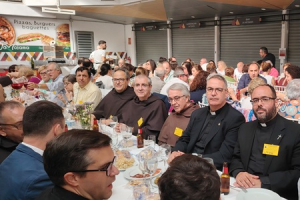
On October 18, 2025, the feast of St. Luke, the Betica Province in Spain celebrated the 34th Carmelite Family Gathering. On this occasion, the event took place in El Viso del Alcor (Seville), in the centenary year of the founding of the Brotherhood and Confraternity of Our Lady of Mount Carmel in that town.
More than one hundred people attended, not counting the religious of the province who accompanied the different groups from seventeen different locations throughout our geography (Sisters of the Blessed Virgin Mary of Mount Carmel, TOC, confraternities, teachers from our schools, and parishioners). Of particular note was the presence of the prior general of the Order, Fr. Desiderio García Martínez, who, in addition to presiding over the Eucharist of the meeting, gave a beautiful and moving lecture on the life and experience of faith of Fray Pablo María de la Cruz.
The Commissary General of Portugal Visits East Timor
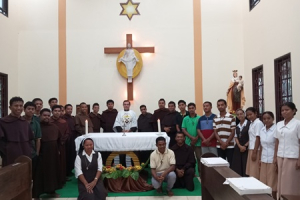
A Few Days of Joyful Fraternity with the Carmelites of East Timor
Given the geographical proximity and the fact that I was in Indonesia for the General Chapter and had previously planned this visit with the prior provincial of the Province of Australia and East Timor, Bruce Clark, I was given the opportunity to make a fraternal visit to our confreres of this Province in East Timor.
The connection between Portugal and East Timor is a historical fact. The first Portuguese merchants and missionaries arrived on this island in 1515, exploiting the region's natural resources and proclaiming the Gospel. Timor was Portuguese territory until 1975.
Despite all the historical vicissitudes, East Timor has been a fully independent territory since May 22, 2002. The link with Portugal has been maintained due to our shared history and mutual collaboration in various areas. For example, one of East Timor's official languages is Portuguese.
It is in this context that the Commissariat of the Carmelites in Portugal has maintained a close relationship with the Carmelites of East Timor, supporting the confreres in their formation and in their learning the Portuguese language. It was also this relationship that led me to visit our confreres in this country for a week. To the historical, cultural, and collaborative closeness, I have now added an experience of closeness through physical presence.
I can testify to the joy with which these brothers live the charism and fraternity, and how the different generations live a simple life of prayer, collaboration and mutual support. It is with this same joy that they welcome those who visit them.
East Timor is teeming with vocations. It throbs with hope in living and proclaiming Jesus Christ and the Carmelite charism. It is growing in communion and participation in the local Church. The affection with which the Carmelites are treated is a testimony to this dedication in the community.
Something that also struck me was the closeness between the various branches of the Carmelite Family: confreres, lay people and Carmelite Sisters. There is great complicity between everyone and the realization of projects in which everyone is involved.
It's been a growing presence since 2001, when our confreres in Australia began this project. In addition to the older communities in Hera (two formation communities), Zumalai and Fatuhada (Dili), the confreres are starting a new community in Comoro (Dili) and have embraced a missionary project in Guisarudo where they are creating the spiritual and material conditions for the creation of a new parish.
Personally, I have witnessed the generosity of the confreres in their service to the community and of the community towards the confreres. Some of the confreres are still present in institutes and on formation fronts linked to philosophy and theology, as well as being asked to lead retreats and provide spiritual assistance to some chaplaincies.
I had the opportunity to visit some of the houses of the Carmelite Sisters of the Virgin Mary of Mount Carmel. The Sisters' dedication in the education sector, in running a retreat centre and in various socio-charitable projects, especially in peripheral contexts, is commendable. I would also like to thank the sisters for their fraternal welcome, which was always very lively and choreographed!
I carry with me an enviable collection of "tais" (Timor's traditional garments used in honoring and welcoming people) that I keep as a symbol of a memorable time!
As well as visiting and socializing with the various branches of the Carmelite Family, I also had the chance to visit some of Timor's emblematic and historic sites, as well as some of its natural beauty.
In a Jubilee year with the theme "Pilgrims of Hope," these days in East Timor were an opportunity for me to reinforce hope in the present and future of the Carmelite Order, wherever it may be. It perfectly complemented and added to the memory of the fraternity and vitality of the Order experienced at the Malang General Chapter.
I thank God for the witness of fraternity that I received and for the joy of our confreres on this "good and holy" journey in "obedience" to Jesus Christ, following the example of Mary and Elijah."
Agostinho Marques Castro, O. Carm.
Commissary General


![[photo 1]](/images/2021/Foto_1.jpg)
![[photo 2]](/images/2021/Foto_2.jpg)
![[photo 3]](/images/2021/Foto_3.jpg)
![[photo 4]](/images/2021/Foto_4.jpg)